Is Elon Musk still implanting chips in monkeys, while our brain-computer interface can already be paid through medical insurance?
It all feels very sci-fi: in recent times, numerous hospitals across China have opened specialized "Brain-Computer Interface" outpatient clinics. Passersby who stumble upon the signboards often do a double-take, wondering if they've misread it: Wait, has BCI technology really advanced this far already?
Yes, and it even has official, publicly listed pricing now. Not long ago, local authorities across the country successively released regulated fees for BCI procedures. For example, in Beijing, the implantation procedure costs 7980 yuan, the removal procedure costs 3500 yuan, and both are fully covered by national medical insurance.
It feels a little too much like a plot straight out of *The Matrix*.
01
Science Fiction Films Are Coming to Life
Recently, topics about BCI being included in national medical insurance have repeatedly trended on Weibo's hot search lists. The comment sections are always full of delightfully whimsical takes: "Will it shut down if I don't pay a monthly subscription fee?" "Do I need to install an extra 360 antivirus software for it?" "Will I have to watch a 30-second ad as soon as I wake up every morning?" "Is this the same device that Elon Musk used on his monkeys?"


Pragmatic commenters left messages saying things like "Can I download all the college entrance exam knowledge directly into my brain first?" and "I think about a lot of stuff, so I need a model with huge memory storage". Philosophical netizens started pondering deeper questions: "After I get a BCI implanted, am I still the same person I used to be?"
As people chime in with all kinds of random ideas, a futuristic landscape brimming with conspiracy theories, cybercrime fears, and superhuman fantasies gradually takes shape: some worry that their BCI could be hacked, and they might wake up to find themselves remotely controlled to place orders for ten durians. Others wonder if they can directly copy foreign language knowledge into their brains to skip the tedious pain of memorizing vocabulary words.
It's no surprise that people's imaginations are running wild, because this technology used to feel so distant from ordinary people's daily lives.
Most people's impressions of BCIs come almost entirely from sci-fi movies: in *The Matrix*, Neo plugs a data cable into the back of his skull and instantly downloads combat skills into his brain. In *Avatar*, a paralyzed soldier lies down in a connection pod, and his consciousness can control an avatar on a distant alien planet.

The real-world scenario isn't quite that flashy. Right now, the BCIs used in hospitals are mainly designed for one core purpose: to help paralyzed patients regain the ability to move on their own.
The first patient in mainland China to receive a BCI implant is a man named Lao Yang. He suffered a high-level spinal cord injury in a car accident, leaving him completely unable to move any part of his body below his neck. At the end of 2023, surgeons drilled a small hole in his skull and implanted two coin-sized BCI devices.
Doctors also provided Lao Yang with a pneumatic glove, which looks similar to a thickened sports glove. It fits over his paralyzed right hand and connects to a small air pump via thin air tubes.

The working principle is surprisingly straightforward to understand: for example, when Lao Yang thinks about making a fist, the BCI immediately detects the corresponding "make a fist" brainwave in his mind, transmits the signal wirelessly to a computer, which then sends a command to the pneumatic glove to inflate. The tiny airbag on the back of the glove expands, pushing Lao Yang's fingers forward to complete a grasping motion.
Lao Yang's old dream was to be able to light a cigarette by himself, instead of having to ask his wife for help every time he craved one. Now, he can independently feed himself, play the piano, and play chess.
With this first successful case under their belts, BCI development in the medical field has accelerated dramatically.

Earlier this year, the neurosurgery departments of top-tier domestic medical institutions including Huashan Hospital, Xuanwu Hospital, and Tiantan Hospital successively treated their first batches of BCI implant patients. These patients include people trapped in their own bodies by ALS, young people left completely paralyzed after car accidents who can no longer hold their loved ones' hands, and locked-in syndrome patients who remain fully conscious after a brainstem stroke but cannot move a single muscle in their body.
Major hospitals have been opening BCI outpatient clinics one after another, where doctors evaluate whether a patient is a suitable candidate for BCI implantation.
The screening criteria are extremely strict. The first check confirms whether the brain's motor cortex still has detectable active neural signals. For many patients who have been paralyzed for years, the corresponding regions of their brains have atrophied or gone completely dormant, so even implanted electrodes cannot pick up valid usable signals. On top of that, doctors conduct a comprehensive assessment of all treatment indicators, the patient's physical tolerance, post-surgery rehabilitation expectations, and even the patient's personality and psychological state are taken into consideration. If a patient has severe anxiety and poor treatment compliance, they will struggle to stick to the long, tedious rehabilitation training after surgery, and the final therapeutic effect will likely be greatly diminished. When all these factors are combined, only roughly one-tenth of the patients who come to the BCI outpatient clinic for consultation end up passing all assessments and receiving the actual implant treatment.

Many people are also concerned about the cost issue: the first batch of price lists released by local medical insurance bureaus shows that BCI removal procedures cost between 3000 and 5000 yuan, while implantation procedures cost roughly between 5000 and 8000 yuan. This figure initially seems much cheaper than most people expected, but in reality, these prices only cover the pure surgical operation fees — the labor costs for the surgeon to perform the craniotomy, implant the electrodes, and suture the incision, and do not include the cost of the BCI device itself at all.
Right now, the vast majority of BCI surgeries performed in hospitals are still in the clinical trial stage. After patients pass strict evaluations and are selected to join the trials, the device costs are mostly covered by the scientific research project teams.
Once the technology officially moves from the trial phase to large-scale commercial application, the device cost will become the major expense. The electrodes, chips, and transmitters implanted in the brain, plus supporting hardware like the pneumatic glove and the external processor responsible for signal decoding, all come with significant costs.

There is no official pricing for this hardware yet, but we can estimate the cost by referencing a similar implanted neurostimulation device with comparable technical complexity: a full cochlear implant system currently costs between 200,000 and 300,000 yuan in China. BCIs have higher technical complexity and greater manufacturing costs, so after full commercialization, the device price will most likely be even more expensive.
The high cost mainly stems from the extreme difficulty of R&D. The invasive BCI devices developed by Chinese scientists have electrodes that are only 1/5 the thickness of Neuralink's (the BCI product developed by Elon Musk's company) electrodes, which is equivalent to 1% of the thickness of a human hair. Their softness is nearly 100 times better than Neuralink's electrodes, and their stiffness is at the magnitude of intercellular forces. This makes brain cells almost unable to detect the presence of the foreign implanted object.
This achievement relies on cross-cutting breakthroughs in more than a dozen cutting-edge disciplines including materials science, micro-nano fabrication, biocompatibility, and neural coding. Every tiny improvement to any single performance indicator requires piles of academic papers, countless failed animal experiments, and R&D investments totaling tens of millions or even hundreds of millions of yuan.
So it's reasonable that such advanced technology would come with a high price tag! If it were really sold for 9.9 yuan with free shipping on Pinduoduo, patients probably wouldn't dare to get it implanted anyway — what if it starts playing a 60-second ad right after you turn it on, and you have to invite friends to "slash the price" to skip it?

02
Can a BCI Be Hacked?
When talking about BCIs, the first question many netizens ask is "Is the next 10x skyrocketing stock about to be born?" The second most common question is "Will my private thoughts and personal privacy get leaked?" The first question is better directed at stock market experts, but the second one can be carefully analyzed from a technical perspective.
To figure out this problem, you first need to fully understand exactly how a BCI works.
The human brain contains roughly 86 billion neurons. Every time you form a thought, make a movement, or experience an emotion, a specific group of neurons is firing electrical signals intensely. For example, when you want to lift your right hand, the region in your brain's motor cortex responsible for controlling the right hand sends out a specific sequence of electrical signals. These signals travel down the spinal cord all the way to the muscles in your right arm, the muscles contract, and your hand lifts up.
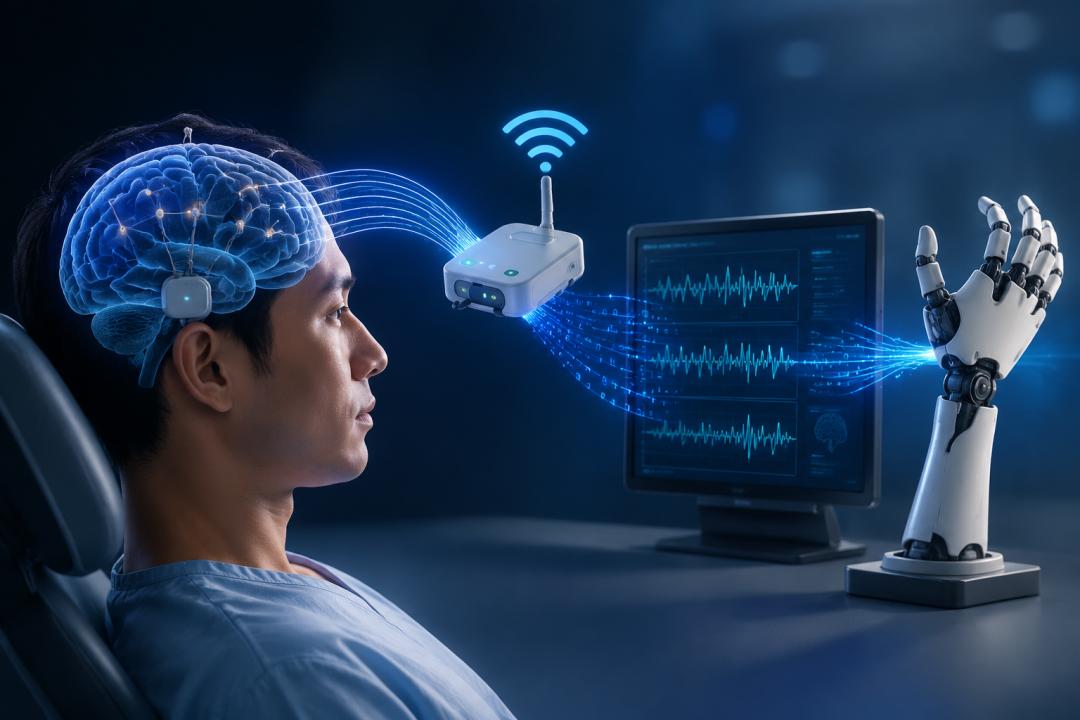
This is how a normal, healthy human body functions. But for patients with spinal cord injuries, the "lift right hand" signal sent by the brain gets cut off halfway, and cannot reach the arm. What a BCI does is bypass that broken pathway, directly "eavesdrop" on these electrical signals in the brain, and then send the commands to a machine to execute the intended movement.

How exactly does this "eavesdropping" work? Surgeons place a tiny electrode array on the surface of the patient's brain motor cortex, which is densely packed with hundreds of contact points. Each contact point can capture the electrical firing activity of a small cluster of surrounding neurons. When the patient silently imagines performing a movement, hundreds of contact points simultaneously record the electrical signal data.
After this data is transmitted to an external device, it is decoded by specialized algorithms. The processor translates the decoded user intent into machine instructions, which are then sent to external devices such as a pneumatic glove, a robotic arm, or an on-screen cursor control system.
So the full working chain is: neuron firing → electrode capture → algorithm decoding → instruction output.
Now the question arises — could this "translator" in the chain be hacked? If someone intercepts the wireless signal in transit, would they be able to read exactly what the patient is thinking? Could they even send unwanted data back into the brain?

The answer is: it is almost impossible with current medical-grade BCI systems.
Let's start with the most fundamental underlying design. The BCIs currently used in hospitals are unidirectional in signal transmission: they only "read" neural signals, and cannot "write" any signals back into the brain. The electrodes only capture neuron firing activity and send the signals outward. They have no capability to receive external incoming signals, and there is no channel whatsoever to "write" any information back into the brain.
But what if the wireless signal traveling through the air is intercepted? Theoretically that is technically possible, but all someone would get is a jumble of meaningless, unstructured electrical current data. Without the matching proprietary decoding algorithm, the intercepted data is completely useless. Every patient's brainwave characteristics and the signal patterns corresponding to each movement are completely unique. The decoding algorithm is trained over a very long period of time to adapt specifically to that individual patient.
Even in the most extreme hypothetical scenario, where a hacker somehow manages to both intercept and fully decode the user's signals