Microsoft bets $2.5 billion: In the next 10 years, only these 2 types of companies will survive
Five days ago, the tech giant Microsoft made a major strategic move.
It announced the establishment of an independently operated entity: Microsoft Frontier Company, committing a one-time investment of 2.5 billion USD and assembling a team of 6,000 industry specialists and engineering professionals to be stationed long-term on-site at client organizations.
What critical signals and insights lie behind this development?
In today's article, we will conduct a comprehensive breakdown of this initiative.
I. Treating AI merely as a tool is a fundamental misunderstanding
Our past operational logic followed this pattern: whatever a business lacked, it would procure a dedicated system for it.
When lacking customer management capabilities, companies purchased CRM systems; when needing improved financial management, they adopted ERP platforms; when requiring collaborative work tools, they implemented Office, Lark, or DingTalk;
After acquiring these tools, providing basic training, and having employees follow prescribed workflows, businesses considered themselves to have completed a digital transformation upgrade.
But modern AI does not operate according to this model.
For AI to deliver tangible value, it must integrate directly into the core operational environment of an enterprise: access customer data, understand order histories, connect to approval workflows, clarify who is accountable for outcomes, and continuously refine its performance through every cycle of business feedback.
A customer service AI that cannot access records of a customer's orders, complaints, refunds, and subscription renewals will, no matter how natural its conversational ability, remain nothing more than a low-cost automated response system.
A sales AI that cannot integrate with CRM systems, quotation authorization frameworks, customer profiles, and transaction data can at most help sales representatives draft follow-up messages, but cannot genuinely assess which customers warrant resource investment.
A management AI that lacks connections to financial metrics, workforce efficiency data, inventory levels, procurement records, and sales forecasts will, the more polished its generated reports appear, the higher the risk of leading the company into severe operational pitfalls.
Therefore, between the state of "having implemented AI tools" and "having undergone AI-driven organizational transformation," there remains a substantial amount of critical work to complete.
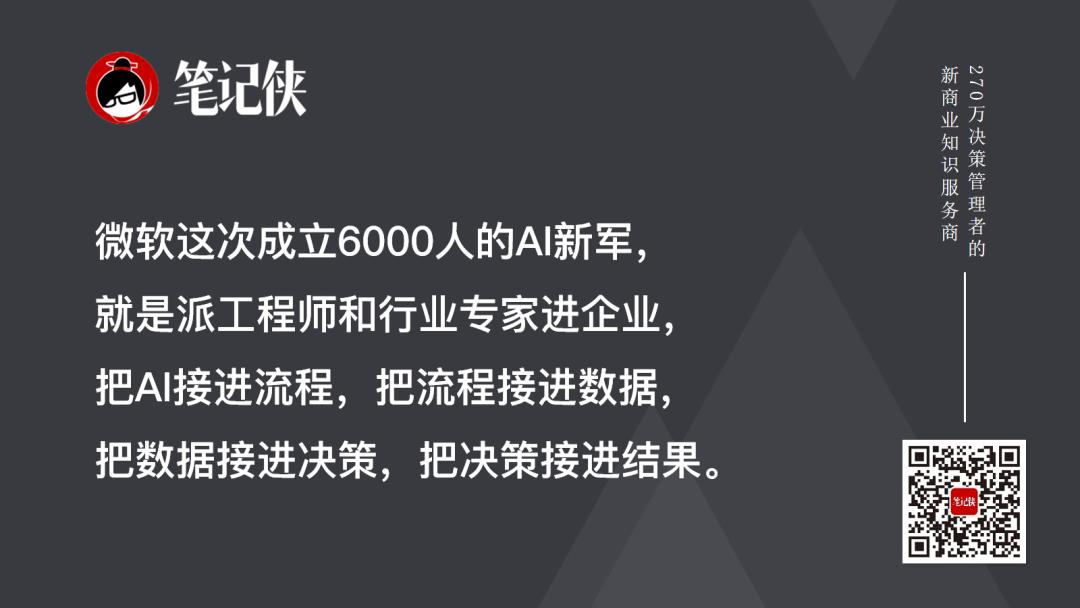
Microsoft's recent formation of this 6,000-person AI task force is specifically designed to deploy engineers and industry specialists directly into enterprises, connecting AI to workflows, linking workflows to data, grounding data in decision-making, and translating decisions into measurable results.
II. What are top Silicon Valley companies currently executing?
Beyond Microsoft, Amazon Web Services has also invested 1 billion USD to launch its FDE program (Note from Notesman: Frontier Deployment Engineers, who are stationed directly at client sites, embedded deeply in frontline business operations to customize and integrate general-purpose AI models or technologies into clients' real, complex business workflows, resolving the "last-mile" challenge of AI implementation and taking accountability for final business outcomes. This definition applies hereinafter).
OpenAI has also established the OpenAI Deployment Company, attracted external capital, acquired the Tomoro firm, and recruited 150 deployment engineers.
The FDE role traces its earliest significant origins to Palantir.
While providing services to U.S. intelligence agencies, the company discovered that when engineers were denied access to real operational scenarios, requirements became distorted through multiple layers of interpretation. This led them to adopt a model where engineers work directly on-site with intelligence analysts and operational staff, embedding systems deeply into clients' actual workflows.
Essentially, FDEs are not "outstationed programmers" nor traditional management consultants, but represent a new client-embedded engineering role: possessing both technical expertise and close proximity to operational realities, they are responsible for deploying and integrating general-purpose software or AI capabilities into clients' real workflows, and driving these implementations to deliver tangible business results.
All three companies are now advancing in the same strategic direction: deploying personnel to client sites to move AI beyond demonstrations, pilot programs, and standalone tools, embedding it into real workflows and tangible business outcomes.

The underlying logic is straightforward: if AI does not understand business contexts, it can only generate content; only when integrated into workflows can AI fundamentally alter outcomes.
What these companies are currently doing is leveraging AI to help clients redesign their operational workflows.
This is fundamentally distinct from simply procuring tools.
Procuring a tool adds a plugin to an existing workflow. Redesigning a workflow means re-evaluating core questions: Why is this task performed in its current manner? Which steps require human judgment? Which steps can be safely delegated to AI? What datasets need to be interconnected? Who bears accountability in the event of errors?
Microsoft has repeatedly emphasized "measurable business outcomes" throughout this initiative.
This phrase is not novel, but it carries critical significance.
The success of an AI project cannot be measured solely by headcount allocated, volume of content generated, or time saved. It must be evaluated by metrics including improved sales conversion rates, enhanced customer renewal rates, accelerated inventory turnover, shortened R&D cycles, and more timely management decision-making.
III. "On-site deployment" represents a new strategic direction in the AI era
Some may question: after decades of development, hasn't the software industry been advancing toward standardization, scalability, and automation? Why are Microsoft, Amazon, and OpenAI now moving in the opposite direction by deploying engineers directly to client premises? Does this represent a regression from high technology back to traditional consulting service models?
This is an excellent question to raise.
In reality, this is no regression. Rather, as AI enters deeper operational domains, standardized off-the-shelf products are no longer sufficient to meet complex enterprise needs.
Traditional software solves relatively stable, well-defined problems. Financial bookkeeping, customer data entry, workflow approvals, and document collaboration—while implemented differently across organizations—are built on relatively consistent underlying logics, making them suitable for productization, modularization, and subscription-based distribution.

The problems AI is designed to address are far more centered on contextual judgment.
For example: determining whether a specific customer warrants dedicated follow-up efforts, assessing whether a particular complaint will lead to customer churn, evaluating whether a supply chain anomaly will impact delivery timelines, judging if a product requirement is a false demand, or deciding whether to commit resources to a new market opportunity.
These judgments do not follow universal workflows; they are embedded deep within an enterprise's unique datasets, accumulated experience, customer relationships, and organizational context.
No matter how advanced a model may be, it cannot innately comprehend the entire historical operational context of a single company.
This is precisely why "Frontier Deployment Engineers" will become exceptionally critical in the coming period: they are neither traditional consultants nor ordinary programmers, but professionals who embed technical capabilities directly into core business operations.
This is also why professionals from frontend development, product management, system architecture, and algorithm engineering backgrounds may all transition toward this new role. Frontend developers understand user interactions and operational workflows; architects master system integration; product managers excel at requirement decomposition; algorithm engineers comprehend model boundaries. By supplementing these existing skills with industry domain knowledge, client communication abilities, and outcome-focused accountability, all these professionals are well-positioned to step into this emerging high-value role.
Therefore, the truly noteworthy aspect of the FDE role is that it embodies a shift in talent value in the AI era: the most scarce professionals in the future will not be those with the strongest isolated technical skills, but those capable of uniting AI capabilities, business workflows, and client outcomes into a fully closed-loop operational system.
Additionally, there is a common misconception: many organizations mistakenly perceive FDEs as "premium outsourced engineers."
While it is true that FDEs work on-site at client locations, write code, and develop customizations aligned with client business needs, on the surface they may appear very similar to outsourced engineers.
But the fundamental distinction does not lie in whether they write code—it lies in their feedback loop mechanisms.
Outsourced teams receive a clearly defined list of requirements: specific features to build, acceptance criteria to meet, and delivery deadlines to satisfy.
FDEs are typically assigned an incompletely defined business mission: Clients recognize that AI should be able to help solve their problems, but the precise decomposition of challenges, workflow modifications, model integrations, and outcome measurement methodologies often need to be collaboratively discovered through iterative exploration.

Outsourcing engagements deliver partial deliverables—completing a module, a system, or a webpage, with responsibilities concluding upon acceptance. FDEs deliver end-to-end value: integrating model capabilities into clients' actual workflows to validate improvements in conversion rates, reduced churn, shortened cycles, and sustained user adoption.
Critically, feedback from outsourcing projects typically remains confined within the project scope. Insights gathered by FDEs flow back into the model provider's core product and technology roadmaps. Real-world tool invocation issues, permission boundary challenges, and workflow bottlenecks encountered by clients in actual operational contexts all become input for subsequent iterations of models, tools, and product features.
They are not merely selling services—they are collecting the most authentic product signals directly from client operational environments. These signals cannot be obtained through surveys, nor uncovered in meetings; they can only be gathered by engineers embedded in specific operational workflows, who have directly encountered and resolved real-world implementation obstacles.
IV. Three priority actions for Chinese entrepreneurs to implement now
In China, FDEs (Frontier Deployment Engineers) have become a key recruitment focus for major technology firms making substantial talent investments.
ByteDance offers monthly salaries ranging from 35,000 to 70,000 RMB with 15 annual salary payments, translating to maximum annual compensation of up to 1.05 million RMB. Alibaba Cloud Intelligence provides monthly salaries between 20,000 and 50,000 RMB with a 16-month annual pay structure.
However, for most enterprises, there is no immediate need to recruit external personnel explicitly titled "FDE."
Your organization may already employ a cohort of professionals performing FDE-equivalent work, even if their formal job titles differ.
Your AI application engineers, product managers, and business technology leaders may already be executing analogous responsibilities. The critical step is to identify these individuals, reclassify their roles appropriately, and establish a career development path that directly aligns with their actual operational contributions.
Rather than establishing a standalone AI department and convening ten cross-departmental alignment meetings, a more pragmatic approach is to designate several "internal FDEs" and embed them in core business units including sales, customer service, supply chain, and R&D, to fully integrate model capabilities into actual workflows.

You can begin by executing the following three core FDE responsibilities to lay a solid foundation for your organization's AI transformation.
1. Restructure role definitions to align with redesigned workflows
When enterprises first adopt AI, their immediate reaction is often "which positions will be automated away." But the actual transformation rarely results in the sudden elimination of entire roles. Instead, individual tasks within roles are reallocated: some delegated to AI models, some to automated systems, and some reserved for human experts to exercise judgment and provide oversight.
Traditionally, a product manager would write requirements, create prototypes, organize meetings, and oversee development. Now AI can initially handle information aggregation, competitive analysis, and draft solution development. A sales representative previously relied solely on experience to assess customer intent; now AI can pre-process lead scoring and generate follow-up recommendations. Engineers once wrote large volumes of code from scratch; now models can handle portions of standardized development work.
Consequently, human value is no longer measured primarily by "execution proficiency," but by the ability to define problems, decompose workflows, validate outcomes, and accept accountability.
FDEs have grown in importance precisely because they possess both a deep understanding of model capabilities and intimate knowledge of client operational contexts, enabling them to reassemble AI-fragmented workflows into fully functional, revenue-generating business cycles.
2. Prioritize organizing data access and permission frameworks before conducting tool usage training
Many enterprises launching AI initiatives immediately begin training employees on prompt engineering and tool operation.
While this training has utility, it does not constitute the foundational infrastructure for successful AI implementation. The true foundation rests with structured data, clear permission frameworks, and defined accountability structures.
Even with the most powerful model capabilities, if customer data resides in sales representatives' local systems, order data is locked in ERP platforms, after-sales records are confined to customer service systems, contract information is stored on legal department computers, and product feedback is scattered across WeChat group chats, AI will be incapable of forming comprehensive contextual judgments. It will only access fragmented information, and consequently can only produce fragmented recommendations.
Permission structures are equally critical.
What specific datasets is AI authorized to access? Can it retrieve private customer information? Is it permitted to generate formal quotations? Can it automatically send outgoing communications? Which actions are restricted to advisory status and cannot be autonomously executed? Is every operation logged for audit trails? Who bears ultimate accountability for AI-generated decisions?
If these fundamental questions are not explicitly addressed upfront, the deeper AI penetrates business operations, the greater the organizational risk becomes.
Therefore, enterprises should avoid rushing into tool-focused training. Instead, first map out the data flows, permission boundaries, and accountability frameworks for a single end-to-end workflow.
For example, for the sales workflow, integrate customer source tracking, follow-up records, quotation authorization rules, transaction data, and post-deal review mechanisms. For the customer service workflow, connect order histories, complaint logs, refund records, renewal data, and escalation protocols.
AI will not resolve pre-existing organizational chaos. If a company's data is already scattered, permissions are unregulated, and accountability is ambiguous, implementing AI will only accelerate the propagation of that chaos.
