AI Native Organizational Transformation: Jobs Are No Longer "Person-Based"
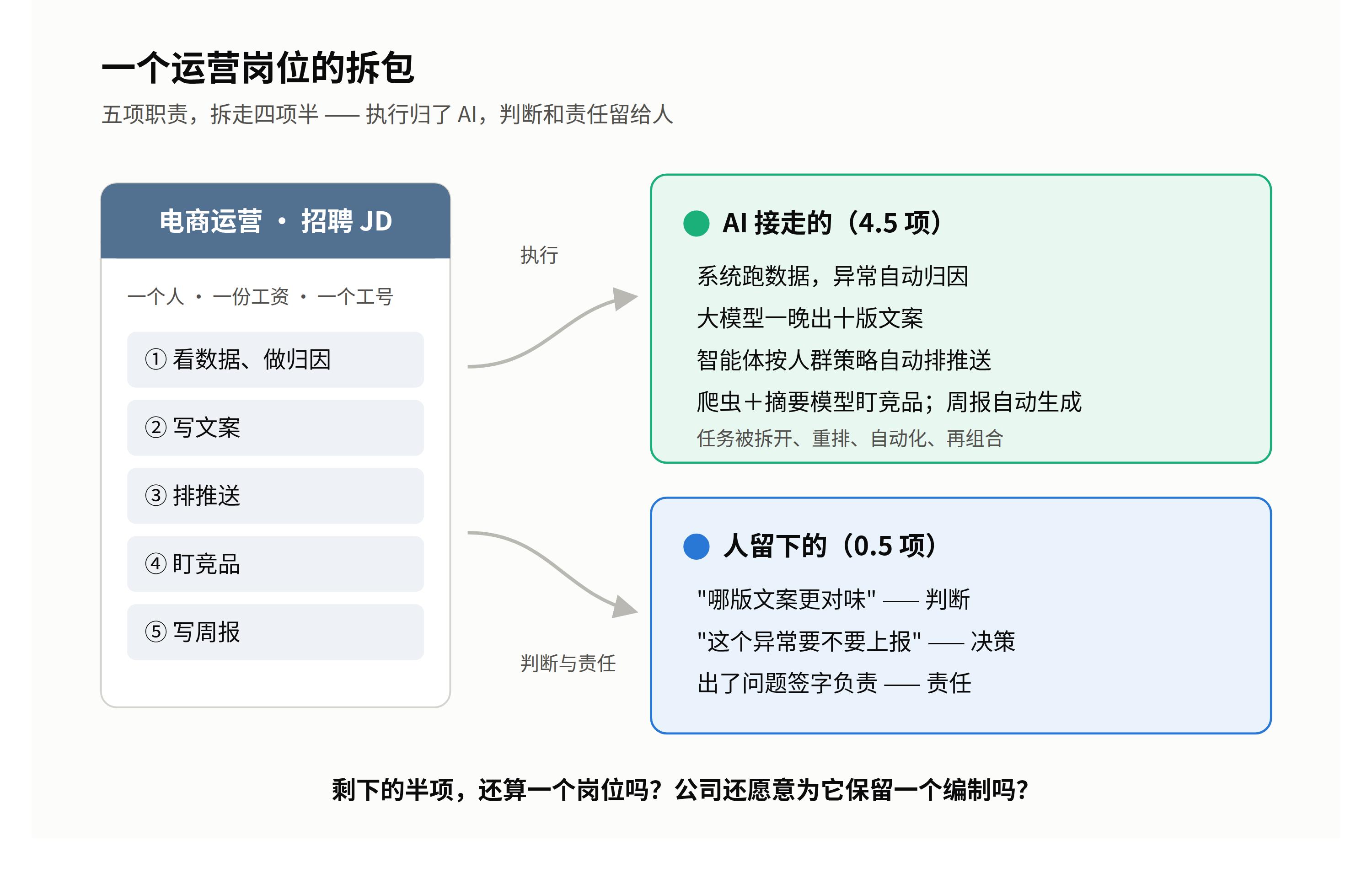
Three years ago, a typical day for an e-commerce operations specialist unfolded like this: reviewing data in the morning, drafting copy before noon, scheduling push notifications at lunchtime, monitoring competitors in the afternoon, writing weekly reports in the evening, and often working overtime until 10 PM on bad days. The job description listed five core responsibilities, all assigned to a single person with one salary and one employee ID — clear and straightforward.
Today, she arrives at her desk at 9:30 AM only to find all tasks already completed. Data is automatically processed by the system with anomaly attribution; the large language model generated ten copy drafts overnight waiting for her selection; push notifications are pre-scheduled based on audience segmentation strategies; competitor dynamics are tracked by a crawler paired with a summarization model; even the weekly report has auto-generated itself in Feishu. What remains for her are judgment calls like "which copy version hits the right tone" and "whether this anomaly needs escalation" — along with full accountability for any issues that arise.
Her workload has lightened, but she knows better than anyone this is no good news: four and a half of the five original responsibilities have been stripped away, leaving her wondering if the remaining half even counts as a proper role anymore, and whether the company will still maintain a headcount slot for it.
This dilemma now faces millions of white-collar workers. Over the past year, the internet industry has seen rounds of "optimization" layoffs, where "AI-driven efficiency gains" has replaced "winter season" as the new buzzword in corporate announcements. Many companies are simultaneously downsizing some teams while urgently hiring for AI roles with six-figure annual salaries. More thought-provoking are two key developments: media statistics estimate that global tech giants will lay off 230,000 employees citing AI labor substitution, while Gartner predicted in early 2026 that by 2027, half of the companies that cut customer service staff due to AI will rehire human agents.
Layoffs are still ongoing, yet the rollback has already been foretold. These two trends together read like a pre-written self-criticism for the industry: most companies haven't realized that AI isn't just targeting labor costs or specific roles — it's fundamentally disrupting the very concept of "jobs" itself — that basic organizational unit we've taken for granted for a century, where one person owns a defined set of responsibilities.
To understand this shift, we must first answer a more fundamental question: how did jobs come into existence in the first place?
Jobs Are a Legacy Organizational Solution
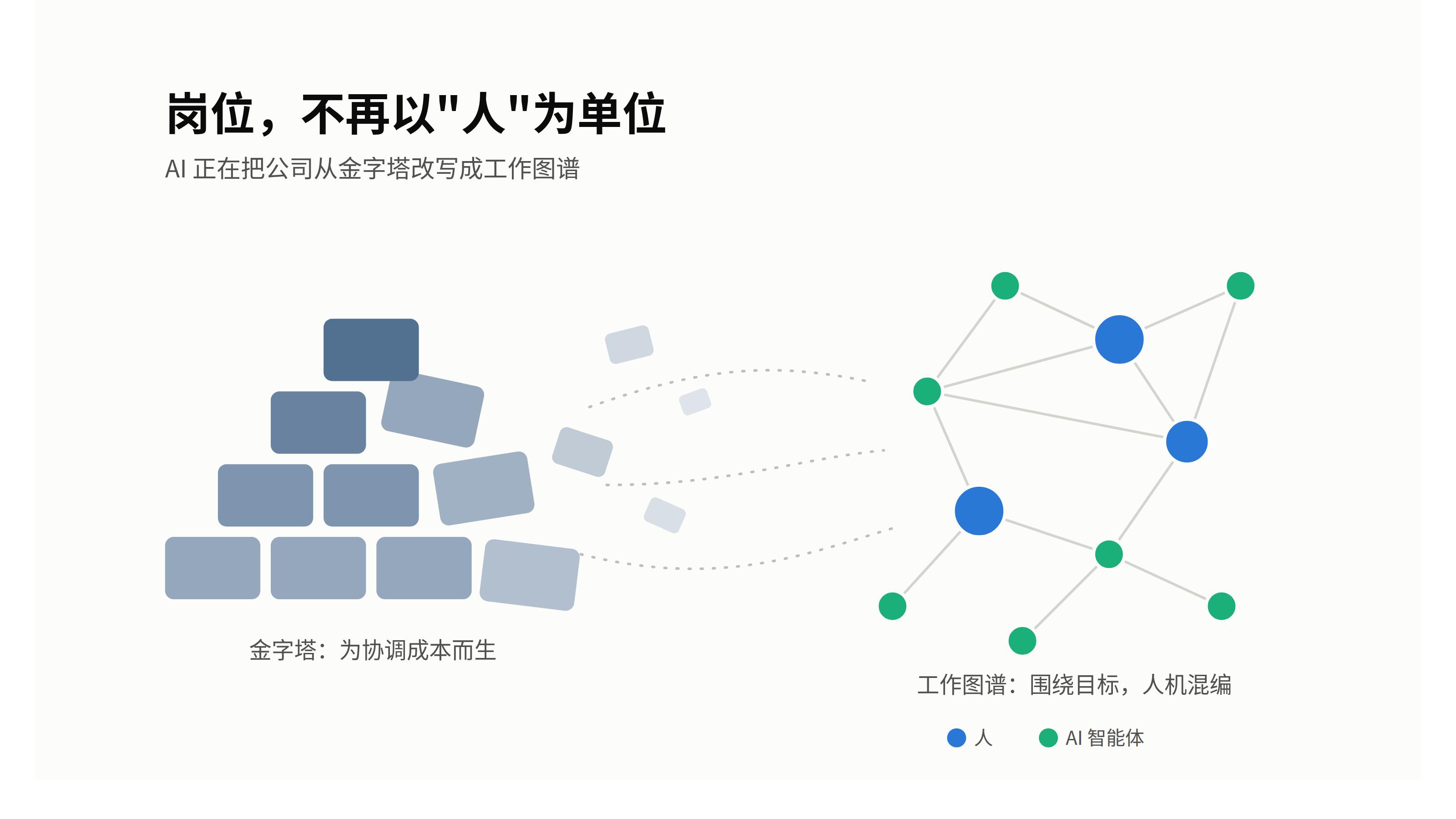
Economist Ronald Coase answered why companies exist over 80 years ago: because market transactions are too costly. Constantly sourcing vendors, negotiating prices, signing contracts, and verifying deliverables creates unsustainable overhead. Instead, hiring full-time employees and replacing bargaining with administrative directives gave rise to the modern corporation.
The origin of job roles follows the same logic applied internally within companies. Hand-offs, alignment checks, and deliverable verifications between tasks all create friction and waste. The most efficient solution was to bundle related tasks into a single package and assign it entirely to one person. An operations specialist holding five responsibilities isn't because those tasks naturally belong together — it's because splitting them across five people would create more coordination overhead than the salary savings.
In other words, "people as the smallest organizational unit" has never been a natural law — it was a compromise when coordination costs were prohibitively high. Jobs are packaged bundles of tasks, and the corporate hierarchy is just layers of these bundles stacked vertically: a manager can oversee at most 7-8 subordinates, information must flow upward through layers for aggregation, and organizations naturally grow taller. Middle managers essentially act as information relays: breaking down top-level directives for their teams, aggregating progress reports for upper management, and negotiating resources with peer departments. Concepts popularized by big tech in the last decade — centralized platforms, business partners, cross-functional alignment, upward management — are all components of this human-powered information system.
This model worked smoothly for a century, until the very rationale for task bundling began to disappear.
Unbundling
AI can generate copy, analyze data, write first-draft code, and auto-summarize meeting notes. As execution tasks are progressively taken over by AI, the cost premise that "tasks must be bundled into a single job" no longer holds. Tasks can now be split, rearranged, automated, and recombined — transforming jobs from fixed responsibility bundles into dynamically reconfigurable task checklists.
This fundamentally changes how companies view employees. Instead of asking "is this person competent," they now calculate: what percentage of their work requires human judgment, what can AI handle, and what can be done by lower-cost staff augmented with AI. This is the real source of white-collar anxiety in recent years: you think you're competing with AI on skills, but the company is actually recalculating how much of your role still truly needs a human. The old "35-year-old career crisis" has a colder iteration in the AI era: decades of accumulated execution experience are depreciating at the speed of model iterations, while the irreplaceable judgment capabilities don't come naturally to everyone.
Notably, the first roles to be fully unbundled aren't always entry-level positions. Middle managers' core responsibilities — assigning tasks, tracking progress, aggregating information — are exactly the functions AI can take over entirely. Feishu and DingTalk have heavily invested in AI features for automatic task decomposition, real-time progress sync, and auto-generated weekly reports. With information relay taken over by machines, middle managers whose entire skill set revolves around meetings, forwarding messages, and collecting reports find themselves in a more precarious position than frontline staff.
Layoffs are merely the financial settlement after unbundling is complete.
What Are Unbundled Tasks Reforming Into?
Work doesn't disappear after unbundling — it reorganizes according to new logic. Over the past 2-3 years, two Chinese case studies deserve close examination.
The first is Alibaba. Around 2015, it pioneered the "large centralized platform, small front-end teams" model that was widely adopted across the industry; in 2023, it launched the "1+6+N" restructuring to dismantle its own centralized platform. This cycle of construction and dismantling can't be simply attributed to AI — it had business and capital motivations — but it demonstrates a critical truth: organizational structures evolve with coordination costs. Back then, aligning information across departments was so inefficient that consolidating redundant functions into a centralized platform made sense. But as information and resource access methods changed, the very departments built to reduce friction became new sources of bureaucracy. AI will only accelerate this transformation.
This principle applies to managers too: surviving employees will focus on work that machines cannot do — articulating ambiguous problems, making final decisions amid conflicting opinions, designing human-AI collaboration frameworks, and taking accountability when things go wrong. AI hasn't eliminated management; it's stripped away administrative overhead, leaving behind the core essence of management.
The second case is DeepSeek, preceded by Pinduoduo. Pinduoduo has long topped the internet industry's labor productivity rankings, with per-capita revenue exceeding 10 million RMB — several times higher than many peers. It proved that with sufficiently systematized processes, team size no longer correlates with business scale. DeepSeek represents the AI-native version: public reports show its team of just over 100 people built a model that forced Silicon Valley to reassess the US-China AI gap. When DeepSeek went viral in early 2025, observers were most shocked not by the model itself, but by its organizational structure: no rigid hierarchy, no KPI chains, temporary teams formed around specific problems, and junior researchers fresh out of college granted direct access to the company's most critical computing resources. Silicon Valley has been studying this operating model in academic papers.
Microsoft's "Work Trend Index" report refers to these organizations as "Frontier Companies" and predicts their internal dynamics: no fixed departmental boundaries, temporary teams assembled around goals, human-AI hybrid workforces that disband once projects complete. Every employee manages a fleet of AI agents, assigning tasks and reviewing outputs like a manager. This represents a profound shift: previously, you had to climb the corporate ladder to delegate work, but now every ordinary employee has an on-demand AI team at their disposal. A new analyst backed by five tireless AI agents can deliver output far beyond traditional limits, with productivity no longer measured by overtime hours but by how effectively they leverage machines. For an industry built on mandatory overtime policies, "labor productivity" has been completely redefined.
Even hiring practices are transforming. Previously, headcount naturally grew with business expansion, but now many companies freeze total headcount, embed AI efficiency targets into OKRs, and list "AI replacement of outsourced work" as departmental annual goals — to get approval for new hires, teams must first justify why the work cannot be done by AI.
Tasks Are Automated, But Accountability Falls Through the Cracks
Returning to Gartner's earlier prediction — it wasn't arbitrary. The rollback already has a real-world blueprint starring Sebastian Siemiatkowski, CEO of Swedish fintech giant Klarna. In 2024, he was the most vocal global advocate for AI labor substitution, announcing that an AI customer service system handled the equivalent of 700 full-time agents' monthly workload, halting hiring, and publicly claiming AI could perform all human work. He became the poster child for the AI era for a full year. Then, exactly one year later, he reversed course: the company had gone too far, excessive cost-cutting had eroded service quality, and customers simply wanted to speak to human representatives. Klarna resumed hiring human agents, adopting a hybrid model where customers can always choose to connect with a person. From trailblazer to self-correction, the turnaround took exactly 12 months.
This same dynamic plays out in everyday Chinese contexts. In April 2024, the digital avatar "Dongge the Procurement Specialist" debuted in JD.com's live streaming room — not the real Liu Qiangdong, but his likeness, voice, and sales mannerisms modeled by AI. The premiere drew millions of viewers, many curious if a digital CEO could actually drive sales. Soon after, AI live streamers and customer service chatbots proliferated across the entire e-commerce industry. These new "digital workers" handle tasks, meet performance metrics, and complete "pre-job training" — but they don't occupy official headcount slots. Who owns their roadmapping, budgeting, and performance reviews? When a digital influencer makes a harmful mistake or an AI agent mishandles a critical customer complaint, who bears ultimate responsibility? This isn't an isolated problem — every company that has automated tasks with AI hasn't answered this question: the speed at which tasks are being automated far outpaces the speed at which accountability structures are being redesigned.
Both stories reveal the same root cause: companies only unbundled job roles without rebuilding accountability frameworks. Klarna's failure wasn't just that customers wanted humans — the deeper issue was that there was no fallback human to resolve complex edge cases when AI made mistakes. The entire industry still hasn't addressed the accountability gap left by dissolving traditional job roles.
AI takes over tasks, but no one answers for the outcomes: who fact-checks AI-generated content? Who owns system architecture and security for AI-written code? Who de-escalates emotional customer crises that AI can't navigate? Who takes responsibility when AI screening algorithms reject qualified job candidates? In traditional organizations, these accountabilities were embedded in job roles — the person doing the work took responsibility, an unwritten rule everyone understood. When job structures dissolve, these unassigned accountabilities float in limbo. Previously, slow processes allowed veteran employees to quietly resolve issues through experience and communication; now AI accelerates workflows, and errors propagate into production at the same accelerated speed.
The scale of this gap is quantified in Deloitte's 2026 research: enterprises have rising expectations for automation, yet 84% of companies have never redesigned job roles around AI, and less than half have updated their talent strategies. In China's internet industry, which has pursued cost-cutting for four consecutive years, this percentage is likely even lower. Cutting headcount to reduce budgets is always far easier than rebuilding accountability structures.
What Truly Defines AI-Native Operations
We can now arrive at an unadulterated definition of AI-Native: it's not measured by how many models you purchase, how many user accounts you provision, or how many prompt engineering workshops you host. It means every workflow in the company has been re-evaluated to answer three questions: which tasks should AI handle first? Which judgment calls require explicit human sign-off? Which outcomes must be reviewed by a human before proceeding — and job descriptions, performance metrics, approval workflows, and talent structures have all been rewritten to align with these answers. If these answers aren't formally documented, you haven't achieved true AI-Native status.
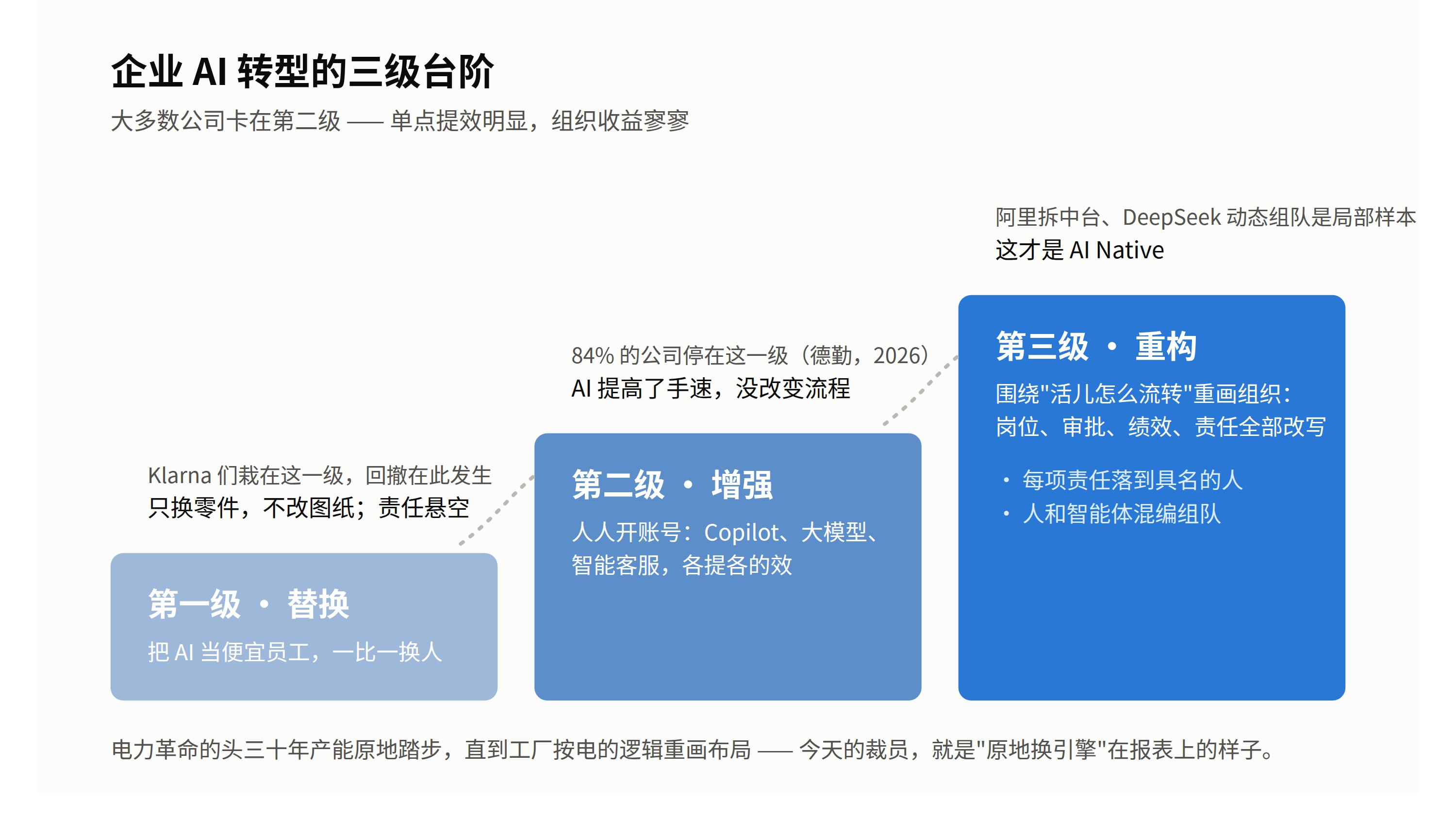
By this standard, enterprise AI transformation progresses through three distinct stages. The first stage is substitution: treating AI as a low-cost labor replacement, swapping out existing roles one-for-one while leaving the rest of the organization unchanged, with cost reduction as the sole objective. Klarna's story and Gartner's predicted rollbacks both occur at this stage. The second stage is augmentation: every employee gets an AI account, marketing teams use generative AI, engineering teams use code copilots, customer service uses intelligent chatbots. While individual productivity improves, the overall company doesn't perform better — copy gets generated faster but reviewers face heavier workloads, code gets written quicker but QA teams are overwhelmed. AI only boosts individual execution speed without transforming underlying processes. That 84% of companies identified by Deloitte are stuck at this stage. The third stage is true reconstruction: recognizing that traditional job roles, approval chains, accountability boundaries, and performance metrics are no longer fit for purpose, and redesigning the entire organization around how work flows rather than how many people are employed. Alibaba's centralized platform dismantling and DeepSeek's dynamic teaming are partial examples of this stage. Just this week, Microsoft announced a $2.5 billion Frontier Company initiative to help enterprise clients integrate and deploy AI at scale. They're no longer just selling API calls — they're selling the capability to embed AI into a company's core data, workflows, and business objectives. That this has become a massive commercial market proves the industry has already assigned tangible value to full organizational AI reconstruction.
Technology history offers a perfect parallel. In the first three decades after electric motors replaced steam engines, factory productivity barely increased — everyone was just swapping out power sources on existing production lines. It wasn't until engineers redesigned entire factory layouts around electrical workflows that productivity truly exploded. Today's wave of layoffs is exactly that "swapping out engines on old equipment" phase, reflected on corporate balance sheets.
Before Pressing the "Optimization" Button
Piecing these trends together, the contours of an AI-Native company become clear: smaller teams, flatter hierarchies, teams formed around objectives rather than departments, human-AI hybrid collaboration, managers shifting focus from people management to designing human-machine collaboration systems, and clear accountability assigned to specific individuals for all outcomes — regardless of whether the work was performed by humans or AI. Organizational charts won't disappear, but they'll evolve into real-time dynamic maps that update with projects, rather than static pyramids revised once a year.
This new organizational model won't necessarily be more lenient. With work decomposed into discrete tasks, every employee's irreplaceability must be recalculated; as workflows are automated, power derived from tenure and information asymmetry will diminish; with real-time outcome tracking, the facade of "looking busy" will no longer protect underperformers. For an industry that invented the concept of "involution" (excessive internal competition), this isn't entirely bad news — the arms race of mandatory overtime loses all meaning when machines never sleep.
Chinese companies are well-positioned for this reconstruction: they already have agile organizational adjustment practices, frontline employees rapidly adopt new tools, and there are proven examples like DeepSeek where small teams deliver outsized impact. What's actually missing isn't execution capability, but the patience to separate short-term cost-cutting from long-term organizational reconstruction.
So the final question goes to managers preparing to press that "optimization" layoff button: are you cutting unnecessary costs, or tearing down structural load-bearing walls? Who will own coordination tasks, who will bear floating accountabilities, who will manage performance reviews for AI-performed work, and who will be held accountable for AI errors? Siemiatkowski has already paid the tuition for everyone, and Gartner's predictions are queuing up for more companies to learn the hard way.
As for the operations specialist in our opening story — her identity could be swapped for any white-collar worker. Whether she gets another job offer, and