MindRank Announced $52 Million Series B Financing, with AI-Designed Weight-Loss Drug Entering Phase 3 Clinical Trials | 36Kr Exclusive
By Hu Xiangyun
Edited by Hai Ruojing
36Kr learned that MindRank AI has recently completed a $52 million Series B financing round, with investors including leading RMB and USD funds. Kaiwu Capital served as the exclusive financial advisor. The raised funds will be used to upgrade and iterate the AI drug discovery engine Molecule Arts Platform (MAP), refine its Multi-Agent collaborative system and Clinical Data-in-the-Loop framework, advance the Phase III clinical trials and commercialization of its self-developed oral GLP-1 small molecule MDR-001, and expand other differentiated innovative drug pipelines.
MindRank AI's vision is to become an AI-native biopharmaceutical company. Its founder and CEO, Niu Zhangming, has years of experience as CTO of a German publicly traded AI healthcare company. He believes traditional new drug R&D relies heavily on the experience of senior experts, requiring hundreds to thousands of synthesized molecules for repeated trial and error. Today, breakthroughs in AI technology are poised to disrupt this traditional path, transforming the "trial-and-error" new drug R&D model—like looking for a needle in a haystack—into a data-driven, computable, and iterable "standardized creation" process.
This was precisely the original intention behind MindRank AI's development of MAP.
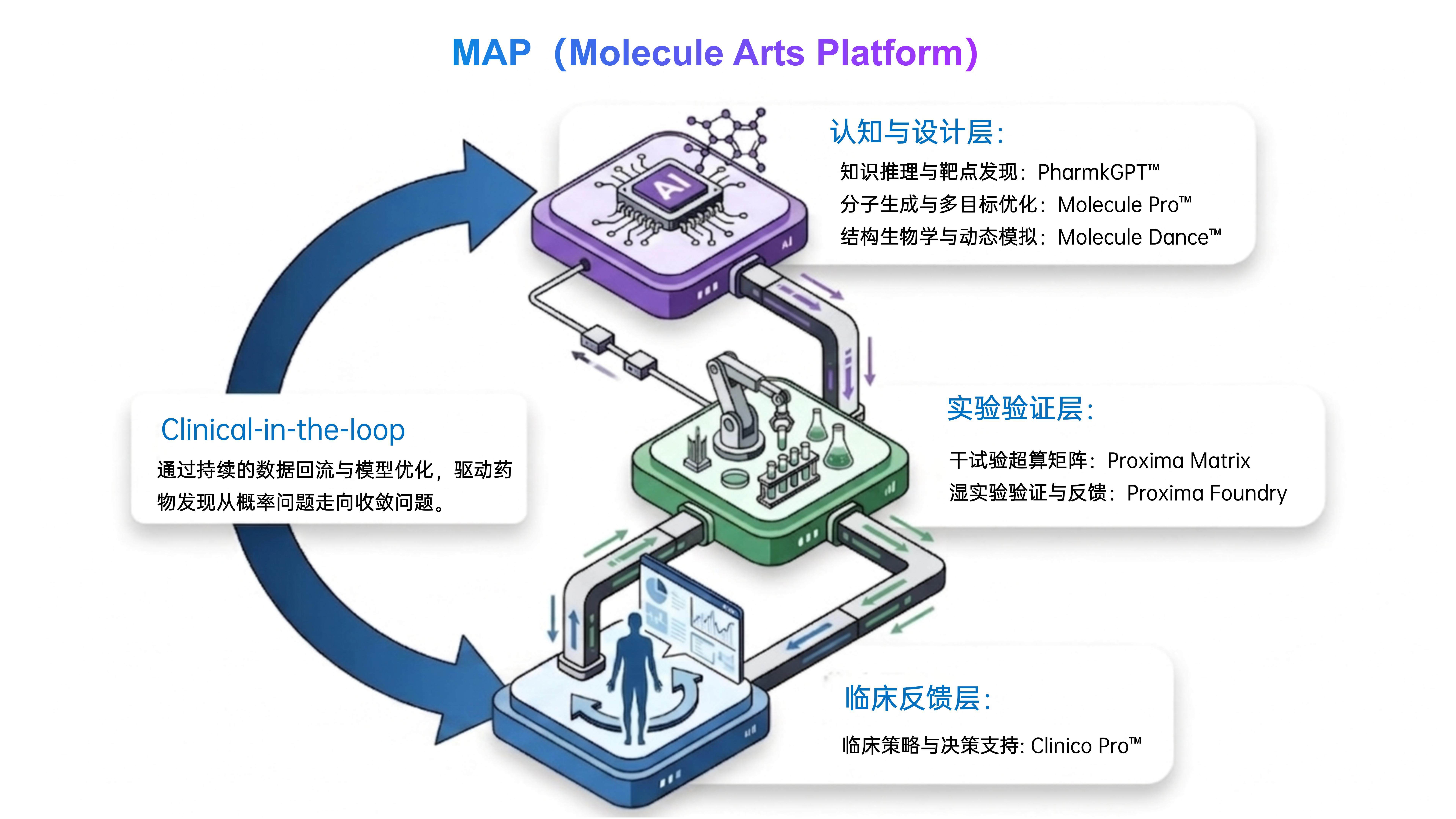
Schematic diagram of MindRank AI's Molecule Arts Platform (MAP) technology platform (Source: MindRank AI)
According to the introduction, the Molecule Arts Platform (hereinafter referred to as "MAP") has a three-tier architecture: The first layer is the AI design layer, which integrates the company's self-developed PharmkGPT biology platform, Molecule Pro small molecule drug discovery platform, and Molecule Dance structural biology platform, covering the entire process from preclinical research to IND application for multiple drug types such as small molecules and peptides.
The second layer, the dry-and-wet complementary experimental platform, is primarily responsible for data supply. It operates synchronously through the dry experiment simulation system Proxima Matrix and the wet laboratory Proxima Foundry, continuously generating high-quality training data to support the iteration of AI models. "MindRank AI has 200 GPUs for independent training of biomedical foundation large models and a self-built data production line. The goal is to make the pharmaceutical company closer to a rapidly iterable AI-native entity, and generate high-quality data required by customized models through standardized laboratories," Niu Zhangming stated.
The third layer is the Clinical Pro clinical AI platform. It does not merely accumulate clinical data but attempts to integrate clinical feedback into the R&D system to correct previous calculations and experimental judgments. This constitutes the core barrier that differentiates MindRank AI from other AI pharmaceutical enterprises. Part of this feedback comes from clinical research data or clinical data accumulated through MindRank AI's own clinical pipelines. For example, Clinical Pro has accumulated over 1,300 anonymized clinical-related data points based on the GLP-1 pipeline MDR-001.
"We do not simply define MAP as an AI tool, but as a continuously learning and evolving drug R&D system. Its core vision is to connect the full-process data from preclinical to clinical stages through AI multi-agent assistants, realizing 'Clinical Data-in-the-Loop' for continuous self-iteration. In this way, the real-world data generated by every pipeline, whether successful or not, can retroactively enhance the platform's capabilities, thereby reducing the costs and failure probabilities of subsequent new drug R&D," Niu Zhangming explained.
At present, MDR-001, the first validated drug from MAP, entered the Phase III clinical stage at the end of 2025. The company has completed the recruitment of 760 subjects in China, with nearly 50 cooperating clinical centers. If all goes well, the drug is "expected to be launched in China within the next 2-3 years," targeting the trillion-dollar GLP-1 market.
Looking back on the R&D process of MDR-001, the MindRank AI team completed PCC (preclinical candidate molecule) confirmation within 8 months by synthesizing more than 80 new small molecules. The entire process from project initiation to Phase III clinical launch took about 4.5 years, with an investment of approximately $23 million (data provided by MindRank AI shows this efficiency is more than 10 times the industry average). In contrast, using traditional methods, the development of an innovative drug from design to Phase III clinical trials often takes 7-9 years and costs $300-400 million.
This high efficiency is not an isolated case. Empowered by AI technology, MindRank AI has only over 40 employees since its founding, yet it has 15 innovative pipelines under development, 5 PCCs in reserve, and 3 IND approvals obtained in both China and the United States. Following MDR-001, MRANK-106, a WEE1 & YES1 dual-target drug targeting solid tumors with no effective treatment options such as pancreatic cancer, has also been approved for clinical trials. In terms of drug types, MindRank AI's pipeline assets cover multiple cutting-edge drug modalities including GPCRs, molecular glues, allosteric inhibitors, and dual-target oncology small molecules.
Niu Zhangming believes that as AI technology gradually integrates into the company's entire R&D system, the value of future AI-native pharma companies will no longer be limited to the traditional Biotech framework. "The valuation logic of traditional Biotech comes from the single-drug NPV model, while AI-native pharmaceutical companies validate more efficient methods of producing drugs. For MindRank AI, this is the MAP system. As more and more drug pipelines advance, MAP can transfer past R&D experience to subsequent pipelines, forming a continuously reusable R&D flywheel."
This was also the path followed by the previous generation of CADD (Computer-Aided Drug Design) enterprises. Taking Vertex Pharma, a global CADD pioneer with a market capitalization of $120 billion, as an example, the company has continuously launched several blockbuster drugs with annual sales exceeding $10 billion through its strategy of precise molecular design via computers, growing into a pharmaceutical giant with a hundred-billion-dollar market value. Its experience proves that by mastering the most advanced computing tools and highest prediction accuracy, greater commercial returns can be achieved with more streamlined resources.
Today, MindRank AI aims to follow this path to build a Vertex Pharma for the AI era, ensuring that "every molecular design, experimental data point, and clinical result becomes the starting point for the next round of innovation." The company expects to continuously advance blockbuster drugs into clinical stages and eventual commercialization, using drug sales to generate stable cash flow that feeds back into the iteration of the AI technology platform, continuously producing new drug assets with global competitiveness.