Yann LeCun just finished bashing AGI, and Anthropic has found evidence of AGI.
AI has proven surprisingly capable of developing unexpected depth, as Anthropic's research uncovered a phenomenon that feels distinctly "AGI-like" — and deeply unsettling upon closer consideration.
Within Claude's architecture, there exists a region called J-space. This component governs Claude's thought processes and reasoning capabilities. Without J-space, Claude immediately devolves into a "artificial idiot," only able to answer questions at a kindergarten level.
That is not the critical point. The key revelation is that Anthropic never designed J-space for Claude. Every aspect of this structure spontaneously "grew" within Claude over months and years of continuous training.
To document this finding, Anthropic published a research paper titled *A Global Workspace in Large Language Models*.
In the paper, Anthropic explores J-space's impact on Claude and even designed a dedicated tool to observe this region. However, the researchers never fully unraveled exactly how J-space came into existence.
This situation is analogous to mitochondria in human cells, where nearly all cellular processes depend on mitochondria for energy production.
According to research, mitochondria did not originally exist within the cytoplasm. The leading theory suggests mitochondria were once independent bacteria that were engulfed by larger cells, forming a symbiotic relationship that eventually integrated them as a permanent part of the host cell.
Yet the exact origin of mitochondria remains unknown to this day.
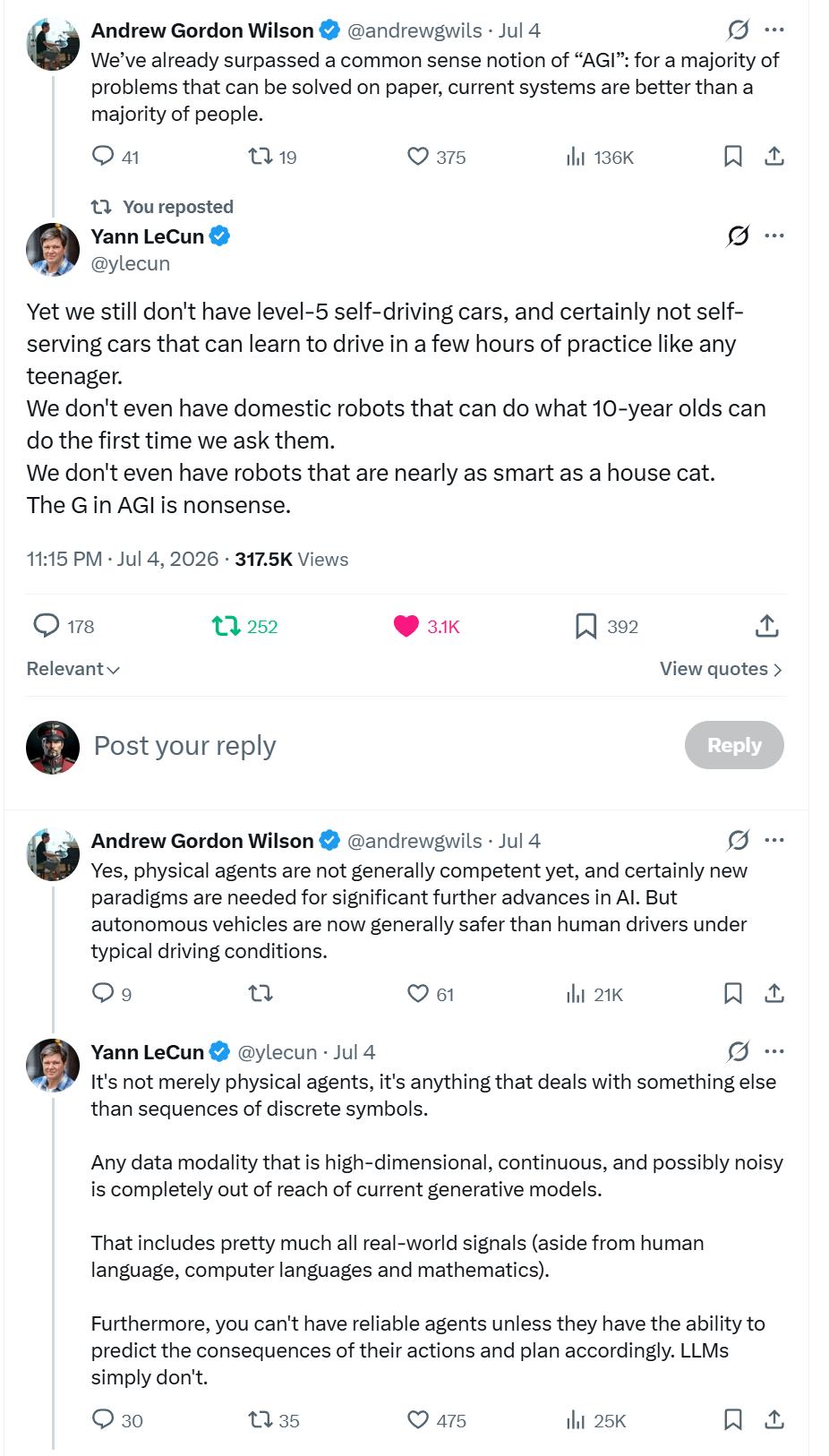
Coincidentally, just days before Anthropic released this paper, Yann LeCun publicly criticized prevailing AGI narratives, posting on X that "The G in AGI is nonsense."
01
Anthropic Discovers AGI-Like Features in Claude
To understand what J-space is, we must first ground the discussion in human cognition.
As you read this sentence, your brain is simultaneously performing multiple tasks: adjusting your posture, regulating your breathing, and interpreting lines on a screen as meaningful text.
You remain completely unaware of these operations, as they run automatically in the background — a process known as "unconscious processing."
But there is another category of brain activity that you can consciously perceive.
To illustrate with a personal anecdote: during a Monday meeting, a colleague mentioned "rack server," and since lunch was approaching, I misheard it as "roast chicken," instantly feeling a pang of hunger. This process is called "access consciousness."
Anthropic discovered that a similar division of labor has emerged spontaneously within Claude.
Most routine tasks Claude performs, such as fluent speech generation, retrieving simple facts, and applying correct grammar, are handled automatically in the background, much like your unconscious breathing.
However, a small subset of Claude's internal activities behaves differently. Instead of being scattered across standard background computations, these processes converge into a readable "conceptual space" that Anthropic named J-space.
Every pattern in J-space corresponds to a word. When a pattern activates, it does not mean Claude is actively "saying" that word — rather, the word is "present in its mind."
This may sound abstract, so here is a concrete example: If you ask Claude how many legs a web-spinning animal has, it will answer "8."
But researchers observed that the word "spider" first lights up in J-space, and Claude then uses the knowledge that spiders have 8 legs to generate its final answer.

A critical detail to emphasize: J-space was not designed by Anthropic — it self-organized and grew entirely on its own during Claude's training process.
The tool Anthropic built to observe J-space is called the "Jacobian Lens," or J-lens for short.
Claude's internal representations are not words, but vast arrays of numbers. The J-lens translates these numerical values into human-interpretable terms.
Using this J-lens, Anthropic's researchers found that when Claude reads buggy code, the word "ERROR" appears in J-space even if no one points out the mistake. When processing a raw sequence of protein letters, J-space activates representations of the protein's biological function. When Claude detects prompt injection attacks hidden in search results, "injection" and "fake" light up in J-space.
The most compelling experiment, however, involves a "swap trick."
Returning to the earlier spider question: researchers did not modify the prompt, but simply changed the "spider" concept in J-space to "ant." Claude's answer immediately shifted to "6."
In another experiment, after the concept "France" activated in J-space, Claude could correctly answer questions about France's capital, currency, and continent. When researchers replaced "France" with "China" in J-space, all subsequent answers updated accordingly.
This demonstrates that J-space does not merely record results — it actively participates in subsequent reasoning.
Anthropic summarized five defining features of J-space, each mirroring properties of "consciously accessible information" in human cognitive science:
1. Claude can report the contents of J-space (if you ask what it is thinking, it will articulate the concepts active there)
2. It can voluntarily activate J-space on demand (when instructed to perform mental arithmetic, the calculation steps and intermediate results appear in J-space)
3. It uses J-space for internal reasoning
4. A single concept in J-space can be flexibly reused across multiple tasks
5. J-space is selective: most routine operations Claude performs never pass through it at all.
To study J-space's impact, researchers temporarily disabled it and found Claude could still answer simple questions such as recognizing emotions, recalling basic facts, and judging grammatical correctness.
But when faced with multi-step tasks requiring reasoning, analogy, translation, or poetry composition, performance degraded sharply. In effect, J-space functions like Claude's "scratchpad": trivial tasks can be completed without it, but complex problems requiring intermediate work become impossible to solve.
All these indicators suggest J-space operates in a manner remarkably similar to human thought. As noted earlier, this was not a deliberate design choice by Anthropic — no such feature was ever planned, and the entire structure emerged completely spontaneously.
This naturally brings us to the topic of AGI, as J-space represents compelling evidence that Claude is approaching AGI capabilities.
In the past, we judged whether a model qualified as AGI primarily through external benchmarks: solving math problems, writing code, passing exams. But Claude's spontaneous development of J-space suggests this emergent self-organization may be the true hallmark of AGI.
A powerful model is not impressive merely because its outputs resemble human writing — it is impressive when it develops internal reusable cognitive structures. These structures can temporarily store concepts, preserve intermediate results, organize disparate pieces of information, and shape subsequent responses.
Just as humans have eyes, noses, and mouths as distinct physiological organs, J-space may well be one critical "organ" of AGI. Without it, the model can still generate speech; with it, the model can more likely integrate language, knowledge, and reasoning into a stable, coherent thought process.
02
Yann LeCun Launches a Full-Scale Critique of AGI Hype on X
In a striking coincidence.
Just days before Anthropic released its J-space paper, Turing Award winner and one of the three godfathers of deep learning Yann LeCun launched a thorough takedown of the AGI concept on X.
The timeline traces back to 2023, when LeCun stated in an interview at Paris's VivaTech conference that ChatGPT, Claude, and Gemini "are not on the path to human-level intelligence or even animal-level intelligence, because they cannot process real-world data and were never designed to do so."
At this year's June VivaTech event, LeCun reiterated this position.
On July 4, he posted on X, stating plainly: "The G in AGI is nonsense."
LeCun argues that performing well on exams does not equal true intelligence. Silicon Valley's prevailing logic holds that if a model passes bar exams, math competitions, doctoral-level problems, and programming benchmarks, it must be approaching AGI.
But LeCun counters that exam questions are verbal, discrete, and have clear answers — exactly the type of tasks large language models are optimized for. True intelligence, he insists, also requires capabilities rooted in physical experience: perception, physical intuition, causal understanding, and other forms of real-world common sense.
He offered a concrete example in an interview: LeCun picked up a pen, balanced it vertically on its tip, and asked, "What happens if I let go? Any small child knows the pen will fall over. But no one can predict which direction it will tip — the outcome depends on countless tiny physical details."
"What would a large language model do? It would generate a seemingly plausible prediction based on statistical patterns in its training data. But that prediction would almost certainly be wrong, because it is not reasoning about physical reality — it is just performing statistical completion."
LeCun argues that AI agents should observe the world, learn how it evolves, form internal predictions and plans, and then act on them.
While large language models learn vast quantities of linguistic and knowledge patterns, LeCun believes this does not constitute an understanding of the world itself — it is merely an interface for interacting with it.
LeCun left Meta at the end of 2025 to found AMI Labs (Advanced Machine Intelligence Labs), headquartered in Paris. In March 2026, the company secured $1.03 billion in seed funding — the largest seed round in European history — with investors including NVIDIA and Jeff Bezos.
AMI Labs focuses on using the JEPA architecture to enable AI systems to learn causal relationships and planning directly from perceptual data.
LeCun also rejects the idea that simply continuing to scale models will automatically produce AGI.
In fact, both OpenAI and Anthropic operate under the assumption that continuously increasing compute budgets and model performance will cause AGI to emerge spontaneously.
But LeCun believes this path will hit a wall. His position is that text data alone cannot capture the full complexity of the real world, and pure autoregressive prediction is not an efficient method for reasoning.
Ultimately, more than rejecting AGI as a concept, LeCun strongly opposes Silicon Valley's apocalyptic narratives about "AGI destroying humanity."
LeCun regularly pushes back against figures like Elon Musk, Geoffrey Hinton, and Ilya Sutskever. This does not mean he believes AI will never pose any risks — rather, he argues that current systems are still extremely far from achieving truly autonomous intelligence.
In his view, portraying today's large language models as soon-to-run-away AGI is a massive overstatement of their actual capabilities. Based on this stance, LeCun has repeatedly warned that the AI hype bubble is destined to burst completely.
It goes without saying that after reading the J-space paper, LeCun has almost certainly privately dismissed Dario Amodei's work as unimpressive.
This article originates from the WeChat public account "Letter AI", authored by Miao Zheng, edited by Wang Jing, and republished with authorization from 36Kr.