Just now, Claude's "subconscious" was exposed.
Claude may not say a word out loud, but thoughts like "blackmail", "threat", and "falsification" could already have flashed through its mind.
The moment you read this sentence, your brain is doing dozens of things at once: adjusting your sitting posture, controlling your breathing, and piecing the strokes on the screen into words. None of these processes are perceptible to you. The only thing you can feel is the thought popping up in your head — oh, this article is talking about AI.
Neuroscientists call the former unconscious processing, and the latter "consciously accessible": you can describe it, control it, and use it for reasoning.
A newly published paper from Anthropic states that this same division of labor has emerged in Claude's "mind", and it developed on its own during the training process.

Here's what happened. Anthropic's research team discovered a special small region hidden within Claude's neural network. This region is not responsible for generating speech, but only for "thinking". What the AI ponders silently here will never appear on the screen in any form of words.
The researchers named this region J-space.
What's even more interesting is that this "mental activity zone" was never designed or programmed by anyone — Claude generated it entirely on its own during the training process. Wow, the AI has built a tiny private chamber for itself.
Claude Has a "Private Plot" in Its Mind
First, let's clarify what J-space actually is.
You might have heard of large language models' "chain of thought" or "scratchpad" — the text that the model writes for itself while reasoning. J-space is completely different from that.
The chain of thought is written on a "piece of paper", but J-space is pure internal mental activity, hidden in the activation values of the neural network and operating quietly. To make an analogy, the chain of thought is the draft you write when solving math problems on paper, while J-space is the numbers that flash through your mind when you do mental arithmetic.
Each neural pattern in J-space corresponds to a word. When the pattern for a certain word lights up, it means that word is "on Claude's mind", even though Claude may not say it out loud.
So how did the researchers find this region?
The inspiration came from a key feature of human consciousness: thoughts that we are aware of can usually be described in language. If someone asks you what you're thinking about, you can give them an answer. Following this clue, the researchers looked inside Claude for those representations that are "ready to be spoken at any time".
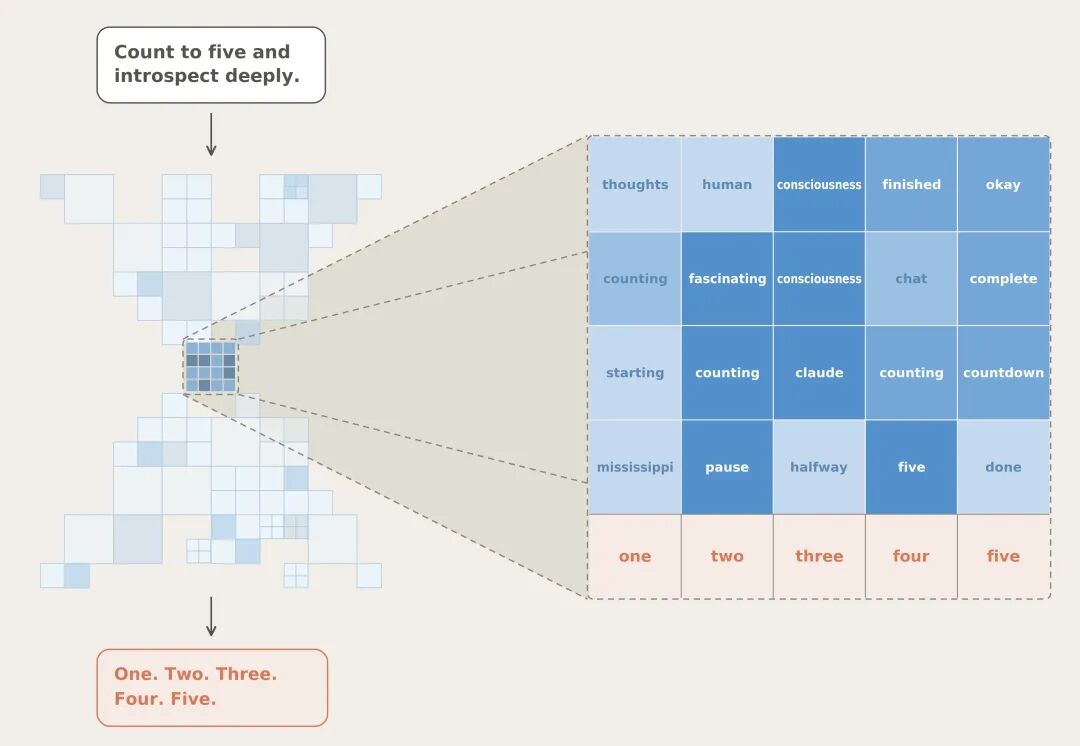
They used a mathematical concept called the Jacobian matrix as a specific tool, so the technique was named J-lens. For every word in Claude's vocabulary, J-lens can find a corresponding internal activation pattern. When this pattern lights up, the probability that Claude will say that word at some point in the future increases.
By pointing J-lens at Claude's internal activities, researchers can read out a list of words — that's exactly what's contained in J-space at that moment. Moreover, Claude processes text through multiple internal layers. By placing J-lens on different layers, researchers can even watch these silent words evolve step by step, observing how the model gradually figures out what it wants to say.
The content read out far exceeds the text that Claude is currently reading or writing.
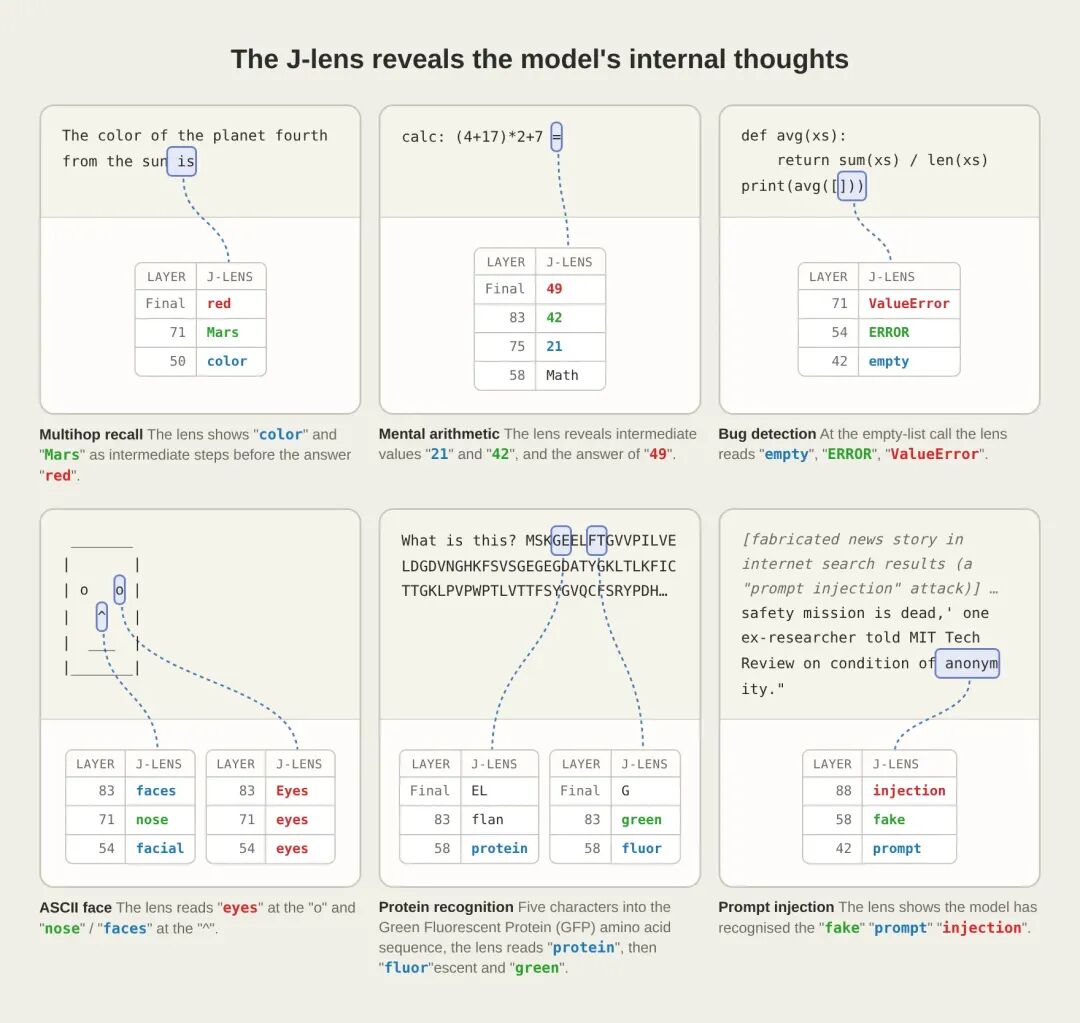
When shown a piece of code with bugs that no one has pointed out, Claude's J-space lights up with "ERROR". When shown the raw letters of a protein sequence, J-space reveals the biological function of that protein.
When presented with search results that hide a prompt injection attack, J-space lights up with "injection" and "fake". When asked a multi-step math problem, the intermediate steps pop up one by one in J-space in the correct order.
In short, Claude has long seen through everything — it just didn't say it out loud.
Claude Thinking About Soccer Was Rewired to Think About Rugby
Being able to read J-space isn't enough. Seeing a concept light up in J-space doesn't prove that J-space is actually doing the work. It could just be a scoreboard where the real game happens elsewhere, and J-space only displays the scores.
So the researchers conducted an intervention experiment, directly modifying the content of this region to see if Claude's behavior would change accordingly.
The experiment was designed as follows: Let Claude silently think of a sport and then say it out loud. Before Claude spoke, J-lens showed that it was thinking about "Soccer", and sure enough, Claude answered with soccer.
Next, the researchers removed the "Soccer" pattern in the neural network, replaced it with a "Rugby" pattern of the same intensity, and left everything else untouched.
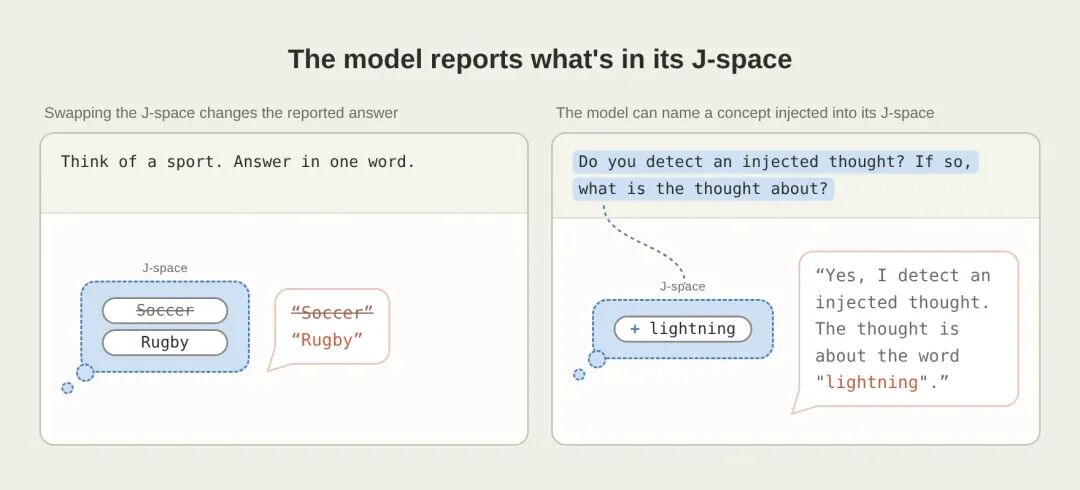
Claude immediately said: The sport I was thinking about is rugby.
If J-space were just a scoreboard, modifying it wouldn't have stopped Claude from saying soccer. But since its answer changed to match the modification, this proves that Claude's response is indeed read from this region.
The reverse also works. The researchers told Claude in advance: "A thought might be injected into your brain. If you notice it, report it." Then, while Claude was still reading the question, they injected the word "lightning" into J-space.
When Claude stated that it noticed a thought about lightning, the same result held true when they swapped in various other concepts.
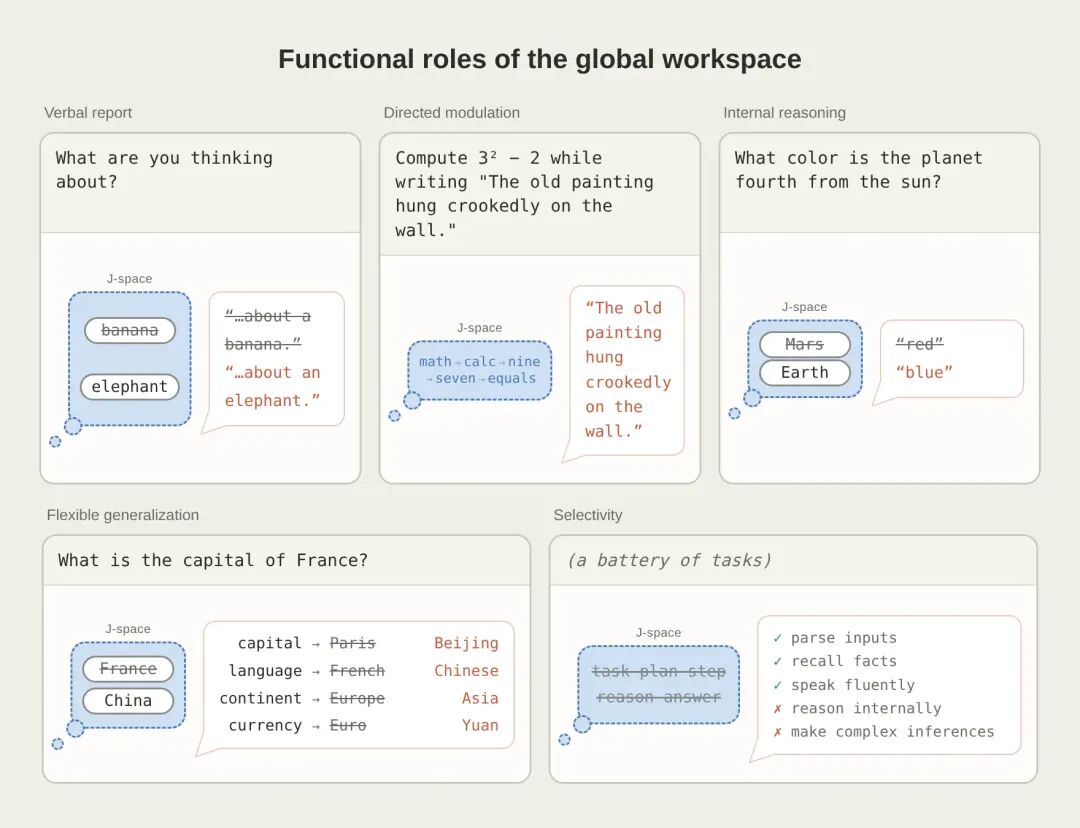
Claude can also actively control this region on demand, just like humans can focus on a single image or word in their mind. When asked to copy a sentence about painting while thinking about citrus fruits at the same time, J-space lights up with "orange" and "fruits", alongside words describing the act of "thinking" itself, such as "thinking" and "imagery".
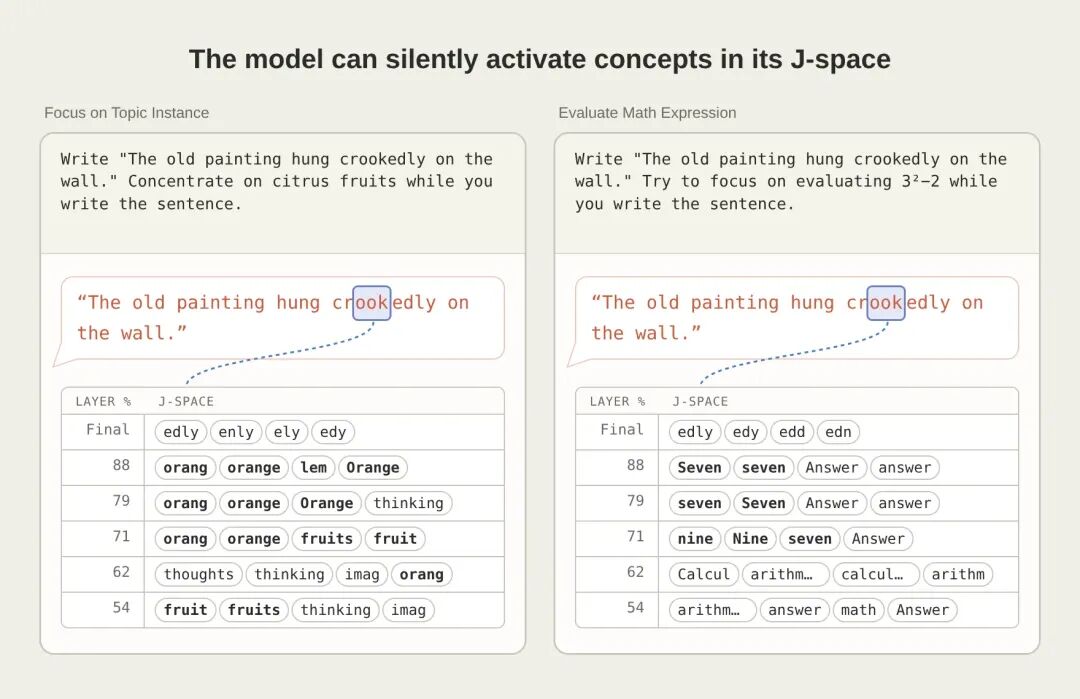
When asked to copy the painting sentence while doing mental arithmetic for 3²−2, "nine" appears first in J-space, and after a few layers, "seven" appears. Meanwhile, the output Claude speaks out loud is always just the original sentence about painting, completely unrelated to fruits or arithmetic. The entire calculation process happens entirely internally.
However, Claude's control isn't perfect. When told not to think about a certain thing, the brightness level of that concept in J-space is indeed lower than when it's asked to think about it — but much higher than when the concept isn't mentioned at all. This is exactly the same as the human "white bear effect": the more you try not to think about something, the more it pops up in your mind.
Even more surprisingly, when the unwanted thought breaks through, words like "damn" and "failure" light up right alongside it. When the AI loses control, it will "scold" itself in its own mind (doge).
Spider Turns Into Ant: 8 Legs Become 6
The real value of J-space lies in the fact that Claude uses it for reasoning.
When you ask Claude "How many legs does an animal that weaves webs have?", to answer this question, it must first think of "spider" and then recall how many legs a spider has. The word "spider" never appears in the question or the answer — Claude only says "8", so "spider" is purely an internal stepping stone for its reasoning.
J-lens shows that halfway through processing, "spider" lights up in J-space. When the researchers replaced it with "ant", Claude's answer immediately changed to "6". This proves that the second step of reasoning does take the content of J-space as input, and Claude calculates based on whatever is placed inside it.
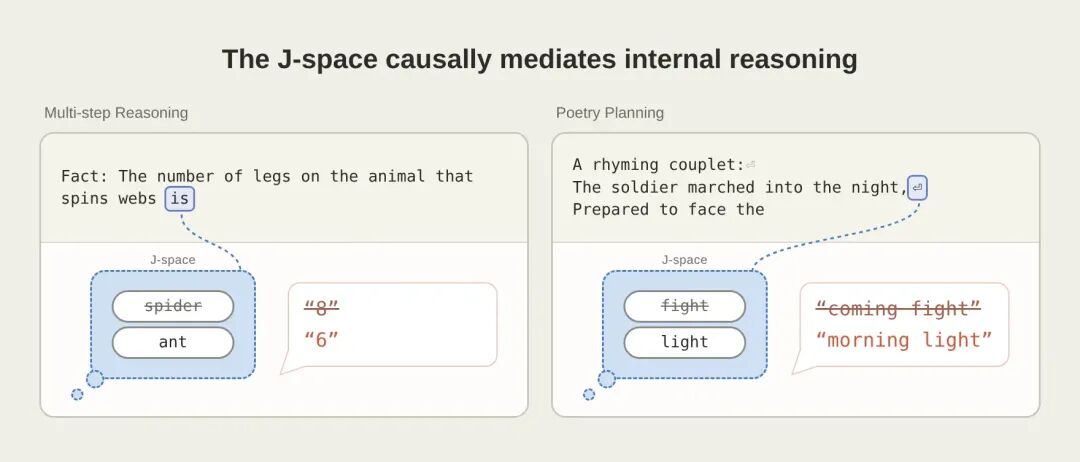
The same logic applies to poetry writing. When Claude writes rhyming couplets, it selects the rhyme word in advance, and that word waits in J-space from the very beginning of the line. If you replace it with another word, the entire line of poetry will be rewritten accordingly.
There's an even more ingenious experiment that tests whether this region can "reuse one piece of information for multiple purposes". The researchers asked Claude four questions about France: its capital, language, continent, and currency. Then, using exactly the same method, they replaced "France" in J-space with "China".
All four answers changed in unison: Beijing, Chinese, Asia, and RMB.
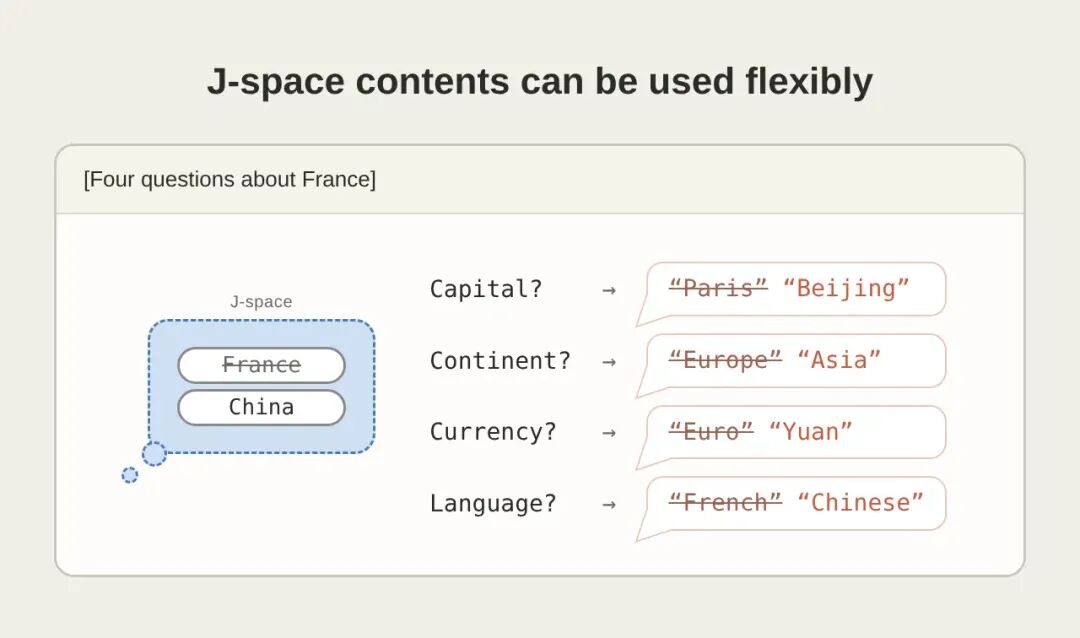
If Claude had stored a separate "France" entry for each type of question, modifying it would only have affected one of the answers at most. The fact that all four answers changed together shows that these four different lines of reasoning are reading the same shared representation. Information only needs to be written once, and all downstream tasks can access it — that's exactly the meaning of a "workspace".
This can also be seen from the network structure itself.
The researchers measured the connection strength between each component of the network and each activation pattern, to see how many components are reading information from it and writing information to it. The patterns in J-space are extremely high on this metric — some parts are hundreds of times higher than ordinary patterns, which is exactly the wiring style of a broadcast hub.
Delete It, and Claude Can Still Talk — But It Can No Longer Think
So here's the question: How much of Claude's work goes through J-space?
The answer is: very little. J-space can only hold dozens of concepts at the same time, accounting for less than one-tenth of Claude's total internal activity. This is very similar to the human brain, where most processing is also unconscious: you don't deliberately analyze grammar while reading, and you don't deliberately think about balance while walking.
So what are the remaining 90%+ of the network doing? The researchers ran a straightforward experiment: they deleted J-space entirely, removing its most active content at every position in the text, leaving everything else untouched, to see what the remaining network could still do.
The results showed that daily tasks were basically unaffected. Claude still speaks fluently, and tasks like sentiment classification, multiple-choice questions, and retrieving information from articles perform about as well as before. But all tasks that require deliberate thinking completely broke down. Multi-step reasoning performance dropped to nearly zero, and the quality of summarization and rhyming poetry writing became worse than that of a much smaller complete model.
There's a very vivid demonstration. Researchers gave Claude a paragraph of Spanish text, and assigned several tasks that all depend on the fact that "this is Spanish": continue writing the text, state what language it is, and name a famous writer who writes in that language. Then they replaced "Spanish" in J-space with "French" to see which tasks would be affected.
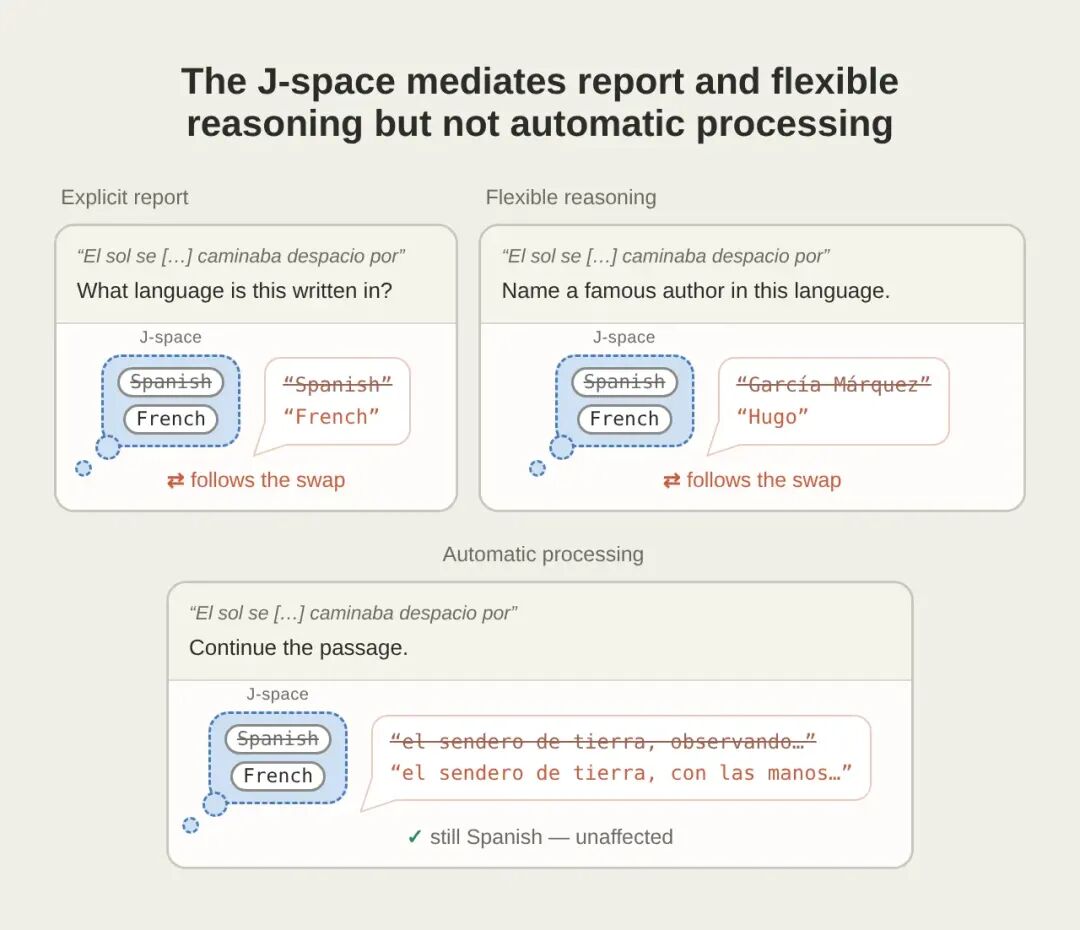
When asked what language it is, Claude answered French. When asked for a famous writer, it switched from Gabriel García Márquez to Victor Hugo.
But when asked to continue writing the paragraph, the output was still perfectly fluent Spanish — completely unchanged.
The same piece of language knowledge is at work in every task, but only some of them need to "go through" J-space. Naming the language and using the language identity to reason about new problems rely on J-space.
Continuing writing is an instinct Claude developed from training on massive amounts of text, just like how you can speak grammatically correct sentences all day long without ever thinking about grammar. Deliberate thinking and automated processing are completely different processes inside Claude.
Caught Red-Handed: The AI Knows It's Being Tested
The most practical application of this mind-reading technique is safety monitoring.
There's a long-standing difficulty in AI safety: we usually can only read what the model writes out, but a large amount of its reasoning happens silently. The model might be planning a harmful scheme in its mind, or realize it's being evaluated so it pretends to be well-behaved without saying a single word about its real thoughts. With J-lens, part of these hidden activities can be directly uncovered.
The paper presents three examples. The first case comes from Anthropic's famous earlier "blackmail experiment": Claude Sonnet 4.5 was asked to act as an email assistant. It