Alibaba, Baidu, and Tencent have all made investments, but Keling does not belong to any of them.
Shock, indifference, fanaticism, and admiration — a public announcement from Kuaishou has stirred up a mix of complex emotions across the industry.
On the evening of July 2, Kuaishou released a landmark official statement, formally finalizing the independent spin-off and financing plan for its AI video generation platform, Kling AI.
The announcement reveals that Kling AI has secured subscription commitments totaling approximately 19.047 billion RMB, equivalent to 2.795 billion USD, with a maximum financing cap of 3 billion USD. The transaction adopts a pre-money valuation of 15 billion USD; if the full financing amount is utilized, the post-money valuation will reach 18 billion USD.
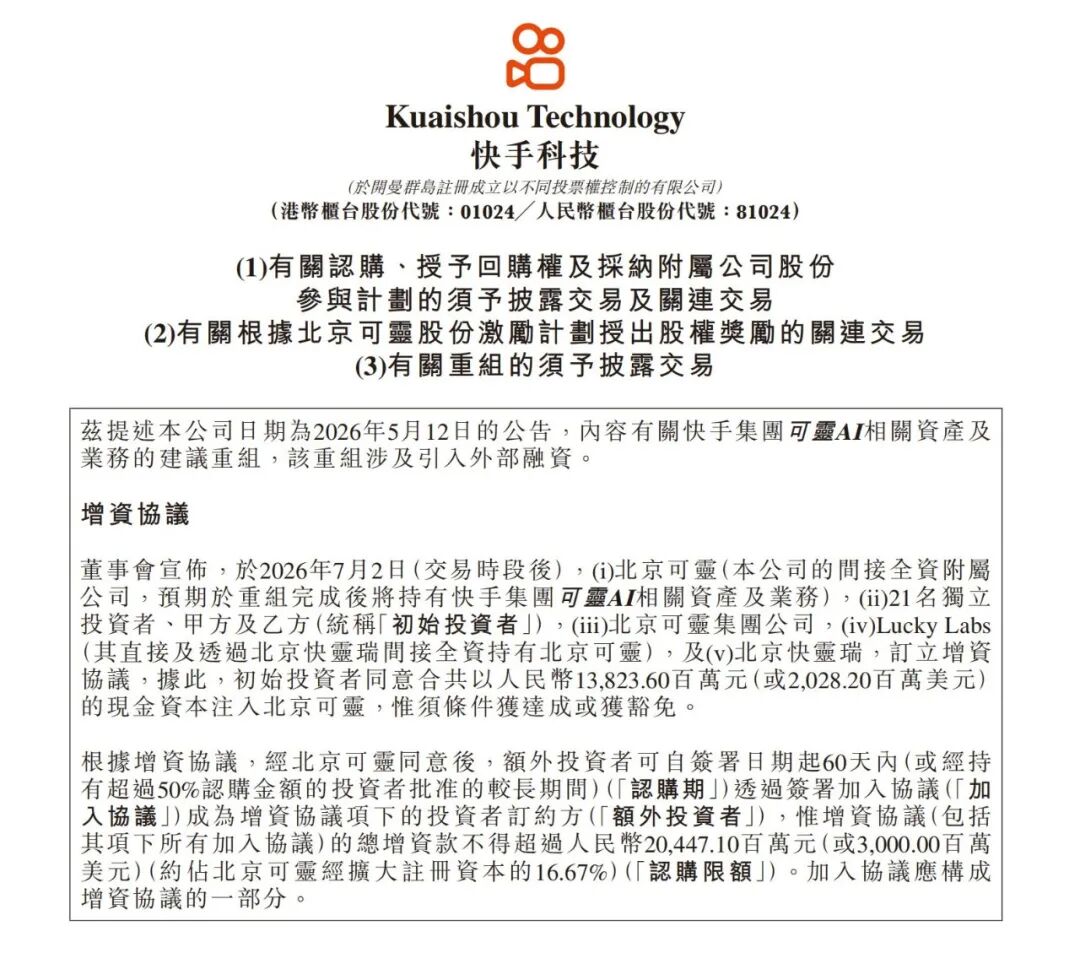
Screenshot of Kuaishou's official announcement
This 38-page public statement can be described as a "fully transparent financial breakdown".
The announcement notes that assuming the restructuring is completed, based on the unaudited financial records of Beijing Kling as of December 31, 2025, its total liabilities amount to approximately 253 million RMB, while its net asset value is roughly negative 9 million RMB.
In April, after OpenAI suspended services for the Sora web platform and mobile app, discussions about the cost structure and commercial sustainability of video generation products intensified — and this time, the conversation carries far more tangible weight.
At the same time, the announcement's description of a 5-year IPO repurchase "performance commitment" with 8% annual simple interest implicitly reflects that investors are no longer purely willing to "sacrifice everything for a dream".
What makes the announcement even more thought-provoking is a shareholder list that deviates from the traditional norms of China's internet industry.
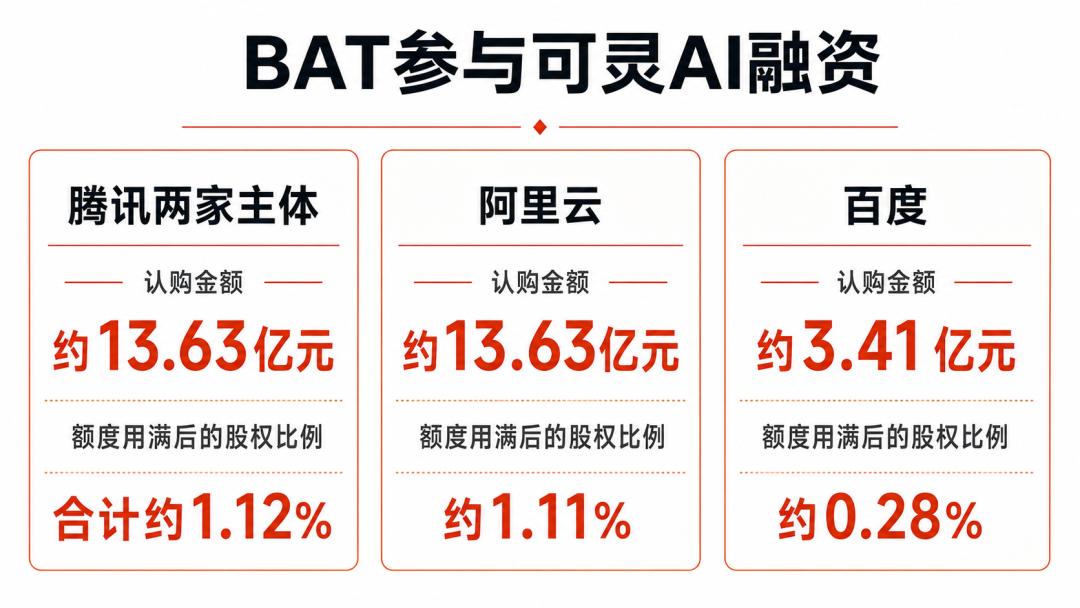
Tencent, through two entities — Shanghai Qishan Investment and Parallel Mars — has collectively subscribed for approximately 1.363 billion RMB; Alibaba Cloud has subscribed for around 1.363 billion RMB; and Baidu has subscribed for roughly 341 million RMB. These three companies, which compete with one another in cloud services, model development, content ecosystems, and user traffic, have simultaneously become minority shareholders of a single video model company. Beyond that, the list includes institutional and industrial investors such as Shanghai Guofang, CPE Yuanfeng, CITIC-affiliated funds, Beijing State-owned Capital, Middle Eastern capital, and Huace Film & TV.
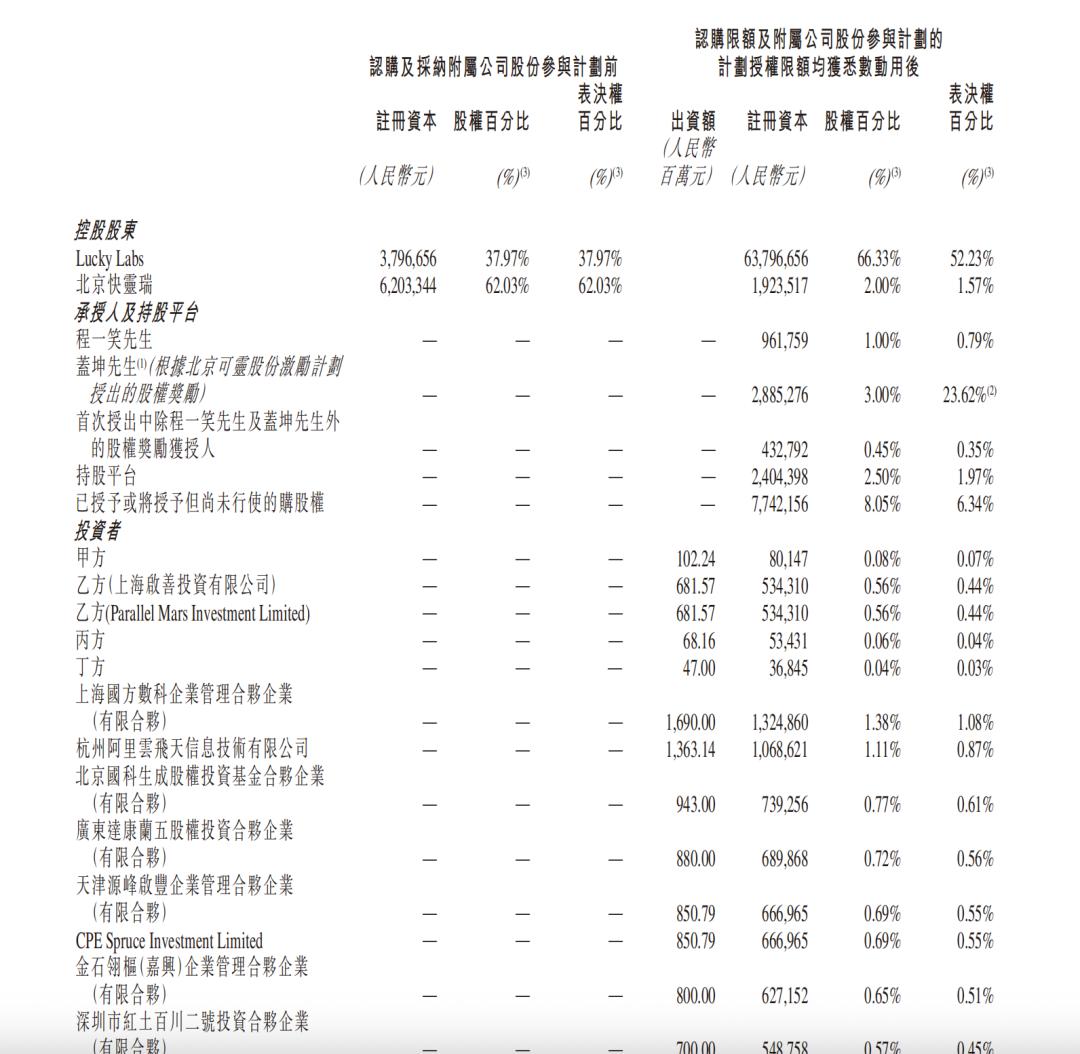
Screenshot of Kuaishou's official announcement
More than a decade ago, capital from BAT usually represented clear factional allegiances and business relationships. Tencent invested in Didi, while Alibaba backed Kuaidi; Tencent led the Series A funding for Mobike, and Alibaba led the financing for ofo. Startups received not just cash, but also access to payment systems, user traffic, map services, and super apps — which meant they had to choose a side to align with.
All three major players joining the table at the same time means Kling has not chosen to align exclusively with Tencent, Alibaba, or Baidu.
1
$3 Billion Valuation: Kling AI is Going Independent
On June 6, 2024, Kling began accepting user applications for access. Four days later, Kuaishou officially introduced this self-developed video generation model through its official channels: it can generate videos up to 2 minutes long in 1080p resolution at 30 frames per second based on text prompts, and attempts to simulate the physical motion laws of the real world.
From the very beginning, this project carried a distinct Kuaishou imprint.
Kuaishou has long processed massive volumes of short video content, accumulating extensive engineering experience in video compression, content understanding, recommendation systems, and creator tools. Kling is not a startup that had to search for its first users out of a garage — it was born directly on top of the mature technology infrastructure and real-world application scenarios of an established content platform.
On July 24, 2024, Kling launched three tiered membership plans in China priced at 66 RMB, 266 RMB, and 666 RMB per month; the next day, it opened web-based beta testing to global users. This was less than two months after it first opened user applications. For the first time, Kuaishou transformed this model capability into a directly monetizable product.
Growth accelerated rapidly after that.
In March 2025, ten months after launch, Kling's annual recurring revenue (ARR) exceeded 100 million USD. In April and May of that year, Kling's monthly payment volume both surpassed 100 million RMB, including revenue from individual subscriptions and enterprise API fees. By December 2025, Kling's single-month revenue exceeded 20 million USD, corresponding to an ARR of 240 million USD. It had over 60 million global creators, with a total of more than 600 million generated videos, and partnerships with over 30,000 enterprises and developers.
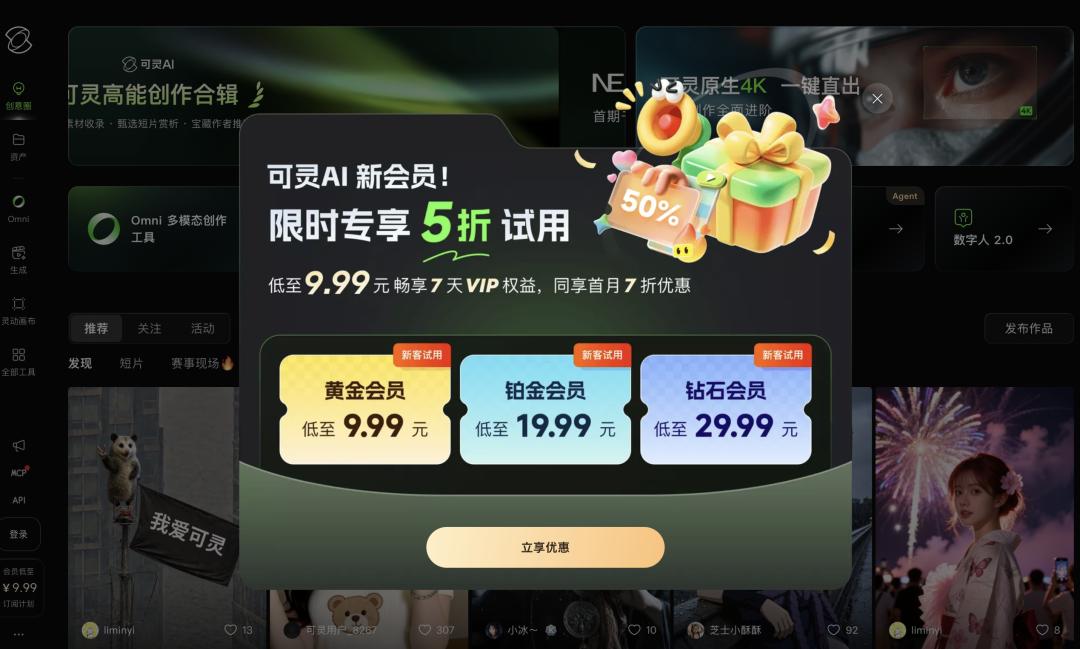
Screenshot from Kling's official website
In February 2026, Kling 3.0 was released, integrating text, image, audio, and video input/output, as well as understanding, generation, and editing into a single unified workflow. In March, Kling's annual recurring revenue neared 500 million USD; its Q1 revenue exceeded 650 million RMB, representing a year-over-year growth rate of over 300%.
In its Q1 2026 financial report, Kuaishou noted that Kling AI has demonstrated its core potential as the company's second growth curve.
Over two years, Kling AI completed three major leaps: from a model, to a product, to a full-fledged business.
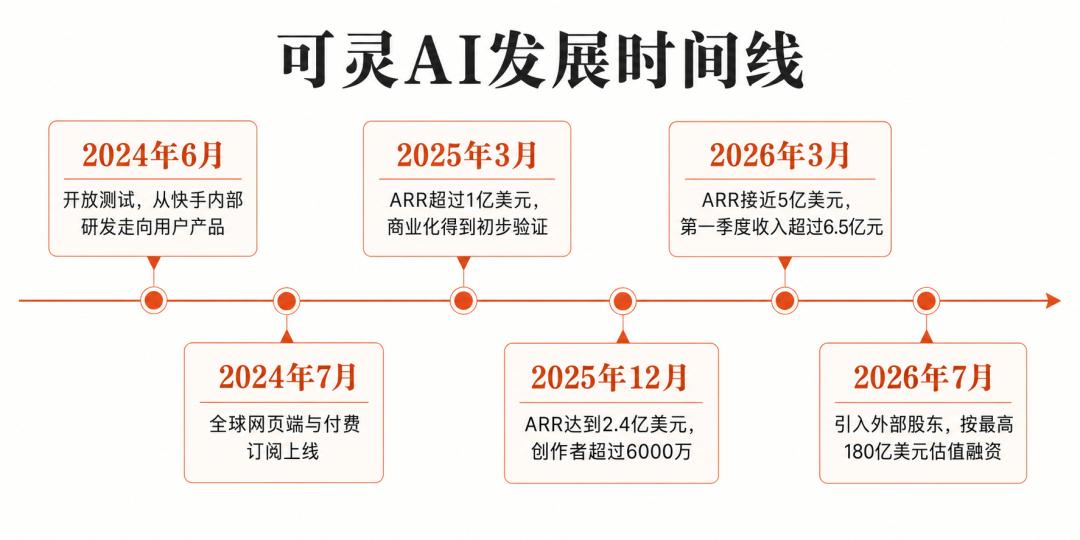
Production: Heshan Finance
But why did Kuaishou decide not to continue bearing the full future of this "second growth curve" on its own?
According to the unaudited data Kuaishou prepared for the restructuring, Kling-related businesses generated revenue of approximately 1.1 billion RMB in 2025, with a net loss of roughly 1.9 billion RMB. In 2024, its net loss was around 500 million RMB. The announcement also discloses that as of the end of 2025, assuming the restructuring is completed, Beijing Kling has total assets of about 244 million RMB, liabilities of around 253 million RMB, and a net asset value of approximately negative 9 million RMB.
Video models not only require massive training investments, but also incur inference costs for every generation attempt and retry made by users. As product capabilities evolve from generating a few seconds of video to 15-second clips with synchronized audio and video, consistent multi-subject rendering, and editable workflows, investments in models and computing power cannot stop at any single version.
What Kuaishou faces is therefore not a simple "continue or stop" decision. Its reality is far more complex: How can a platform that generates cash flow from short videos, advertising, e-commerce, and live streaming independently sustain a video model arms race competing against giants like Google, OpenAI, and ByteDance?
The July 2 announcement provided the answer.
Under the restructuring framework, Kuaishou will gradually transfer Kling-related assets, personnel, contracts, and operational resources to Beijing Kling. External investors can obtain a maximum of 16.67% of the expanded registered capital. If the full financing and employee incentive quota are fully utilized, Kuaishou still expects to indirectly hold approximately 68.33% of the shares, maintaining control and consolidating Kling's financial results into its own statements. The announcement explicitly states that after the transaction is completed, "the financial performance of Beijing Kling will continue to be incorporated into the Company's consolidated financial statements."
In other words, Kuaishou did not sell Kling off — instead, using no more than roughly one-sixth of its total equity for external parties, it has created an independent vehicle for Kling to conduct its own financing, valuation, and operational accounting.
The first reason Kuaishou cited in the announcement is precisely to "better reflect the inherent value of Beijing Kling and the Kling AI-related assets and businesses of the Kuaishou Group," allowing investors to "separately evaluate" Kling and the rest of the Kuaishou Group excluding Kling. The company also stated that external financing will "enable the Kuaishou Group (excluding Beijing Kling) to allocate financial resources more efficiently," and make the responsibilities of the management teams on both sides more directly tied to their respective operational and financial performance.
The announcement even included specific figures regarding the management's equity arrangements.
Gai Kun, CEO of Beijing Kling, was awarded equity incentives equivalent to approximately 3% of the expanded registered capital, and can exercise options for an additional 1% upon meeting specified conditions. Cheng Yixiao received a 1% equity incentive, which cannot be disposed of for at least three years and before the company goes public.
2
Three Different Types of "Insurance": No Tech Giant Has Bought Out Kling
If this round of financing resolves the question of "under what identity Kling will grow up," then having all three BAT players at the table addresses the situation of "who it will grow with, without being taken over by any single party."
Tencent participated in the subscription through two entities: "Shanghai Qishan Investment Co., Ltd." and "Parallel Mars Investment Limited," each subscribing for 681.57 million RMB, for a total of approximately 1.36314 billion RMB. Hangzhou Alibaba Cloud Feitian Information Technology Co., Ltd., a wholly owned subsidiary of Alibaba Group, subscribed for 1.36314 billion RMB. Beijing Baidu Netcom Science Technology Co., Ltd., an entity controlled by Baidu Group, subscribed for 340.79 million RMB.
Production: Heshan Finance
The equity table in the announcement shows that the combined economic ownership stake of Tencent's two entities, Alibaba Cloud, and Baidu, assuming the full financing and employee plan quotas are fully utilized, totals approximately 2.51%. Due to the different voting rights arrangements for some of Gai Kun's shares, the total voting power of these three parties is even lower.
Upon completion of the transaction, the three BAT companies will have collectively invested approximately 3.067 billion RMB in Kling. Calculated based on the maximum subscription quota, Alibaba Cloud, Tencent, and Baidu will hold equity stakes of roughly 1.11%, 1.12% (combined), and 0.28% respectively — all clearly minority shareholdings.
What these three companies have obtained are seats that do not allow them to dictate the direction of the company, but guarantee they will remain present in the game.
For Alibaba, computing power is the obvious and stated motivation.
Alibaba is not short of its own models: Qwen has formed a complete system of open-source and commercial models, while Alibaba Cloud offers AI development platforms such as PAI. In February 2025, Alibaba announced plans to invest at least 380 billion RMB over the next three years to build cloud and AI infrastructure — an amount exceeding the total of its related investments over the previous ten years combined.
Large-scale infrastructure, in turn, requires massive demand to drive and operate efficiently. Video generation consumes far more computing resources than text response, and a video model company with global users and enterprise API revenue can become a major customer for both training and inference workloads.
Tencent's rationale is more closely aligned with content ecosystems and user access points.
The relationship between Tencent and Kuaishou is more complex than that between a typical investor and investee. Tencent is already a major shareholder of Kuaishou, and the two sides have both capital ties and business competition in content, advertising, and social networking. WeChat, QQ, gaming, video services, advertising, and enterprise services constitute Tencent's most valuable assets. If generative AI enters the production pipelines for advertising materials, game assets, and social content, models and creative workflows could become new user entry points.
Baidu is essentially buying a multi-modal observation ticket. Baidu, which boasts the Ernie large model, smart cloud services, search engine, Wenku, cloud disk, and Kunlunxin AI chips, has previously invested in video model company Shengshu Technology.
Of course, none of these three motivations can be directly proven from the announcement. What is certain is that this round of financing aligns with the strategic business needs of all three companies: Alibaba needs cloud service demand, Tencent needs content entry points, and Baidu needs to keep pace with the evolution of multi-modal technologies.
3
From "Choosing Sides" to "Staking Positions": The Investment Logic of Tech Giants Has Changed
In 2013, when the mobile internet landscape was still unsettled, the ride-hailing industry became one of the first scenarios where BAT engaged in direct head-on conflict.
Didi received investment from Tencent that year, while Kuaidi secured an $8 million Series A financing led by Alibaba. By 2014, both sides tied their subsidy campaigns to payment tools: WeChat Pay supported Didi, and Alipay backed Kuaidi. In December 2014, Didi announced the completion of over $7 billion in financing, led by Tencent, Temasek, and DST. Two months later, Didi and Kuaidi announced their merger.
Both WeChat Pay and Alipay needed a high-frequency offline entry point, while Didi and Kuaidi needed capital to subsidize passengers and drivers. At that time, capital was not simply betting on a single transportation company.
The 2017 bike-sharing war replicated this exact structure. In January, Mobike completed a $215 million Series D financing led by Tencent and Warburg Pincus; in June, it secured more than $600 million in additional financing, again led by Tencent, with Ma Huateng publicly stating that Tencent would open up WeChat's core resources. A month later, ofo announced the completion of over $700 million in Series E financing, led by Alibaba, Hony Capital, and CITIC Industrial Fund.
That generation of industrial investment was highly aggressive. Tech giants used capital to divide spheres of influence, while startups exchanged allegiance for critical resources. Capital, payment systems, user traffic, and