AI PPT generation goes far beyond "one-click drafting": researchers from Tsinghua University, Shanghai Jiao Tong University, and Beijing University of Posts and Telecommunications propose MemSlides, enabling slide agents to develop memory capabilities
AI-generated PPT is no longer just a demonstration-level feature.
Today, many systems can generate complete slides from a paper, a report, or a single theme description. The problem is that real-world writing rarely stops at the first version. Users will continue to adjust page order, content density, visual style, and local elements; more troublesome, some preferences are not fully articulated from the start, but gradually revealed through subsequent revisions.
This raises a more specific challenge: the Slides Agent must not only understand the current prompt, but also recognize which preferences belong to the user's long-term habits, which constraints are only valid for the current task, and which content should remain untouched when the user requests edits to a specific area. For AI PPT, memory is no longer just an accessory to chat history — it has become an essential capability that determines whether multi-turn collaboration can proceed stably.
To address this issue, researchers from Beijing University of Posts and Telecommunications, Tsinghua University, and Shanghai Jiao Tong University jointly proposed MemSlides, a hierarchical memory-driven Agent framework designed for personalized slide generation and multi-turn local revision. It treats PPT creation as a stateful continuous editing process: first generating a personalized initial draft using user profile memory, then maintaining working memory across multi-turn feedback sessions, and leveraging tool memory to improve the reliability of local modifications.
Paper Link: https://arxiv.org/pdf/2606.17162
GitHub Repository: https://github.com/huohua325/Memslides
Project Website: https://memslides.github.io/
The research significance of MemSlides lies in that it does not treat AI PPT generation as a simple source-to-slides conversion, but incorporates "continuous post-generation revision" into the system design. In other words, the paper does not focus on making the model memorize more historical conversations, but on enabling the Slides Agent to distinguish, maintain, and invoke different types of memory.
How is Memory Designed in MemSlides?
The MemSlides approach can be summarized along two main axes: one is how memory is organized, and the other is how modifications are executed. The former answers "what the system should remember," while the latter addresses "how the system can complete edits without breaking existing content."
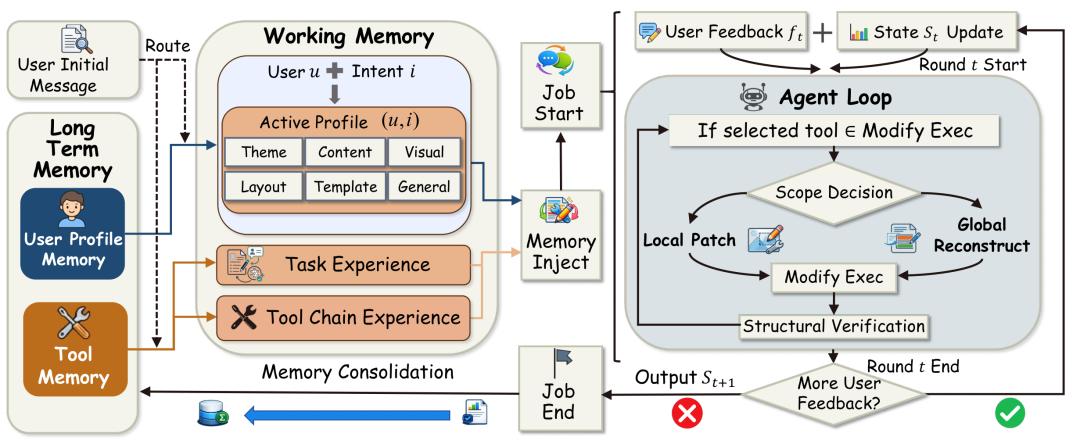
Figure | MemSlides combines long-term memory and working memory to support personalized generation and multi-turn local revision.
In terms of memory organization, MemSlides models memory from two perspectives: life cycle and functional role. From the life cycle perspective, long-term memory stores information that remains stable across tasks, while working memory maintains temporary constraints, feedback status, and revision progress that are still valid within the current deck. From the functional role perspective, user profile memory focuses on what preferences the slides should reflect, while tool memory focuses on how the agent can perform edits more reliably.
This distinction is critical. User profile memory is not a fixed profile prepended to every prompt — it is retrieved, filtered, and routed according to task intent. For example, the same user may prefer completely different page structures for academic presentations versus business pitch decks; the system needs to select relevant preferences based on the current intent and reconcile them with the current request. If the current request conflicts with long-term preferences, the current request takes priority within this deck.
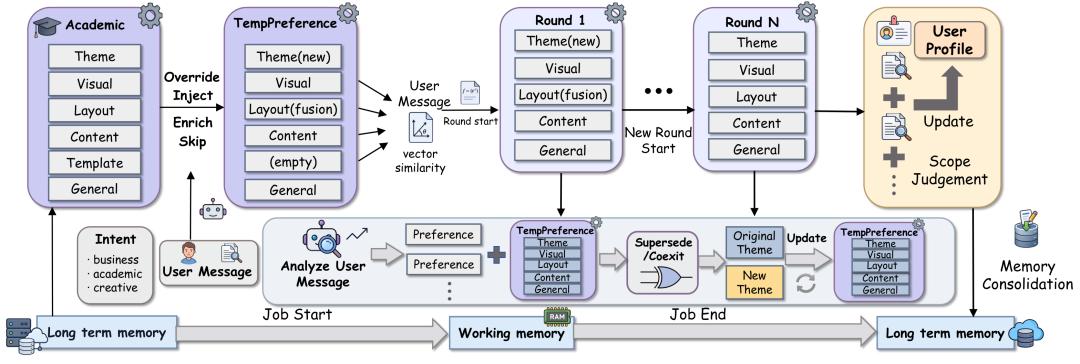
Figure | User profile memory goes through retrieval, routing, usage in the current task, and stable signal consolidation after the task ends.
After the task ends, MemSlides does not directly write all feedback into long-term memory. The paper adopts a consolidation strategy, updating only stable and transferable interaction signals into the user profile. This avoids a common problem: temporary user requirements from a single task being mistakenly treated as long-term preferences and repeatedly applied in subsequent tasks.
Working memory handles another category of problems: constraints that do not belong to long-term preferences but must be carried across turns within the current session. For example, if a user says "use blue for all titles on new pages added later," this instruction may not have an immediate execution target in the current turn, but it should still take effect when new slides are added in subsequent turns. MemSlides stores these active temporary preferences, carryover instructions, resolved targets, and coverage status in working memory, making multi-turn revisions a continuous editing process on the same task state.
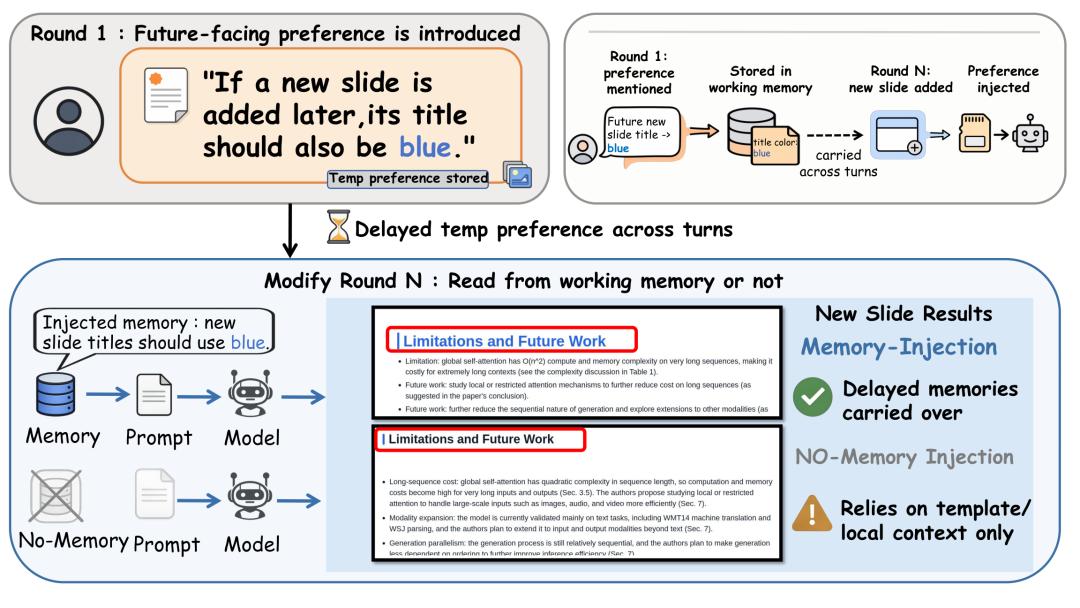
Figure | Working memory stores temporary preferences and revision status that remain valid within the current deck.
Unlike preference memory, tool memory records execution experience. Slides editing typically involves page structures, selectors, style rules, layout snapshots, and tool calls; even if the model understands what the user wants, errors can still occur due to misreading regions, expanding the modification scope, or terminating verification prematurely. MemSlides therefore divides tool execution experience into two levels: task-level, which consolidates error summaries and transferable lessons from a single revision turn, and operation-level, which stores finer-grained reasoning-tool-observation fragments to serve as references before similar tool calls.
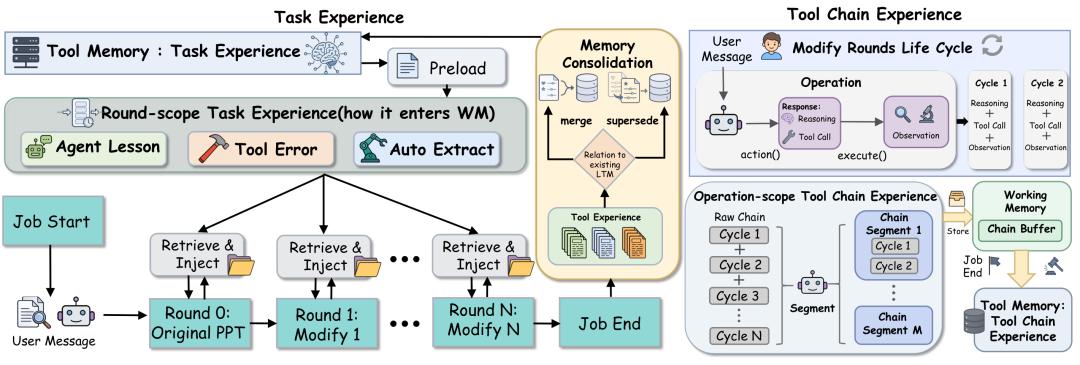
Figure | Tool memory does not determine the preference direction of slides, but helps the agent reduce redundant trial and error during editing.
For local modifications, MemSlides introduces scoped slide-local revision. Instead of reloading or rewriting the entire PPT after each feedback, the system first maps the natural language request to the minimum effective revision region, then completes the editing through a Plan-Act-Guard workflow. The Plan phase forms an execution contract that clarifies target pages, scope of effect, and coverage requirements. The Act phase performs constrained editing operations based on the page structure. The Guard phase verifies that targets are correctly covered and prevents premature finalization.
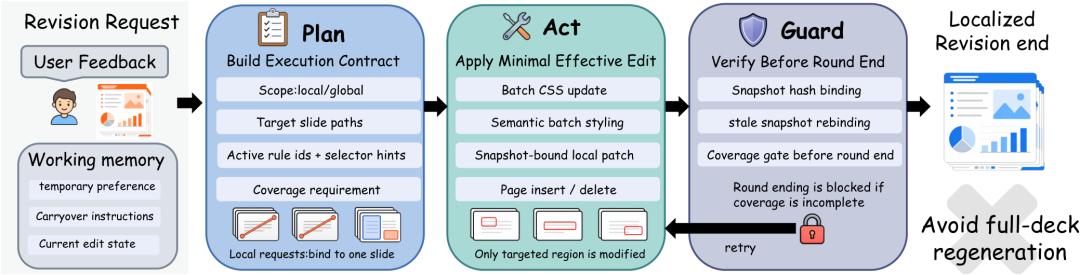
Figure | Plan-Act-Guard breaks down local revision into three phases: scope planning, controlled execution, and result verification.
The motivation behind this design is simple: when a user only wants to modify a local region, the system should ideally alter only that region. For already aligned page content, maintaining stability is itself a capability.
How Effective Are Personalization and Local Modifications?
The paper evaluates MemSlides from three perspectives: personalized initial draft generation, in-session preference carryover, and local modification reliability.
In terms of personalized generation, the paper constructs a multi-persona, multi-intent user profile evaluation setup, using persona-alignment judgments to measure whether the generated results match the user's role and task intent. The results show that user profile memory improves persona alignment in the round-0 initial generation phase. Further analysis indicates that this improvement is not merely due to template matching or visual polishing, but is reflected in more planning-level dimensions such as content prioritization, page structure, evidence organization, and role differentiation.
For general PPT quality, the paper also conducts a DeepPresenter-style quality check to observe whether improvements in persona alignment come at the cost of overall generation quality. The results demonstrate that while enhancing personalized alignment, MemSlides still maintains competitive overall deck quality. This is critical for practical applications: personalization should not only make slides "more like a specific person," but also produce a fundamentally usable, structurally complete set of slides.
In terms of working memory, the paper demonstrates delayed preference carryover through qualitative case studies. In other words, certain user preferences may not be immediately executable when stated, but the system can still apply them to the current deck when subsequent operations trigger relevant conditions. This capability shows that working memory serves as session-level state maintenance, rather than being a simple substitute for long-term user profiles.
Local modification experiments adopt a diagnostic matched-pair modify setting, isolating the variable of whether tool memory is injected. The results show that in this diagnostic setup, tool memory increases closed-loop completion from 0.815 to 0.963, raises strict verification rates from 0.310 to 0.534, and reduces the time to first correct edit from 609.5s to 242.5s. These metrics not only measure "whether the final edit is correct," but also focus on revision closed-loop completion, verification rigor, and the efficiency of finding the correct editing path.
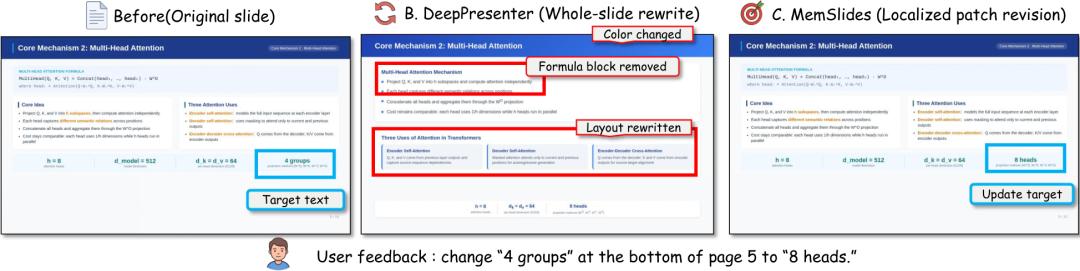
Figure | In local modification examples, MemSlides focuses edits more precisely on target elements and reduces unintended changes in non-target regions.
It should be noted that the paper does not interpret the results as a monotonous lead across all scenarios. The benefits of tool memory still vary across paired tasks, and some metrics are affected by task difficulty and model behavior. More accurately, these results support a diagnostic conclusion: when the editing process is constrained to a local scope and reusable tool experience is introduced, the Slides Agent is more likely to form verifiable, convergent revision paths.
Limitations and Future Directions
MemSlides currently primarily validates the role of memory mechanisms in controlled experiments and diagnostic settings. Meanwhile, the demo website has over 100 real users, with new users continuing to join daily.
In the future, the team plans to incorporate more real-world usage feedback to further investigate memory governance issues under long-term user interaction, including how users can view, edit, and delete saved preferences, how the system can avoid storing sensitive or outdated information, and how to provide explainable handling when long-term profiles conflict with current task requirements.
The evaluation of local modifications also has room for expansion. For PPT creation, task success is not the only metric; modification scope, non-target content drift, user satisfaction, cross-turn editing cost, and recoverability all affect real-world experience. Future Slides Agent evaluations need to more granularly characterize "what was revised correctly" and "what was not accidentally altered."
From a broader perspective, MemSlides highlights a research direction worth further exploration: as generative Agents evolve from single-turn output to long-term collaboration, memory should become an integral part of the system architecture, rather than simply being stacked as historical text in the context. For AI PPT, the next stage of competition may not be about who can generate the most beautiful first page, but about who can continuously understand the user, maintain stable boundaries through repeated revisions, and steadily guide a set of slides toward the version the user truly wants.
This article is from the WeChat public account "Academic Headline" (ID: SciTouTiao), authored by the MemSlides Team, and authorized for distribution by 36Kr.