Looking for the next Wang Tao
A group of Hong Kong tech innovation teams crossed the Shenzhen River.
July 1 marked the 29th anniversary of Hong Kong's return to China. The following afternoon, six startup teams with roots in Hong Kong universities gathered in Nanshan, Shenzhen, at the "X-Day" Xili Lake Roadshow Society Hong Kong Tech Innovation Special Session, presenting projects covering lithium battery materials, quantum dot displays, intelligent robot control, digital sports, smart airports, and medical health.
In fact, such scenes have become increasingly frequent in recent years. Scientific research achievements from Hong Kong's universities are continuously moving into the Greater Bay Area to find their next stop for industrialization. And so, they have come to Shenzhen.
From the laboratory to full-scale industry, a longer journey unfolds from this point.
A Group of Hong Kong University Entrepreneurs Gather in Shenzhen
Starting with a Roadshow
The first to take the stage was Superpower New Energy, founded in October 2023 by Qi Liu, a tenured professor at City University of Hong Kong. Headquartered in Shenzhen, the company focuses on the R&D and industrialization of lithium-rich manganese-based cathode materials.
Voltage decay has been a long-standing bottleneck preventing the industrialization of lithium-rich manganese-based materials. The team revealed that Superpower New Energy is the world's only enterprise capable of synthesizing lithium-rich manganese-based materials with ultra-low voltage drop. A production line with an annual capacity of 300 tons has been completed in Pingshan, Shenzhen, and samples have been sent to leading battery manufacturers for testing. "Driving 1,000 kilometers on a single charge is no problem," stated Wang Bo, Deputy R&D Director of Superpower New Energy.
Coincidentally, an existing investor was seated in the audience. Zhuoshi Capital had previously invested in the team, and Zhong Qiankai, Founding Partner of Zhuoshi Capital, noted that Superpower New Energy's progress has been faster than expected.
Next up, Wave Photon took the stage. Founder Zhang Zhikuan holds a PhD from the Hong Kong University of Science and Technology and completed his undergraduate and master's degrees at Peking University. He previously served as CTO of Jufei Optoelectronics, before co-founding the company with Sun Xiaowei, Chair Professor at Southern University of Science and Technology and Foreign Member of the Russian Academy of Sciences, to provide an integrated full-process supply of high-end quantum dot materials.
The company's products are already present in many people's daily lives — the screens of Lenovo Legion 9000K and ASUS ROG series laptops all use Wave Photon's quantum dot films. In the highly demanding automotive sector, Wave Photon is the world's first company to achieve mass production of front-loading automotive quantum dot films. Starting with the Zeekr 7X, its products have gradually been adopted by NIO, Audi, and other vehicle models, capturing over 70% of the global automotive quantum dot film market share.
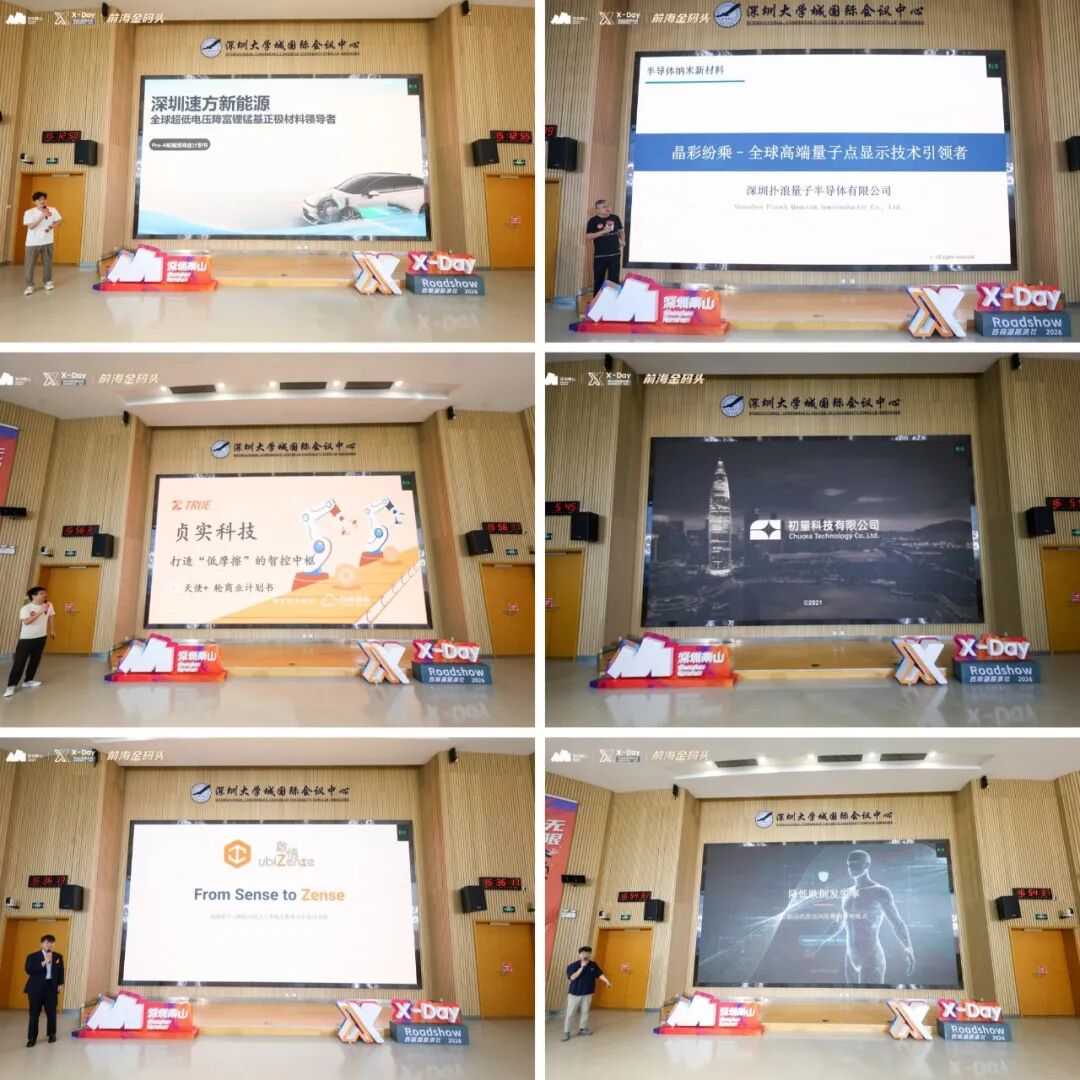
Then, Zhenshi Technology presented a "plug-and-play" embodied intelligent control system for robots, focusing on "vision, control, and AI integration" to target small-batch, multi-variety non-standard industrial scenarios. The founders are two brothers: CEO Gui Kai is responsible for market operations and "cerebellar" control, while his younger brother Gui Shun, a PhD from The Hong Kong Polytechnic University, leads the AI "brain" development. The company is headquartered in Nanjing, and this year it established a research center in Qianhai, Shenzhen, settling into the Hong Kong Polytechnic University Qianhai Advanced Technology Research Center.
Following that, the technologies began to enter more specific daily life and industrial scenarios.
Chuliang Technology has created the digital sports brand PARTYDAY, using self-developed hardware-software integrated devices such as ski simulators and mini racing machines to build indoor sports and entertainment spaces. Currently, it has opened 7 stores in Xi'an, Shenzhen, Wuhan, Hangzhou, and Shanghai, serving over 3 million cumulative visitors. The company has settled into the University of Hong Kong Youth Innovation and Technology Academy in Qianhai, leveraging the cross-border incubation platform of Hong Kong universities to achieve two-way tech innovation collaboration between Shenzhen and Hong Kong.
Ubizense, a startup originating from the Asian Institute of Supply Chains and Logistics at The Chinese University of Hong Kong, has integrated AI and the Internet of Things into airports. Its apron collaborative decision-making system has been deployed and operating at Hong Kong International Airport for 8 years.
Now, the team is migrating this system from a two-dimensional apron to three-dimensional airspace, developing a collaborative decision management system for drones to target the low-altitude economy. The first stop for implementation is Shenzhen. Co-founder Xu Shenghao stated that the team will first establish a presence in Shenzhen and strive to launch a pilot at Bao'an Airport.
The final presenter, Bugu Health, focused on an easily overlooked issue: falls among the elderly. According to Xu Hongyuan, General Manager of the company, the annual incidence of falls among people over 60 years old is approximately 30%, while most existing solutions on the market only provide alerts and protection after a fall occurs.
The company originated from Hong Kong Baptist University and was incubated at the Hong Kong Science Park. It uses wearable sensors combined with AI motion analysis to proactively screen fall risks from data on balance, strength, and gait, followed by targeted exercise interventions. Currently, nearly 20 large public hospitals and more than half of the community health centers in Hong Kong are its users. The product has obtained US FDA certification and is preparing to enter the mainland market.
Six teams with backgrounds from different Hong Kong universities arrived at Xili Lake, Shenzhen. With their technologies exiting the laboratory, the next question to answer is how to truly integrate them into the industrial ecosystem.
From Hong Kong to Shenzhen, Seeking the Next Frank Wang
An unavoidable question arises: Why are Hong Kong's tech innovation teams flocking to Shenzhen? Before the roadshow began, four investors with long-term experience in Hong Kong tech innovation investment discussed this very topic.
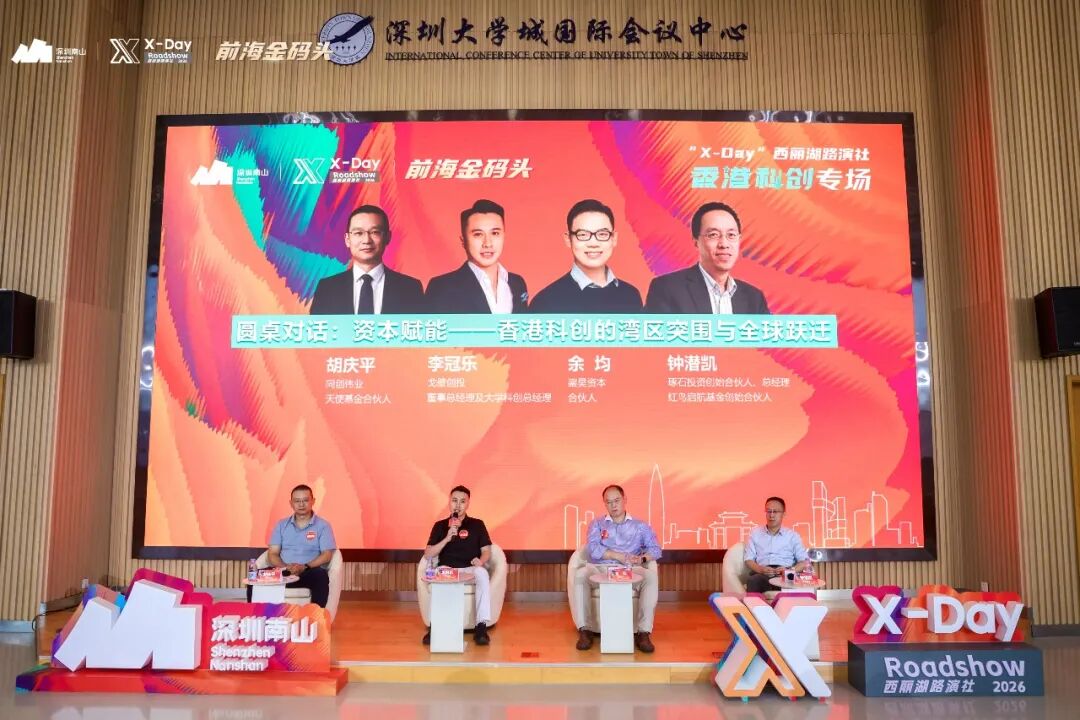
Yu Jun, Partner at Jiyuan Capital, mentioned a detail: Hong Kong, with a land area of approximately 1,100 square kilometers, hosts a high density of universities and scientific research resources, which in itself constitutes a rare competitive advantage.
For a technology to move beyond the laboratory, it must pass through pilot testing, find customers, and undergo real market validation. Yu Jun repeatedly emphasized the importance of "real demand": no matter how cutting-edge a technology is, it must ultimately translate into a viable business model.
Li Guanyue, Managing Director of Gobi Partners, has a deeper personal understanding. With long-term investments in university-originated tech projects, he has observed that Hong Kong is often the first stop for many overseas scientists returning to the region. Its English-speaking environment, global academic networks, and dense concentration of university resources endow Hong Kong teams with a natural international perspective.
"Hong Kong teams excel at the 0-to-1 stage, while the Greater Bay Area can provide the engineering and industrial support required for the 1-to-100 stage," Li Guanyue stated.
Zhong Qiankai, Founding Partner of Zhuoshi Capital, refers to this as "Integration+". Over the years, he has encountered numerous semiconductor, AI, and material projects from the Hong Kong University of Science and Technology. Many of these technologies are already on the verge of industrialization, and the next step is to truly connect Hong Kong's scientific research capabilities with mainland China's industrial ecosystem.
Shenzhen is perfectly positioned to facilitate this transition.
In fact, a tech innovation channel between Shenzhen and Hong Kong has gradually taken shape. Platforms from Hong Kong universities such as the City University of Hong Kong Shenzhen Research Institute, the University of Hong Kong Youth Innovation and Technology Academy, and the Hong Kong University of Science and Technology Blue Bay Qianhai Innovation Port have been established in Shenzhen. Beyond university laboratories, the industry and market are moving closer than ever.
The six roadshow projects on that day all reflect this trajectory. Separated by a single river, the two cities are leveraging their respective strengths. As Hu Qingping, Partner at Tongchuang Weiye Angel Fund, noted, entrepreneurial interactions between Shenzhen and Hong Kong have become increasingly close since the angel investment stage, and future development requires "mutual proactive engagement" for collaboration.
The Xili Lake Roadshow Society has made this connection more tangible. Since its launch, the "X-Day" event has hosted 18 themed roadshows, attracting over 520 project registrations. 53 enterprises have received equity investment totaling over 2.096 billion yuan, and 32 enterprises have secured new bank credit lines exceeding 1.145 billion yuan. In addition, 8 roadshow projects from other cities have established their legal entities in Nanshan.
Hong Kong provides cutting-edge original innovation, while Shenzhen serves as the next stop for industrialization. The Shenzhen River is narrow, and the distance between Shenzhen and Hong Kong's tech innovation ecosystems is shrinking rapidly.
Perhaps the next entrepreneur, like Frank Wang of DJI, who will bring their products to the global stage, is setting off from right here.
This article is from the WeChat Official Account "PE Daily" (ID: pedaily2012), written by Wang Lu, and published with authorization from 36Kr.