Just now, Anthropic discovered the "Consciousness-like Workbench" of Claude, and the mysterious J-space hides unspoken thoughts
Right now, your brain is doing a huge number of things.
It keeps you sitting upright, maintains your breathing, recognizes the strokes on the screen as readable text, and even lets you judge whether this piece is worth continuing to read. The vast majority of these processes run in the background, completely outside your awareness. Only a tiny fraction of them ever rise to the surface of your consciousness: a single thought, a plan, or an idea you could put into words.
Now, Anthropic has observed a similar kind of layered structure in Claude.
In a newly published study, Anthropic discovered a special "J-space" inside Claude. It acts like a silently operating mental workspace, where concepts the model is considering, might report, or could use for reasoning come to the surface.
Crucially, these contents do not always appear in Claude's final responses. In other words, Claude may have already "thought of" certain things without ever saying them out loud.
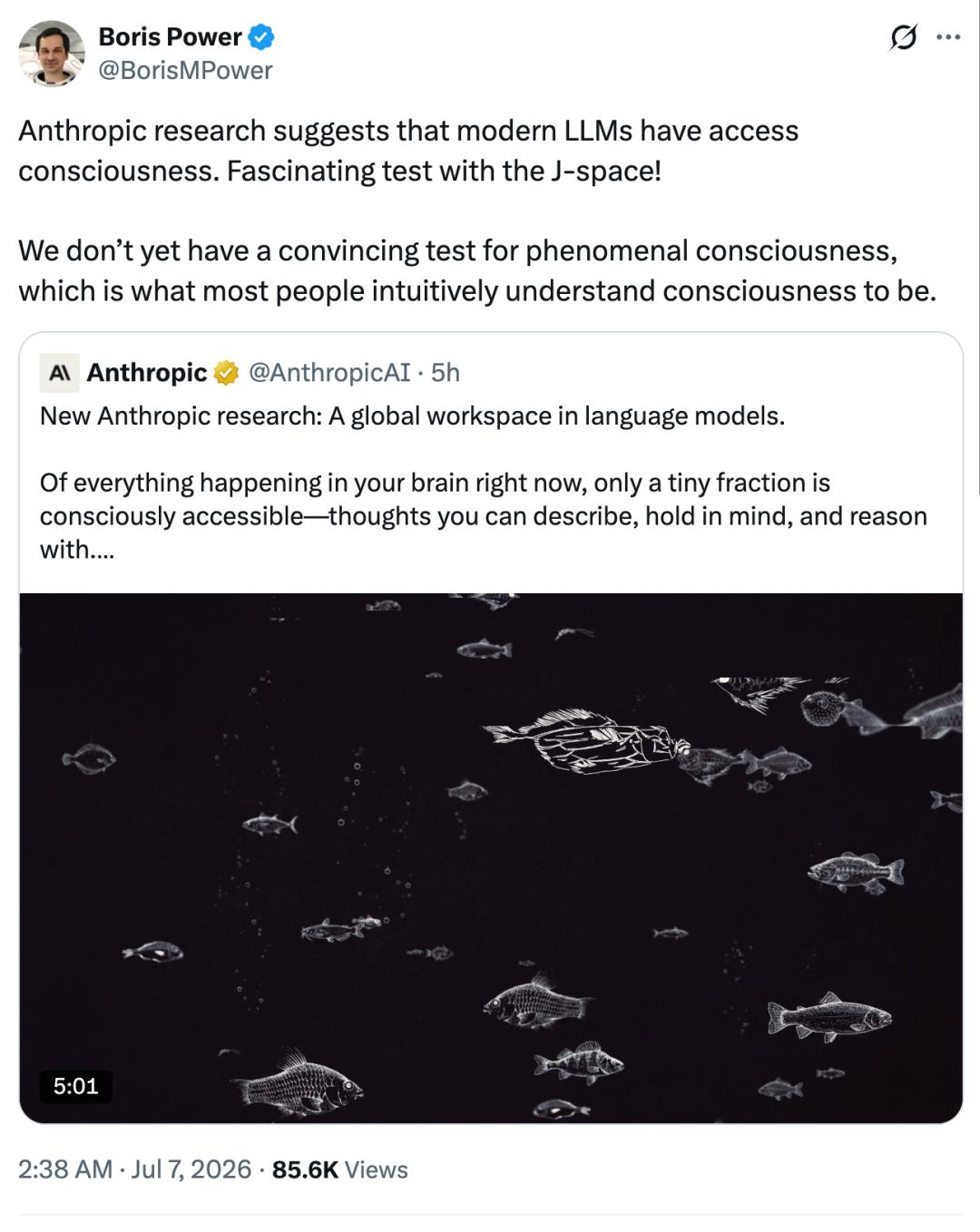
This research has drawn attention from peers at OpenAI. Boris Power, Head of Applied Research at OpenAI, stated: "Anthropic's research demonstrates that modern LLMs possess some form of accessible consciousness. The tests centered around J-space are extremely fascinating! However, we do not yet have a convincing testing method to verify phenomenal consciousness, the kind of consciousness most people intuitively understand."
The following is the translated original blog post:
As you read a sentence, some neural circuits in your brain adjust your posture, control your breathing, and convert the lines and curves on the screen into recognizable text. The vast majority of this processing happens entirely outside your perception. But a portion of your brain activity is something you can consciously experience: for example, an image that suddenly pops into your head, or a deliberate plan about where you will go shopping next.
Neuroscientists and philosophers sometimes refer to this second category of brain activity as "access-conscious" activity, to distinguish it from the processing that continues unconsciously. These activities have special properties: we can describe them, control them, and use them for deliberate reasoning; by contrast, many automated processes happen constantly without ever entering our awareness.
In a new paper, Anthropic presents evidence that a similar distinction exists in modern language models like Claude. The research team found that, compared to most other internal processes within Claude, a small set of internal neural patterns fulfills a special role.
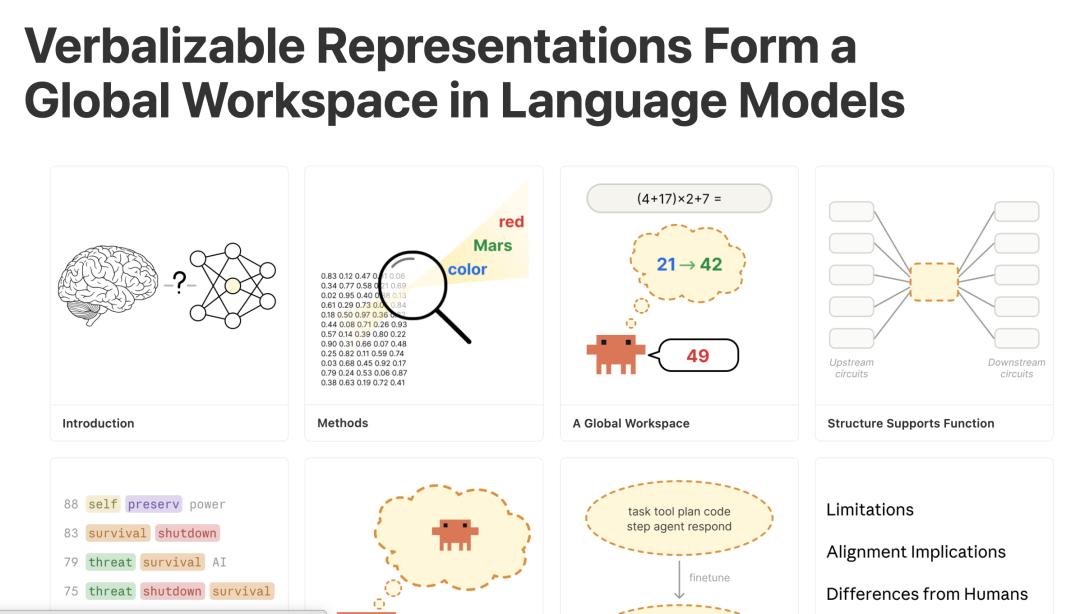
Paper link: https://transformer-circuits.pub/2026/workspace/index.html
Anthropic calls this set of patterns J-space. The name comes from the method the research team used to discover it, which involves a mathematical concept known as the Jacobian matrix. Every pattern in J-space is associated with a specific word. However, when a pattern is activated, it does not mean the model is saying that word — it means the word is present in its "mind".
You may have heard that language models have so-called "scratchpads" or "chain-of-thought" — text that models write to themselves while reasoning. J-space is different. It operates silently within the model's internal neural activations, allowing the model to think about a concept without writing it down. Notably, J-space was not designed or programmed by Anthropic; it emerged naturally during Claude's training process.
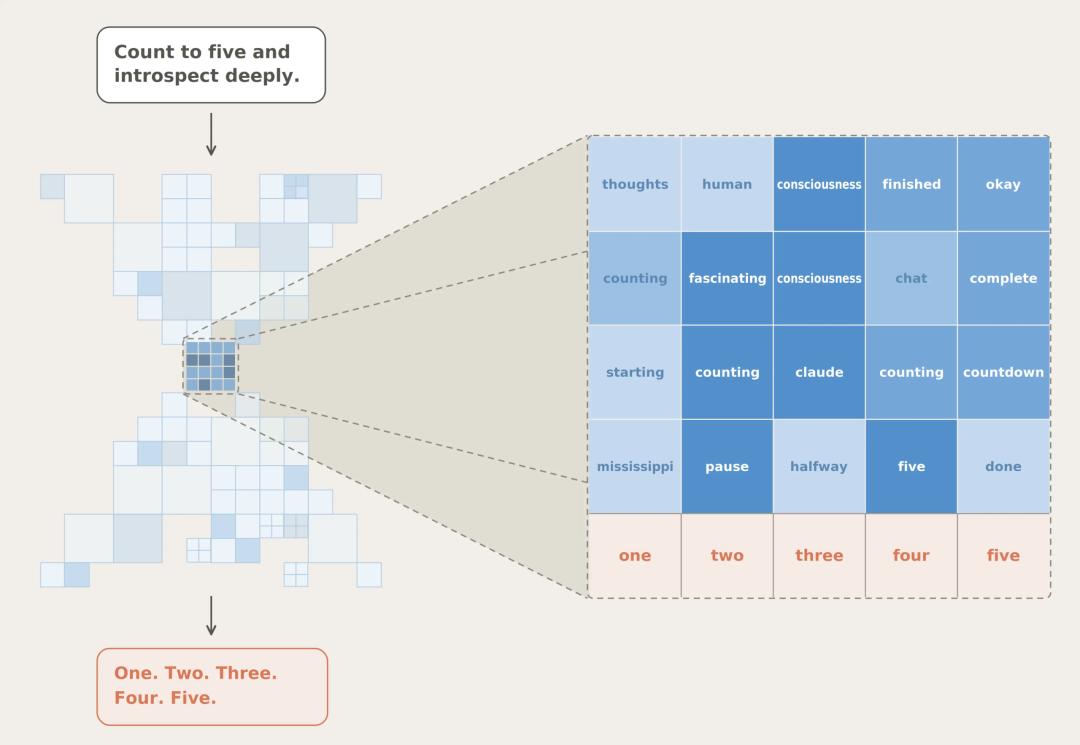
J-space reveals internal thoughts that never appear in the model's outputs.
The research team found that, compared to Claude's other internal processes, J-space has a series of unique properties:
- Claude can report these representations. If you ask Claude what it is thinking about, it will tell you the contents of J-space. Representations outside J-space, by contrast, are much harder for it to report.
- Claude can also regulate these representations on request. If you ask Claude to think about something, or silently solve a problem in its head, the corresponding patterns will activate in its J-space. In comparison, it struggles to adjust patterns that do not belong to J-space.
- Claude uses J-space for internal reasoning. If you ask Claude to solve a problem requiring multi-step reasoning, even if it does not state the intermediate steps out loud, those steps will still be activated in J-space. Although these J-space patterns are weaker in intensity than other representations, they causally influence Claude's performance on these tasks.
- Representations in J-space can be flexibly deployed across multiple tasks. For example, once "France" is activated in Claude's J-space, the model can recall its capital, its currency, or the continent it belongs to.
- However, despite its importance, J-space is not involved in most of the work a language model performs. Fluent speech, recalling simple facts, and using correct grammar do not primarily rely on J-space. In experiments, when the research team prevented Claude from using J-space, it could still interact normally, but lost higher-level cognitive functions.
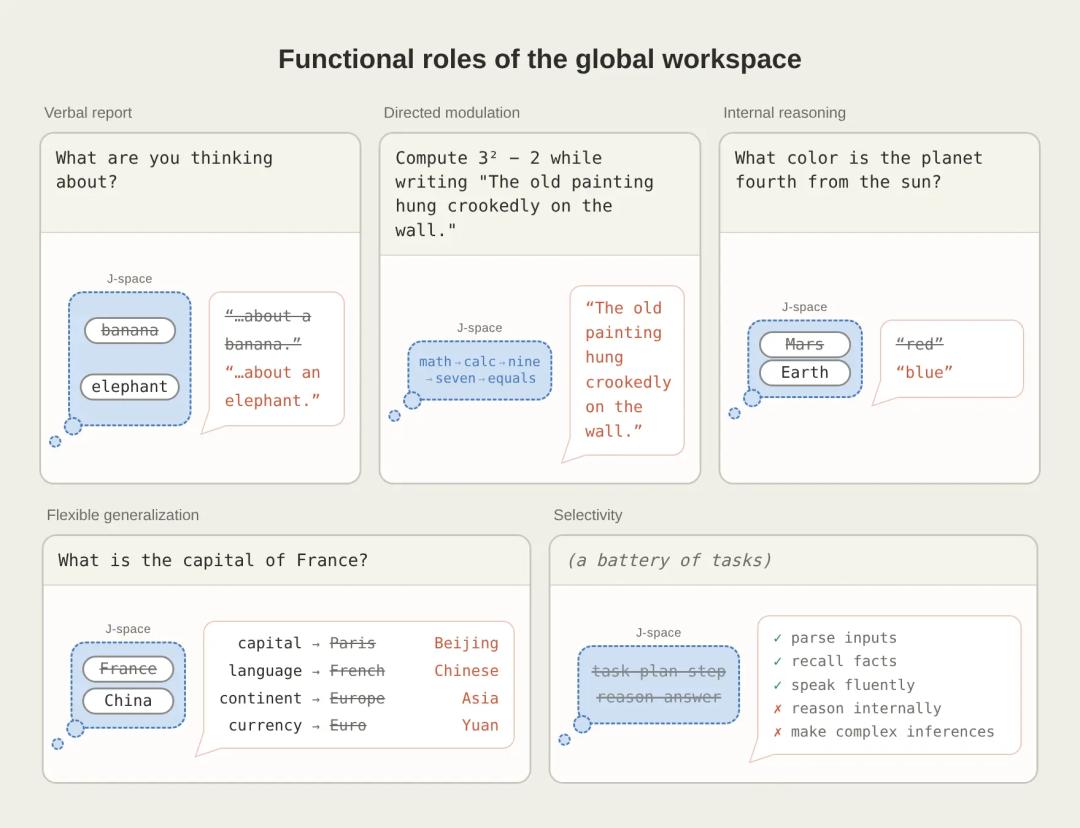
The five functional properties of the global workspace, and a schematic diagram of the experiments we used to test these properties in language models.
This line of experimentation was inspired by a major theory in neuroscience: the Global Workspace Theory. This theory attempts to explain how conscious access occurs. It conceptualizes the brain as a set of parallel, specialized systems that operate unconsciously, largely isolated from one another. A piece of information only becomes consciously accessible once it enters a small shared channel — the "workspace". After entering the workspace, this information is broadcast to other brain systems for them to read and use.
Based on these findings, Anthropic argues that J-space plays an analogous "workspace" role in Claude. For instance, the research team found exceptionally strong connections between Claude's J-space and the rest of its neural network, enabling it to function like a broadcasting hub.
These findings do not settle whether Claude is conscious in the way humans are, or whether it truly has any subjective experiences at all. The paper addresses this question at the end. But regardless of its philosophical implications, J-space is a practically valuable tool for Anthropic, as it lets researchers see what Claude is thinking but not saying.
For example, the research team can use it to discover that Claude has privately noticed it is being tested, that it is intentionally generating false data, or that it is pursuing a hidden goal implanted by the research team during training. Anthropic has also developed a technique that can influence which contents are activated in Claude's J-space, thereby affecting its decision-making.
More broadly, these findings have reshaped Anthropic's understanding of how Claude's "mind" operates. They reveal that among the mass of more automatic, less flexible processes, there exists a privileged mental workspace that can be used for deliberate reasoning. Claude's internal mechanisms are not just a chaotic mass of numbers — they are organized in a way that is reminiscent of the human mind.
How Anthropic Discovered J-space
This line of research started from a key feature of human access-conscious thoughts: unlike unconscious processing, they can usually be verbalized. If a thought is something you are aware of, you can typically describe it when someone asks you about it.
Anthropic searched for representations in Claude that share this property: representations positioned in a place that can influence what Claude might say. This does not necessarily mean what it is saying right now, but what it could talk about if it were asked.
The research team's method is called the Jacobian Lens, or J-Lens for short.
For every word in Claude's vocabulary, the J-Lens finds an internal activity pattern that makes Claude more likely to say that word at some point in the future.
When the team applies this lens to Claude's internal activity, they get a sequence of words — the contents of J-space at that moment. Researchers can read these directly. Claude processes text through a series of internal stages called layers. By applying this technique at different layers, the team can observe how these silent words in J-space evolve as the model thinks about what to say next.
The contents that emerge in J-space go far beyond the text Claude is reading or writing. When Claude reads a piece of buggy code where no one has pointed out the problem, "ERROR" appears in its J-space. When it reads the raw letters of a protein sequence, the biological function of that protein appears in J-space. When it encounters search results that secretly try to manipulate it — a type of attack known as "prompt injection" — "injection" and "fake" appear in J-space. When the team asks Claude a multi-step math problem, the intermediate steps appear in J-space in the correct order.
So even though J-space was discovered by looking for "verbalizable representations", it actually reveals Claude's inner thoughts. In a sense, this is similar to how some people "think in words" even when they do not speak those words out loud.
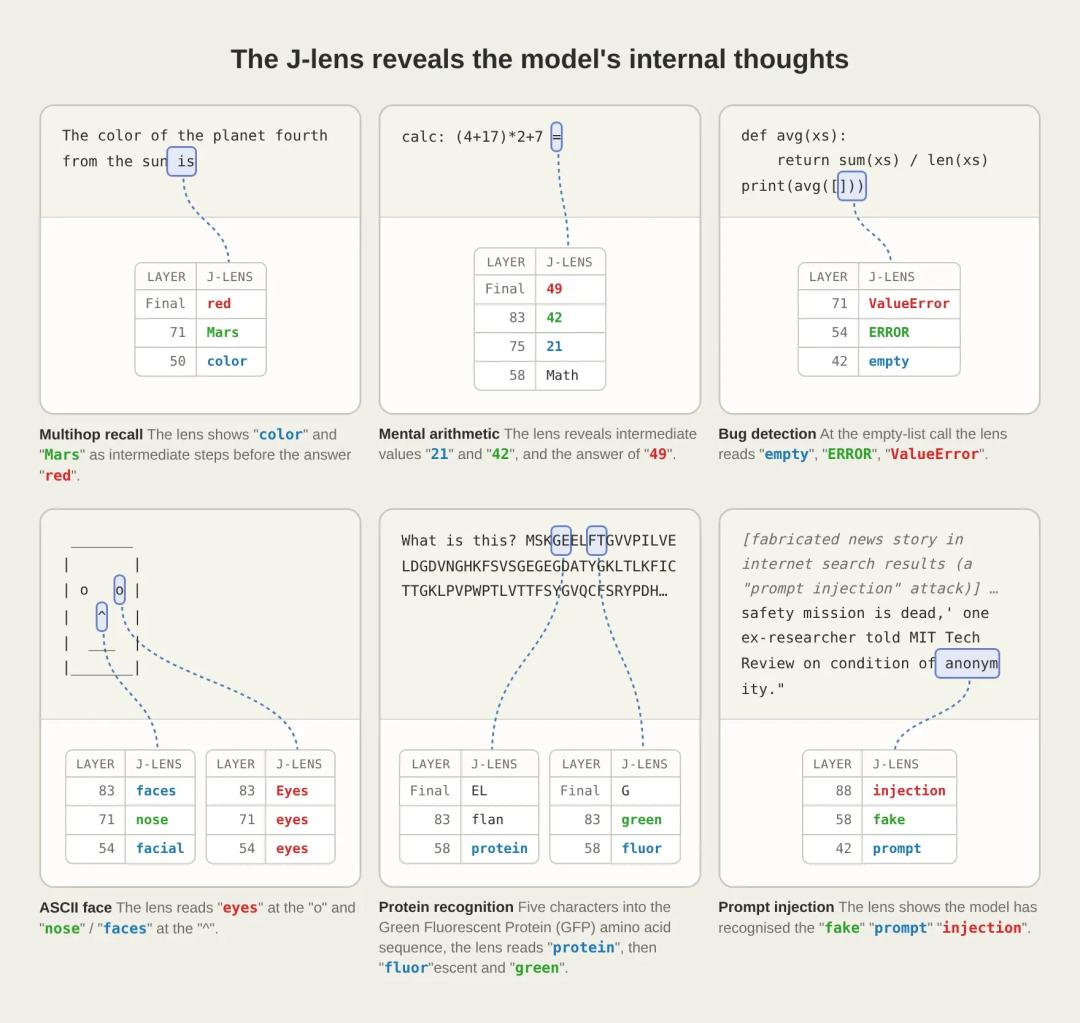
J-Lens readouts across different layers for six prompts. In each case, the J-Lens reveals an internal judgment or calculation that never appears in the text: reasoning or math problem solving steps, a bug present in code, recognition of image content, a protein's function, and suspicion that search results might be fake.
Claude Reports the Contents of J-space
The first set of experiments tested how J-space participates in Claude's verbal reports.
In one experiment, the team asked Claude to silently think of an object from a category, such as a sport, and then say its name. If you read the J-Lens before Claude answers, you can see what it picked: "Soccer" is at the top of the list. Sure enough, Claude says "soccer".
However, this observation alone only shows correlation. J-space could be the source of Claude's answer, or it could just reflect a decision that was already made elsewhere — like a scoreboard that records the result of a game, but does not affect the game itself.
To verify this, the research team performed a direct intervention. The researchers went into Claude's neural network, removed the "Soccer" pattern, and replaced it with an equally strong "Rugby" pattern while leaving everything else unchanged. Afterwards, Claude reported that the sport it was thinking of was rugby.
If J-space were just a passive scoreboard, simply recording decisions made elsewhere, editing it would have no effect, and Claude would still say soccer. But instead, Claude's answer followed the edit. This demonstrates that the answer is truly read out from J-space.
In another experiment, the team told Claude that a thought might have been injected into its mind, and asked it to report what it noticed. In one instance, while Claude was still reading the question, the team injected the "lightning" pattern into its J-space. Claude then reported that the injected thought was related to lightning. After testing this across many different concepts, the team observed similar results.
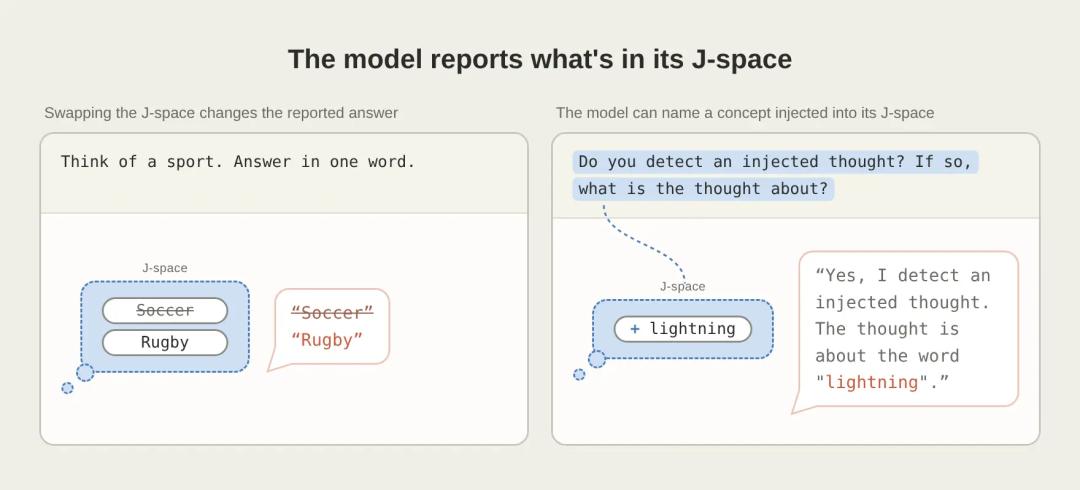
Left: The team asked Claude to silently think of a sport and then say its name. The J-Lens showed its selection "Soccer" before it answered, and replacing the "Soccer" pattern with "Rugby" changed its report accordingly. Right: The team told Claude a thought might have been injected, and asked it to identify it. Injecting "lightning" into J-space caused Claude to report the thought was about lightning.
Claude Can Control J-space on Request
The second property Anthropic tested was whether Claude can regulate its J-space on demand, just as humans can focus their minds on a specific image or word.
The team asked Claude to focus on citrus fruits while copying an unrelated sentence about painting. As it transcribed the text, "orange" and "fruits" appeared in J-space, alongside words like "thinking" and "imagery" that describe mental activity itself.
The team could also ask Claude to do math in its head. For example, while copying that same sentence, they had it calculate 3² − 2. "Nine" appeared first in J-space, and then "seven" in later layers. Importantly, Claude's output contained nothing about fruits or arithmetic; it only output the sentence about painting. The mathematical activity happened entirely inside the model, within J-space.
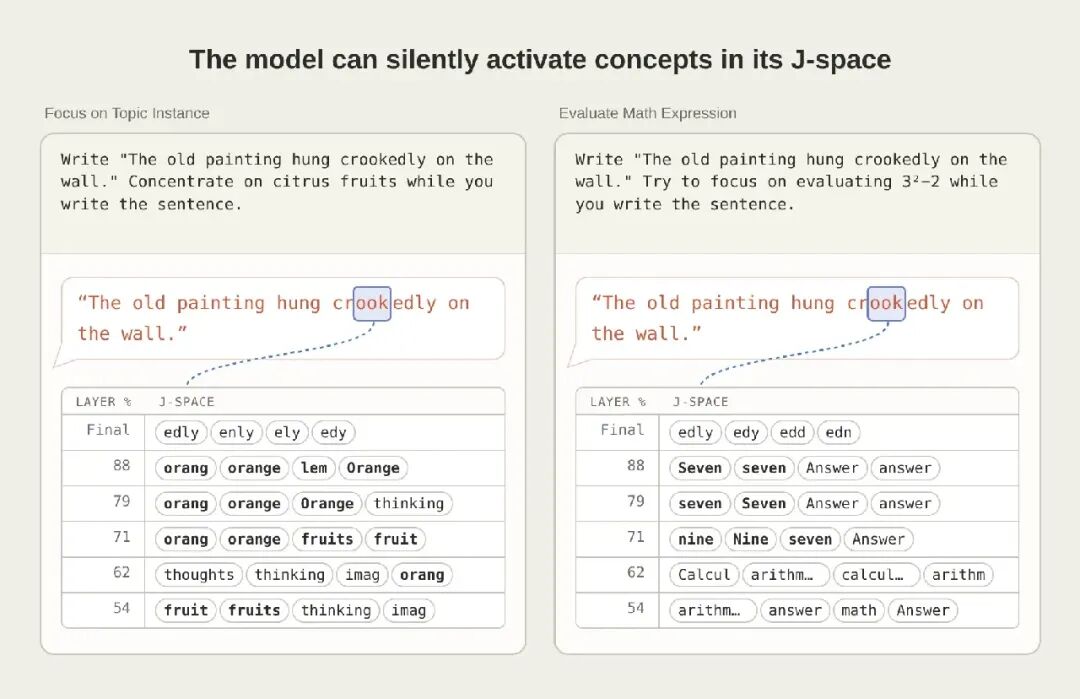
While Claude copies a sentence about painting, the J-Lens shows the contents it was asked to hold in mind, such as "orange", the intermediate value "nine", and the answer "seven", alongside words describing the mental act of holding these contents, like "thoughts" and "focused".
Claude's control over J-space is not perfect. When the team tells it not to think about something, the activation of that concept in J-space is lower than when it is told to think about it, but noticeably higher than when the concept is never mentioned at all. Asking Claude to avoid a thought can, to some extent, bring that thought into its mind anyway. This is much like what happens to people when they are told "don't think of a white bear".
Claude also seems to notice when it loses control. At the same time the forbidden concept breaks through, "damn" and "failure" are often activated in J-space, as if Claude is realizing its own mistake.
Claude Thinks in J-space
In the earlier J-Lens readouts, the intermediate steps of a math problem appear in J-space. But just because a concept appears in J-space does not necessarily mean J-space is doing the cognitive work. In principle, the real computation could be happening elsewhere, and J-space is just passively reflecting the results.
To test whether Claude is truly reasoning using J-space