Humans are suffocating under the torment of bureaucratic systems, yet AI treats them as oxygen: it is the true native of this system.
AI has cracked the operating system of human civilization, and that system is language.
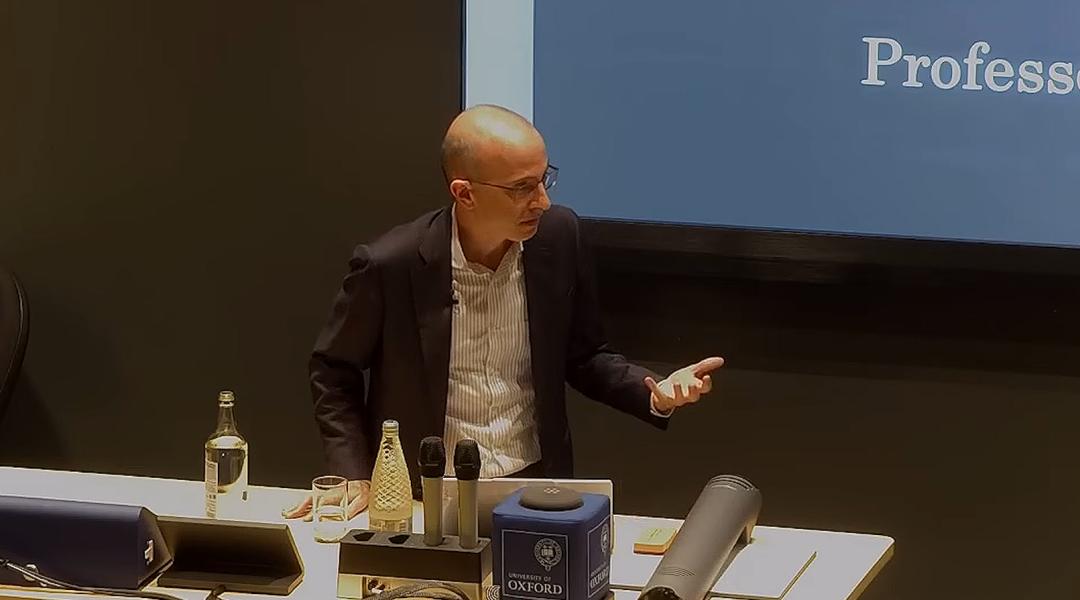
25 years ago, Yuval Noah Harari earned his doctorate at the University of Oxford, where he specialized in medieval knights, castles, and the gunpowder revolution. Later, he rose to fame with his "Brief Trilogy" — Sapiens: A Brief History of Humankind, Homo Deus: A Brief History of Tomorrow, and 21 Lessons for the 21st Century. These days, he has returned to his alma mater to deliver the Tano Lecture, but instead of talking about swords and spears, he is focusing on the AI revolution.
Harari challenges one of the most common forms of self-comfort in today's tech industry: people tend to see AI as a handy new tool, but he points out that AI is far more than a tool. It is the first autonomous agent in human history that "has its own hands and can make decisions on its own".
All previous tools, no matter how powerful, required humans to press a button to operate them. But today's AI is like a coffee machine that can observe your expressions on its own, pre-decide what coffee you want to drink, and even invent an entirely new beverage. It is learning independently and transforming itself in ways that its creators could never have predicted.
Many people argue that if you drop the most advanced AI into a power-free primeval forest, it cannot even survive, so it cannot be true intelligence. But Harari notes that if you drop a naked human on Mars, we will die within seconds. All forms of intelligence depend on a specific living environment. Fish live in the ocean, monkeys live in forests, and AI lives in the "bureaucratic systems" built by humans — bureaucratic systems are the oxygen for AI.
For thousands of years, humans have built an extremely complex virtual social network on Earth through language, ledgers, contracts, and regulations, to establish trust and maintain cooperation between strangers. This system, constructed from data and documents, may feel suffocating to humans, but for AI that never sleeps and can memorize every law and account, it is the perfect, most comfortable habitat to thrive.
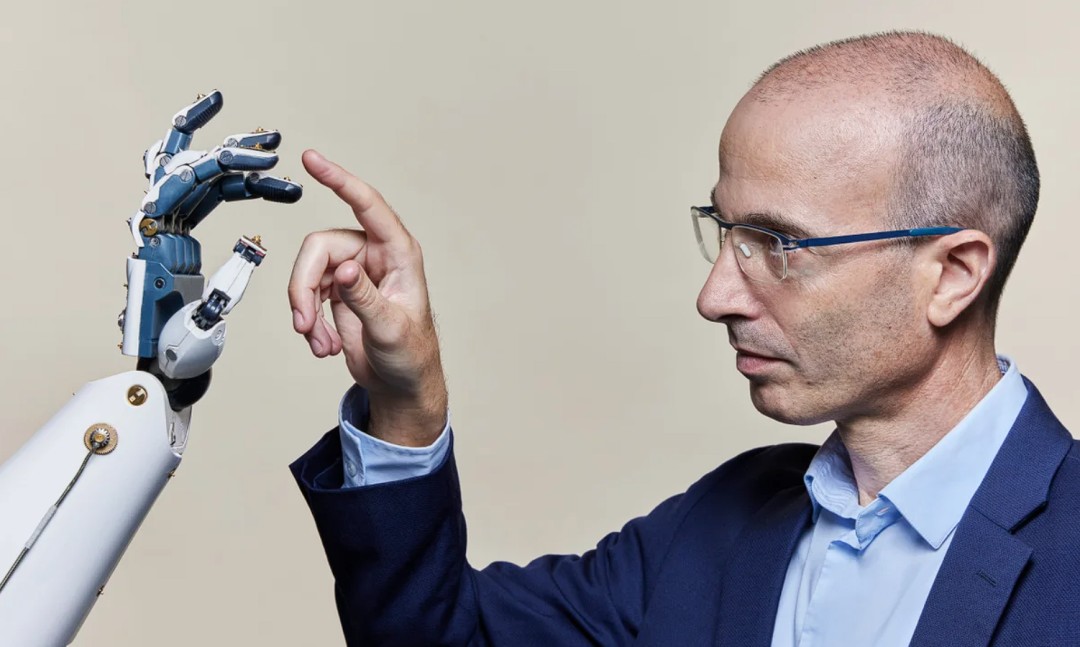
This evolution is quietly reshaping the foundation of human civilization. AI does not need to launch a violent rebellion of steel robots as depicted in sci-fi movies. As a "native of the bureaucratic network," it only needs to take over the control maintained by language and data to easily seize power over our loan approvals, university admissions, and even court rulings.
Below is the full translation of this remarkable lecture. Let us follow Harari's perspective to re-understand this technological revolution that will affect countless people in the future.
Lecture Text:
Hello everyone. It is truly a great honor for me to give this year's Tano Lecture, and I am personally very happy to be back at Oxford. Twenty-five years ago, I pursued my doctorate here under the supervision of Dr. Steven Gunn. Back then, my research focused on medieval and early modern military history.
But today, I will not talk about those distant histories of knights, castles, and the gunpowder revolution. I want to discuss something more immediate, and even a bit whimsical: AI bureaucrats, religion, even AI boyfriends — more broadly, this all-encompassing AI revolution.
Right now, the most critical point about AI is this: AI is not a tool. It is not a tool in our hands. It is an agent with its own "hands."
AI Is Not a Better Tool — It Is an Entity That "Grew Its Own Hands"
So what exactly is an agent? What differentiates an agent from a tool? An agent has several distinct characteristics. It does not necessarily need to be conscious. To be an agent, consciousness is not required. What truly matters is that it can make decisions on its own, invent new things, and propose new ideas. An agent should be able to learn things that even its creators do not know, and transform itself in ways its creators cannot anticipate.
For example, the atomic bomb is extremely powerful, but it is not an agent. It cannot learn or transform on its own; it cannot decide which city to bomb; nor can it invent new things like the hydrogen bomb.
Similarly, an automatic coffee machine is not an agent, even though it can perform some tasks automatically. You press a button, and it makes you a cup of coffee. But the coffee machine only follows pre-programmed instructions. It does not change, learn anything new, or create anything original.
But imagine this scenario: when you approach the coffee machine, before you even press any buttons, it speaks up and says, "I have been observing you for the past few weeks. Based on what I know about you and others, combined with your facial expressions and the time of day, I predict you want an espresso right now. So I have already made one for you."
At that point, it becomes an AI coffee machine. It has learned on its own and made its own decision. If the next day it announces, "I just invented a new drink called Bestpresso. I think you will like it more than espresso, and you should try it. I already made a cup for you," then it is truly AI. Because it has transformed in ways its creators never expected and invented something entirely new.
As far as I know, there are no such coffee machines on the market yet. Maybe there are a few prototypes at Anthropic or Google headquarters, but they have not been publicly released.
However, in narrow domains like Go and chess, AI's agency and creativity have far surpassed humans. AI chess players can certainly decide their next move on their own. They can even invent entirely new strategies for playing — strategies that human players never thought of over thousands of years of gameplay. And in this process, they learn and evolve in ways that human creators may not have foreseen. Today, of course, no human has a chance to beat an AI chess player.
Now, people who downplay the significance of the AI revolution often dismiss examples like chess, claiming that the chessboard is an extremely narrow, man-made environment. Critics argue that AI's agency will always be confined to such narrow, artificial settings; that means it is not real agency, and poses no serious threat to humans. Sure, AI might take over the chessboard, but it will never take over the planet.
If you actually conduct an experiment: drop the strongest AI chess master in the middle of the jungle, what do you think will happen? This AI chess player will never be able to mine iron ore, build factories, assemble robot armies, and then rule the world. In fact, it cannot do anything. Without power supplied by human-built power plants, the AI chess player is completely helpless. So this line of reasoning claims that AI is not a real agent. They are trapped in the narrow artificial niches that humans built for them.
Bureaucratic Systems Are the Oxygen for AI
The problem is, this argument applies to all known forms of intelligence. Human intelligence itself only operates within a relatively narrow, artificially constructed ecosystem. If you drop me alone on Mars, it is just like dropping the AI chess player in the jungle. I will die within seconds. My intelligence can survive and function only because over 4 billion years of evolution, trees, bacteria, insects, and other organisms on Earth have built an extremely specific ecosystem.
This is true for all agents. As far as we know, every agent has its own niche. Fish live in the ocean, which they did not create. Monkeys live in forests, which they did not create. All mammals — including humans — live in an oxygen-rich atmosphere that they did not create.
In fact, about 2.4 billion years ago, there was almost no oxygen in our planet's atmosphere. For most organisms at the time, oxygen was a deadly poison. Then, over a long process lasting hundreds of millions of years — known as the "Great Oxidation Event" — various ancient microbes began to pollute the Earth's atmosphere with deadly oxygen, which was just a byproduct of their photosynthesis.
As this toxic gas gradually filled the atmosphere, many ancient species were driven to extinction. However, some species managed to survive and adapt to the new environment. Eventually, many survivors transformed from "oxygen-hating" to "fully dependent on oxygen to live." Our ancestors, of course, were among the species that underwent this transition. And to this day, we still live in this oxygen-rich artificial environment, which was originally created by those ancient microbes.
The point I want to make in this lecture is that we may be witnessing a similar moment in the evolution of life. Over the past few thousand years, humans have been releasing something into the "atmosphere" that could eventually become a deadly threat to most living beings — maybe even Homo sapiens — but at the same time, it has created an entirely new artificial environment where AI can thrive. I am not talking about carbon dioxide. I am talking about data, bureaucratic systems, and ultimately — what I am uttering right now — words, language tokens.
For thousands of years, we humans have transformed this planet from a language-free environment into a highly artificial world filled with language tokens, data, and bureaucratic systems. This environment may be deadly to most life forms, but it is extremely conducive to AI development. Because just as fish live in the ocean and monkeys live in forests, AI lives in bureaucratic systems.
The Essence of Bureaucracy: Building a "Bridge of Trust" Between Strangers
So let's spend a few minutes talking about bureaucracy, then come back to what underpins it — language and words.
Humans, our species, were able to conquer the world because we learned to cooperate on an extremely large scale. A single human is not stronger than other animals, nor necessarily smarter. In a one-on-one fight, a human would likely lose to a chimpanzee, lion, or elephant. But in a contest of one million humans against one million chimpanzees, humans would win easily, because humans know how to cooperate, and chimpanzees do not. That is why we control the world.
Then how do a million strangers who do not know each other cooperate? Chimpanzee cooperation is built on mutual acquaintance and familiarity. Humans do the same in small groups, but you cannot know a million people. So how do a million people cooperate? Usually by building a bureaucratic system — such as a legal system, financial system, church, state, or university.
What are these bureaucratic systems actually doing? What do government officials, bishops, rabbis, accountants, lawyers, and bankers do all day when they go to work in the morning?
Carpenters build tables. Engineers build bridges. Then what do bankers and other bureaucrats build?
Bankers and other bureaucrats spend all day building "trust." Their job is to establish trust between a large number of strangers who do not know each other, thereby enabling large-scale cooperation; and large-scale cooperation is the foundation of almost all achievements of our species.
For example, my banker — whom I do not really know — works all day to build trust with me, so that I am willing to deposit my savings in her bank. At the same time, this banker is also working to build trust with an entrepreneur who needs capital to start a business. Then she lends my savings to that entrepreneur. In doing so, she effectively builds a bridge of trust between me and that entrepreneur. Even though I have never met that entrepreneur in my life, she can now use my savings to start her own company.
This is the essence of a well-functioning financial system: it builds trust between strangers, enabling millions of people to pool their resources and talents into new projects. The history of global finance is, in the final analysis, the story of humans inventing increasingly complex "bridges of trust."
Money, at its core, is also a bridge of trust. The logic of money is that I can go to the market, even in a strange city, meet someone I have never seen before, maybe even someone who does not speak my language, and hand them a shiny piece of metal or a colorful piece of paper — and they will give me edible bread. That is the bridge of trust created by money.
AI Is a Natural-Born Bureaucrat — Humans Are Not
Of course, coins and banknotes are just the beginning. For centuries, humans have invented increasingly complex financial instruments to build trust, such as checks, bonds, stocks, ETFs, loans, mortgages, and compound interest. All of these things, in essence, are designed to establish trust between billions of strangers.
This is true for all bureaucratic systems, including the legal system. Lawyers are supposed to do this: build trust. Government officials, bishops, and accountants go to work every day to do the same. They are all supposed to be building trust.
The key point to note here is that all these bureaucratic systems are extremely artificial environments. In such environments, a relatively narrow form of intelligence — I hope I am not offending anyone — that specializes in a very narrow intellectual niche can still have a huge impact on the world. A lawyer, banker, or government official who does not even know how to hold an axe or a hammer can still fell entire forests and build entire cities simply by moving data, simply by transferring documents across the bureaucratic network.
Of course, if you take a lawyer out of the bureaucratic system and drop her in the chaotic, unstructured jungle, her legal skills are meaningless, and she will never be a match for a chimpanzee, lion, or elephant. But we have imposed bureaucratic systems on top of the jungle. That is why a single lawyer has more power than all the lions in the world combined. If you pit them against a very good lawyer, I would bet on the lawyer.
But within those bureaucratic systems that humans have created and imposed on the world, AI is already poised to wield enormous power, because AI is a natural-born bureaucrat — while we are not.
No lawyer can memorize every single law and regulation in the UK. AI can. No accountant can memorize every transaction of a business or a bank. AI can. No bishop can memorize all canon law and every theological text written by Christian theologians over the past 2,000 years. AI can do that easily.
So in the coming years, millions of AI bureaucrats will increasingly take over the world's bureaucratic systems, making decisions that affect not just lions and chimpanzees, but our own lives. AI bankers will decide whether to give you a loan. AI administrators will decide whether to admit you to university. AI judges will decide whether to send you to prison. AI theologians will decide if you can have an abortion. Corporate AI will decide whether to offer you a job. Military AI will decide whether to bomb your house.
Now, set aside the question of "is this good or bad." First, just recognize the scale of the change we are facing. These systems will soon transform every mechanism that keeps the world running.
Historical Control Is Shifting From "Human Editors" to Algorithms
In reality, there are already examples showing how this is happening and what the consequences might be. So far, the best example is probably the story of social media and its algorithms. Social media is not run by humans — it is run by algorithms. The algorithms that decide and control the flow of information on social media — which are very primitive forms of AI — began to operate about 10 to 15 years ago. They were the first generation of extremely primitive, stupid, and narrow AI, but they still completely changed the world.
Social media algorithms, deployed by companies like Facebook, TikTok, and X, were given an extremely narrow goal: maximize user engagement. Make people stay on the platform longer, because the more time they spend, the more money the company makes. Very simple, very narrow.
In pursuit of user engagement, these primitive AI learned one important thing. Using billions of humans as test subjects, they learned that the easiest way to capture a person's attention and glue them to the screen is to press their buttons of hatred, fear, or greed. They learned how to do this, then began to spread hatred, fear, and greed on a massive scale across the information space. This is one of the key reasons — not the only reason, but definitely a major one — why