Computing power is extremely costly, and Meta has thrown in the towel.
Last week, media reports stated that Meta is developing a cloud infrastructure business, with plans to rent out its computing power externally. This single piece of news directly triggered a sharp sell-off in AI hardware stocks and Neocloud, which counts Meta as its major client. The market began pricing in the narrative of a "computing power glut," and pessimistic sentiment spread—even the storage sector, which had the strongest fundamentals recently, could not escape panic-driven declines.
Let’s start with our core conclusions from Dolphin Research:
(1) Judging from the single-day drop, market sentiment may have overcorrected significantly. Yesterday's reaction was more like a chain reaction triggered by crowded long positions, as short-side expectations showed signs of being fulfilled.
(2) However, this does not mean the market will rebound immediately. Divergences in industrial logic have emerged at a short-term high, which will take time to digest and adjust, or require new positive catalysts to offset pessimism and rebuild confidence. As a result, speculative capital will choose to exit, and onlooking bullish funds will likely adopt a wait-and-see attitude in the short term rather than blindly catching falling knives.
(3) As for Meta's computing power rental business, whether it is a "temporary business choice" or a "long-term planned business," it is definitely more beneficial than harmful for the company. In the short term, it will drive sentiment-driven valuation (P/E) repair, but we believe a full inflection point still depends on the progress of Meta's in-house large language models and Meta AI.
We still believe that frequent changes to Meta's internal organizational structure and strategy make a complete fundamental reversal unlikely to happen in the short term (e.g., within this year).
(4) As for how much fundamental boost Meta can gain from computing power rental, it entirely depends on how much "idle computing power" Meta has, which is likely to change along with shifts in the company's strategy and the broader computing power environment. Dolphin Research has conducted estimates based on certain assumptions, for reference only.
From bulk buyer to reseller: Meta’s unspoken dilemma?
End customers' Capex is the sole pillar supporting the entire computing power industry chain, and only a handful of leading tech giants currently have the capital capacity for such large-scale spending. Since the second half of last year, Meta, Google, and Amazon have successively started raising funds through various channels, leading the market to worry that "even the wealthiest households will run out of grain" eventually. This narrative has become a valuation curse hanging over the computing power industry chain, which gets brought up and repriced from time to time.
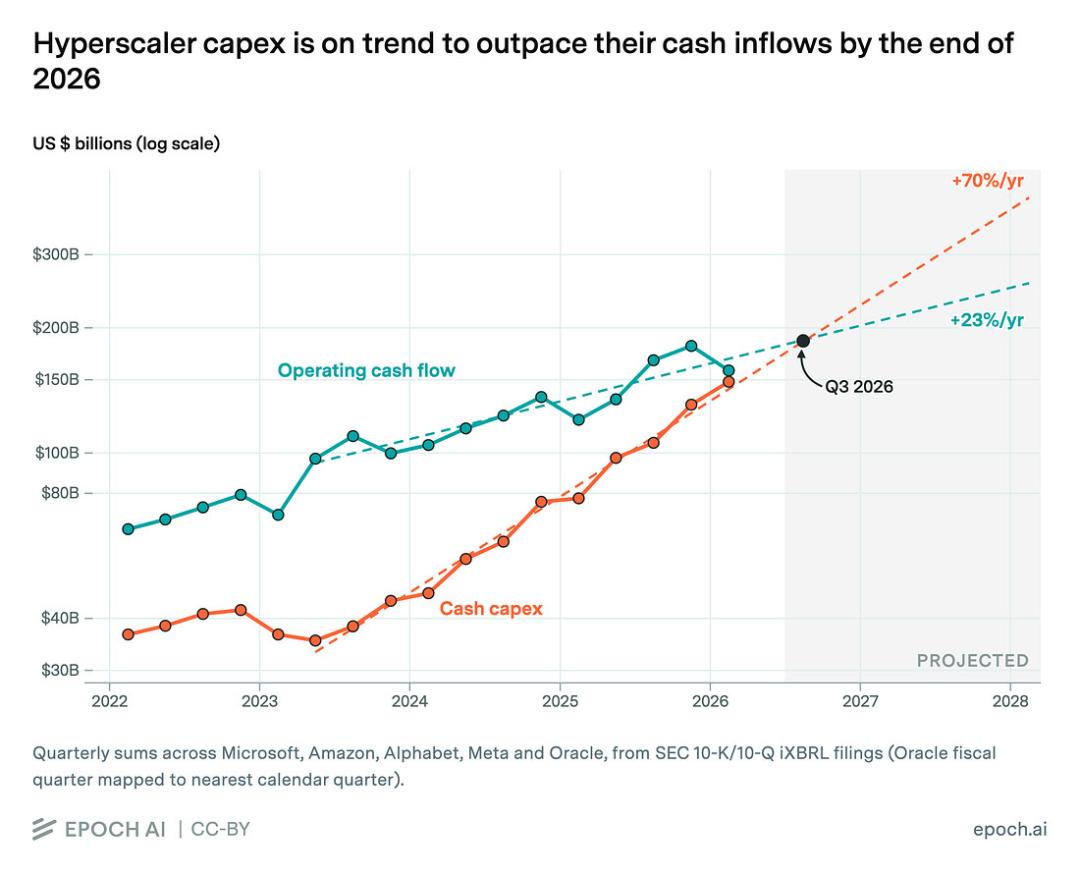
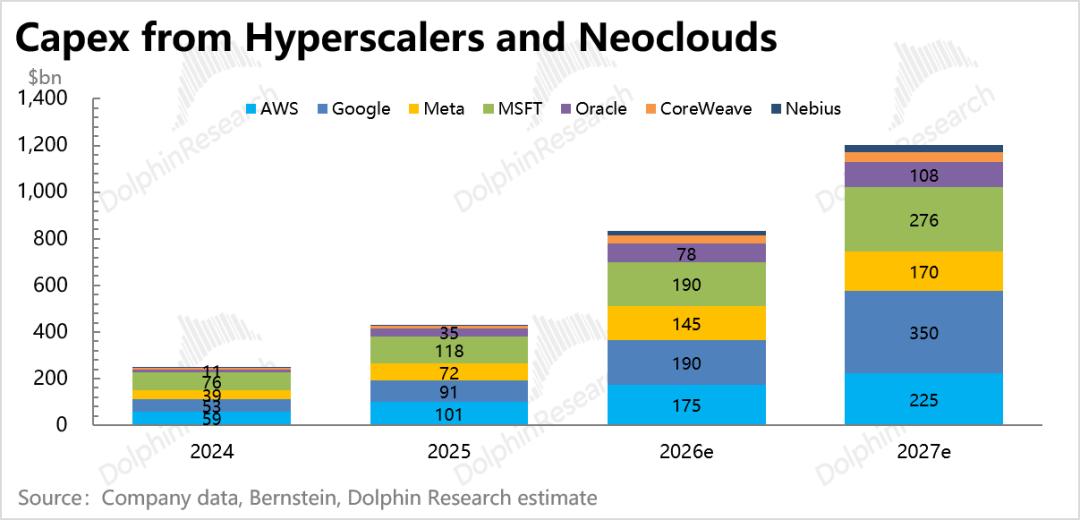
Meta is currently one of the world's top-tier large buyers of AI computing power, alongside Google, Microsoft, and Amazon—all of which operate or lease data centers with multi-GW scale capacity. In terms of investment contribution, Meta's 2026 Capex budget stands at $145 billion, accounting for over 17% of the global total.
Over the past two years, Meta has stockpiled a large number of H100/H200 GPUs, plus some Blackwell and AMD MI300X chips. By the end of 2025, its total equivalent computing power will reach 2.5 million H100 units, approximately 2GW. However, most of these H100/H200 chips are currently used for inference tasks, and their economic efficiency has become relatively low for the training of large-parameter, long-context, multimodal large language models.
Therefore, from the perspective of optimal computing power allocation, since old chips like H100/H200 currently command a very high rental premium, and Meta cannot use this part of its computing power to accelerate training for its next-generation Muse Spark model, renting them out directly to recoup some cash is a sensible move.
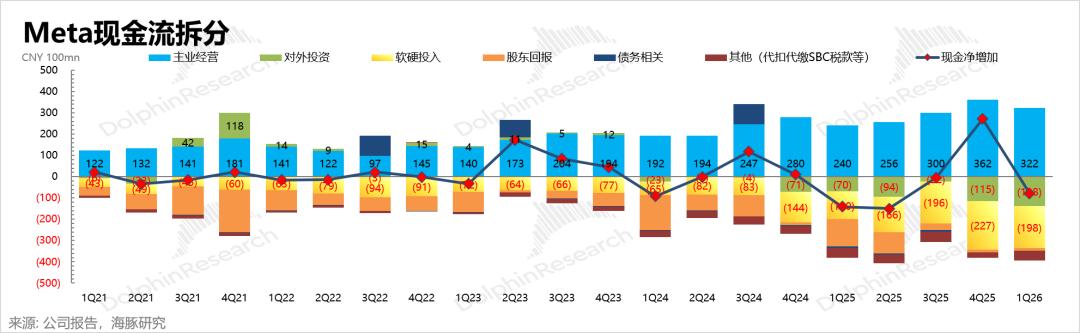
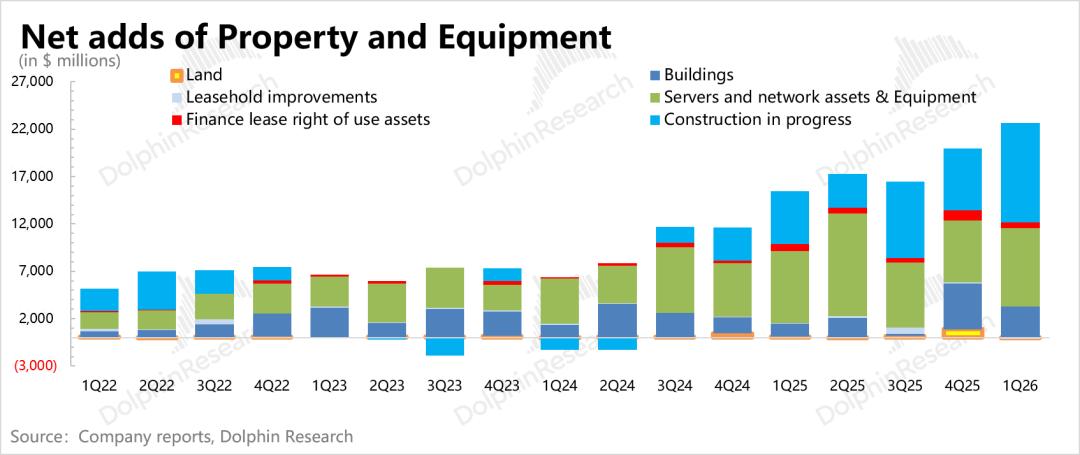
However, this transformation from one of the most aggressive computing power buyers to a seller—acting like a reseller—has been interpreted by the currently sensitive market as a sign of industry-wide "computing power glut." At the shareholders' meeting at the end of last month, Mark Zuckerberg mentioned that many clients have approached Meta to rent computing power at high prices, and the company would consider renting out excess capacity if it felt it had built more than it needs.
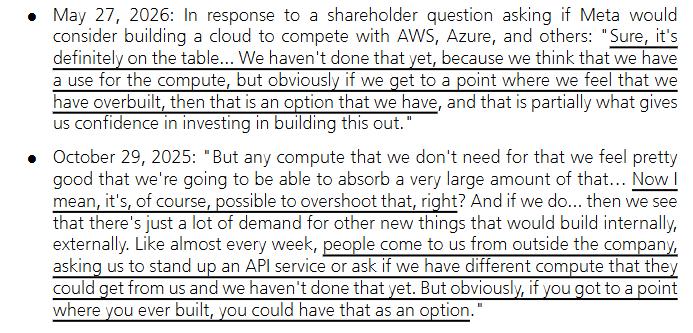
The market barely reacted to this comment at the time, since Meta had just raised its 2026 Capex budget again in its Q1 earnings report (the median target was increased by $10 billion to $135 billion). This demonstrated such strong hunger for computing power that a strategic shift was hard to imagine. Meanwhile, Google had just imposed restrictions on Meta's computing power supply, and Meta itself had locked in a 1.6GW long-term computing power supply deal with Crosue in June.
In fact, Meta has been hit by a wave of negative news in the two months following its Q1 earnings report. Aside from falling behind in the tech race that has dented employee morale (the Muse Spark large model released in April appeared to have narrowed the gap with tier-1 models, but now it has been left behind by the leading pack again), the most critical issue lies in organizational culture—frequent adjustments to strategies and organizational structures have left the team confused and unfocused.
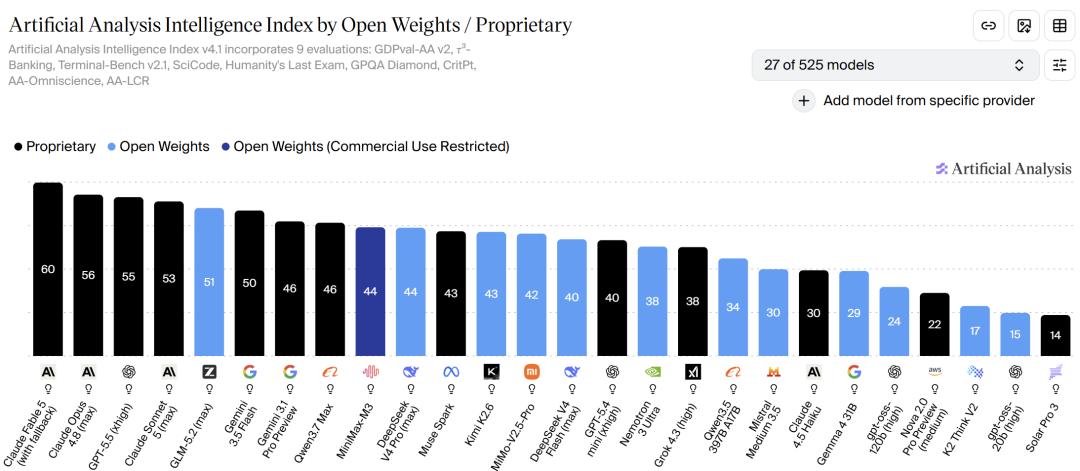
Therefore, the news breaking out at this point is most likely closely tied to the chaos in its in-house development system. Before Meta can catch up to the top tier in large model development, a significant improvement in the Meta AI user experience and large-scale deployment of Meta Business Agents and Meta AI robots are unlikely to be seen in the short term.
Renting out computing power can directly and effectively generate AI monetization revenue for Meta, easing the market's doubts about the ROI of Meta's heavy Capex spending, as well as concerns over further deterioration of its 2027 profits and cash flow.
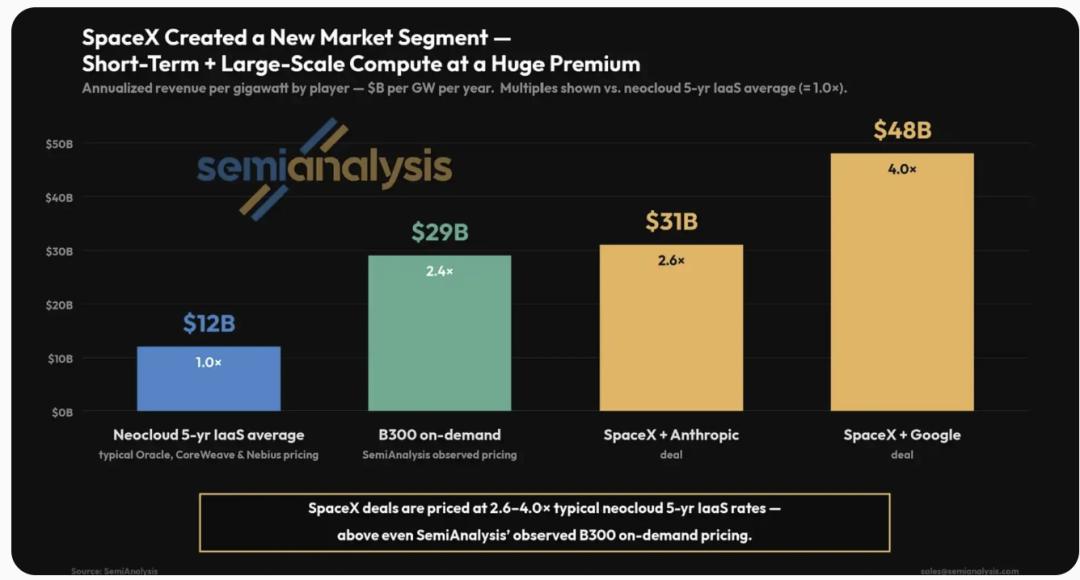
Coupled with xAI's recent multi-billion-dollar contracts, the immediate availability of capacity has pushed short-term rental premiums to extreme levels (according to Dolphin Research's estimates, the annualized revenue per GW exceeds $30 billion, 2-3 times the normal industry price). Given the B300 system deployment cost of $40-50 billion per GW, the payback period is just 18 months. The ROI of selling computing power at such a markup is so attractive that Meta would find it hard not to covet the opportunity.
Meta will not voluntarily exit the competition
However, Dolphin Research believes that Meta, like xAI, is not completely dropping out of the large model race. Selling idle computing power while focusing on cutting-edge capacity does not equal reducing total computing power investment.
As we mentioned in our previous in-depth report on SpaceX, xAI operates two computing clusters: Colossus 1, which is dominated by H100 chips, and Colossus 2, built on the GB series. Colossus 1 has been fully leased to Anthropic, while Colossus 2 will continue to handle the training of Grok 5 and subsequent frontier models, with only a portion of its capacity made available for external rental.
By analogy, Meta's newly announced rental capacity is reportedly dominated by H100/H200 chips stockpiled aggressively in previous years, while advanced computing power such as the GB series and Rubin series will remain dedicated to the continuous training of core large models like Muse Spark.
Based on public information and industry forecasts, Meta currently owns the world's largest total AI-related data center computing capacity. Industry analysts predict that by the end of 2027, Meta will have a total of 10GW of self-built and externally procured computing power.
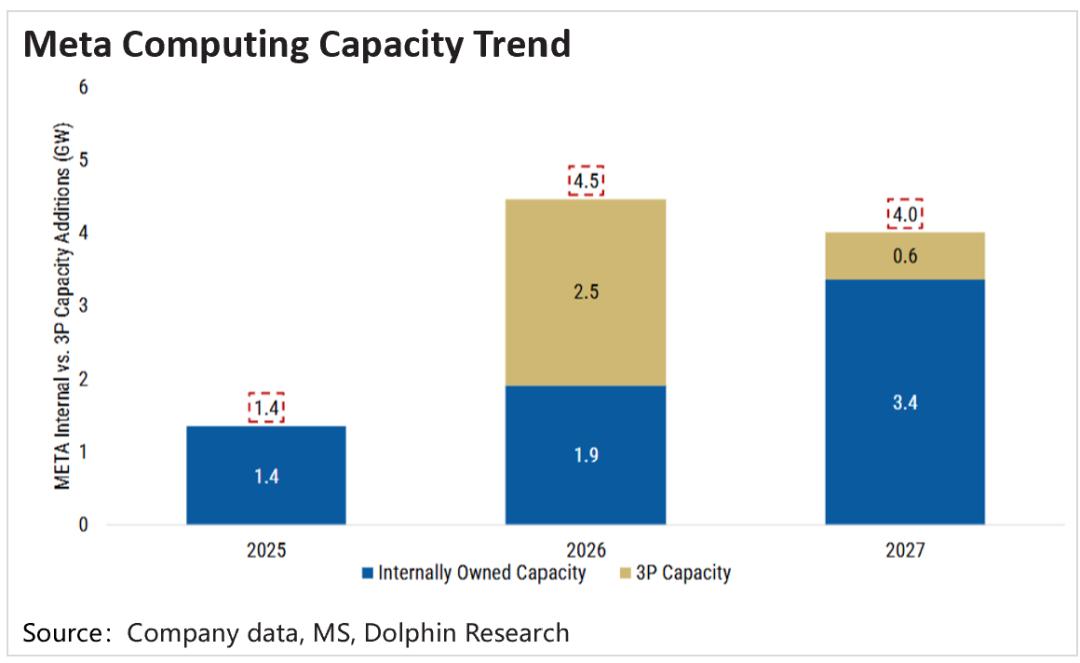
(1) Self-built capacity: It reached 2GW (equivalent to 2.5 million H100 units) by the end of 2025. With the advancement of the Hyperion project, another 2GW and 4GW of capacity are expected to come online in 2026 and 2027, respectively. By the end of 2027, Meta's self-built computing capacity is on track to hit 8GW.
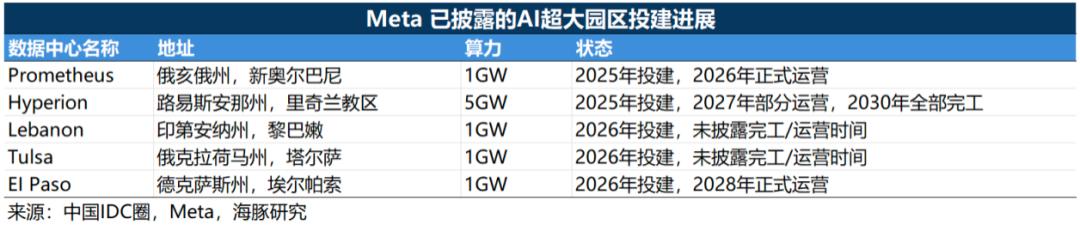
(2) Leased capacity: Since the beginning of 2024, Meta is estimated to have signed a cumulative 10GW of computing power contracts with third-party cloud providers, with CoreWeave, Nebius, and Google as its major rental partners. According to SemiAnalysis estimates, Meta signed over 5GW of new third-party cloud hosting capacity in the first half of 2026, under multi-year locked-in contracts.

Although CoreWeave has strict contract terms that ensure the validity of short-term contract performance, Neocloud will inevitably face long-term competition from former large buyers that have pivoted to join the computing power rental market.
Therefore, while the market may still have doubts and disputes over whether Meta will pause its Capex growth due to renting out capacity, the intensifying competition in the computing power rental space will inevitably impact Neocloud's business logic and valuation expectations.
How much market share can Meta capture?
Finally, returning to Meta, based on the above analysis, we believe that regardless of whether Meta is renting out computing power as a short-term measure or a long-term strategy, it can at least eliminate some of the market's uncertainties, driving dual improvements in EPS and valuations.
According to Bloomberg, Meta is likely to adopt two operational models for its computing power rental business:
One is similar to Amazon AWS's Bedrock service, which provides combined computing power + model services to external clients; the other is to rent out bare computing power directly like Neocloud (a reasonable choice, given Meta's lack of leading-edge large model advantages).
In the current seller's market, Meta's computing power rental revenue will largely depend on how much "idle capacity" it is willing to release. Based on the current situation, if Meta moves aggressively to launch the rental business in the second half of this year, Dolphin Research believes that bare metal computing power rental will be the dominant model in this short timeframe (bundling large model APIs would require building out dedicated sales and after-sales support teams first).
Meta currently has 2-3GW of operational AI computing power. After its self-built capacity is fully rolled out in 2027, its total computing power reserves (self-built + leased) are expected to reach 10GW, without any new capacity additions. Considering its ongoing in-house large model development and AI Agent initiatives, Dolphin Research assumes that Meta will rent out 15% and 20% of its total operational computing power in 2026 and 2027, respectively.
Since the market's consensus forecasts have already factored in data center-related costs (depreciation, electricity bills, etc.), even at the average 5-year contract prices Neocloud has signed (far lower than spot market rates)—which translate to $10-15 billion in annualized rental revenue per GW—the incremental net profit boost to Meta's existing earnings forecasts will be substantial. After deducting minor costs such as sales expenses, electricity bills, and platform support, and based on Meta's normal 20-40% profit margin, Dolphin Research assumes a marginal profit margin of 70% for this business.
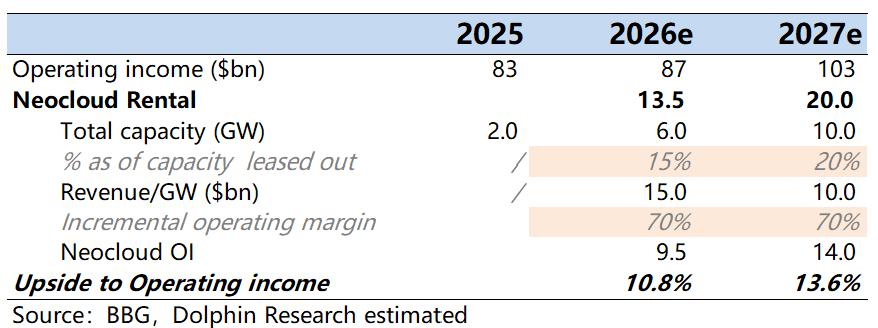
Under these non-aggressive assumptions, Dolphin Research estimates that Meta's cloud computing power rental business will bring a 10-15% net increase in its total profits. Last week, after the computing power rental news broke, Meta's share price rose 9% on the day, but gave back nearly 5% the next day—indicating partial correction of the market's short-term panic over computing power oversupply.
At the same time, a full fundamental reversal still requires more progress from Meta's in-house development teams, especially iterations of its large models to narrow the gap with the tier-1 leaders. This suggests that Meta's valuation pressure relative to other Mag 7 peers may persist for some time