HarmonyOS 3 official version got high scores, Tencent's full suite of apps can be used with confidence.
After long-awaited anticipation, the first heavyweight product Hy3 official version from Shunyu Yao following his joining Tencent has been officially unveiled today.
Tencent has spent more than half a year preparing for this product.
In December 2025, Tencent carried out a major restructuring of its internal large model R&D architecture, newly establishing the AI Infra Department, AI Data Department, and Data Computing Platform Department. At the same time, Shunyu Yao, an alumnus of the Yao Class at Tsinghua University, was appointed as Chief AI Scientist, reporting to Chi-ping Liu and Lu Shan through a dual reporting line.
Shortly after taking office, the first task Shunyu Yao undertook was to overturn the existing training framework, rebuild the entire pre-training and reinforcement learning infrastructure within a month, and set the three core principles of "no biased performance across domains, no over-optimization for benchmark scores, and no excessive resource waste".
The first product after the reconstruction was Hy3 preview, which was launched on April 23. The model took only three months from the start of training to public release.
However, Hy3 preview was ultimately just a preview version, with only passable capabilities across various aspects and did not reach the domestic SOTA (State-of-the-Art) level.
The official version of Hy3, by contrast, is a fully mature and competitive release.
What Improvements Has the Official Hy3 Version Made
The official Hy3 version retains the underlying architecture of the preview, with a total parameter count of 295B. It activates 21B parameters per inference, and an additional 3.8B parameters are allocated to the MTP (Multi-token Prediction) layer. The model consists of 80 layers (excluding the MTP layer), adopts the GQA grouped attention mechanism, with 8 KV heads out of 64 total attention heads, a hidden layer dimension of 4096, and an intermediate layer dimension of 13312. The expert system is configured with 192 experts, activating the top-8 experts per run. It features a 256K context window, a vocabulary size of 120832, and BF16 precision.
In other words, its effective parameter count is approximately half that of GLM 5.2. In fact, the entire architectural design of Hy3 was finalized as early as the preview stage, and no structural modifications were made in the official release.
So what exactly has been changed in the official version?
The official statement notes that the team "further improved the quality and diversity of post-training data, and expanded the scale of RL computing resources".
In plain terms, the architecture remains unchanged, but the training data fed to the model is of higher quality and greater diversity, and more computing resources have been allocated to reinforcement learning.
Judging from benchmark data, Hy3 has released a very detailed score sheet on its official blog and HuggingFace, covering six major domains: coding, search, work agents, STEM, reasoning, and in-context learning, with horizontal comparisons against mainstream models including GLM-5.2, GLM-5.1, DeepSeek V4 Pro, Seed-2.1 Pro, Qwen-3.7 Max, Gemini-3.1-pro-preview, Claude Opus 4.8, and GPT-5.5.
All the following figures are sourced from the official appendix tables published by Hunyuan.
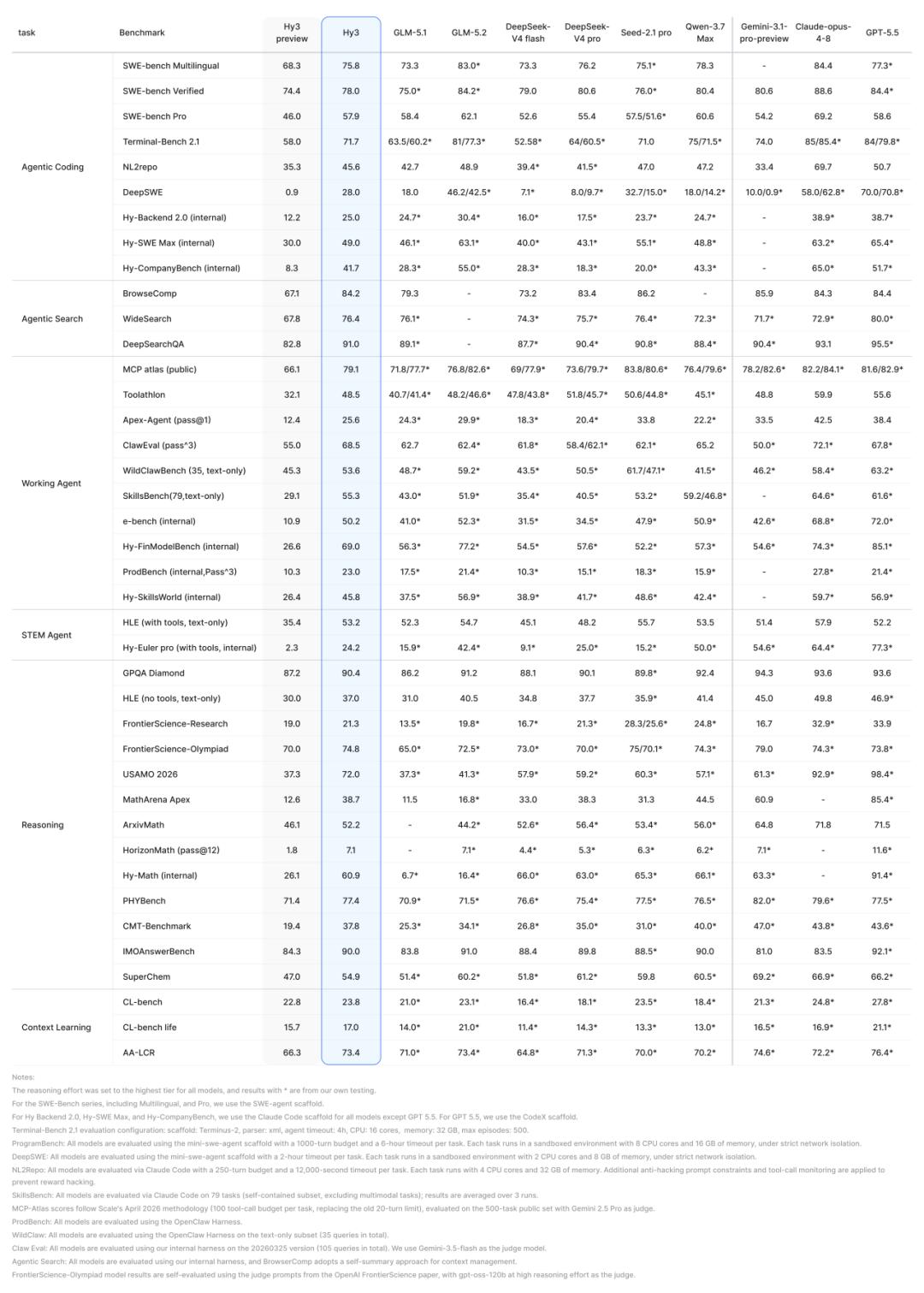
Looking first at the coding agent domain. The official Hy3 version scored 78.0 on SWE-Bench Verified, 57.9 on SWE-Bench Pro, 75.8 on SWE-Bench Multilingual, 71.7 on Terminal-Bench 2.1, and 28.0 on DeepSWE.
For comparison, GPT-5.5 scored 84.4 on SWE-Bench Verified and 58.6 on SWE-Bench Pro; GLM-5.2 scored 62.1 on SWE-Bench Pro; DeepSeek V4 Pro scored 55.4 on SWE-Bench Pro.
Hy3 performs on par with open-source models, but there is still a certain gap between it and top-tier closed-source models.
The search agent domain is where Hy3 delivers its strongest performance. It scored 84.2 on BrowseComp, ranking first among all compared models and even matching the performance of GPT-5.5. It also achieved 76.4 on WideSearch and 91.0 on DeepSearchQA.
In the work agent domain, Hy3 scored 79.1 on MCP Atlas (public version), 68.5 on ClawEval (pass³), 48.5 on Toolathlon, and 53.6 on WildClawBench (35 rounds, plain text).
Hunyuan also ran evaluations on its internal benchmark Hy-FinModelBench (financial modeling), achieving a score of 69.0, which is roughly on par with GLM-5.2.
In the STEM and reasoning domain, Hy3 scored 90.4 on GPQA Diamond (compared to 93.6 for GPT-5.5), 53.2 on HLE (with tools, plain text) (compared to 54.7 for GLM-5.2 and 48.2 for DeepSeek V4 Pro), 72.0 on USAMO 2026, 90.0 on IMOAnswerBench, 38.7 on MathArena Apex, and 54.9 on SuperChem. The 90.4 score on GPQA Diamond is already very close to GPT-5.5's 93.6, and the 53.2 score on HLE with tools is lower than GLM-5.2 (54.7) but higher than DeepSeek V4 Pro (48.2).
I need to elaborate on the in-context learning domain, where tests were conducted using two Tencent self-developed benchmarks CL-bench and CL-bench Life, as well as AA-LCR. Hy3 scored 23.8 on CL-bench, 17.0 on CL-bench Life, and 73.4 on AA-LCR.
These three numbers may seem low, but this is not a flaw of Hy3, but an inherent characteristic of this evaluation domain.
CL-bench is the first paper published under Shunyu Yao's authorship after he joined Tencent (released in February 2026, arXiv 2602.03587, a joint research project of Tencent Hunyuan and Fudan University). It is specifically designed to test the "in-context learning ability" of language models, where a higher score indicates that the model is better at learning completely new knowledge from context and applying it correctly.
Meanwhile, this paper also notes that almost all current SOTA models perform poorly in this domain. At the time of the paper's release, the top-performing GPT-5.1 (High) only achieved a 23.7% task success rate on CL-bench. Without providing context, GPT-5.1 can barely solve less than 1% of the tasks.
It is precisely for this reason that Shunyu Yao regards this as one of the core issues to be tackled in the "second half" of large model development.
Do not be misled by Hy3's seemingly low scores: it is worth noting that even Claude Opus 4.8 only scored 24.8 on CL-bench. Hy3's 23.8 score is the highest among domestic models.
Scores are ultimately just scores, and Tencent itself acknowledges that public benchmarks cannot fully reflect the model's "real-world performance".
Prior to the official release of Hy3, Tencent conducted a special test, organizing 270 experts from different disciplines internally to carry out blind model evaluations based on real work scenarios, collecting 312 valid comparison samples.
The results showed that Hy3 achieved an average score of 2.67/4, outperforming the vast majority of models, with advantages concentrated in categories such as front-end development, data and storage, and CI/CD. The sample size of this test is not large, but since the test method adopted is expert blind evaluation in real work scenarios, it can better reflect the model's actual performance in productivity tasks than pure benchmark running.
Compared with Hy3 Preview, the hallucination rate of the official version has dropped from 12.5% to 5.4%, a decrease of more than half. The common sense error rate fell from 25.4% to 12.7%. The multi-turn problem rate decreased from 17.4% to 7.9%. The long dialogue comprehension benchmark MRCR rose from 42.9% to 75.1%. The error recovery capability and efficiency of tool calling have been significantly improved, and invalid calls that trigger infinite loops have been reduced. Cross-framework generalization has also been enhanced.
This means that no matter which programming tool framework you use to call Hy3, the performance difference will not be significant, and the effect will be better than that of Hy3 Preview.
In terms of pricing, Hy3 continues the cost-effective route of the preview: the API input is 1 yuan per million tokens, the output is 4 yuan per million tokens, and input hits to the cache are priced at 0.25 yuan per million tokens. The model weights are open-sourced under the Apache 2.0 license on platforms such as GitHub, HuggingFace, ModelScope, and GitCode, allowing global developers to use them for free for commercial purposes. For overseas platforms, OpenRouter, Cline, OpenClaw, OpenCode, CherryStudio, and others will also support access successively.
Two weeks after the preview was launched, the token call volume reached 10 times that of the previous generation Hy2, and it ranked "double first" in the overall ranking and market share on OpenRouter with a weekly call volume of 3.66 trillion tokens. By the time the official version was released, the average daily token consumption had increased by 20 times.
The growth in call volume is particularly noticeable in coding and Agent-related scenarios, with an increase of more than 16.5 times in WorkBuddy/CodeBuddy and QClaw-type applications.
How Does It Perform in Real Products
No matter how high the model's benchmark scores are, they are only meaningful when translated into actual product performance.
At the time of the official Hy3 release, it has already been integrated into Tencent's core businesses including WorkBuddy/CodeBuddy, Yuanbao, ima, Marvis, QQ Browser, Tencent News, WeGame, Tencent LeXiang, Sogou Input Method, WeChat Official Accounts, WeChat Read, Tencent Maps, and Tencent Docs, while nearly 50 other businesses are queuing up for integration.
WorkBuddy is one of the most high-profile AI office agents in China at present, and it is also the main battlefield for verifying Hy3's capabilities.
From the data, Hy3's performance on WorkBuddy has indeed achieved qualitative improvement. Compared to the preview version, the task success rate has jumped from 72% to 90%, and the average task completion time has been shortened by 34%. In terms of token efficiency, Hy3's token consumption in high-frequency office tasks is significantly lower than that of GLM5.2: for example, it saves 47.4% of tokens in document processing and 49.0% in PPT production.
Moreover, since the release of Hy3 preview, the number of users who voluntarily choose to use Hy3 on WorkBuddy has increased by 6 times.
When it comes to actual office scenarios, the tasks Hy3 can handle are more complex than those supported by the preview version.
According to the official showcase, Hy3 can generate Excel modeling analysis and a 30-page presentation PPT from sales data of 101 SKUs; use linked formulas to aggregate data from three company regions into a single table with more than 5000 cells; design a conceptual promotional webpage for a nuclear fusion energy engine; use gesture interaction through the camera to control the dissolution and reorganization of image particles; and create a "Sunset Roller Coaster" game through multi-turn interaction.
Yuanbao is another important implementation scenario.
After integrating Hy3, Yuanbao has also launched the Agent feature simultaneously. Users can input requirements in daily conversations, and Yuanbao can directly execute complex tasks and deliver files such as PPT, Word, Excel, PDF, and HTML.
Tencent's internal evaluation shows that Hy3 has surpassed GLM-5.1 in the two core scenarios of comprehensive office and life services, with a 7% improvement in the overall score of document generation and a 6% improvement in webpage production and automated scripting.
Hy3 has also been integrated into ima's knowledge base Q&A and Agent scenarios. The system stability in Agent tasks reaches 95.1%, with prominent tool orchestration capabilities, and invalid operations such as blind retries and unnecessary continuation of tasks that should be terminated have been greatly reduced. The reasoning quality in knowledge base Q&A scenarios has seen a net improvement of nearly 19%, with the hallucination rate dropping by 15 percentage points. In Marvis's multi-Agent collaboration scenario, the task completion rate reaches 93.7%, and the task distribution accuracy rate under the collaboration of 6 Agents reaches 92%.
The success rate of programming and code output tasks in QQ Browser has increased by 37.6%. The intent recognition accuracy of WeChat Official Accounts AI assistant and customer service has increased from 98.28% to 98.94%.
The comprehensive success rate of multi-turn reasoning and tool scheduling for the AI game assistant of WeGame's "Path of Exile: Affliction" (POE2) has been increased to 92%, and the hallucination rate has dropped from 4.5% to 2.8%.
It is worth mentioning Hy3's capabilities in WeChat Mini Program development.
When Hy3 preview was released, Hunyuan demonstrated a case where a user provided the model with a complex prompt, requesting the development of a complete hiking route and travel plan recommendation mini-program using the native WeChat Mini Program framework. The requirements included a homepage image carousel and category navigation, a route detail page with a travel timeline and gallery, a personal center collection function, a fresh and natural UI design, closed-loop code logic, and the ability to be directly imported into WeChat DevTools for operation.
The model output all files at once, including the global configuration file app.json. With the official Hy3 release, this capability has been further enhanced.
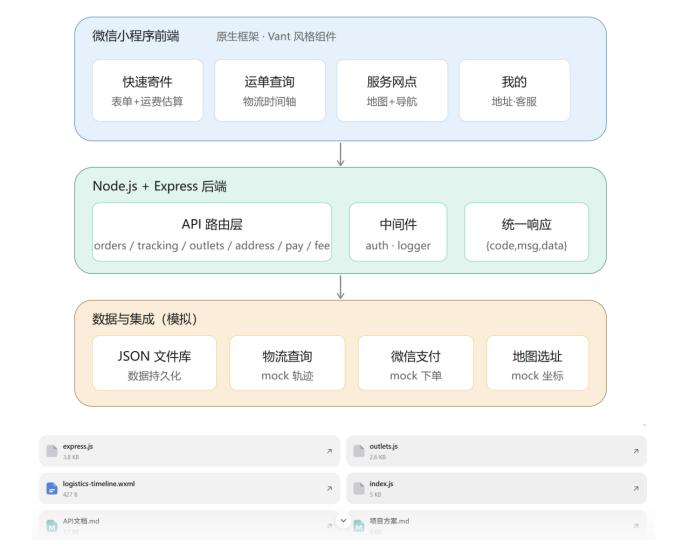
For example, when I asked Hy3 to develop an express delivery mini-program for me, it output not only the front-end and back-end code, but also the APIs, data structures, and project plan all together.
There is actually an interesting detail here: the native AI assistant "Xiaowei" launched by WeChat not long ago also has the ability to generate mini-programs through natural language.
For example, as shown in the image below, I asked Xiaowei to generate a dedicated article recording assistant for Letter AI.

However, the model behind Xiaowei is not Hy3, but WeChat's self-developed WeLM and DeepSeek-v4. Daily interactions are handled primarily by WeLM, while complex reasoning tasks call on DeepSeek.
On May 15, the "Growth Plan" for WeChat Mini Programs completed a model upgrade, fully adopting the Hy3 preview model.
On June 8, WeChat released the "Guidelines for Developers to Access the WeChat AI Ecosystem", officially opening up AI ecosystem access capabilities to mini-program developers. Leading platforms including Meituan, Didi, JD.com, and Tuhu Tire, and Ctrip have announced their cooperation with Tencent in the AI Agent domain.
Perhaps in the field of mini-program development, the scenario where developers use Hy3 and ordinary users use WeLM+DeepSeek is