Surpassing the Journey | WAIC 2026 Theoretical Breakthrough: Taking Dual Empowerment of Mathematical Reasoning as the Key to Open a New Journey of AI Paradigm Innovation

At WAIC 2022, Shing-Tung Yau, the first Chinese recipient of the Fields Medal, put forward a highly forward-looking core assertion: "Mathematics is the cornerstone of the development of artificial intelligence technology, and in turn, the advancement of artificial intelligence can also provide critical support for mathematical research." This underlying logic of two-way empowerment between mathematics and digital intelligence has long been validated by top international academic conferences such as AAAI and ACM (Association for Computing Machinery), as well as leading international journals including Nature.
Currently, the drawbacks of the extensive development of the AI industry have become prominent. The iteration model that relies solely on parameter stacking and computing power overdraft has reached its theoretical ceiling. Industry pain points of large models, such as weak interpretability, unclear emergence mechanisms, and insufficient robustness, are essentially caused by the lack of a fundamental mathematical and physical system for AI and the lag in the iteration of basic theories.
At present, the two-way integration of mathematics and digital intelligence has produced a large number of implementable and traceable outcomes. Mathematical theories such as convex optimization, probability and statistics, and functional analysis have effectively solved engineering challenges of large models including overfitting, poor generalization, and redundant computing power. Intelligent systems such as DeepMind AlphaGeometry, FunSearch, and AlphaProof have broken through the upper limits of traditional manual research in the fields of geometric reasoning, combinatorial mathematics, and formal proof. Mathematician Hong Wang, who has long dedicated her research to harmonic analysis and geometric measure theory, has filled the algorithm gaps in AI image processing and image denoising by proving the 3D Kakeya conjecture and optimizing Fourier analysis techniques, providing solid mathematical and physical support for the optimization of visual models.
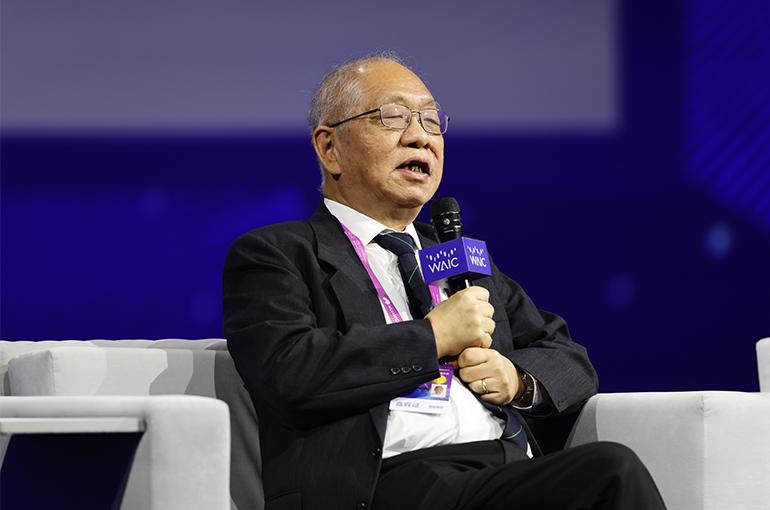
Shing-Tung Yau at WAIC 2024
As the top vane of the AI industry, 2025 WAIC launched the top-level academic dialogue "The Question of Mathematics". The event was proposed by Academician Shing-Tung Yau, with multiple domestic large models solving problems on site, breaking away from shallow engineering competitions, returning to the first principle of AI, and completing in-depth speculation on the mathematical and physical boundaries and underlying reconstruction of AI.
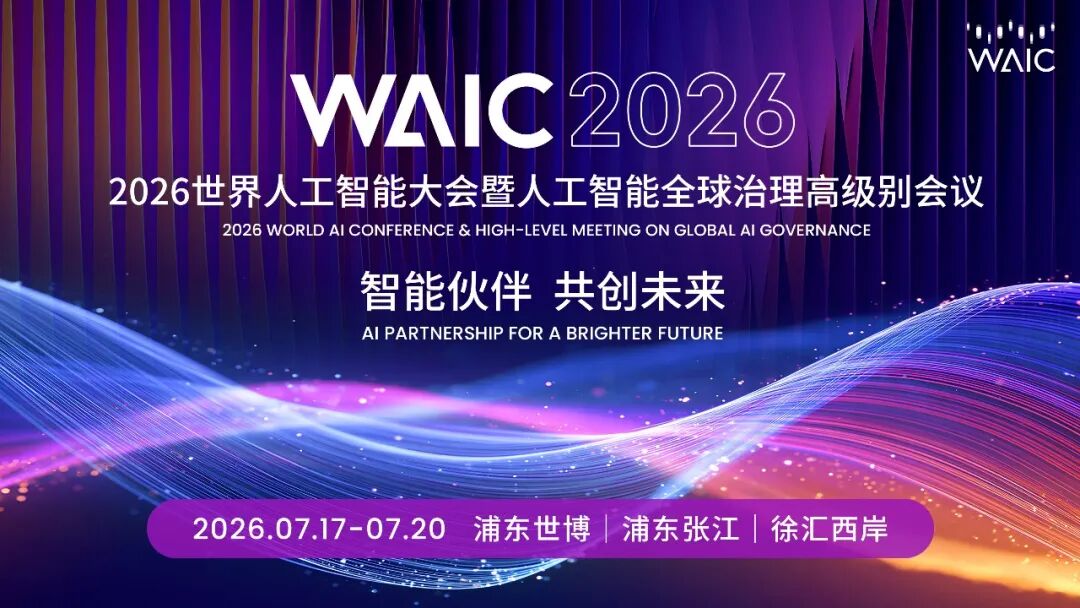
WAIC 2026, which is about to kick off from July 17 to 20, takes the original innovation of basic theories as its core axis and establishes three core themes: Math for AI, AI for Math, and AI+Mathematics Implementation in the Real World.
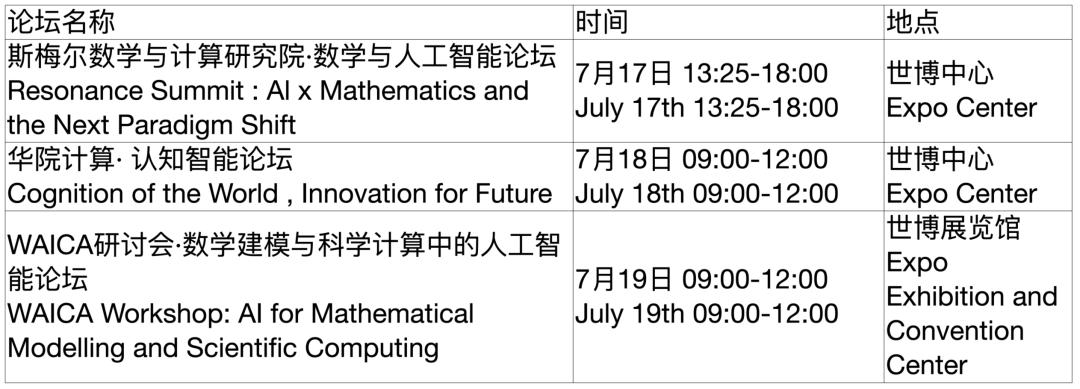
The conference brings together three high-end academic sections: the Smale Forum on Mathematics and Artificial Intelligence, the Huayuan Computing Cognitive Intelligence Forum, and the WAICA Symposium on Mathematical Modeling and Scientific Computing. The three platforms complement each other's advantages and interact across disciplines, consolidating the underlying architecture of AI with mathematics, lowering the threshold of mathematical research with AI computing power, and promoting the domestic AI industry to move from engineering application iteration to a new stage of coordinated development of theoretical innovation and industrial implementation.
Math for AI: Building a Foundation with Mathematical Axioms to Reconstruct the Underlying Scientific Paradigm of AI
A number of authoritative studies from AAAI, ACM (Association for Computing Machinery) and Communications of the ACM have confirmed that the modern mathematical system is the core starting point for breaking through the technical bottlenecks of large models and promoting AI to evolve towards "Scientific Intelligence".
In terms of model optimization, convex optimization and non-convex optimization reconstruct the training logic of large models, eliminating inefficient trial-and-error training. Probability statistics and information theory standardize the Transformer attention mechanism, greatly improving the accuracy of multimodal matching. Tools such as functional analysis and partial differential equations effectively solve technical difficulties of AI including high-dimensional denoising, complex scene modeling, and nonlinear fitting.
A number of public experimental results have fully verified the value of mathematical empowerment: the test-time reinforcement learning framework jointly developed by Tsinghua University and Shanghai AI Lab has greatly improved the performance of mathematical competition models; NVIDIA Nemotron-Math has realized the systematic upgrade of the mathematical reasoning ability of large models relying on a tens of millions-level mathematical reasoning dataset.
From the perspective of the first principle, AI intelligent modeling is an infinite-dimensional scientific problem, while all models implemented in industries are finite-dimensional engineering architectures. The dimensional contradiction between the two is the core crux of AI's long-term reliance on empirical parameter tuning, insufficient controllability and interpretability. The core value of Math for AI is to build a deducible, verifiable and traceable mathematical system, clarify the operating boundary of intelligence, and support the safe, general and scientific iteration of AI.
This year's Smale Institute of Mathematics and Computation · Forum on Mathematics and Artificial Intelligence is the core position for tackling the basic theories of AI. The forum brings together top academicians and scientific research teams at home and abroad to focus on in-depth discussions on breaking through underlying theoretical bottlenecks.
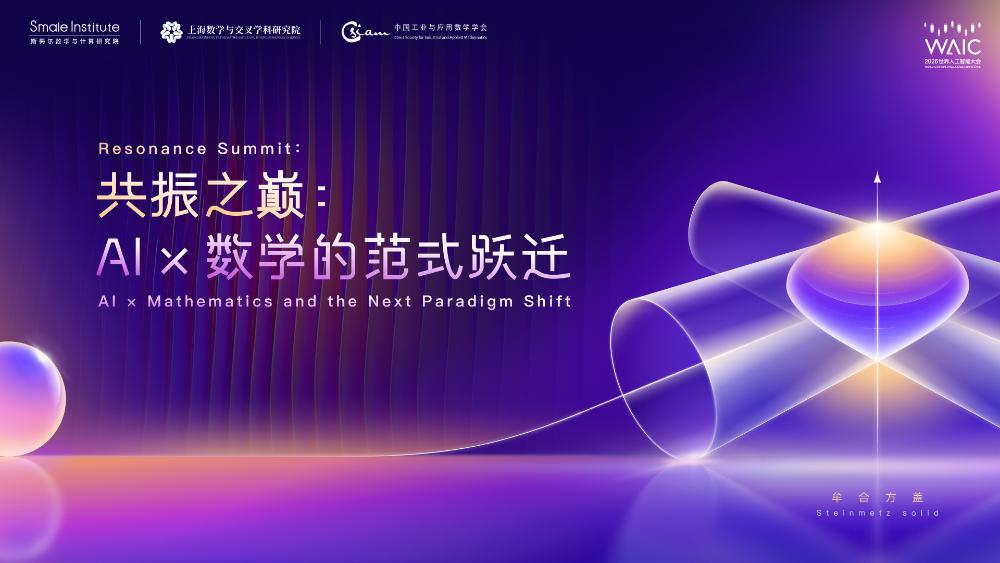
Smale Institute of Mathematics and Computation · Forum on Mathematics and Artificial Intelligence
Academician Zongben Xu will deeply dissect the core contradiction of AI: "Infinite-dimensional scientific propositions and finite-dimensional engineering technologies", analyze the mathematical and physical mechanisms of the scaling law and intelligent emergence of large models, and provide theoretical basis for model architecture optimization and performance evaluation. Authoritative scholars including Weinan E, Bin Dong, and Shi Jin will share cutting-edge achievements such as the integration of differential equations and neural networks, and complex system modeling, to improve the complete mathematical system of AI causal modeling, robust optimization, and safety risk control.
The forum features special sessions such as the Youth-Blue Dialogue and Roundtable Speculation, inviting well-known scholars at home and abroad including Jianqing Fan and Dacheng Xiu together with young scientific researchers to focus on tackling issues such as high-dimensional data modeling, mathematical optimization of intelligent algorithms, and theoretical engineering transformation, continuously optimizing the extensive R&D mode of AI, and helping models achieve interpretable mechanisms, controllable performance and optimizable iteration.
AI for Math: Empowering with Intelligent Computing Power to Reshape the Scientific Research Paradigm of Fundamental Mathematics
The value of AI empowering fundamental mathematics has been recognized by the global academic community, effectively breaking through the research limitations of traditional manual deduction and reshaping the scientific research paradigm of modern mathematics.
A number of benchmark achievements have been put into practical use: DeepMind AlphaGeometry has achieved IMO-level geometric reasoning capabilities, and AlphaEvolve has advanced the century-old kissing number problem research; the Peking University AI4MATH team has successfully falsified the Anderson conjecture that had been suspended for more than ten years, completed standardized formal verification, and the results were published in Nature.
Traditional mathematical research is restricted by manual deduction and limited computing power, leading to low efficiency in tackling complex problems. With efficient computing power, parallel deduction and intelligent law mining capabilities, AI breaks through the bottleneck of traditional scientific research methodologies and builds a brand-new human-machine collaborative mathematical research system.
Continuing the human-machine collaborative innovation concept of "The Question of Mathematics" in 2025, WAIC 2026 continues to deepen the interdisciplinary research of mathematics and digital intelligence. This year's Huayuan Computing · Cognitive Intelligence Forum focuses on cutting-edge tracks such as automated theorem proving, formal mathematics, mathematical large models, and symbolic-numerical hybrid reasoning, and deeply cultivates AI-assisted original mathematical innovation.
Well-known scholars at home and abroad including Manuel Blum and Jianqing Fan will interpret the innovative paths for intelligent technologies to solve complex mathematical problems. Dr. Wei Tang will combine the cutting-edge practices of AI for Science to share the implementation outcomes of intelligent tools empowering fundamental mathematical research, providing a new paradigm reference for global interdisciplinary research.
Huayuan Computing · Cognitive Intelligence Forum
This year's WAIC collaborates with Tongji University to launch the WAICA Symposium on Mathematical Modeling and Scientific Computing. The conference breaks down the disciplinary barriers between artificial intelligence, applied mathematics, scientific computing and engineering, and provides new AI-driven solutions for complex system modeling, partial differential equation solving, and high-precision scientific simulation.
The symposium focuses on core directions such as physics-informed neural networks, neural operators, and data-physics hybrid driving, taking into account both theoretical innovation and scenario implementation, and exploring the large-scale application of AI in engineering simulation, digital twins, and climate simulation. Relying on diverse academic exchange forms, the conference tackles core challenges in the interpretability, generalization, and error control of AI scientific computing, and builds a high-level international exchange platform for the integration of mathematics and digital intelligence.
AI+Mathematics Implementation: Empowering with the Integration of Mathematics and Digital Intelligence to Realize the Industrial Closed Loop of Theoretical Value
Nowadays, the integration of mathematics and digital intelligence has evolved from theoretical exploration to large-scale industrial implementation. Mathematical tools such as harmonic analysis, numerical calculation, and topological modeling continue to optimize AI performance, effectively improving the accuracy and stability of tasks such as industrial vision, medical imaging, meteorological simulation, and multimodal fusion.
At the same time, AI's capabilities of efficient solving, intelligent simulation and complex deduction have greatly reduced the cost of mathematical modeling in the fields of high-end manufacturing, intelligent risk control, and aerospace, breaking through the transformation barriers from basic research to industrial applications.
Relying on three distinctive academic forums, WAIC 2026 builds a complete chain of "Mathematical Research - AI Iteration - Industrial Empowerment", promotes the standardized and high-precision implementation of cutting-edge mathematical and digital intelligence achievements, and empowers the development of the real economy with basic research.
A mature two-way innovation closed loop of mathematics and digital intelligence has been formed in the industry: mathematics consolidates the underlying foundation of AI, and AI broadens the research boundaries of mathematics.
From the launch of mathematical speculation through "The Question of Mathematics" in 2025 to the full implementation of three major innovation themes in 2026, the domestic AI industry has officially bid farewell to the involution of parameters and computing power, and entered a refined development stage driven by mathematics, human-machine collaboration, and industry-research integration. Relying on Shanghai's science and innovation resources and the WAICA international platform, global scientific research forces work together to continuously consolidate the academic and industrial ecosystem of the integration of mathematics and digital intelligence.
From July 17 to 20, WAIC 2026 is about to kick off in Shanghai. The conference will gather top scholars from all over the world, debut cutting-edge achievements in the integration of mathematics and digital intelligence, unlock new paradigms of AI mathematical innovation, and continuously promote the coordinated implementation and iterative advancement of artificial intelligence and fundamental mathematics.
Appendix: WAIC 2026 Mathematics Forums