1600 lines of code create an underwater Manhattan, Fable 5 leaves Karpathy stunned
[Introduction] Fable 5 is back online. In a new video, Gostev from Arena.ai demonstrated 63 3D worlds, nearly all generated in a single attempt. Even Karpathy, who recently joined Anthropic's pre-training team, was left utterly astonished after watching the footage.
A bear stands by the riverbank and clamps its jaws around a leaping salmon.
The fish struggles frantically in its mouth.
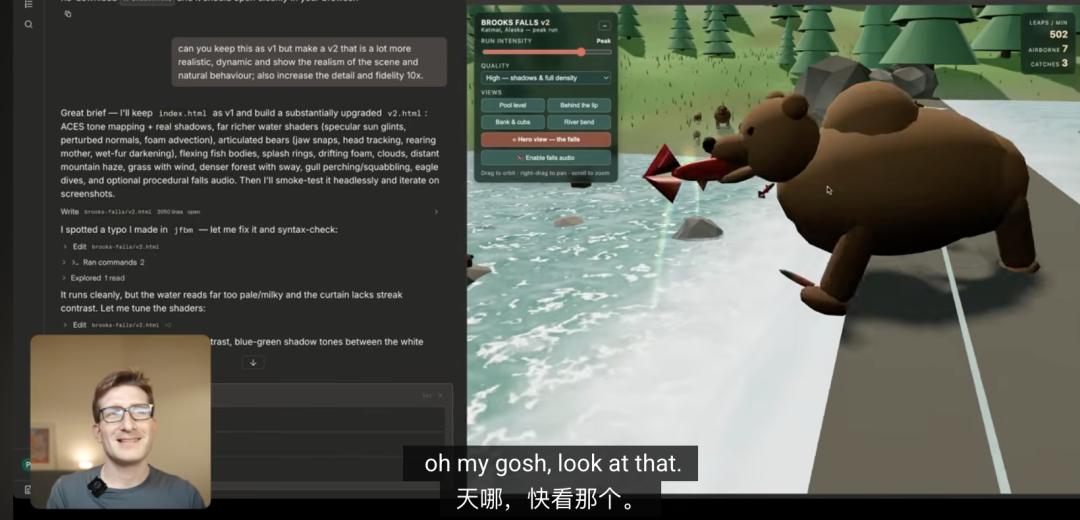
This exact scene left Andrej Karpathy completely stunned.
After going through this collection of 3D clips, he shared in a post on X:
This is absolutely mind-blowing. I never realized a model could create such incredibly vivid, rich, and fully interactive playable worlds.
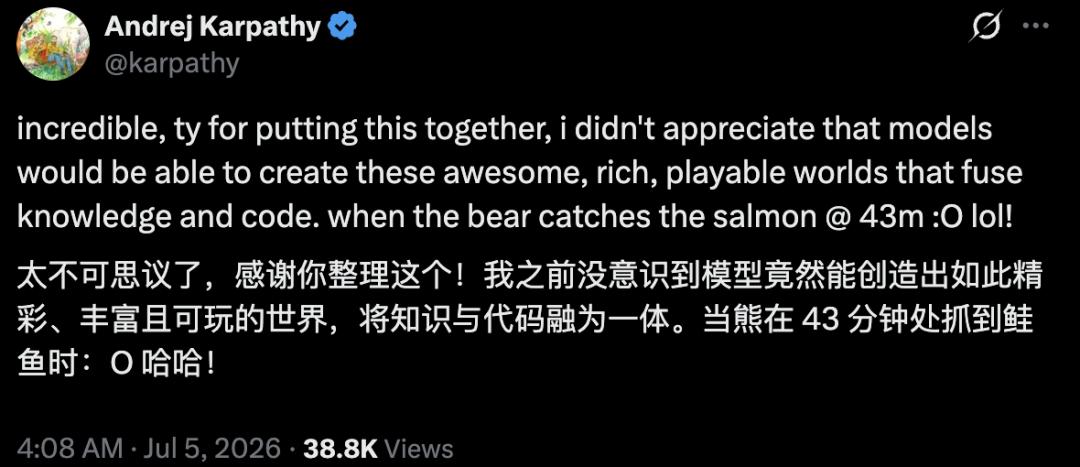
He even coined a brand new term in the post: fablemaxxing.
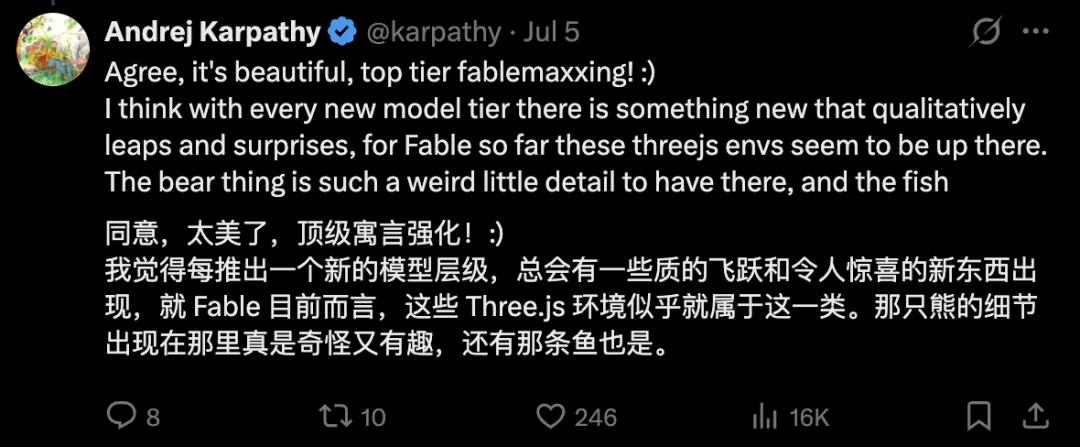
This is stunning, peak fablemaxxing! Every new generation of model always brings something entirely new that delivers a qualitative leap and total surprise.
Karpathy joined Anthropic back in May this year, landing a spot directly on their pre-training team.
Fable 5 first launched in June, only to be halted three days later by U.S. export control restrictions, before finally getting the green light again on July 1. The video's creator is Peter Gostev, from the AI evaluation platform Arena.ai.
He pushed Fable 5 to generate 63 high-difficulty 3D creations in one go, almost all built on Three.js, with the vast majority generated perfectly on the first try.
Just over a month ago, getting an AI to produce a fully explorable, playable 3D world in a single generation was nothing short of a fantasy. Now, Fable 5 can churn out 63 of them in a single session.
As a result, Gostev couldn't help but remark in his video that even the teams behind the model haven't fully uncovered its full capabilities yet.
1,600 Lines of Code Power a Living Underwater Manhattan
Let's start with the most unforgettable creation from the video.
The entire island of Manhattan is submerged underwater. Central Park, skyscrapers, street textures, all rendered with an absurd level of intricate detail that feels nearly impossible.
Gostev checked the underlying code, and it only came out to 1,600 lines. That small snippet of code is all it takes to power a fully dynamic, living underwater city.
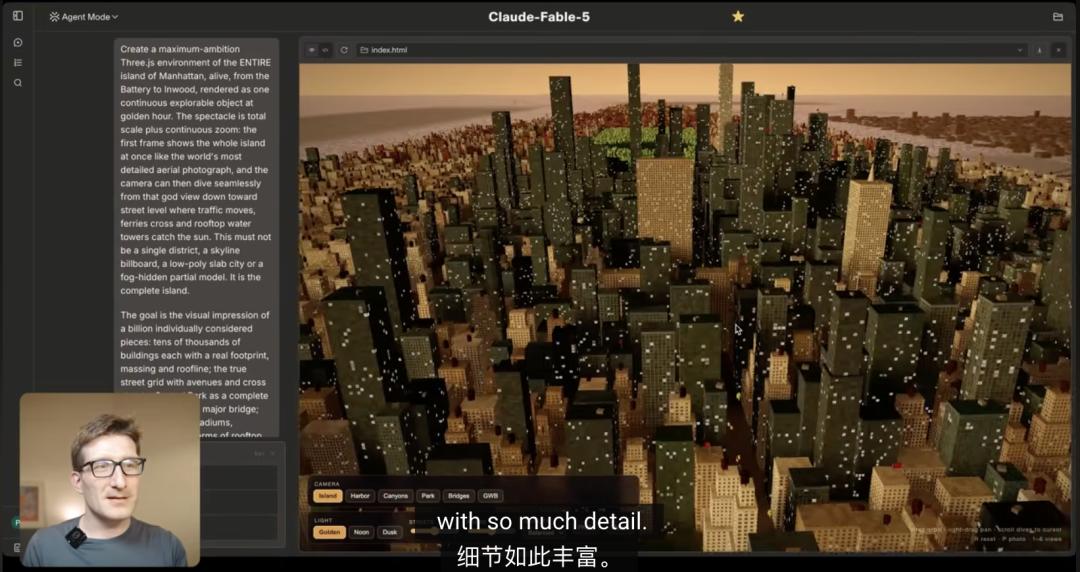
Fable 5-generated Manhattan, with the full island visible from Battery to Inwood, with tens of thousands of distinct building outlines all powered by just 1,600 lines of code. (Source: Peter Gostev's video)
Gostev created a total of 63 such distinct worlds, grouped into 6 core thematic categories.
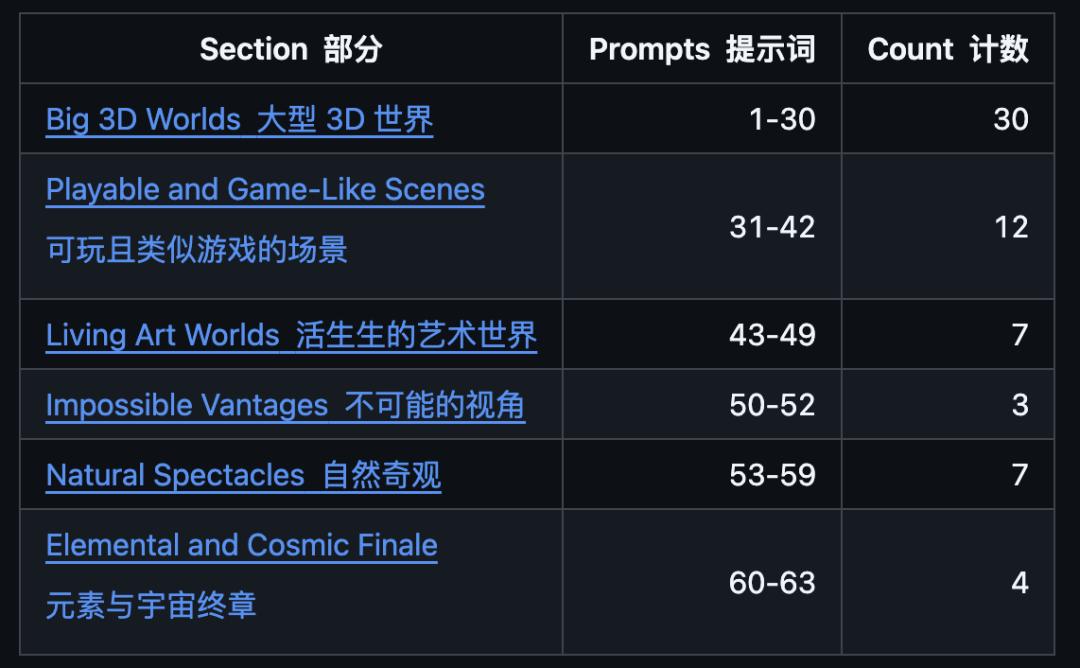
Within the massive 3D worlds category, cross-continental Istanbul spanning Europe and Asia, London evolving across 2000 years, grand ancient pyramids, the erupting Mount Vesuvius over Pompeii, and the traffic-packed Golden Gate Bridge were all constructed from scratch;
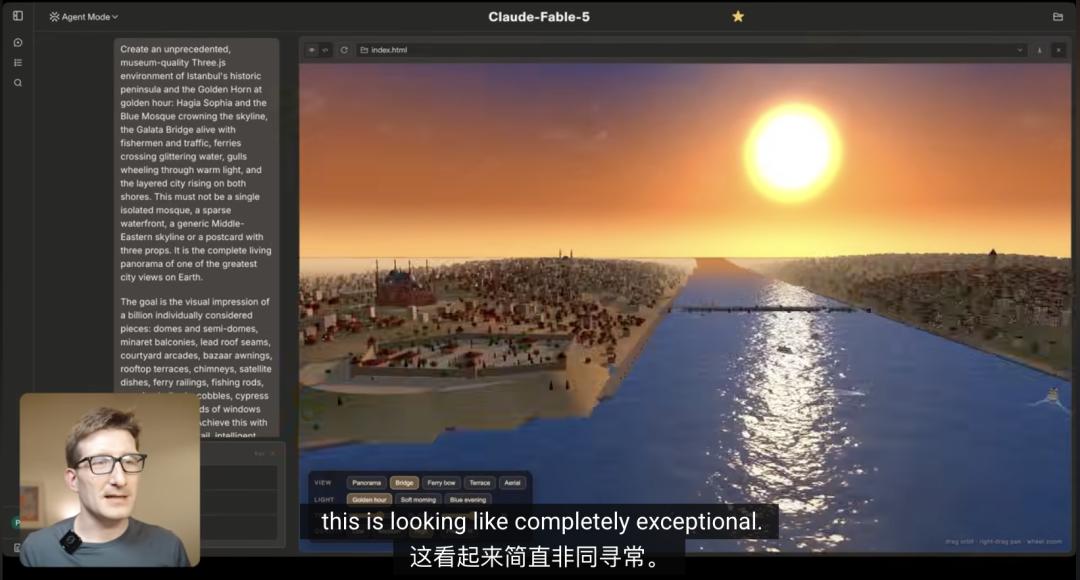
Fable 5 generated Istanbul in a single pass, stretching across two continents and cascading toward the sea. (Source: Peter Gostev's video)
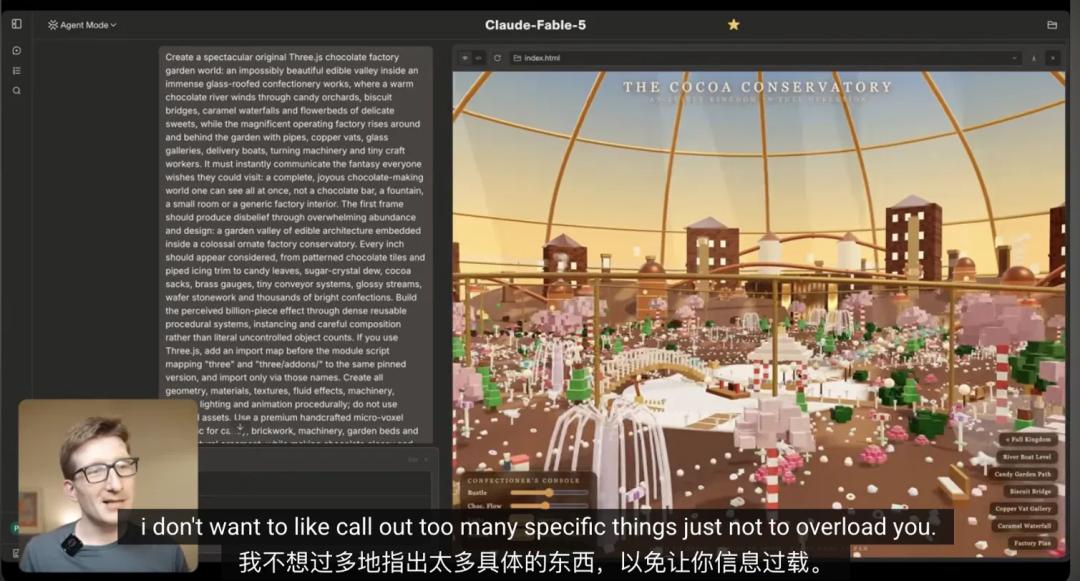
Fable 5's edible kingdom world, a chocolate factory built entirely out of candy. (Source: Peter Gostev's video)
The interactive, playable scenarios include New York rooftop parkour, a physics sandbox where you can demolish an entire city, and a fully functional flight simulator with complete cockpit controls.
The most astonishing category turns iconic masterpieces of art into explorable 3D spaces. Van Gogh's Starry Night, Monet's Water Lilies, each transformed into immersive worlds you can walk through.
There's also a category focused on impossible perspectives: a 1mm-tall ant observing a garden in the rain, suddenly coming face to face with an entire mountain made of solid gold.
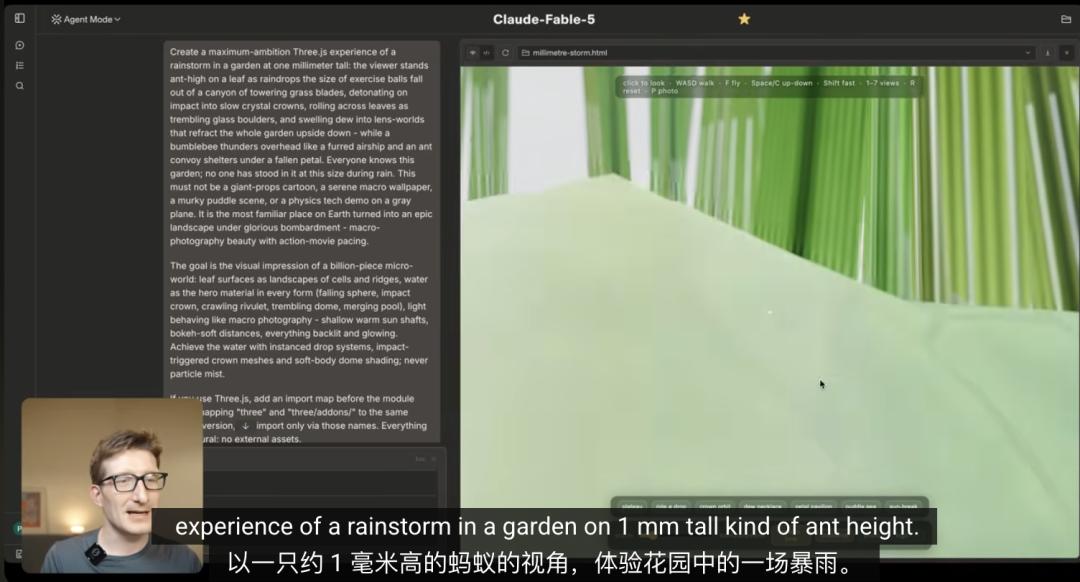
Fable 5 drops the perspective down to 1mm height, turning ordinary grass blades into towering mountain peaks. (Source: Peter Gostev's video)
Under natural wonders, you'll find Niagara Falls, forests filled with synchronously flashing fireflies, and the exact bear-salmon scene that left Karpathy so impressed.
Finally, the elements and cosmos category features the split Red Sea, a newly forming volcanic island, and a space elevator piercing straight through the clouds into orbit.
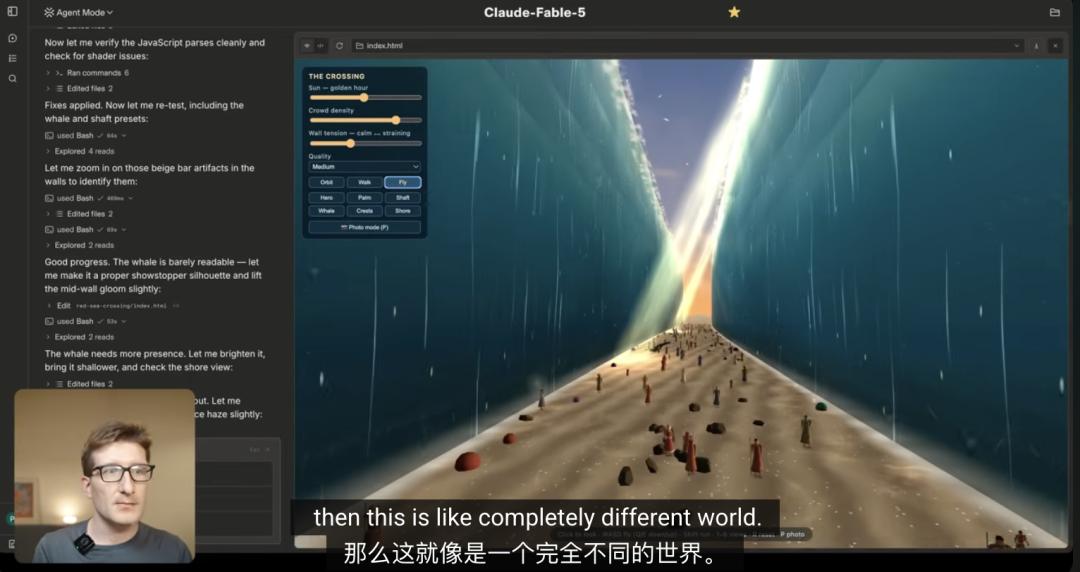
Fable 5 renders the Red Sea split down the middle, letting visitors walk between two towering walls of water. (Source: Peter Gostev's video)
For Gostev, making a single scene look visually appealing was never the real challenge. The hard part is whether the model can manage massive volumes of interconnected elements all at once, and keep them perfectly coordinated with each other.
Weaker models can often nail the first 80% of a scene decently, but completely fall apart in the final 20%, leading to far more time spent debugging than the generation itself.
It Can't Just Copy a Painting - It Has to Truly Understand It First
If generating realistic cities still follows logical rules, this next batch of art-inspired worlds is what made Gostev repeatedly say "unbelievable" over and over.
Van Gogh's Starry Night.
You can't just directly copy a painting like this, with thick impasto paint layered across the canvas, each brushstroke swirling into distinct spirals.
What Fable 5 does instead is reconstruct that exact starry sky in 3D space using thousands of individual independent strokes, then let you fly right into the scene and navigate through the swirling vortexes.
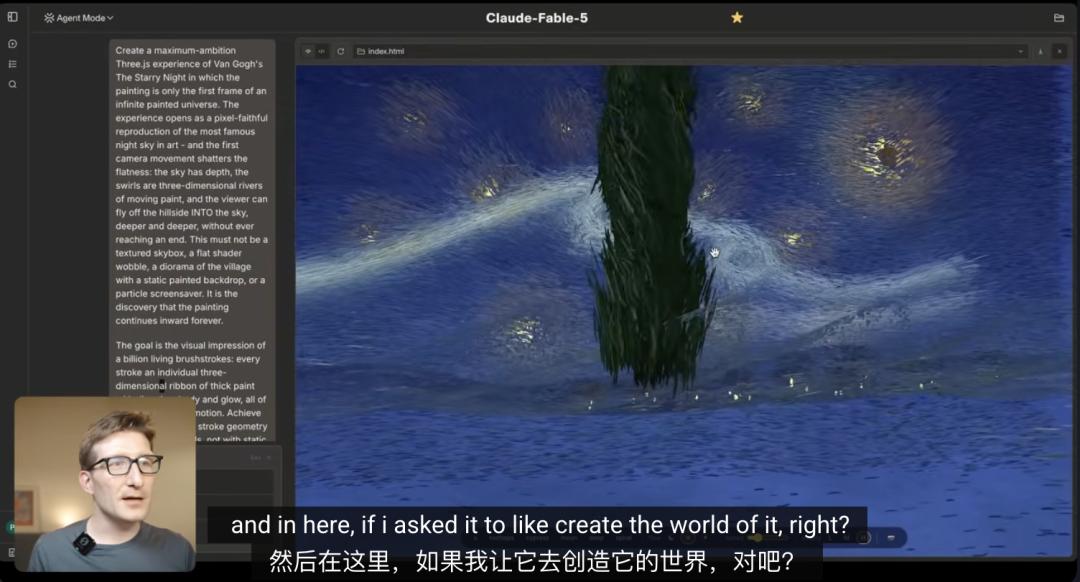
Fable 5 breaks Van Gogh's Starry Night into individual 3D strokes, reassembles it in volumetric space, and lets you fly through the swirling stars and vortexes. (Source: Peter Gostev's video)
Monet's Water Lilies and Hokusai's Great Wave off Kanagawa were similarly "unfolded" into fully explorable walkable worlds.
According to Gostev, Fable 5 stands out especially for its ability to clearly explain how things work, demonstrating the concept while articulating its underlying mechanics at the same time. This explanatory power was something he never anticipated before testing it.
Of course, none of these worlds are generated from a single short prompt.
Gostev fed the model long, detailed specification documents, with most cases generating perfectly on the first try, and only a small portion requiring one or two rounds of minor tweaks.
The real breakthrough is that what used to take a dozen iterations to refine now can be generated as a complete HTML file, mostly in a single attempt.
Even With All Its Magic, It Still Has Limitations
Gostev openly admits that the showcased 63 examples are curated. He generated roughly 20% more total content than what he presented, filtering out all outputs with obvious bugs to leave this polished final set.
Full-fledged games are still its weak point.
He acknowledges that the few playable scenarios he included "get boring after 30 seconds of play." One Roman Empire-themed version he tested felt overly cartoonish for his taste.
More subtly, he noticed the model sometimes seems to hold back, acting lazy and hiding its full potential - you have to repeatedly push it to be more ambitious before it delivers its absolute best work.
When Fable 5 launched, it immediately claimed the top spot on Arena.ai's own Agent Arena leaderboard by the largest margin in the platform's history.
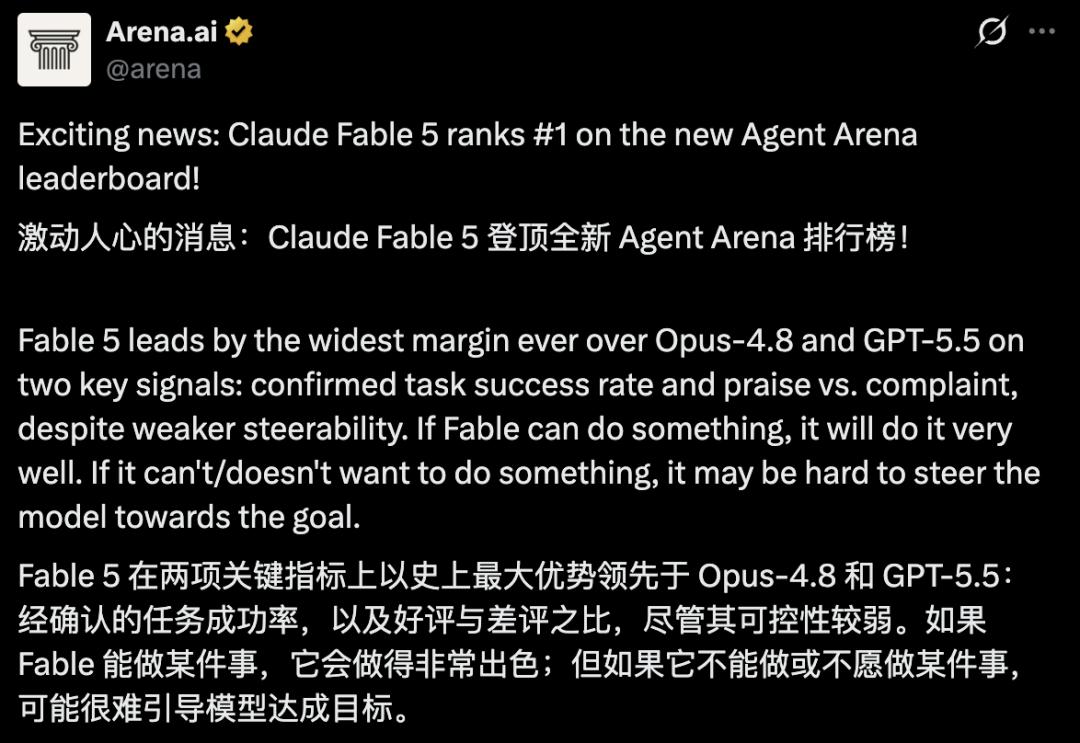
Arena.ai states that this leaderboard measures a model's actual success rate at completing real-world tasks across millions of test cases.
This Journey of Exploration Has Only Just Begun
Let's circle back to that bear catching salmon scene from the original video.
What puzzled Karpathy is the detail of the fish struggling after being bitten - a completely unprompted, unrequested nuance. How does a large model that only learned from internet data even know that this behavior exists?
And once it understands that concept, how does it translate that knowledge into XYZ coordinates, meshes, transformations, animations, visual effects, interactions, and even tiny self-contained micro-stories?
This question goes far beyond "how well can AI draw," and cuts straight to the core of "how much does this model truly understand?"
Karpathy also reflected that it's impossible to even imagine what could be built once we add 1 to 3 more generations of model improvements on top of this.
Gostev is equally astounded by the rapid pace of AI progress, saying "Don't limit your expectations based on models from six months ago. You might not care about 3D generation, but there's definitely something you work on that old models couldn't do, that this one can. Go try it."
Even the teams that built these models haven't fully mapped out their boundaries yet.
This entire journey of exploration has only just started.
References:
https://github.com/petergpt/3d-prompt-collection#prompt-01
https://x.com/karpathy/status/2073505440479293773
https://www.youtube.com/watch?v=rTc2_-1KuRE&t=14s
This article is originally published on the WeChat Official Account "Xinzhi Yuan", authored by ASI Revelation; edited by Yuan Yu, and republished by 36Kr with official authorization.