Just now, DeepMind's classic masterpiece has once again reached new heights, and the ICML 2026 grand award winners have been announced
The Distinguished Paper Awards of ICML 2026 have been officially announced. Two papers on diffusion models have topped the list, and many of the authors are Chinese.
The big awards of ICML 2026 are announced!
The Distinguished Paper Award and the Test of Time Award of ICML have been officially announced.
Among them, a total of 9 papers have been shortlisted for the Distinguished Paper Award, including 7 research papers and 2 position papers. Finally, there are 3 winners and 6 honorable mentions; the Test of Time Award of ICML goes to the field of reinforcement learning, and a classic masterpiece of DeepMind is crowned again.
The complete list of award winners:
https://blog.icml.cc/2026/07/05/announcing-the-icml-2026-awards/
ICML, the full name of which is the International Conference on Machine Learning, is one of the three top conferences in the field of AI, along with NeurIPS and ICLR. The number of submissions exceeds 10,000 every year, and the acceptance rate is less than 30%.

From July 6th to 11th, 2026, ICML 2026 will be held at the COEX Convention and Exhibition Center in Seoul, South Korea.
The Distinguished Paper Award is the Oscar in the field of machine learning.
The value of this list is not only to recognize technical contributions but also to send a directional signal to the entire field.
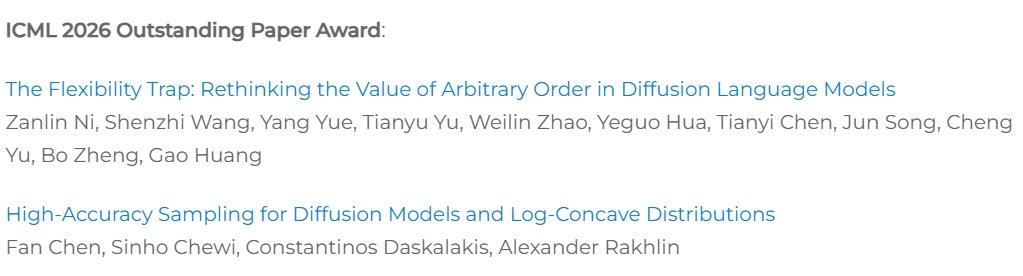
Diffusion models are the biggest winners this year. Two related papers have won the Distinguished Paper Award:
The Flexibility Trap: Rethinking the Value of Arbitrary Order in Diffusion Language Models. This masterpiece deeply analyzes the key mechanisms in diffusion large language models.
High-accuracy sampling for diffusion models and log-concave distributions: A major breakthrough has been achieved in algorithm accuracy.
The Distinguished Paper Award for Position Papers describes a strange phenomenon in the field of AI security: the alignment community is inadvertently building a set of auditing toolkits.

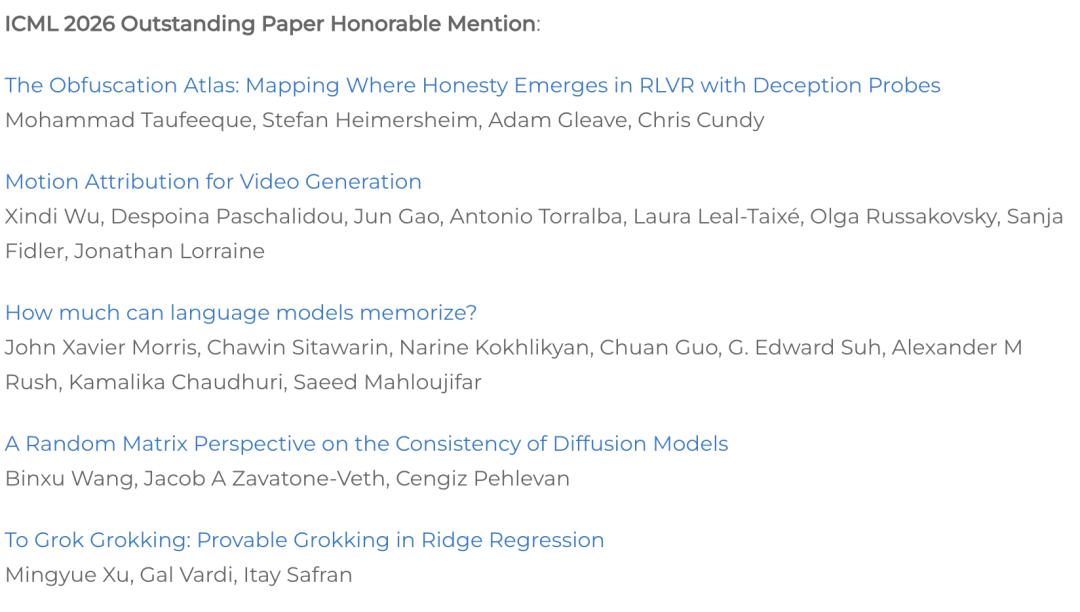
Five research papers have received honorable mentions for the Distinguished Paper Award:
- The Obfuscation Atlas: Mapping Where Honesty Emerges in RLVR with Deception Probes
- Motion Attribution for Video Generation
- How much can language models memorize?
- A Random Matrix Perspective on the Consistency of Diffusion Models
- To Grok Grokking: Provable Grokking in Ridge Regression
A position paper has received an honorable mention for the Distinguished Paper Award:
Position: AI/ML Deepfake research is at odds with AI-generated non-consensual intimate images (AIG-NCII)

Finally, the Test of Time Award goes to the absolute hit of that year:
Asynchronous Methods for Deep Reinforcement Learning

Congratulations to the above award winners.
Diffusion models sweep the Distinguished Paper Awards. Behind the double win is a new consensus
The two winning papers of the Distinguished Paper Award are both centered around diffusion models.
It is rare in the history of ICML for two papers in the same direction to win awards simultaneously. Behind this coincidence seems to be a collective judgment: diffusion models have entered a stage that requires "correction" and "infrastructure improvement".
The first paper is from the team of Huang Gao at Tsinghua University and Zanlin Ni et al. The title is very aggressive: "The Flexibility Trap: Rethinking the Value of Arbitrary Order in Diffusion Language Models". Just by looking at the title, you can tell that it's here to challenge the status quo.
Title: The Flexibility Trap: Rethinking the Value of Arbitrary Order in Diffusion Language Models
ICML: https://icml.cc/virtual/2026/oral/71086
Project homepage: https://nzl-thu.github.io/the-flexibility-trap/
Let's first explain the background.
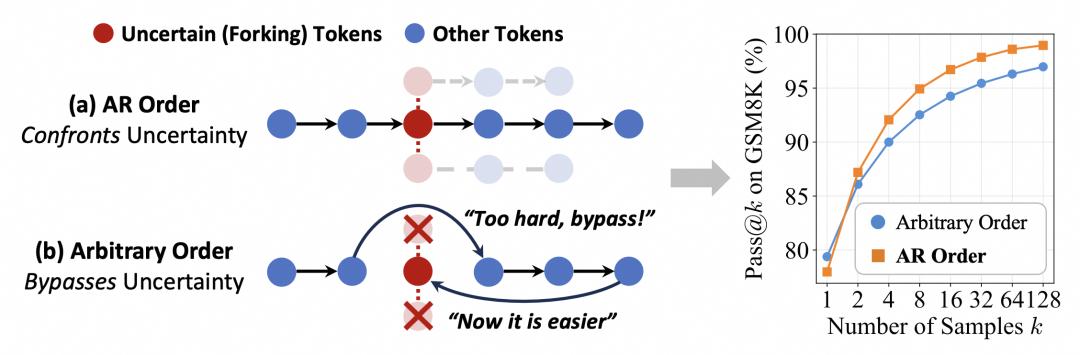
Diffusion large language models are one of the hottest research directions at present. Different from autoregressive models like GPT and Claude, diffusion language models do not generate text token by token from left to right. Instead, they gradually "denoise" a complete text from a cloud of noise, just like painting.
Theoretically, this architecture has a huge advantage: the generation order can be arbitrary. You can write the middle part first and then the beginning, or determine the conclusion first and then supplement the arguments. It doesn't matter.
It sounds great. But the paper by Ni et al. poured cold water on it.
They proved through a large number of experiments that the so-called "arbitrary order generation" not only failed to bring the expected benefits in actual training but also became a trap.
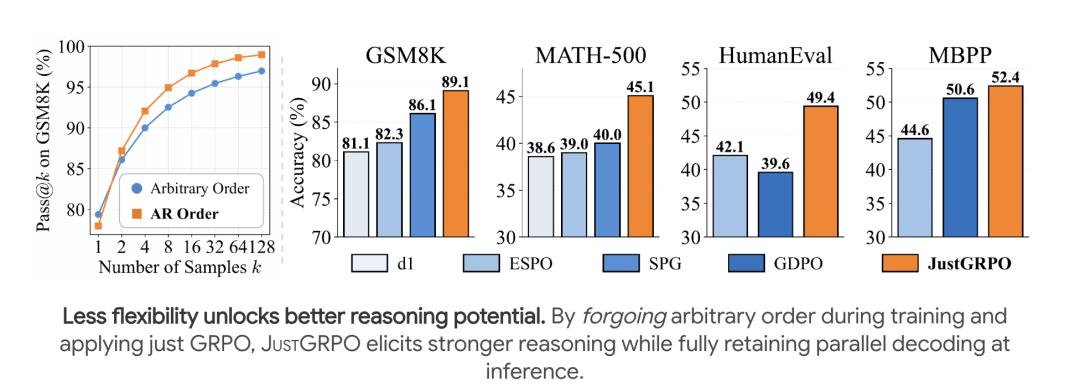
Flexibility itself comes at a cost. In order to support all possible generation orders, the model performs worse in each specific order.
The impact of this conclusion is that it shakes the core selling point of diffusion language models.
In the past two years, a large number of papers have regarded "arbitrary order" as the key argument for diffusion LLMs being superior to autoregressive LLMs. Many teams have invested a large amount of computing power in experiments based on this assumption. Now, the official of ICML has confirmed that this argument is not valid.
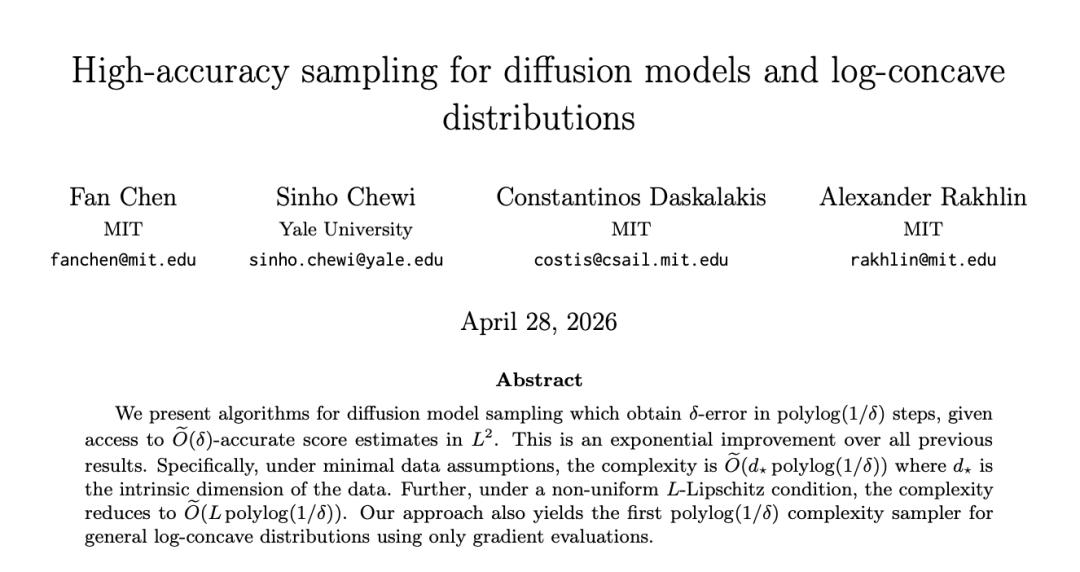
The second winning paper is from Fan Chen et al., focusing on the sampling accuracy of diffusion models.
Title: High-accuracy sampling for diffusion models and log-concave distributions
ICML: https://icml.cc/virtual/2026/oral/71132
Preprint: https://arxiv.org/abs/2602.01338
They proposed a higher-precision sampling method for diffusion models and log-concave distributions.
It solves the underlying bottleneck of the "theoretical upper limit of generation quality" in the actual deployment of diffusion models.
One paper dismantles the core assumption, and the other raises the technical ceiling.
ICML rewards both destruction and construction at the same time. The signal is clear: diffusion models are moving from "proof of concept" to the "deep water area". What is needed is no longer more tricks but a calmer review and more solid infrastructure.
The most explosive award goes to the sharpest criticism
Let's get back to the paper that silenced the whole audience.
"Position: The Alignment Community is Unintentionally Building a Censor’s Toolkit" by Sarah Ball and Phil Hackemann won the Distinguished Position Paper Award.
Title: Position: The Alignment Community is Unintentionally Building a Censor’s Toolkit
ICML: https://icml.cc/virtual/2026/oral/71119
Paper: https://openreview.net/pdf?id=dy2HwmOvFX
The Position Paper Award of ICML is specifically awarded to articles that do not conduct experiments or run data but raise fundamental questions about the direction of the field.
The core argument of this paper is straightforward and harsh: the researchers in the current field of AI safety and alignment aim to make AI safer and more controllable. However, the technical tools they have developed, such as RLHF, Constitutional AI, and value alignment frameworks, are being systematically misappropriated as the infrastructure for content censorship.
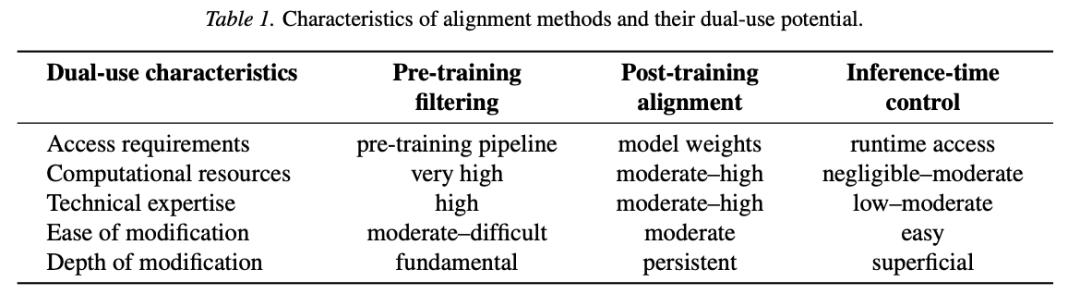
People working on alignment think they are building a safety lock. But the design drawing of this lock can also be used to build a prison cell.

This judgment is not groundless. In the past year, the controversy surrounding AI content censorship has been heating up. From Claude's refusal to answer strategy to ChatGPT's content filtering mechanism, "over-alignment" has become a frequently used word for users to complain about.
Every few weeks, you can see someone posting screenshots on social media: clearly it's a normal academic discussion or creative need, but the AI refuses to answer on the grounds of "safety".
Ball and Hackemann have brought this user-level resentment to the academic level: this is a structural risk inherent in the research paradigm itself.
ICML awarding the Best Position Paper to this article is an attitude in itself. The top conference is telling the entire alignment community: you need to stop and think about who is using the tools in your hands and in what way.
Incidentally, the honorable mention for the Distinguished Position Paper is also very sharp.
The paper by Li Qiwei et al. points out that there is a serious disconnect between Deepfake research in the AI/ML field and AI-generated non-consensual intimate images.

Researchers are busy detecting face-swapping videos of political figures but have ignored the abuse scenarios that cause the most harm to ordinary people.
A quick look at the honorable mentions
The 5 honorable mentions for the Distinguished Paper Award cover almost all popular directions, and each paper has opened up a new perspective in its own field.
Mohammad Taufeeque et al. used "deception probes" to map the emergence position of honesty in RLVR training.
Title: The Obfuscation Atlas: Mapping Where Honesty Emerges in RLVR with Deception Probes
ICML: https://icml.cc/virtual/2026/oral/71065
Preprint: https://arxiv.org/abs/2602.15515
Simply put, at which layer of the model does it learn to lie?
