The second-generation real estate heir's chip-making journey: Sinovo Technology's second attempt to list on the STAR Market, cracks beneath the global leader's aura
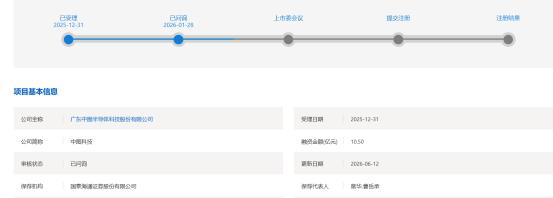
On the last day of last year, the IPO application of Guangdong Zhongtu Semiconductor Technology Co., Ltd. was accepted. This is its second attempt to list on the Science and Technology Innovation Board after an interval of five years. On June 12, information on the official website of the Shanghai Stock Exchange showed that Zhongtu Technology updated its prospectus to complete the financial data update and submitted the response to the first-round inquiry.
For the capital market, Zhongtu Technology is a semiconductor material company. But for people in Dongguan, from the name in the column of the actual controller in the prospectus, they read a completely different meaning: Chen Jianmin, the son of Chen Runguang of Everbright Group.
When did the "Everbright", which has built dozens of real estate projects and owns tens of thousands of properties in Dongguan, start to bet on the chip industry? When Zhongtu Technology, with the halo of "over 32% global market share", encounters issues such as a record of inaccurate information disclosure, dual binding of supply and sales, sudden dividends, and barely meeting the requirements for science and technology innovation attributes, the road to IPO is far more complicated than the story of "the second - generation real - estate heir venturing into the chip industry".
The Father Builds Buildings, the Son Makes Chips
In 1983, the year when Chen Jianmin was born, Chen Runguang, who came from a peasant family, started a construction team in Qiantou, Dongcheng. The "Qiantou Trading Company" was the predecessor of Guangdong Everbright Group.
From a construction team to a real - estate developer, from Jinghu Garden to Jinghu Bay, and then to the Tianjiao series and Times City, the name "Everbright" is almost engraved in every stage of the housing memories of middle - class families in Dongguan.
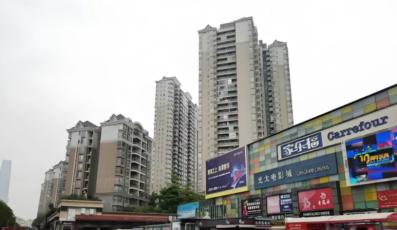
Especially Jinghu Times City, a benchmark project in Xiping that opened in 2009. With residential buildings, Caiyi Department Store, and Carrefour, it transformed an under - developed area into the "second city center" of Nancheng, Dongguan. At that time, when people in Dongguan talked about Everbright, they would say, "Where has another large - scale Everbright project opened?"
In that year, Chen Jianmin was 26 years old. He had just returned from studying in the UK for three years and was standing in front of the sand table of Times City, learning how to take over the blueprint from his father. It is said that this real - estate project was his first project to handle, and it also had a good reputation for its quality.
If the story had followed this script, it would have been a typical case of "the second - generation real - estate heir": the father builds buildings, and the son continues to do so, passing the business from one generation to the next. But things took a turn in his hands.
During the financial crisis in 2008, the main theme for most bosses in Dongguan was "survival". However, Chen Jianmin did something that outsiders couldn't understand at that time: he made a connection between Everbright and the Wide - Bandgap Semiconductor Research Center of Peking University.
In 2009, the two parties jointly established Dongguan Zhongjia Semiconductor Technology Co., Ltd. Zhongjia was mainly engaged in the production of gallium nitride substrate materials, which are the most "fundamental" materials in the semiconductor industry chain. At that time, there were numerous LED packaging factories in the Pearl River Delta. The profit per LED bead was only a few cents, and it was hard - earned money. But the substrate, the "foundation" on which the chips grow, was completely imported at that time, and the technology was controlled by a few companies in Japan and the United States.
It was unexpected that a family engaged in the real - estate business suddenly ventured into the most challenging part of the semiconductor industry. At that time, no one thought this could succeed.
But Zhongjia survived. Moreover, from this group of people, a core team that later supported Zhongtu Technology was formed. Kang Kai, the chairman and general manager, Zhang Neng, an engineer, and Lu Qianjun, the person in charge of the process, all emerged step by step from the Zhongjia system.
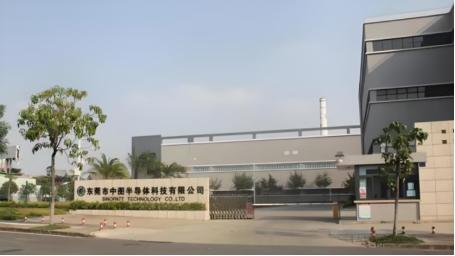
However, Zhongjia's technology was too advanced, so advanced that it was a bit far from the market. Gallium nitride homogeneous substrates are good products, but there are few customers, the verification cycle is long, and it requires a large amount of capital. Chen Jianmin obviously realized this problem. In December 2013, he established Zhongtu Technology at No. 4, North Second Road, Songshan Lake Industrial Zone.
Zhongtu Technology targeted the patterned sapphire substrate (PSS) market. As the epitaxial substrate for LED chips, it has a large demand, many customers, and the downstream products are mainly used in Mini/Micro LED displays, car lights, backlights, and general lighting.
Chen Jianmin's role is more like a "stage - setter". He invested money and directly holds 46.39% of the company's shares. He indirectly controls 33.27% through Zhongmin Holdings, with a total of 79.66% of the voting rights. But he doesn't sit in the office to manage daily operations. The one who really "performs on the stage" is Kang Kai, born in 1963, a professional in semiconductor physics and devices. In 2018, he participated in a project as the main contributor and won the second - prize of the National Technological Invention Award.
The combination of the second - generation real - estate heir providing funds and the experienced technical veteran running the business was formed.
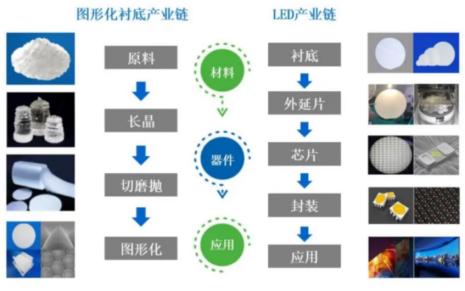
After ten years of development, by 2023, according to statistics from LEDinside, the company's global PSS market share was about 32.82%. Its direct customers include leading LED chip companies at home and abroad such as Formosa Epitaxy, Seoul Semiconductor, Sanan Optoelectronics, and Huacan Optoelectronics. The end - customers cover well - known brands such as Apple, Samsung, BYD, and NIO.
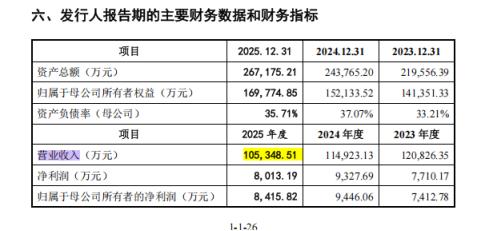
In 2025, the company's operating revenue was 1.053 billion yuan, and the net profit attributable to the parent company was 84.16 million yuan.
So far, everything seems logical: the second - generation real - estate heir crosses over into the semiconductor industry, the experienced technical veteran leads the way to break through, the global market share exceeds 30%, and the end - customers are well - known brands. This is almost a perfect narrative for a Chinese hard - tech IPO. However, under the halo of a 32% global market share, the cracks in Zhongtu Technology's operation are gradually emerging.
Cracks under the Glorious Surface of the "Small but Beautiful" Leader
A 32.82% market share is an awe - inspiring figure in any industry. However, looking closely, the global PSS market where Zhongtu is located has a total size of only 3 - 4 billion yuan.
In 2025, the company's revenue was 1.053 billion yuan, which means that as the global leader, Zhongtu has captured one - third of the market, and the ceiling is within reach. This is not a trillion - level track like CATL. It is a typical dilemma for a "small giant in a niche material market": it is indeed the leader, but the market it operates in is limited in size. This determines that Zhongtu's valuation model cannot tell a story of high - growth. Secondly, even in this niche track, the upward cycle has passed, and the financial data in Zhongtu Technology's prospectus is showing warning signs.
On the other hand, in 2025, Zhongtu's revenue decreased by 8.35% year - on - year, which was the second consecutive year of decline. The net profit attributable to the parent company was 84.16 million yuan, a year - on - year decrease of 10.9%, making the situation even worse.
The unit price of the core product PSS dropped from 71.26 yuan per piece in 2022 to 51.14 yuan per piece in 2025, a decrease of 28% in four years. What's more worrying is the accounts receivable. The balance at the end of 2025 was 524 million yuan, accounting for 49.77% of the revenue. The payment cycle of downstream customers is lengthening, and Zhongtu's cash flow is being squeezed.
Therefore, the volume is increasing, the price is decreasing, the revenue is shrinking, and the accounts receivable are soaring. This is a typical "trading price for volume + being squeezed by downstream" curve, which tests the company's bargaining power with downstream customers.
In 2025, the top five customers accounted for 81.28% of Zhongtu's revenue. Huacan Optoelectronics alone contributed 312.5999 million yuan, accounting for nearly 30%. In terms of suppliers, the top five purchases accounted for 85.11%, and the largest supplier, Yunnan Lanjing (a wholly - owned subsidiary of Huacan), accounted for 38.71%.
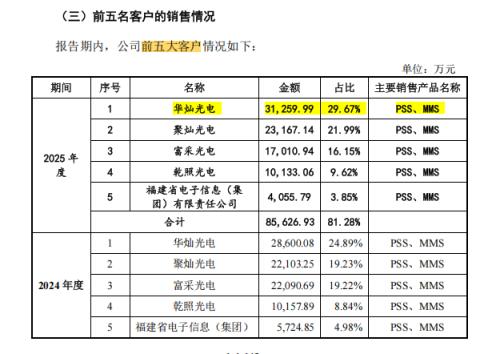
Connecting these two sets of data, the picture is disturbing: Zhongtu buys sapphire wafers from Yunnan Lanjing, a subsidiary of Huacan, processes them into PSS, and then sells them back to Huacan. Both the supply and sales ends are controlled by Huacan. Zhongtu is not just a "supplier" of Huacan, but a trapped link in Huacan's industrial chain.
Moreover, Huacan itself is in a difficult situation. In about four years, Huacan Optoelectronics has accumulated a loss of about 2.7 billion yuan and relies on BOE for financial support.
A major customer that is struggling to survive accounts for nearly 30% of your revenue, and its subsidiary is your largest source of raw materials. Once Huacan's capital chain tightens further, the payment cycle continues to lengthen, or BOE adjusts its procurement strategy and Huacan builds its own PSS production capacity, Zhongtu's accounts receivable will be greatly affected.
Downstream companies building their own production capacity is a common practice in the industry. Zhongtu's own prospectus also admits that "many downstream enterprises build their own patterned substrate production capacity to ensure the supply chain."
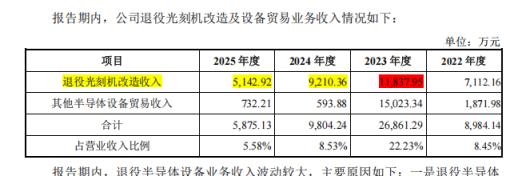
In addition to its main business of substrates, Zhongtu also has a business that is hard to understand: the renovation and trading of retired semiconductor equipment. In simple terms, it buys second - hand lithography machines, repairs and modifies them, and then sells them.
In 2023, this business contributed 274 million yuan in revenue, accounting for 22% of the company's total revenue, with a gross profit margin as high as 30.73%. However, by 2025, the revenue shrank to less than 60 million yuan.
What's more troublesome is the inventory. At the end of each reporting period, the book value of the inventory of retired equipment increased from 543 million yuan to 648 million yuan and then decreased to 564 million yuan, accounting for more than 30% of the current assets.
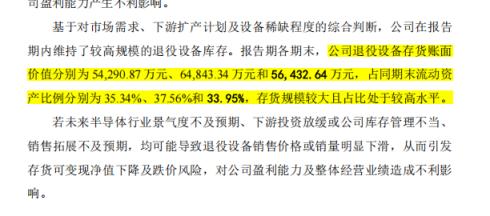
This means that the company stocked up a large amount of retired equipment at the market peak. Now that the industry is in a downward trend, these high - priced inventories cannot be sold, and the impairment provision is gradually eroding the profits.
Second Attempt on the Science and Technology Innovation Board: What Are the Chances of Success?
Zhongtu Technology is no stranger to the Science and Technology Innovation Board. In March 2022, after the company voluntarily withdrew its IPO application, it still received a regulatory warning from the Shanghai Stock Exchange. The core issue was the integrity of information disclosure - the disclosure of the top five customers was inaccurate, and the affiliated relationship and capital transactions between Jian Weisheng, the then deputy general manager, and Jingzhi Co., Ltd., a major trader, were not fully revealed.
Objectively speaking, Zhongtu Technology made targeted rectifications before this application: Jian Weisheng left the company, the overseas sales model was changed from trading through a trader to direct supply, and the function of Jingzhi Co., Ltd. was adjusted to that of an agent.
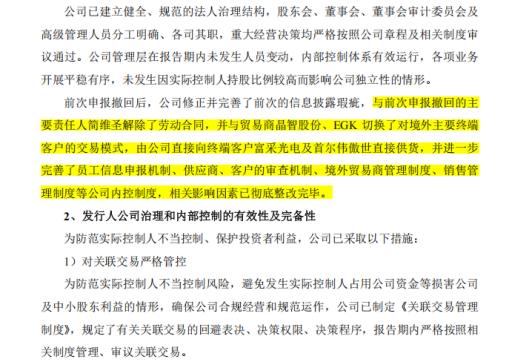
From the institutional level, the internal control system has been strengthened. However, it is worth considering whether the change in the internal control concept of a management team that was once under regulatory scrutiny for "selective disclosure" has truly been internalized into the corporate governance culture. Although the institutional documents can be revised and improved in a relatively short period, the fundamental improvement of the awareness of information disclosure often requires a longer - term test.
There is also the business relationship between Zhongtu Technology and Huacan Optoelectronics mentioned above. In its response, Zhongtu hopes for "endorsement from BOE". In 2023, BOE took