Stardust Era raised 2.5 billion yuan in two months, with state-owned capital groups entering the market
The leading embodied companies in China are staging a battle of the gods —
The investment community learned that today (July 6), Xingdong Jiyuan completed a new round of financing of 1 billion yuan. This round of investment was led by Chengtong Fund, a state-owned capital operation company under the State-owned Assets Supervision and Administration Commission of the State Council, and jointly participated by many large state-owned assets such as Jiangxi State-owned Assets Supervision and Administration Commission, Guoyuan Equity, Yufu Zhongxin Fund, and Hangzhou Capital. In addition, CICC Raynor, Jiukun Venture Capital, Hony Capital, Juntai Capital, and Shenghe Capital followed the investment; old shareholders Houxue Capital, Tsinghua Holdings Tiancheng, and Qianshan Capital continued to increase their investment.
So far, Xingdong Jiyuan has raised 2.5 billion yuan in intensive financing within two months, constructing a triple capital matrix of "leading by national-level capital + empowering by top financial institutions + coordinating with industrial ecosystem", in which the most industrial capital in the industry has gathered, with a total of more than 20.
In past exchanges with investors, Xingdong Jiyuan left us a deep impression: the only embodied company held by Tsinghua University, one of the earliest embodied companies to propose the world model, and it has achieved large-scale delivery in the logistics scenario in just three years since its establishment. In the Chinese embodied arena where various sects stand out, Xingdong Jiyuan has quietly broken through.
Tsinghua's direct-line robot
Raised 2.5 billion yuan in two months
The outside world may not know that Xingdong Jiyuan is the proposer of the embodied world model.
Back in 2024, VLA was still the mainstream in the industry, but Xingdong Jiyuan started the relevant research work on exploring the world model early. Xingdong Jiyuan not only proposed the "world model" route for the first time, but also released its world model results globally the earliest — the PAD model released in September 2024, which is the world's first world action model (WAM), integrating video prediction and action prediction, and was released nearly one year earlier than similar solutions from NVIDIA (such as DreamZero).
This was a pioneering "minority" voice at that time, somewhat too highbrow to find many takers.
It wasn't until the second half of 2025 that discussions about the world model began to frequently appear in the embodied field. In October of this year, Xingdong Jiyuan jointly launched Ctrl-World with the Chelsea Finn team from Stanford University, using the world model as a data simulator to generate training data approaching real physical laws, with a performance improvement of 45% compared to Pi0.5. Since then, we have witnessed the global explosion of the world model, and the entire industry has moved towards it.
Being able to move faster than the industry is inseparable from the unique academic background of the helmsman, Chen Jianyu.
He was born in 1992 and was recommended to the Department of Precision Instruments at Tsinghua University in 2011 — one of the earliest domestic units engaged in the research of bipedal humanoid robots. During his undergraduate studies, Chen Jianyu began to study the gait planning of bipedal robots. Later, he went straight to a doctoral program at the University of California, Berkeley, under the guidance of Professor Masayoshi Tomizuka, an academician of the US National Academy of Engineering and a pioneer in the field of electromechanical control, and delved into robot reinforcement learning and motion control algorithms.

After graduating with a doctorate in 2020, at the invitation of Turing Award winner and academician of the Chinese Academy of Sciences, Yao Qizhi, Chen Jianyu returned to China and joined the Institute for Interdisciplinary Information Sciences at Tsinghua University as an assistant professor. At the age of 28, he became one of the youngest doctoral supervisors at Tsinghua University at that time.
These academic and research experiences have made Chen Jianyu a scarce talent in the industry with both hardware and "brain" capabilities. Therefore, he is very forward-looking and sensitive in the selection of technical routes and model iterations. In August 2023, relying on the technology transfer policy of Tsinghua University, Beijing Xingdong Jiyuan was officially established. It is the only embodied intelligent enterprise directly held by Tsinghua University, and Chen Jianyu served as the founder.
His core judgment is that to achieve true general intelligence, robots must have both a smart "brain" and a dexterous "body" at the same time — a robot without a brain is likely to become scrap iron, while a brain without a body can hardly be called a robot.
Therefore, since its establishment, Xingdong Jiyuan has been driven by AI Native, building the industry's only full-stack self-developed barrier of "data - brain - motion control - dexterous hand - body". The core logic is "algorithm requirements first, data value first". Starting from the real needs of brain model training and implementation, it reversely defines the hardware design. So far, it has three major product lines, including the full-size bipedal humanoid robot Xingdong L7, the wheeled humanoid service robot Xingdong Q5, and the fully direct-drive five-finger dexterous hand Xingdong XHAND series.
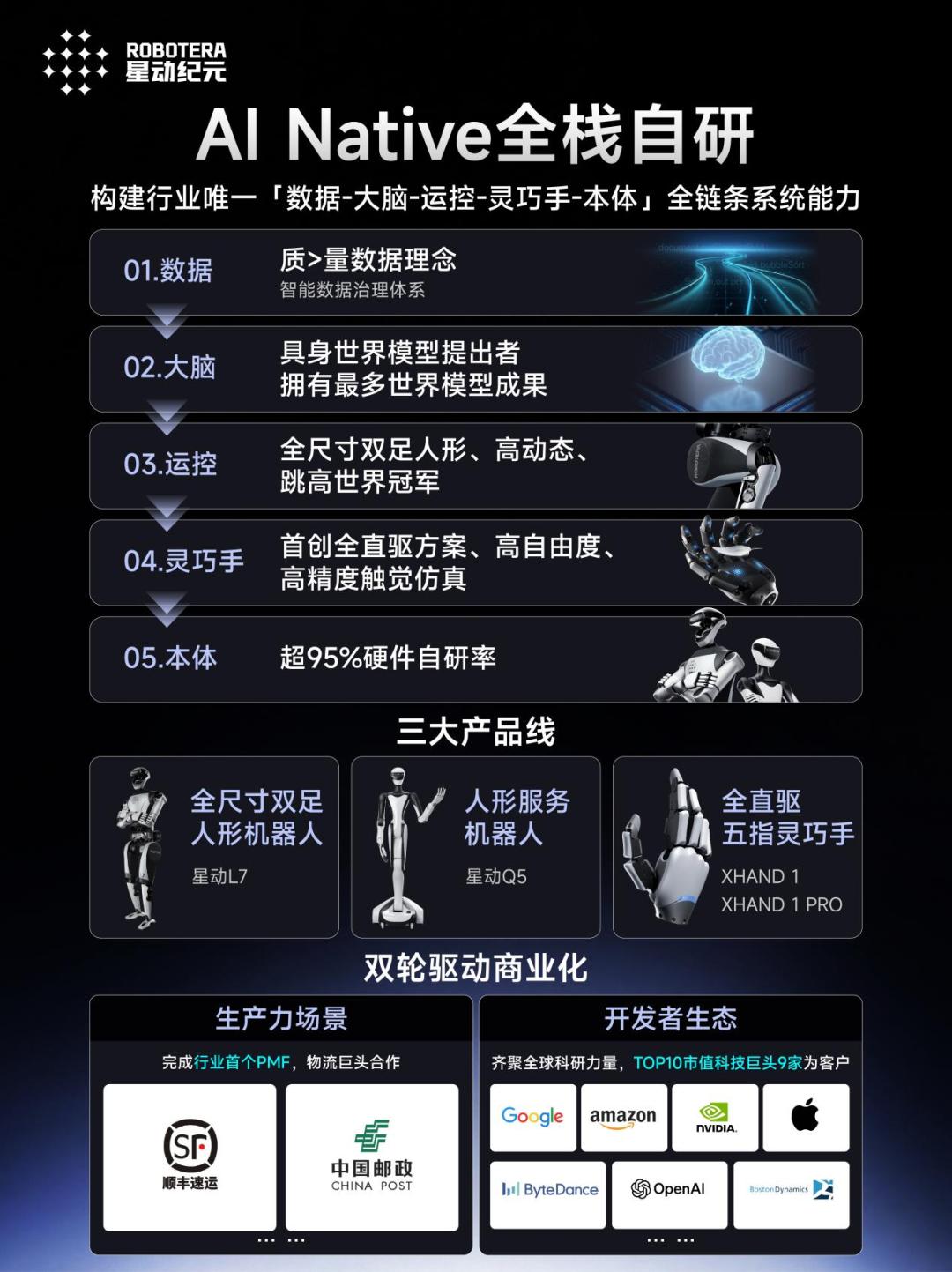
In less than three years, there has been a long queue of investors behind Chen Jianyu. From the early Tsinghua University and Alibaba, to top financial institutions such as CDH VGC, Sequoia China, IDG Capital, Qingliu Capital, and CICC Capital, to industrial leaders such as SF Express, Samsung, Geely Capital, Haier, Lenovo, Singtel, BAIC Industry Investment, Dongfeng Industry Investment, CICC Porsche, CICC Raynor, and funds under China Unicom, as well as local state-owned assets such as the Beijing Artificial Intelligence Industry Investment Fund — the shareholder list of Xingdong Jiyuan almost covers the most complete capital spectrum in the embodied intelligent track.
Entering 2026, the financing rhythm has accelerated sharply: in March, it completed a strategic round of financing of 1 billion yuan, with the valuation exceeding 10 billion yuan. For the first time, overseas industrial capital such as South Korea's Samsung and Singtel appeared among the shareholders; just one month later, a financing of 200 million US dollars was in place, led by SF Group, and jointly increased by leading institutions such as Sequoia China and IDG Capital. The lineup of industrial parties was expanded synchronously; and today, national-level state-owned asset platforms such as Chengtong Fund have entered the market collectively, and a new financing of 1 billion yuan has emerged. Raising three rounds of intensive large-scale financing in three months has set one of the fastest financing speeds in the embodied track this year.
So far, Xingdong Jiyuan has constructed a triple capital matrix of "leading by national-level capital + empowering by top financial institutions + coordinating with industrial ecosystem", with more than 20 industrial capitals gathered behind it — this lineup is rare in the industry.
Strengthening the brain with the hand, opening up a new path for embodiment
At present, for embodied intelligence to realize industrial value, the competition is no longer about single-point strength, but the system ability of integrating software and hardware — the "brain" (model and data) determines the upper limit of value, while the "body" (whole machine and end effector) restricts the lower limit of ability.
But in this system, there is a core hub that is often overlooked: the dexterous hand.
Xingdong Jiyuan's adherence to the AI Native full-stack self-development of the entire embodied chain of "data - brain - motion control - dexterous hand - body" means that hardware design does not start from the mechanical structure, but is reversely defined from "what kind of data is most valuable to the brain". And the five-finger dexterous hand is exactly the most abundant and refined collection entrance for interaction data in the physical world — whether a grab is successful, how the force feedback changes, and whether the object slips. These high-dimensional data directly determine what the model can learn.
In the past two years, Xingdong Jiyuan's model has been continuously iterated:
In the first half of 2024, the team proposed the VLA architecture (frequency-divided VLA) of the robot's fast and slow system for the first time, achieving the unity of "real-time action" and "deep thinking"; in the second half of the year, it combined the world model with VLA, released the VLA algorithm framework PAD and VPP integrating the world model, and integrated and launched the end-to-end native robot large model ERA-42.
ERA-42 is one of the core models of Xingdong Jiyuan, integrating vision, understanding, prediction, and action, and realizing the control of the whole body's dexterous operation by the same end-to-end VLA model.
In February this year, Xingdong Jiyuan launched VLAW on the basis of Ctrl-World, taking the lead globally in proposing a VLA reinforcement learning framework based on the world model, realizing the collaborative iteration of strategies and simulators, and making the world model not only "seem right", but also "physically right". So far, Xingdong Jiyuan is one of the embodied companies with the most world model results.
The breakthrough in brain ability is inseparable from high-quality data. In this regard, Xingdong Jiyuan relies on its self-developed dexterous hand and its implementation applications, and has the world's largest real-machine dataset of dexterous hands.
To put it simply, Xingdong Jiyuan obtains high-quality dexterous operation data through the dexterous hand hardware, then uses these data to train a smarter "brain" model, and finally feeds the evolved model back to the dexterous hand, forming a positive cycle of "the more it is used, the smarter it becomes, and the smarter it becomes, the more it can work". Therefore, the "dexterous hand" business is not just a single-point component on the robot body, but a core hub connecting the entire full-stack ability and a core collection entrance for interaction data in the physical world.
Since it predicted early on that the end effector would become a bottleneck for the implementation of embodied intelligence, Xingdong Jiyuan's dexterous hand pioneered the full direct-drive route that is most friendly to the brain in the technical route — the output of the joint module directly acts on the joint, without transmission clearance, elasticity, and friction loss. The data produced inherently has the characteristics of high precision, low latency, and reproducibility, and can be directly used for model training, fundamentally solving the quality problem of physical interaction data.
Currently, Xingdong Jiyuan adopts a product strategy of "attacking with both hands", that is, two dexterous hands with different positioning:
1. Xingdong XHAND 1 PRO (brain hand), focusing on high performance, with the core positioning as a data collection and algorithm verification platform, aiming at the upper limit of model ability; 2. Xingdong XHAND 1 (working hand), achieving precise force control and flexible operation through the full direct-drive technical architecture, and can be adapted to multiple types of humanoid robot platforms, consolidating the lower limit of large-scale implementation.
It is reported that Xingdong XHAND 1 has currently widely covered the diverse scenario requirements of industrial sorting and regular operations, and has become the common choice of global robot manufacturers — the US embodied intelligent unicorn Skild AI, South Korea's Rainbow Robotics, the UK's Extend Robotics, Discover Robotics, and the UK's next-generation humanoid robot HMND 01 of Humanoid AI all use Xingdong XHAND 1 as one of the core end effectors.
When the valuation of a dexterous hand in the industry can even exceed that of the whole robot body, the narrative of Xingdong Jiyuan's "strengthening the brain with the hand" has more weight. But ultimately, "strengthening the brain with the hand" is not the goal, but a means — obtaining high-quality data through the hand, training a stronger brain through the data, driving a more intelligent robot through the brain, and finally running through the full-stack system ability of "data - brain - motion control - dexterous hand - body" to become the real productivity in industrial scenarios. This is the real barrier of Xingdong Jiyuan.
Relying on its self-developed dexterous hand and its implementation applications, Xingdong Jiyuan has accumulated a leading-scale real-machine dataset of dexterous hands in the industry. Based on this, the company has built a triple-gradient data source system:
The core value layer comes from long-term real-machine interaction data in real scenarios such as logistics and industry, with 100% physical authenticity, and is the core foundation for the model to meet industrial needs;
The precise training layer comes from high-precision teleoperation data, providing a standardized action reference paradigm; currently, there are more than 12 million real-machine teleoperation data clips, among which the real-machine teleoperation data of dexterous hands reaches more than 1.5 million, making it one of the largest real-machine datasets of dexterous hands in the industry;
The breadth expansion layer comes from first-person human behavior data and large-scale Internet video data, opening up a million-hour scaling, and covering a large number of daily behaviors and scenarios at low cost.
Among them, the long-term real-machine interaction data in real scenarios and the large-scale human video data simultaneously meet the requirements of authenticity and diversity, constituting the dual-core engine of the data system.
Currently, Xingdong Jiyuan's overall dataset has covered more than 100 real scenarios and more than 1,000 dexterous operation tasks, fully guaranteeing the scene richness and behavior diversity of the data, and laying a high-quality data foundation for the continuous iteration of the general embodied brain.
On this foundation, Xingdong Jiyuan begins to answer the next question: Can these data support the brain to run through the commercialization closed-loop in real industrial scenarios?
Robots start to work stably
Watershed
The answer lies in the industrial field where robots can work stably and continuously.
Xingdong Jiyuan adheres to the commercialization path of "B2B first, then C2C", and gradually implements in the logistics field, high-end manufacturing field, and commercial service scenarios.
As we can see, Xingdong Jiyuan took the lead in achieving the industry's first PMF (Product-Market Fit) in the logistics scenario, and deeply cooperated with leading customers such as SF Express and China Post. It has entered more than 10 logistics centers in 5 provinces and cities in North China, East China, and South China in batches, and partially achieved normal 7×24-hour operation.
Here, the embodied robots can flexibly meet the sorting operation requirements such as grabbing, turning the face of the waybill upwards, and placing various packages with different shapes, materials, and sizes. It is reported that the efficiency in some scenarios has even exceeded the human level, with a processing speed of more than 1,200 pieces per hour.
There is an interesting little story here — when the overseas leading embodied enterprise Figure was live-streaming in its test room, it was once shouted by foreign media: "The robots of China's Xingdong Jiyuan are already working for SF Express and China Post. When will Figure get out of the test room and truly implement?"
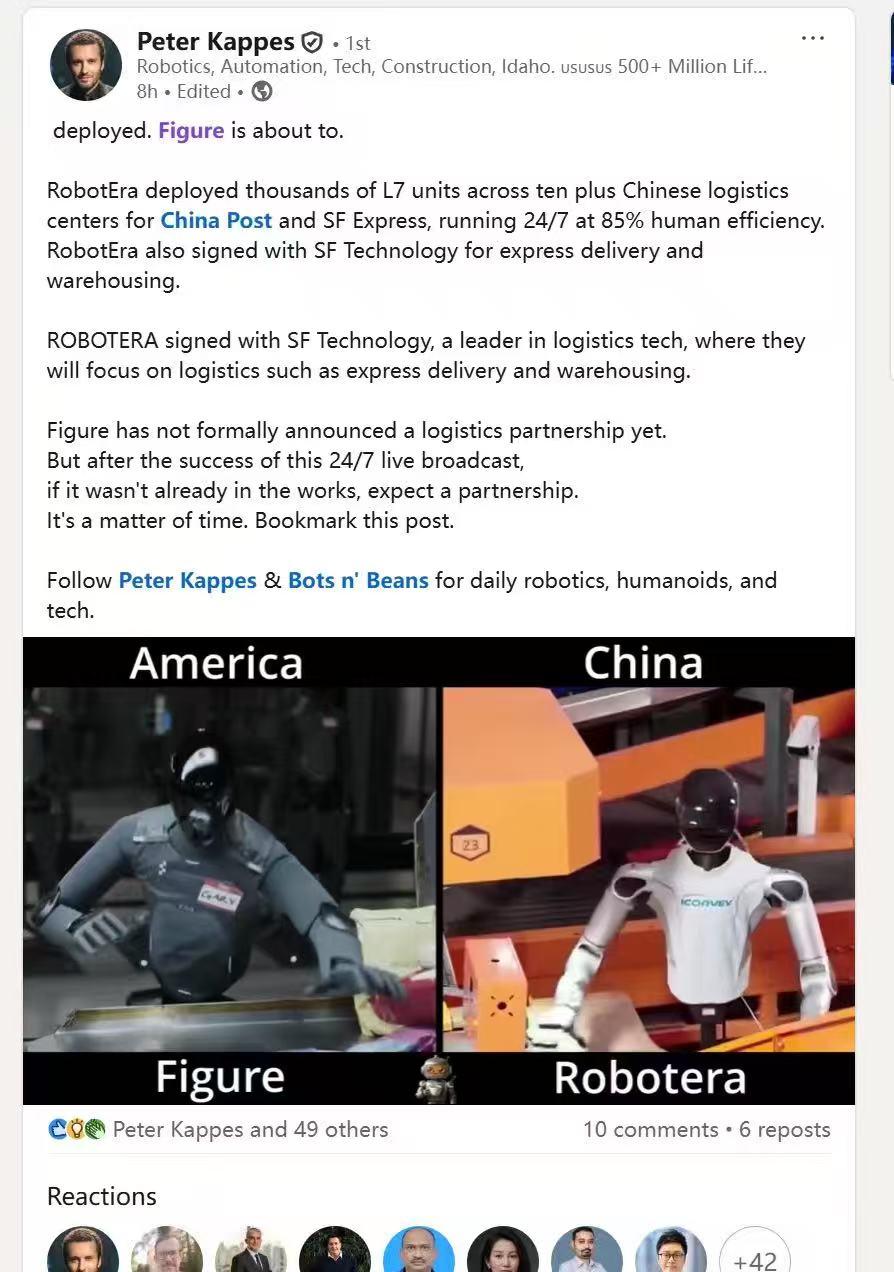
It is reported that in the future, Xingdong Jiyuan will continue to expand the logistics scenario, and build a full-process embodied logistics service system covering inbound logistics, in-plant logistics, sales logistics, after-sales logistics, and extended links of express logistics.
At the same time, the high-end manufacturing and commercial service scenarios are also being expanded synchronously. In the high-end manufacturing fields of 3C electronics and automobiles, Xingdong Jiyuan has cooperated with industry leaders such as Samsung, Lenovo, Haier, and Geely. The real-machine data flowing back from these industrial fields is continuously providing nutrients for the iteration of the embodied brain. In addition, the