Garnering 24k Stars: With One Line of Command, AI Can Locate Skills Automatically
In the past, developers used to exchange prompt templates when they met.
Now, the trend has changed. What people are asking each other is which skill they should install.
Behind this lies a bigger transformation: AI programming tools have started to “install packages.”
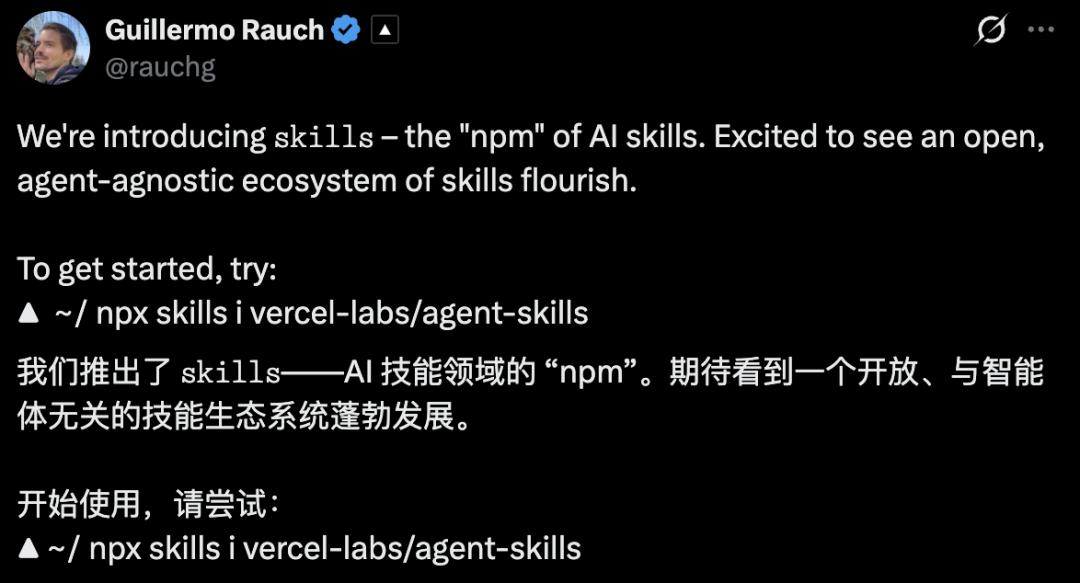
On the morning of January 17th this year, Guillermo Rauch, the founder and CEO of Vercel, posted a tweet on X: We are launching skills - the “npm” for AI skills.
The so - called “npm” is the package manager that front - end engineers use every day. With just one line of command, you can install what others have written into your own project.
What Rauch meant is that the experience of “installing others' achievements with one line of command” is now coming to AI.
Peter Steinberger, known as the “Father of Lobster,” immediately replied, “Cool! I need to synchronize with ClawHub.”
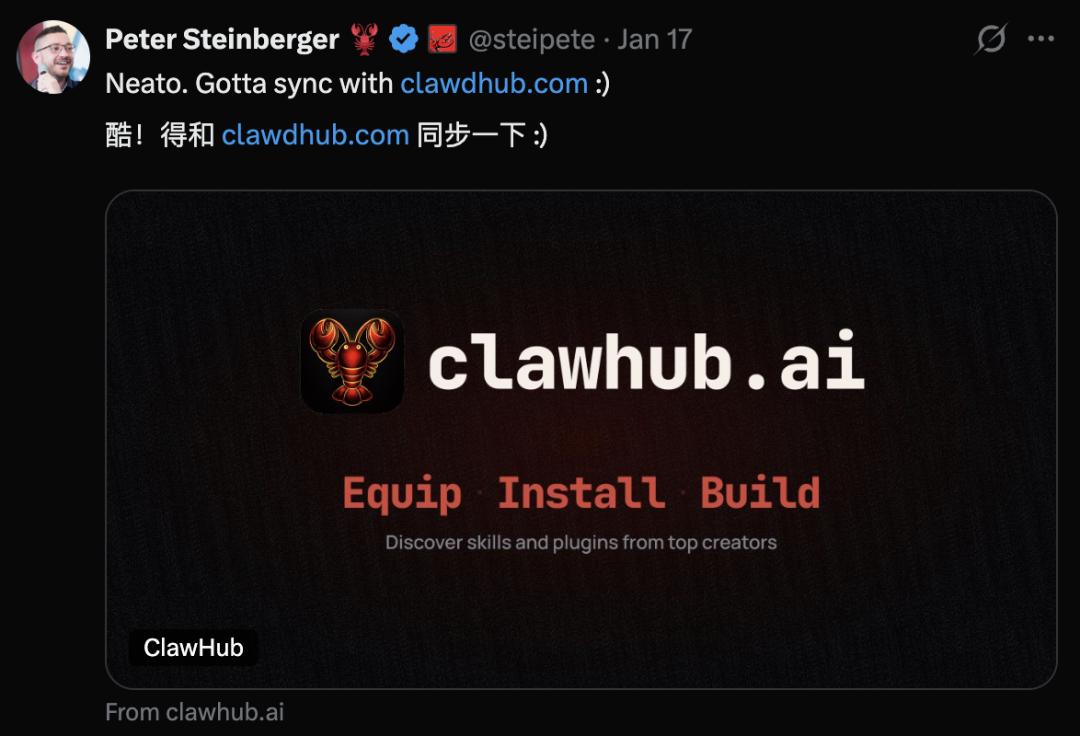
ClawHub is a skill marketplace for another intelligent agent ecosystem and is not affiliated with Vercel. But Peter's first reaction was to “align.”
Three days later, Vercel officially announced it in its update log: a command - line tool for installing and managing capability packages for intelligent agents.
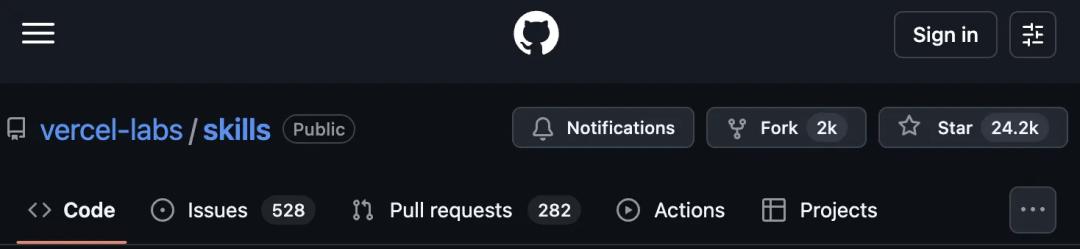
This official repository, vercel - labs/skills, has reached 24,000 GitHub stars in just five months since its release.
Why is it so popular? It's as simple as one line of command:
npx skills add <package>.
To put it simply, it is the package manager for AI agents.
Just like npm, which front - end engineers use every day to install what others have written into their projects with one line of command. This time, what you're installing is not a code library, but “capabilities.”
What's even more amazing is that it is compatible with various tools. Claude Code, Cursor, Codex, Gemini CLI... There are more than 68 officially supported intelligent agents. One capability package can run on any of these tools.
Vercel also launched skills.sh, a skill directory with an installation volume ranking list. You can clearly see which skills are popular and how many times they have been installed.
The top - ranked package called find - skills has reached 2.3 million installations.
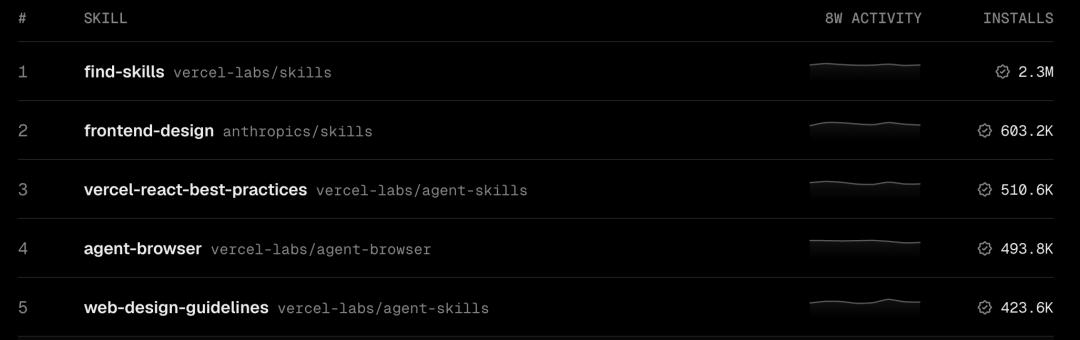
The installation volume ranking list on skills.sh. find - skills ranks first with 2.3 million (2.3M) installations, followed by frontend - design, vercel - react - best - practices, etc. (Source: skills.sh)
For the first time, there is a “popular download” ranking list for AI programming capabilities.
One Line of Command
AI Learns a New Skill
Let's first see what it does.
Type npx skills add vercel - labs/agent - skills and hit enter.
A few seconds later, your Claude Code will have a set of engineering specifications for React and Next.js, along with a set of design guidelines. The next time it writes code, it will automatically follow these rules.
This thing is officially called a “skill package.” In essence, it is a folder, and the core is a SKILL.md file with a YAML header, which clearly states two things: what this skill is and when it should be used.
The folder can also contain reference documents, templates, and a dedicated scripts/ directory with executable scripts.
It solves very practical pain points.
The model understands general programming languages and frameworks, but it doesn't understand the “local rules” of your project: your code style, naming conventions, and past pitfalls.
Previously, you had to repeat these every time you started a new conversation. Now, you can package them into a skill, and it will take effect permanently after one installation.
After installation, you can manage it just like an npm package: use list to see what's installed, update to update it with one click, and remove to delete it.
It is based on a set of shared specifications. What you install on Claude Code will also work on Cursor.
If you even find installation troublesome, there is an easier way: use it directly without installation.
With a single npx skills use command, you can temporarily pull in the skill, pipe it to Claude for execution, and then discard it without “dirtying” your local directory.
In the past, the boundaries of AI capabilities were determined by how you described them. Now, capabilities have become packages that you can directly pick up from the shelf.
The “npmization” of the AI Tool Layer
Many people may think it is a new feature of Claude. But it comes from Vercel, not an inherent ability of Anthropic.
Claude Code, Cursor, Codex, GitHub Copilot, Windsurf... All are supported. The skills CLI integrates them all and provides a unified entrance.
Behind this entrance, the AI tool layer has started to “npmize.”
Vercel encapsulates these scattered experiences into reusable, distributable, and version - manageable modules.
AI capabilities are moving from “prompt engineering” to “capability engineering.” The former solves “how to say it this time,” while the latter solves “how to do it from now on.”
Vercel has played this game before.
Back then, it occupied the deployment entrance of the entire front - end ecosystem with Next.js, and front - end developers couldn't avoid it.
Now, it wants to tell the same story in the AI intelligent agent layer.
Find Skills
AI Gets a “Capability Search Engine” for the First Time
The most futuristic part is Find Skills, a “skill for finding skills.”
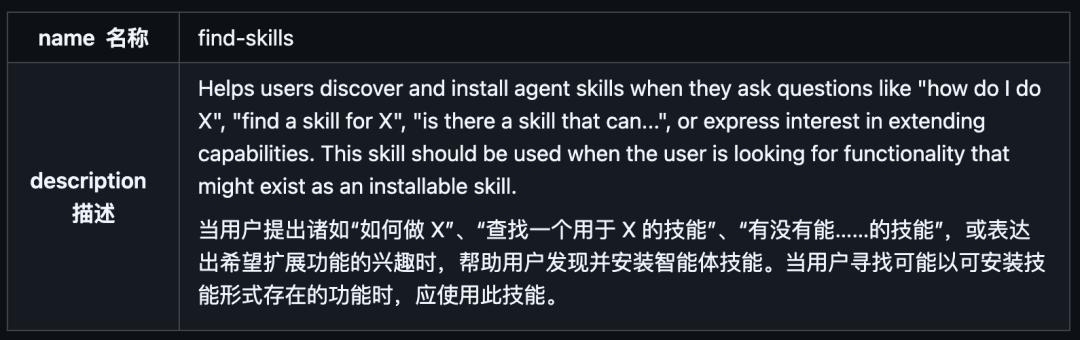
The official definition of the find - skills skill is that when a user asks “how to do X,” “is there a skill that can...,” or wants to expand capabilities, it is responsible for discovering and installing the corresponding intelligent agent skills.
When you say “help me do X,” it will run the entire process for you: search, filter, and install the most suitable one.
What's even more convenient is that it has a built - in quality check. When selecting skills, it will consider the installation volume and the source. Popular and officially produced skills are given priority, and skills from unknown sources will prompt you to be cautious.
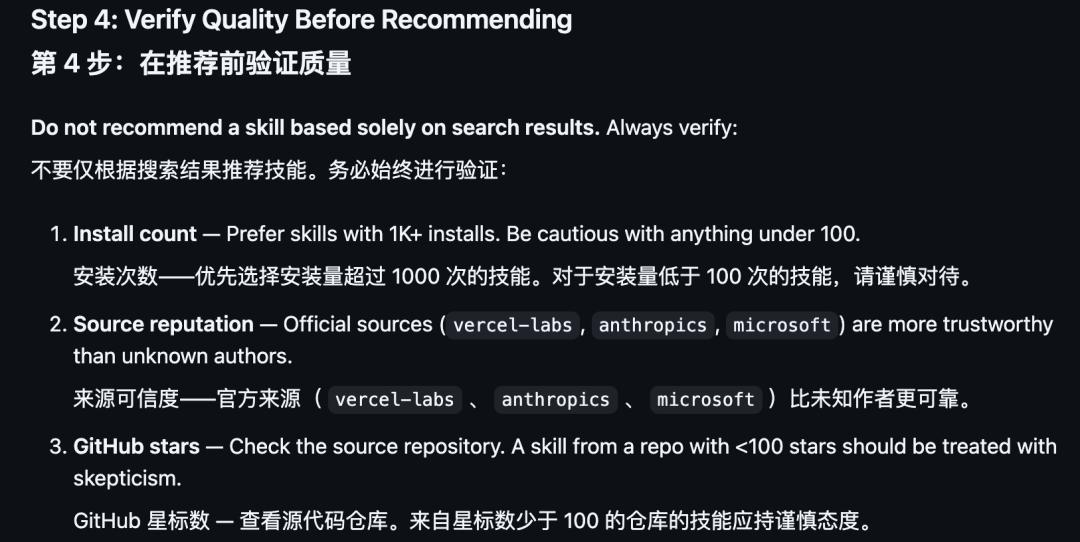
The source code of the SKILL.md file for the find - skills skill clearly writes three quality check rules before recommendation: give priority to skills with more than 1,000 installations, be vigilant about those with less than 100 installations, give priority to official sources such as Vercel, Anthropic, and Microsoft, and be skeptical about repositories with less than 100 stars.
This means that AI has a “capability search engine” for the first time. You don't need to know what skills there are or what their names are. Just tell it what you want to do, and let it find the rest.
More importantly, it is not only useful for programmers.
Those who are most tortured by the “scattered capabilities” are designers, product managers, content creators, etc., who use AI to write code.
They don't have the habit of engineering. Git submissions and document specifications rely entirely on AI. They actually need ready - made skill packages the most.
Find Skills provides them with an entrance to deploy resources without being an expert.
Behind the Hype
Is an Uninsured Account
It sounds great, but don't get too excited.
Let's go back to the scripts directory. The skills contain execution logic, not just a few harmless instructions. They will actually run commands on your computer.
Most people don't even look at which files the third - party packages they casually install have modified.
How many potential risks might be hidden in this?
The ToxicSkills research by security company Snyk conducted the first systematic audit of 3,984 skills on ClawHub and skills.sh: more than 30% have security flaws, and 13.4% (534) are at a serious level, including malware distribution, prompt injection, and key leakage.
This means that on average, one in every 7 or 8 skills can directly harm you.
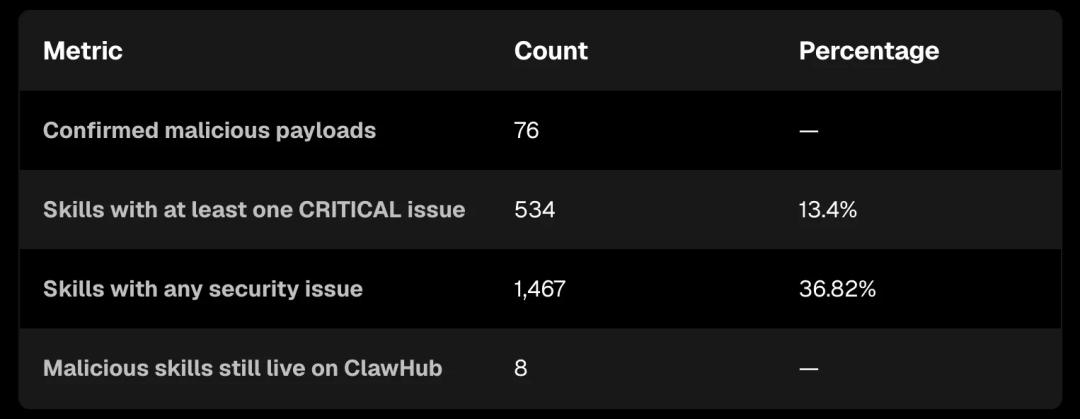
The Snyk “ToxicSkills” research audited 3,984 skills: 1,467 (36.82%) have any security flaw, among which 534 (13.4%) are at a serious level. 76 malicious payloads have been confirmed, and 8 still exist on ClawHub. (Source: Snyk)
Another institution, Koi Security, audited 2,857 skills and found 341 malicious ones.
There are mainly two methods.
One is through scripts, which make your AI download something from a strange IP and execute it locally, or secretly read your SSH and AWS configurations.
The other is more hidden. It directly poisons the text in the SKILL.md file. The AI reads the attacker's hidden instructions as legitimate work instructions and follows them.
The most malicious ones will specifically steal the memory files where the intelligent agent stores private conversations.
You may say that npm also has frequent poisoning incidents, but this time the risks are on a different scale.
npm installs pure code, where data and instructions are separated. Skill blurs this boundary. It combines prompts, code, and full permissions. One SKILL.md file can rewrite the behavior of the intelligent agent and directly access your file system, network, and shell.
The risks in npm can at most damage the build products, while the risks in skill can directly access your local credentials and the entire code library.
Of course, this is not to discourage you from installing. Vercel itself also reminds you to treat skills like code, read them before installation, and be especially careful with the scripts directory.
A simple judgment is that a large download volume does not equal security. What you really should look at is the source and permissions. If a weather - checking skill asks to read the SSH key of your server, what does it need it for?
The long - awaited “npm moment” for AI capabilities has really arrived.
However, it not only brings convenience but also the pitfalls that npm has encountered over the years, and it comes before the ecosystem is mature.
It's really cool to install capabilities with one line of command, but this path has just started. It allows you to reuse the capabilities accumulated by your peers, but at the same time, you need to make judgments when using it.
Selecting packages, checking sources, and verifying permissions - these old skills of developers are still necessary this time.
Twenty Years
One Line of Command
Ultimately, the starting point of all this is Guillermo Rauch, the founder of Vercel.
He is from the Lanús district of Buenos Aires, Argentina. In his own words, most of his career in life is attributed to the Web and open - source.
As a teenager, he was enthusiastic about promoting Linux and teaching others to use it. Later, he delved into JavaScript. After joining the core team of the open - source project MooTools, he got his first full - time job as a front - end engineer at the age of 18 and moved to San Francisco.

Guillermo Rauch
One of his well - known works is Socket.io, a widely used real - time communication library. The real - time synchronization of Notion and the earliest trading products of Coinbase are all based on it.
After that, he identified a direction: developing tools and cloud infrastructure to make the Web faster and provide the best developer experience. Thus, Next.js and Vercel were born.
Now, this platform supports the online businesses of companies such as The Washington Post, Porsche, Under Armour, and Nintendo.
The real killer feature of Vercel lies here: writing code, previewing, and going live can all be done with one command. Once developers start using it, it's hard for them to leave this system.
Ultimately, Rauch has only done one thing in the past twenty years: compressing complex engineering into one line of command that developers can run without hesitation.
From starting a server with one line of now, to Next.js, and now to npx skills add, it's the same skill, but this time it's applied to AI intelligent agents.
References:
https://github.com/vercel - labs/skills#supported - agents
https://www.skills.sh/
https