Online novel writers are trapped in the "AI-flavored" writing, and so are the platforms.
In June, Cheng Miao, a web novel author, failed to pass the signing evaluation of her newly written long - form novel on the Fanqie Novel website. "Fanqie has always been the web novel platform where it's easiest to get a contract. The two previous works I published were both signed on the day I applied." She believes that the reason for this failure might be that the platform judged her work as a "low - quality AI - written novel," which is a problem that Fanqie Novel has been focusing on cracking down on recently.
On June 25th, Fanqie Novel issued a notice to platform authors, adjusting the "long - form web novel recommendation verification process" and tightening the recommendation mechanism. For example, a work must pass the evaluation within 3 attempts. Only after the quality meets the platform's standards can it enter the "recommendation verification" stage. Once a work is "recommended," it can get a small - scale traffic and appear on the recommendation pages of some readers. If not recommended, it can hardly attract natural readers.
In the first half of 2026, Fanqie Novel issued multiple announcements to authors, increasing the intensity of content review, aiming to reduce low - quality AI works on the platform. In June alone, Fanqie Novel rejected over 100,000 low - quality books for signing and dealt with over 40,000 low - quality and violation books.
While the platform is vigorously purifying its ecosystem, AI - written works still keep emerging. An HR who was once in charge of personnel recruitment at Fanqie Novel told Economic Observer: The amount of works uploaded to Fanqie Novel every day is too large to be judged manually by editors. The main way is to use AI to review whether a work is generated by AI and whether its quality is up to standard.
On July 4th, a relevant person in charge of Fanqie Novel told Economic Observer that in May this year, Fanqie Novel clearly defined four types of prohibited low - quality writing behaviors. "AI shoddy workmanship" is one of them, and there are also behaviors such as chaotic formatting, abnormal structure, and empty wordy writing. Through technical monitoring, manual review, and reader reports, the Fanqie Novel platform has dealt with 855 violation accounts in a gradient manner, and permanently banned some of the inferior accounts.
01
The Flood of AI - Written Novels
"Reading web novels now is like taking a big gamble." Li Yan, a reader of Fanqie Novel, described his reading experience in this way. "Some books have an attractive setting and good writing at the beginning, but as you read further, it becomes more and more chaotic. There are many expressions with an AI flavor, and the storylines before and after don't connect. Reading it makes you feel like you're having a conversation with DeepSeek."
Li Yan has been reading web novels on Fanqie Novel for five years. "There used to be many books on the platform that were hard to read, with poor writing and bad plots. You'd give up after reading two lines at the beginning and turn to look for other books." But since the middle of 2025, he has spent significantly more time and energy on choosing books.
AI - written novels sometimes make readers both angry and amused. Li Yan gave an example. In one chapter, the protagonist is going to fight a Boss. The normal writing logic is how the protagonist overcomes difficulties and finally wins. But in some works, it focuses on the knife the protagonist carries, piling up a lot of rhetoric, making you think the knife is very important. But when the protagonist fights the Boss, he doesn't use the knife at all. And even in the next chapter, the protagonist may suddenly decide not to fight the Boss without even explaining the reason.
Readers are not the only ones troubled by the AI flavor. The work email of an editor at Fanqie Novel is full every day. "Some authors send over a dozen works in a day, adding up to hundreds of thousands of words, far exceeding the amount of manual creation." Facing such submissions, she chooses to reject the contract directly.
The large number of AI - written novels on Fanqie Novel may be related to the platform's positioning. This Fanqie Novel editor believes that Fanqie Novel focuses on free content and is mainly targeted at the sinking market. It has a large number of readers and high traffic, and it signs books rather than authors (the platform only signs contracts for single works), giving authors a relatively high degree of freedom. "Some authors have no writing experience and are not good at telling stories. They may throw simple ideas to AI and let the large - scale model generate the whole text."
Novice writers need to rely on AI to produce stories, and there is another type of author who is more hidden. They can write, but want to earn more and more easily with the help of AI. "The core setting and the first dozen chapters are written manually with high quality, so the platform gives a contract and traffic, and some readers start to follow the updates. When the number of readers reaches a certain scale, the author lets AI write the rest of the story and then turns to start a new book. The more books they start, the more their income doubles." The above - mentioned Fanqie Novel editor said bluntly that this troubles the platform a lot.
The aforementioned relevant person in charge of Fanqie Novel explained the platform's original intention of rectifying low - quality content: As the online literature market continues to expand and technology is widely applied, low - quality content shows the characteristics of diversification and concealment. Low - quality content affects readers' reading experience and also damages the rights and interests of high - quality original creators. AI shoddy workmanship - type content is one of the key rectification directions of Fanqie Novel since May this year, mainly manifested as a lack of originality and integrity in content and low overall quality.
According to Economic Observer, Fanqie Novel has also been continuously upgrading its content governance standards, improving its recognition ability and handling intensity, and conducting systematic governance of low - quality content recently.
02
Is It the AI or the Low - Quality That's Being Blocked?
The flood of AI - written novels is impacting the user experience, and the platform is also taking action.
In early February, Fanqie Novel stated in an announcement that it had detected that some accounts were abusing AI technology to produce large - scale low - quality wordy novels, and thus launched a special rectification action, focusing on rectifying the following behaviors: abusing AI tools to generate and piece together content in batches; works lacking originality and logic, with stiff language and empty content.
Compared with other leading web novel platforms, Fanqie Novel has a relatively tolerant attitude towards AI - written content, only targeting low - quality AI - written content. Economic Observer learned that editors from platforms such as Qimao Chinese Network and Qidian Chinese Network have issued "no acceptance of AI - written novels" statements to authors, strictly prohibiting all forms of AI tools from participating in the creation.
Referring to the tough attitude of these platforms, Cheng Miao added, "There has always been a saying in the web novel circle, 'Good writing can break all rules.' As long as a novel is good enough, factors such as genre preference and platform rules can be waived. The same goes for AI." According to her knowledge, there are still some authors using AI to generate works and successfully signing contracts with the platform.
Wu Shan works for a leading domestic novel content distributor, which cooperates with leading web novel platforms such as Fanqie, Qimao, and Yuewen. She is mainly responsible for selecting works with the potential to become blockbusters from the book lists sent by the platforms, generating promotional materials, and promoting them on Douyin. As a downstream participant, Wu Shan hasn't felt the effect of Fanqie Novel's recent crackdown on low - quality AI - written novels. "The books sent to us are still the same as before, with a large amount of AI - generated content."
Each link in content production has its own way of identifying the AI flavor. In Wu Shan's view, one of the most obvious features of AI - written novels is the inability to count numbers correctly. "For example, Character A says four words, but in the next line, it says 'Character B is quite shocked by these five words.' The word - segmentation logic of AI is different from how humans count words, so it's easy to make mistakes in counting." She showed four screenshots of paragraphs with counting errors, all from the works to be promoted that she received recently.
The aforementioned HR in charge of personnel recruitment at Fanqie Novel said that the platform's main method of identifying AI - written novels is "AI detecting AI." The community governance positions she recruited were responsible for focusing on issues such as plagiarism and infringement. "Fanqie Novel used to encourage authors to use AI for creation and didn't completely ban it." In the author's area of Fanqie Novel, the platform's own AI tool still floats on one side of the editing window.
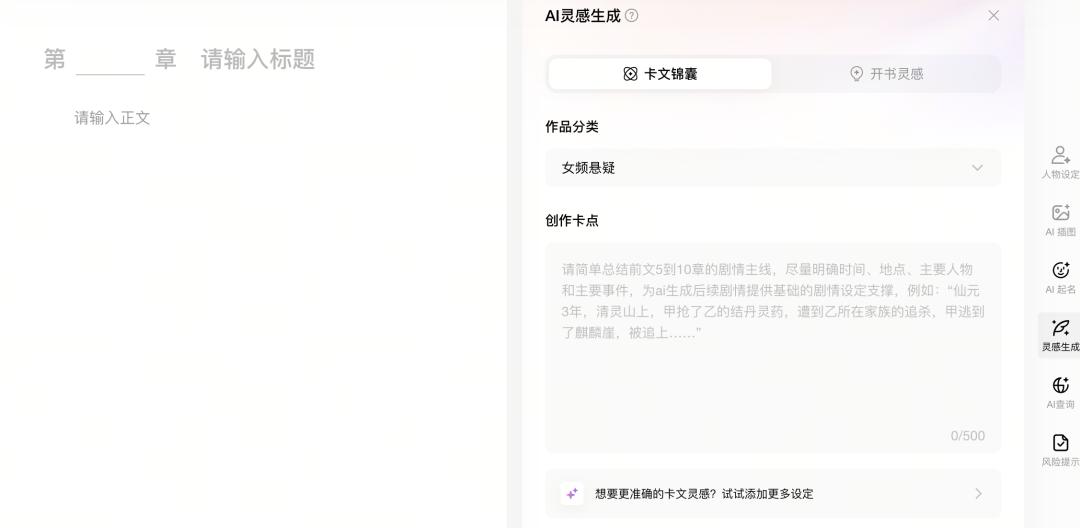
The work editing area of Fanqie Novel website
During this rectification campaign, some authors claim that they haven't used AI but have been "misjudged" by the platform. In mid - June, an author of a long - form novel found that her serialized work had disappeared from the Fanqie recommendation list, and the traffic had dropped significantly. After consulting the customer service, she was given the judgment of "low - quality wordy novel," but the platform didn't give the basis for the judgment. This work has been updated since 2025, has signed a contract with the platform, and has nearly 100,000 readers.
Since the copyright of the signed work belongs to the platform, the suspension of recommendation has put the author of this long - form novel in a dilemma. "Fanqie doesn't give authors the option to terminate the contract. Now that the recommendation has stopped, I can't transfer the work to other platforms."
Can an author choose to terminate the contract after a signed work is judged to be of low quality? Fanqie Novel responded: "It depends on the agreement at the time of signing."
03
Learn AI First, Then Get Rid of AI
Cheng Miao and the web novel authors around her will let others read their works before publishing them to make sure there is no AI flavor before uploading. "After passing the platform's review, there is still the test of readers. On the book reporting page, one of the reporting reasons is 'AI wordy novel.' " Cheng Miao is worried that if someone reports her work, she doesn't know how to explain that she didn't use AI.
Cheng Miao introduced that the currently recognized characteristics of AI - written novels in the web novel circle include but are not limited to: meaningless environmental and psychological descriptions, a large number of short sentences, the "not... but..." sentence pattern, and too many dashes. She believes that these are elements commonly used by AI when generating articles, but they are also learned by AI from human writing habits. "In order not to be said to have an AI flavor, I even have to deliberately avoid the first word that pops up in my mind."
A web novel author who cooperates with a third - party studio told Economic Observer that some platform editors require creators to do an AI rate test before submitting their works. If the AI rate is too high, they need to modify the work until it meets the standard before submitting. "Editors of large platforms have their own AI detection plugins. The Zhuque AI Detection Assistant of Tencent is commonly used by small editors and authors. It's free, but its accuracy is hard to evaluate."
The page of the Zhuque AI Detection Assistant lists several common questions, one of which is "Is AI detection 100% accurate?" The official of Zhuque AI said that "there is a certain possibility of false reports," mainly because "human - created texts are very similar in language and plot structure."
Different from Cheng Miao, this web novel author doesn't care whether he can write text without an AI flavor. Instead, he is more curious about whether AI can write for him. "In the past, when the studio cooperated with authors to write novels, it would give the setting and framework, and let the authors flesh out the details. Now, when authors use AI to generate novels, it's the same logic. They all want to delegate the trivial work after having an idea."
He once downloaded a Skill called "Humanizer" on ClawHub (the official Skill community of OpenClaw) to eliminate the AI characteristics in the text produced by the Agent. The cumulative download volume of this Skill in the community has exceeded 120,000 times, ranking among the top 15 in the community. After installation, the Agent will scan and identify the text by referring to the AI writing characteristics in Wikipedia, replace AI - related terms with natural expressions, and match the writing style of the whole text.
However, the content modified by the Skill may still have an AI flavor. "In order to break the original writing routine, AI will create new routines." The aforementioned web novel author believes that the key obstacle for AI to write novels lies in its context - handling ability. "There are too many backgrounds, too many plots, and too many character relationships. If it can't remember these, how can it write a long - form novel of millions of words?"
(At the request of the interviewees, Cheng Miao, Li Yan, and Wu Shan in this article are all pen names.)
This article is from the WeChat official account "Economic Observer". Author: Liu Sixuan. Republished by 36Kr with authorization.