Japanese machine tools are beginning to lose ground to a county in China
In 2024, Hanoi, Vietnam.
A factory owner needed to purchase CNC machine tools. There were two quotes in front of him: a certain Japanese brand, with a unit price of four to five hundred thousand; those from Tengzhou, Shandong, China, cost only over one hundred thousand.
He chose the ones from Tengzhou.
This is not an isolated case. Every morning, many senior executives of Japanese machine tool companies enter their offices and the first thing they do is to open the Nikkan Kogyo Shimbun.
But in recent years, what they have seen is mostly anxiety.
In Southeast Asian factories, the Japanese machine tools that have been used for many years are being replaced one by one. The machines replacing them come from a county - level city in China:
Tengzhou, Shandong.
01
A Small County Overturns Big Giants
Open a Chinese map and place your finger on the southern part of Shandong, and you'll find this place.
Many people may have heard of Tengzhou for the first time through this article. This county - level city under the jurisdiction of Zaozhuang covers an area of 1,495 square kilometers.
Among the more than 2,800 county - level administrative regions in China, there are many that are larger and more prosperous than Tengzhou. The GDP of Kunshan exceeds 500 billion, Shenmu has rich coal reserves underground, and one out of every five pairs of sports shoes in the world is produced in Jinjiang.
But what Tengzhou does is different from them all.
Tengzhou specializes in small and medium - sized machine tools.
What is a machine tool? It is the mother machine of industry, the machine that manufactures other machines. From aircraft engine blades and chips to missile casings and automobile bearings... nothing can be made without it.
The machine tool level of a country directly determines the kind of industrial products it can produce.
In this field, Japan and Germany have dominated for the past few decades. DMG MORI, FANUC, Mazak... these names have been like mountains weighing on the heads of Chinese machine tool workers.
Then, a county in southern Shandong decided to take on this challenge.
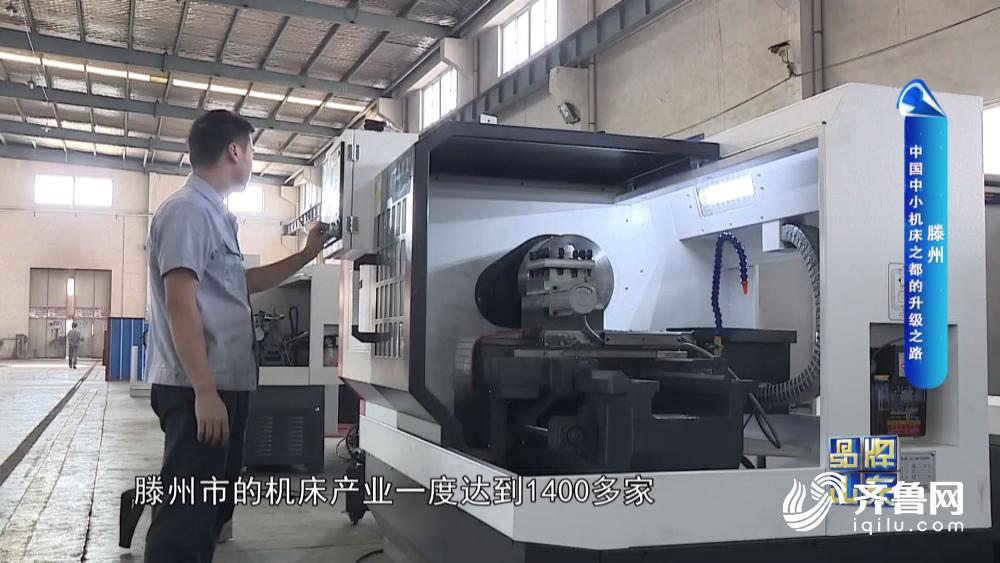
It's not a joke. There are more than 400 machine tool enterprises gathered here, with an annual output of over 200,000 machine tools. Eight out of every ten small and medium - sized drill - milling machines in China are made in Tengzhou. Its products are sold to more than 90 countries and regions around the world.
For this reason, Tengzhou has been rated as the Capital of Small and Medium - sized Machine Tools in China for three consecutive years.
Moreover, it has the only national machine tool product quality supervision and inspection center located in a county - level city in China.
You may think this is just a numbers game of low - end assembly?
Weida Seiko's five - axis five - linkage machining center has an accuracy of 0.003 mm, less than 1/10 of a hair's diameter, and it provides precision machining for China's aerospace industry.
Qingluan Fuxing's revenue exceeded 1.2 billion yuan in 2025. It launched the world's first mass - produced AIMT artificial intelligence machine tool and successfully entered well - known global enterprises such as CATL and Volkswagen.
Sanhe Machinery is the largest sawing machine exporter in China, with 80% of its products exported to the United States, Europe, Russia and other parts of the world.
These are just the emerging stars. Behind them stands an old enterprise founded in 1952 - Lunan Machine Tool.
It was one of the first batch of key machine tool enterprises in New China. The C616 ordinary machine tool it produced, like the C620 - 1 ordinary machine tool printed on the third - series RMB, was a meritorious machine tool of Chinese industry in that era.
A single county has achieved world - class results in the field of small and medium - sized machine tools.
The Chinese machine tool industry, which was once suppressed by Japan and Germany, now has world - class roots in a county - level city.
02
From a Single Seed to a Vast Forest
In 1952, on the ruins of Tianqi Temple in Tengzhou, several blacksmith shops joined together to establish Teng County Iron and Wood Agricultural Tools Factory, which produced hoes, plowshares and iron pots.
The seed was sown.
In 1968, a young man named Xu Longquan graduated from Beijing University of Aeronautics and Astronautics and returned to Tengzhou to join this agricultural tools factory, which had been renamed Lunan Machine Tool Factory at that time.
In the early 1980s, facing the factory's first major crisis, at the age of 35, he was pushed into a core leadership position. Since then, he has been entrusted with important tasks in times of crisis and has turned the tide in many storms.
Someone labeled him: Half a step faster and one step ahead of others.
In the 1990s, while others were flocking to Southeast Asia, he led a team to participate in the International Machine Tool Exhibition in Chicago, USA. Later, when the financial crisis broke out and others were in even greater trouble, Lunan Machine Tool managed to stabilize its markets in Europe and the United States.
The pronunciation of Lunan (the name of Lunan Machine Tool) is similar to the English word "moon", so it has an alias abroad: the Chinese Moon.
During the 2008 financial crisis, while peer companies were laying off employees to survive the winter, Xu Longquan set a rule: no employee would be laid off because of this.
This is not just out of mercy; it's a calculated decision. When a skilled worker leaves, ten years of experience also leaves. Chinese manufacturing suffered a lot from this in that era.
By keeping them, the roots of Tengzhou's machine tool industry were preserved.
With the roots preserved, the trees survived. Then, fission began.
Lu Zijin, who joined the sales system of Lunan Machine Tool Factory in 1990, took over the bankrupt former Tengzhou Agricultural Machinery Repair and Manufacturing Factory ten years later and restructured it to establish Weida Seiko.
In just four years, he transformed a small factory with an annual sales of 12 million into a large - scale enterprise worth hundreds of millions. Later, he made bold moves, investing 820 million to build a production base for CNC boring and milling machines and 1 billion to create a 5G intelligent factory.
Zhang Shiyin, who graduated from a technical school in 1984, worked as a technician in Lunan Machine Tool Factory for three years and then went to Dalian to work in 1997.
There, he met Boss Yang of Dasen CNC. According to Zhang Shiyin's later recollection:
"Boss Yang dedicated his whole life to the research and development of CNC systems. He was still researching CNC machine tools while sitting in a wheelchair. He was my teacher in terms of technology."
In 2001, he returned to Tengzhou. With a dozen people and a 100 - square - meter small workshop, he founded Shansen CNC and developed the first machine tool operation panel, with a price only 1/5 of similar foreign products.
Twenty - two years later, Shansen CNC's market share of CNC operation panels has reached as high as 82%, ranking first in China.
Xu Fucheng, who joined Lunan Machine Tool Factory around the same time as Zhang Shiyin, was promoted from an operator to the deputy general manager over 13 years. In 1998, he resigned resolutely and founded Sanhe Machinery with only a few old machines and dozens of workers.
Later, Sanhe Machinery became the largest sawing machine exporter in China.
These people left Lunan Machine Tool and each rooted themselves to grow into different big trees. Around these leading enterprises, there are also more than a hundred small and medium - sized enterprises supporting each other:
Those engaged in casting, scraping, sheet metal processing, spindle manufacturing and CNC systems.
There are more than 2,000 parts in a machine tool, and they can be sourced within a five - kilometer radius in Tengzhou, with a local supporting rate of 80%.
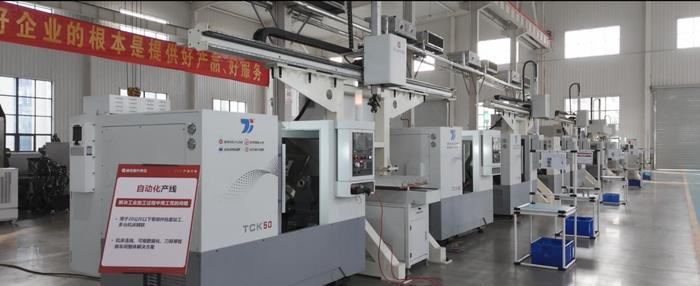
Actual photos of Tengzhou's machine tool factories and products. Source: Jiemian Shandong
A single seed, a single tree, a vast forest.
The best proof of this ecological resilience is a comparison.
In 2011, Shenyang Machine Tool ranked first in the world's machine tool industry, but went bankrupt and was reorganized eight years later. Dalian Machine Tool also collapsed in 2017.
When these two leading enterprises failed, the entire Chinese machine tool industry wailed.
However, the 400 "ants" in Tengzhou withstood the test in the big wave of reshuffle. They not only survived the harsh winter but also captured more than 80% of the national market for small and medium - sized drill - milling machines during the industry reshuffle.
It's not that their technology is stronger than that of Shenyang and Dalian Machine Tools. It's because no single "ant" is too big to fail. They disperse risks, support each other, are independent, and can unite into a powerful force.
This is not the victory of a single enterprise but the victory of an ecosystem.
03
An Army of Ants Can Build a World - Class Industry
If you think that Tengzhou is just a cliche story of hard - working people and industrial clusters, you underestimate this city.
In June 2026, Shandong TV spent nearly three minutes reporting on Tengzhou:
Traditional machine tools are equipped with intelligent brains. Machine tools can sense real - time changes in temperature, vibration and cutting force, automatically optimize the rotation speed and tool path, and predict faults in advance.
This is the world's first mass - produced AIMT artificial intelligence machine tool launched by Qingluan Fuxing, which has transformed machine tools from passive executors to active thinkers.
The People's Daily specially praised Tengzhou on its front page for "deeply integrating artificial intelligence with industrial mother machines".
Many people think that AI is the business of big companies. What does it have to do with a county in southern Shandong?
It has a lot to do with it.
The essence of the machine tool industry is the accumulation of precision and experience. And what AI is best at is turning invisible experience into replicable algorithms.
Zhao Feng, who used to be the deputy chief engineer of Lunan Machine Tool, was transferred to Zaozhuang University in 2019.
This great national craftsman, who worked as a front - line maintenance worker for more than a decade, is now teaching the application of AI in CNC machine tools in the university classroom.
Zhao Feng's story is the best microcosm of Tengzhou's 70 - year machine tool development.
In 1986, 19 - year - old Zhao Feng entered Lunan Machine Tool Factory as a maintenance worker.
When a piece of imported equipment in the factory broke down, the foreign expert charged 2,000 yuan per hour and took away more than 20,000 yuan at one time. At that time, Zhao Feng's monthly salary was only 27.6 yuan.
He asked the foreign expert for advice several times, but the expert was arrogant, which aroused Zhao Feng's inner fighting spirit.
Later, when the equipment imported from Bulgaria in the factory broke down, both Chinese and foreign experts were at a loss and were very anxious.
Zhao Feng stepped forward. Using his self - created fuzzy logic judgment method, he found the faulty component in the dense circuit and solved the problem at once.
The most thrilling time was when a German - imported gantry guideway grinder required an installation fee of 1 million yuan.
Zhao Feng took on the task without hesitation. He didn't go home for half a month. Once during the operation, he accidentally stepped into the air and fell from the equipment, with his arms and legs bleeding. His wife cried on his shoulder.
Forty - five days later, the test run was successful at the first attempt.
Due to his excellent skills, foreigners invited him to join them, but he politely declined. Zhao Feng said: "As a Chinese, I love my country."
Zhao Feng is not an isolated case. At Weida Seiko, Wang Liang, the 80 - post electrical technology department director, took a different path.
After graduating from university and entering the workshop in 2004, Wang Liang mastered the electrical control principle of conventional products in 7 days and completed the internship task that others took three months to finish in 15 days.
In 2017, the customer suddenly required the positioning accuracy to be improved from 0.008 mm to 0.005 mm.
With a tight schedule and urgent task, Wang Liang led his team through 15 days and more than 300 times of debugging, and finally successfully delivered the product. Later, he also solved problems such as the "runaway" of linear motors and was elected a deputy to the National People's Congress in 2023.
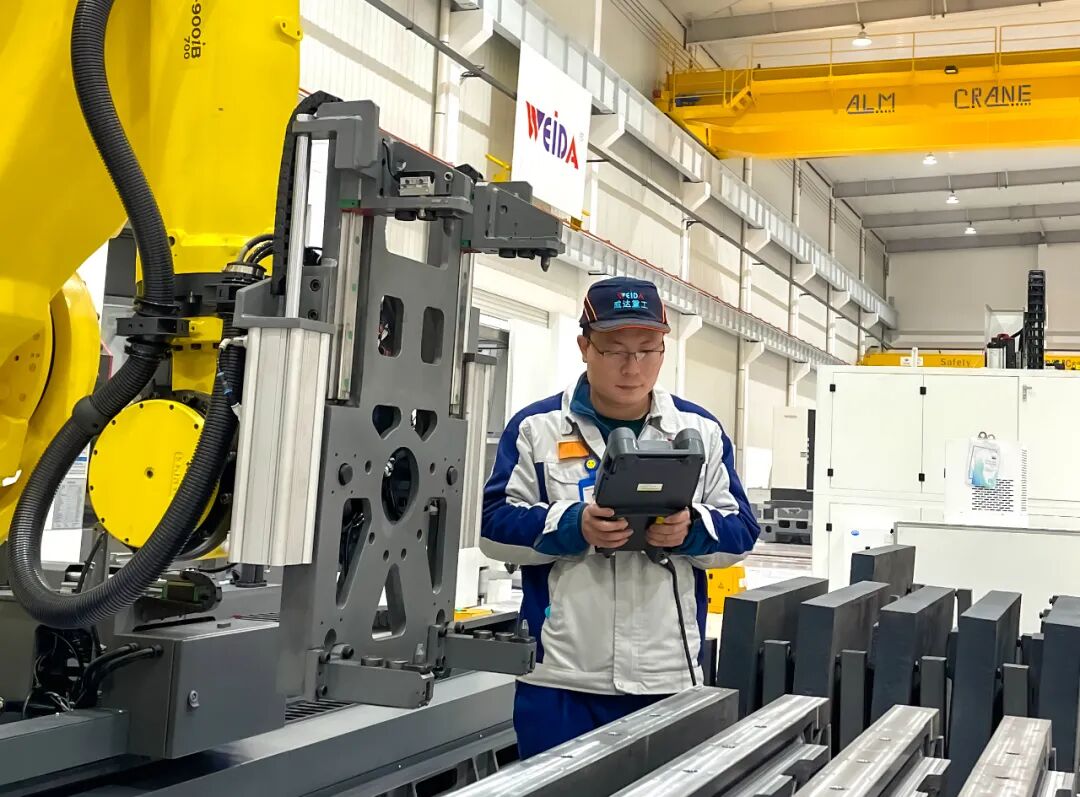
Source: Tengzhou People's Congress
Zhao Feng was a maintenance worker who entered the factory in 1986, and Wang Liang was a college graduate who entered the factory in 2004. One went from a maintenance worker to a professor, and the other went from a workshop apprentice to a deputy to the National People's Congress.
Before them, predecessors like Xu Longquan had been working hard for decades.
It is the combination of several generations that forms the complete arc of Tengzhou's machine tool industry.
04
Epilogue
When it comes to county - level economy, many people's minds picture township enterprises, primitive methods, low - end manufacturing and dust everywhere.
This is not entirely unfounded. The industries in most counties are indeed in the low - threshold and easy - to - start fields. They can survive, but are not very competitive.
Among the top 100 counties in China, Kunshan focuses on electronic information, Jinjiang on shoe - making, Yiwu on selling small commodities, and Shenmu on coal mining. Each has its own strengths.
However, Tengzhou, with its army of "ants" and industrial clusters at the county - level, challenges one of the most hardcore industrial fields in the world - the machine tool industry, which is quite rare.
In 2025, China's machine tool exports accounted for 21.6% of the global market share, ranking first in the world. Tengzhou has made a great contribution to this.
As for the reasons, in addition to historical inheritance and industrial clustering, cultural factors also cannot be ignored.
Tengzhou is the hometown of