How did Elon Musk build a trillion-dollar company from the ruins?
In June 2026, SpaceX completed its IPO worth $75 billion, and Elon Musk became the first billionaire in human history with a personal net worth exceeding $1 trillion. However, over the past decade or so, he has experienced Tesla's near - bankruptcy, consecutive rocket explosions, the Twitter fiasco, and a mass exodus of advertisers. Every time, people asserted that "this is really the end," but every time he persevered and then grew stronger.
Behind all this, what enables Musk to navigate through economic cycles? What underlying thinking principles can be traced in his business empire?
Recently, the book The Musk Principles published by CITIC Press may offer a glimpse of the answers. This book is the first to systematize Musk's thinking fragments over 20 years into 69 actionable principles, extracting a set of "thinking patterns" behind his success.
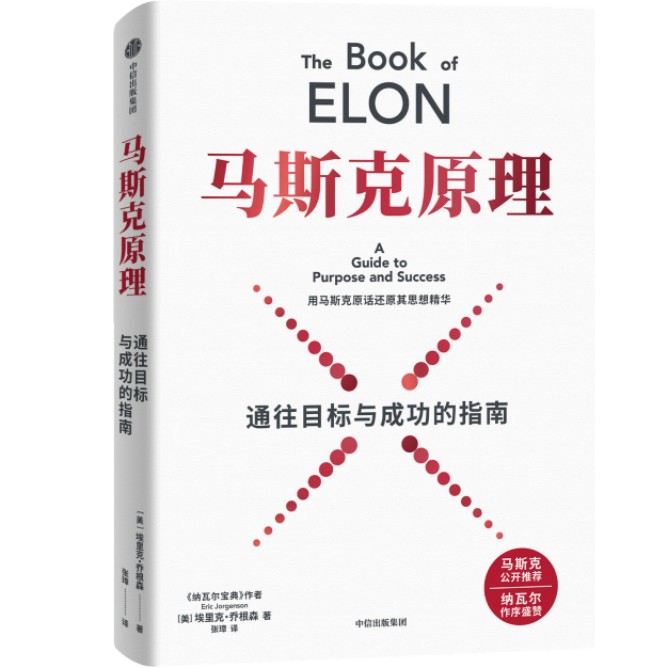
This is a proven decision - making operating system. Moreover, the BookSkills bundled with the book transforms these principles into an interactive thinking coach. Whether you are an entrepreneur in charge of a company worth hundreds of billions or a manager seeking a way out of a predicament, the value of this book and the BookSkills lies in:
When you are confused, you have an additional option: "What new solutions would there be if I thought about this problem in Musk's way?"
Here are 23 of Musk's thinking patterns and work styles that we've selected:
1. Use the laws of physics to combat "empirical inertia"
Typically, in most corporate boardrooms, the most frequently heard questions are: "What is the industry standard?" and "What do our competitors do?" This is an invisible cognitive chain that assumes the rationality of the status quo and confines business competition to the dimension of "marginal improvement." If you ask a hundred CEOs, ninety - nine of them engage in "analogical reasoning": if others do it this way, so do I; if the industry sets it this way, so do I.
Musk's approach is completely different. He asks: "Is this physically feasible?"
In December 2015, with the Falcon 9 launch entering the final minute of the countdown, engineers detected a liquid oxygen leak between stages and requested a halt. Musk paused for a few seconds, quickly assessing the physical risks: there were risks, but they were minimal. "Ignore it and continue the launch," he said. The launch was successful. Years later, when Jon Kosar watched the video, he said, "I thought he had made a quick and complex calculation, but in fact, he just shrugged. He has an a priori intuition in physics."
This intuition is not a gift but the result of training. Musk repeatedly reminds his team: "The only rules to follow are those derived from the laws of physics. Everything else is just a suggestion."
This means that the next time someone tells you "this is impossible," don't accept it immediately. Ask: "Is this physically impossible, or does the 'industry standard' make me think it's impossible?" Most of the time, the answer is the latter.
2. Break things down to the "basic elements"
We can see that most CEOs' approaches to "cost reduction and efficiency improvement" are highly similar: pressuring suppliers for lower prices, laying off employees, and cutting budgets. All these actions are carried out within the existing framework. They are "optimizing within the established boundaries."
Musk's approach is to break down products to the most basic elements and start reasoning from there. There is a dimensional gap between the two approaches.
In the early days of Tesla, the market price of energy - storage batteries was $600 per kilowatt - hour. The entire automotive industry regarded this as an "established fact" because suppliers quoted this price and it was the industry standard, and no one questioned why. Musk asked: "What materials are the batteries made of? Lithium, nickel, cobalt, aluminum, and electrolyte. How much do these materials cost in the spot market?" The answer: only $80 per kilowatt - hour.
$600 is the "market price," and $80 is the "physics price." The $520 difference between them is not a technological gap but a cognitive gap. While most CEOs are "reducing costs and improving efficiency," Musk is eliminating the cognitive premium.
So, the next time you face an "established cost," you might as well break it down. Disassemble the product to the atomic level and then recalculate. You may find that most "reasonable" prices are actually quite unreasonable.
3. Calculate the "idiot index"
Musk has a classic concept called the "idiot index," which refers to how many times the cost of a finished product is higher than the cost of its basic materials. He said bluntly: "If the idiot index of what you're making is very high, then you're an idiot."
In 2002, Musk went to Russia to buy rockets, and the Russians offered each rocket at $18 million. When the negotiation reached a deadlock, one of them even spat at him. On the return flight, an angry Musk opened his laptop and started doing something that made his fellow travelers laugh - using a spreadsheet to break down the rocket's bill of materials: How much does a ton of carbon fiber cost? How much does a kilogram of metal alloy cost? Fuel, valves, avionics... Multiply the unit cost of each material by the required quantity and add them up. The result: the cost of a finished rocket was at least 50 times the cost of its raw materials. So he decided to build rockets himself.
SpaceX's choice was to "compress the rocket's idiot index from 50 times to close to the physical limit." A few years later, SpaceX completed the manufacturing of 70% of its rocket components in - house. In the traditional aerospace industry at that time, this was an almost crazy figure.
It can be said that the idiot index is a ruler in your hand. Use it to measure your core products. The parts with the highest index often have the greatest innovation potential.
4. Assume you're wrong first
Most CEOs are accustomed to defending their judgments. Debates in the boardroom are often not about finding the truth but proving "I'm right." Musk's approach is the opposite: assume you're wrong first and then constantly correct yourself.
This is a cognitive strategy. In psychology, it's called "active cognitive dissonance." Only when you actively look for flaws in your judgments can you truly see the overlooked variables. Musk said in an internal meeting: "If you can't find three flaws in your reasoning within 30 minutes, it means you haven't thought seriously."
At SpaceX, whenever an engineer proposes a plan, Musk's first reaction is not "This is great" but "Where might this go wrong?" He has made "falsification" the default operating mode of the organization.
So, the next time you make an important decision, take 30 minutes to specifically list "If I'm wrong, what are the most likely reasons?" This simple action may change the quality of your decision.
5. Measure success by "usefulness," not wealth
"Entrepreneurs don't really love money in essence." Many people may not believe this when it comes from Musk's mouth. However, his actions do prove that wealth is just a by - product of realizing his vision and has never been the goal itself.
Musk defines success not by wealth but by "how many useful things can be accomplished." He proposed a quantitative formula: Total utility = The number of people you help × The average help you bring to each person. Each of his companies - Tesla, SpaceX, SolarCity, Neuralink - is also solving a specific, physical problem for humanity.
In other words, by binding your company's core business to humanity's long - term needs, you will gain the strategic determination to navigate through economic cycles. Try to redefine your company's success criteria - not revenue and profit, but "What real problems have we solved? How many people have we helped?"
The answers may make you rethink many things.
6. Focus on things that "have just become possible"
Musk also has a precise principle for timing: focus on things that "have just become possible."
If you enter a field too early, the technology is not mature, and you may fail before the dawn. If you enter too late, the pattern is already set, and you can only be a follower. "Just becoming possible" is a precise timing window - the technological critical point has been breached, but the first shot of commercialization has not been fired.
In 2004, when Musk invested in Tesla, the energy density of lithium - ion batteries had just reached the critical point for automotive applications. In 2015, when SpaceX attempted to recover rockets, control algorithms and sensor technologies had just matured.
Every time, he places his bets at the moment when things "have just become possible." Behind this is his precise judgment of the technology curve.
So, list three directions in your industry that "have just become possible" - things whose technologies are already mature but have not been truly realized by anyone. Choose one of them and go all out.
7. If it should exist, don't wait. Make it yourself
"If something should exist, don't wait. Make it yourself." This is a common principle for all of Musk's entrepreneurial projects.
Most CEOs usually wait for the "market demand" to mature. Musk's approach is: if it's physically feasible and valuable to humanity, then just do it, and the market will follow.
Electric vehicles, reusable rockets, Starlink, and brain - computer interfaces - none of them were "demanded by the market" when they were founded. They all "should exist." The difference is that most people accept the "non - existence," while Musk chooses to take action when he sees the "non - existence."
The inspiration for us is: don't ask "What does the market need?" Ask "What should exist but hasn't been done yet?" Then, do it.
8. Question all "requirements" - including your own
At a meeting at SpaceX, an engineer said, "The military requires us to do it this way."
Musk's line of questioning was: "Who put forward this requirement? What's his name? Is he still alive? What technological assumptions did he base it on? If we do it another way, is it physically feasible?"
He said: "The requirements put forward by smart people are the most dangerous because people are less likely to question them." He even said: "Even if the requirement comes from me, you should question it."
Once, when a rocket was about to be launched, engineers found two cracks in the engine skirt. Everyone from NASA present thought the launch would be postponed for weeks because the industry standard procedure was to replace the entire engine.
Musk asked: "What if we just cut off that ring?" The cracks were cut off, and the thrust was still sufficient. The operation was carried out in less than an hour, and the rocket was successfully launched the next day.
So, at the next management meeting, pick out three processes that "have always been done this way" and question whether each one really needs to exist and what assumptions it was based on at the time.
You may find that many "requirements" have been obsolete for a long time, but no one has given them a proper burial.
9. Delete before optimizing
Musk said that one of the biggest mistakes people usually make is: "Start optimizing before deleting."
At the Nevada factory, they once spent a huge amount of money automating a process that shouldn't have existed. Facts have proven that accelerating first and then reflecting has a huge cost.
Based on this, he summarized a five - step work method, and the order is crucial: Question → Delete → Simplify → Accelerate → Automate. This order cannot be changed.
He said: "The most common mistake smart engineers make is to optimize something that shouldn't exist."
He also proposed a "10% principle": If you don't end up adding back 10% of what you deleted, it means you didn't delete enough. Most companies' "efficiency improvements" are actually speeding up "things that shouldn't exist."
Before starting any "optimization" or "automation" project, ask yourself: Does this process really need to exist? If the answer is no, deleting it is more valuable than optimizing it.
10. Push the problem to the physical extreme
Physicists' thinking style has a characteristic: they push variables to the extreme and observe how the system's behavior changes qualitatively. Musk has introduced this methodology into business decision - making.
Regarding urban traffic problems, most people are thinking about "how to optimize ground roads." Musk pushed the problem to the extreme - cities are 3D (high - rise buildings), but roads are 2D (on the ground). How can this contradiction be solved? The answer is to make the roads 3D - underground tunnels. By reducing the tunnel diameter from 28 feet to 12 feet, the area and cost were reduced by four times. Coupled with simultaneous excavation and reinforcement, an eight - fold cost reduction was achieved.
The core of this extreme thinking is that when you think about a problem under extreme conditions, the usual constraints will fail, and new possibilities will emerge. When facing a complex problem, try pushing a variable to the extreme - either extremely small or extremely large - and then observe how the system's behavior changes qualitatively.
11. Pursue breakthroughs in orders of magnitude, not minor improvements
Normally, for a single improvement, most companies aim for a "10% increase." Musk is very radical and sets a goal of a "10 - fold increase."
This is a fundamental difference in thinking style. He believes that a 10% improvement can be achieved within the existing framework - optimizing processes, improving efficiency, and reducing costs. However, a 10 - fold improvement means that the framework itself must be reconstructed - rethinking materials, redesigning processes, and redefining products.
The process of reconstructing the framework often means creating a moat that competitors cannot catch up with. For example, Tesla's integrated casting is not an "optimization" of the casting process but an "elimination" of hundreds of welding processes in traditional automobile manufacturing.
So, when you face a business bottleneck, break the existing thinking framework and ask yourself: If the goal is a 10 - fold increase instead of a 10% increase, what can I do?
The answer to this question may lead you in a completely different direction.
12. All rules are just suggestions
"All rules are just suggestions."
Musk's words are often misunderstood. His complete statement is actually: The only absolute truth is the laws of physics. Everything else - industry standards, company regulations, government laws, safety specifications - is "made by people" and can be questioned, challenged, and rewritten.
In 2018, during Tesla's production hell, Musk set up a tent production line on the empty lot behind the Fremont factory. According to zoning regulations, it was illegal. However, the law allowed "temporary vehicle maintenance facilities" and did not specify the maximum size of the tent.
Musk said: "Get a permit, and we'll pay the fine later." Three weeks later, Model 3 cars rolled out of the tent.
Rules can be a protective umbrella, but they can also be a cage. The key is whether you know their boundaries - which are the laws of physics (unchangeable) and which are man - made regulations (challengeable).
13. Don't give up important things because of risks
"Even if the probability of success is very low, give it a try." "Don't give up important things because of risks."
These two statements reflect Musk's risk - management philosophy.
Most CEOs use "high risks" as an excuse to avoid making decisions. This is a cognitive bias - confusing "risk" with "uncertainty." Musk makes decisions based on probability: if something is physically feasible, if the potential gain after success is large enough, and if the cost of failure is controllable, even if the probability of success is only 10%, he believes it's worth taking the bet.
In 2002, when he decided to found SpaceX, his friends opposed it because the success rate of rocket launches was too low. His response was: The cost of failure might be tens of millions of dollars, but the success would mean making humanity a multi - planetary species.
So, for that project you rejected because of "high risks," recalculate the probabilities. The answer may surprise you.
14. Speed is the best offense and the best defense
Musk has an almost obsessive pursuit of speed.
He divides time into 15 -