Gu Yuxian, a recipient of the Tsinghua Special Award, has joined DeepSeek.
Recently, DeepSeek has been on a massive hiring spree, with positions spanning multiple departments such as algorithms, R & D, product, operations, data engineering, and functional roles.
Meanwhile, the official version of DeepSeek V4 is set to be launched in the middle of this month. In the author list of the previous DeepSeek V4 paper, we found the name of Yuxian Gu, a Ph.D. student in the class of 2021 at Tsinghua University and the recipient of the 2025 Postgraduate Special Scholarship.
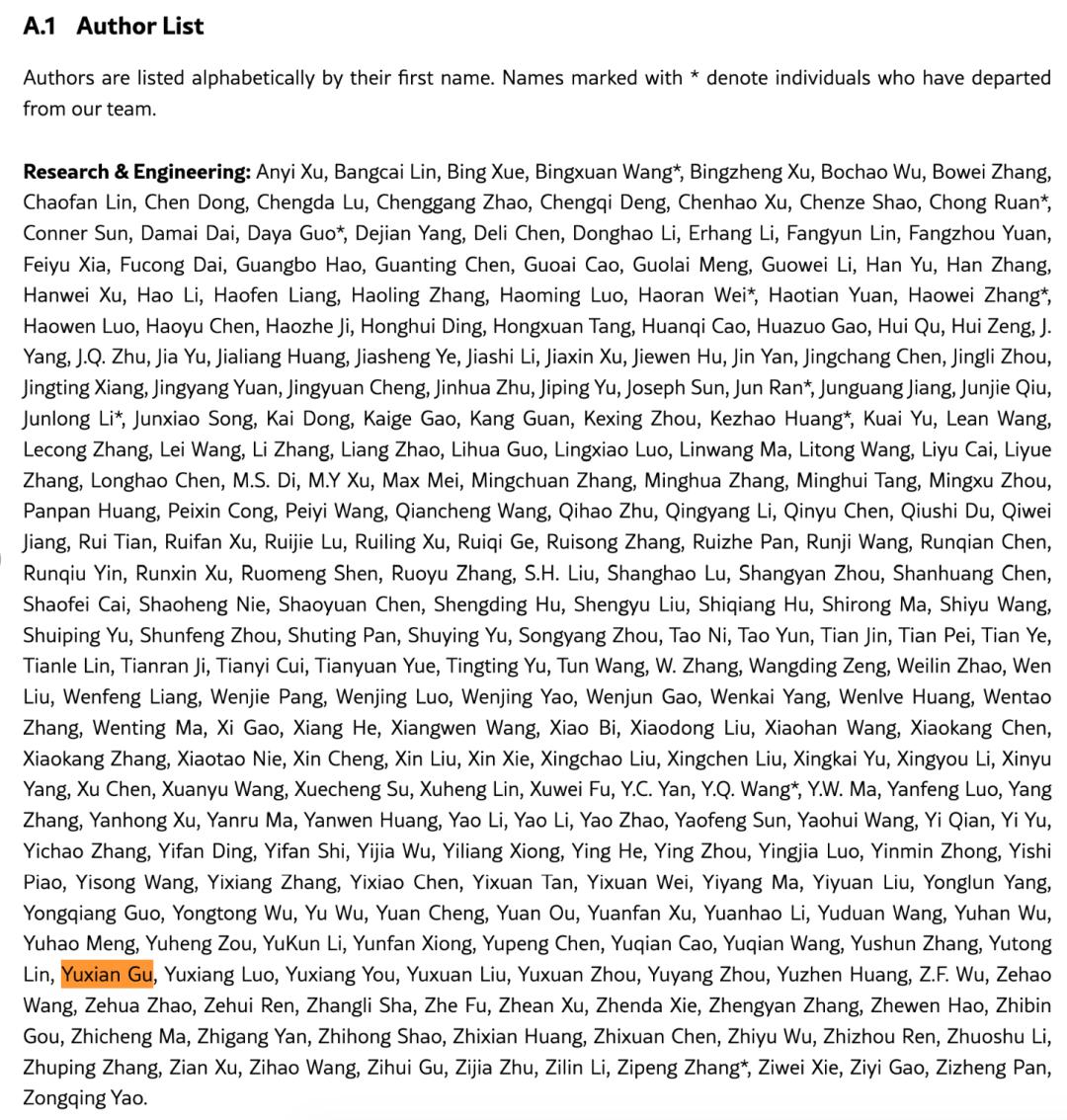
As we know, Yuxian Gu has officially joined DeepSeek.
Yuxian Gu has also won the 2025 Apple Ph.D. Scholarship and the Ant In - Tech Scholarship.
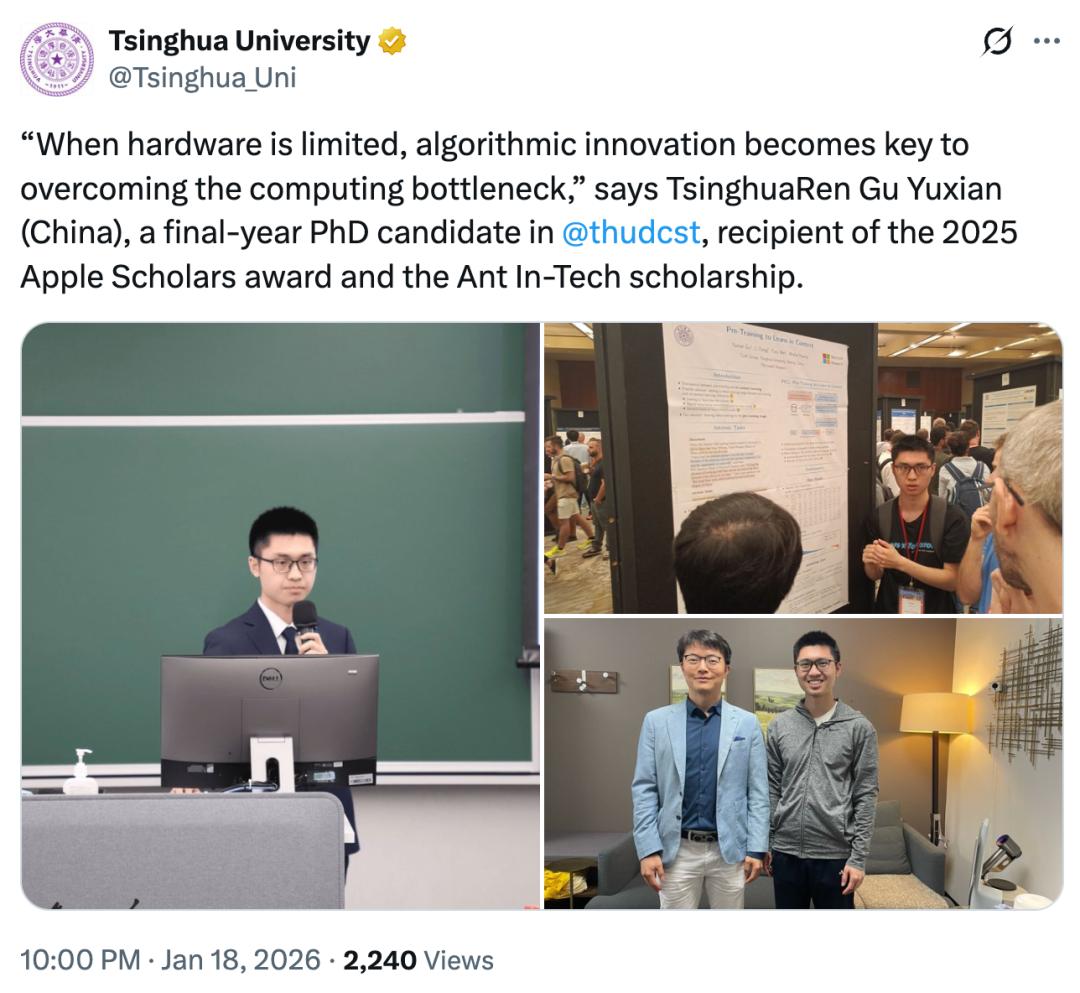
“When hardware resources are limited, algorithmic innovation becomes the key to breaking through the computational bottleneck,” said Yuxian Gu, an alumnus of Tsinghua University. He is a graduating Ph.D. student in the Department of Computer Science at Tsinghua University, and he also graduated from Tsinghua University for his undergraduate studies.
His personal homepage shows that Yuxian Gu studies in the Conversational AI (CoAI) research group at Tsinghua University, under the supervision of Professor Minlie Huang.
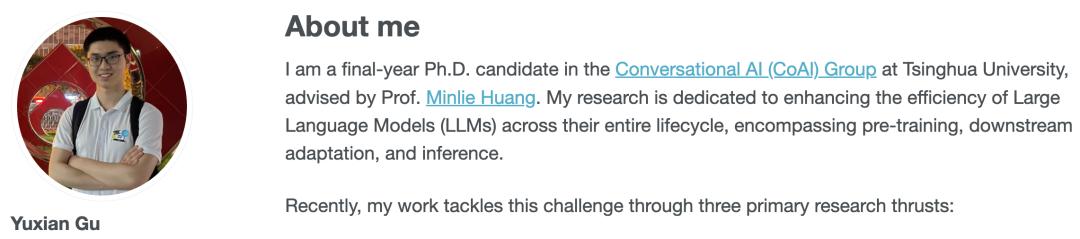
Personal homepage address: https://t1101675.github.io/
His research mainly focuses on improving efficiency throughout the entire lifecycle of large language models, covering key stages such as pre - training, downstream adaptation, and inference. Recently, he has carried out relevant research in three main directions:
Pre - training data screening: Devoted to building theories and algorithms to optimize the data selection process in large language model training, thus training more powerful and efficient models. Representative works include PDS, Instruction Pre - training, and Learning Law.
Knowledge distillation in model compression: Designing new methods to effectively transfer the knowledge of large models to smaller and more deployable models. Representative achievements in this direction include MiniLLM and MiniPLM.
Efficient model architecture: Exploring and designing new model architectures to improve model performance while reducing computational costs. Related work includes Jet - Nemotron.
On his Google Scholar homepage, Yuxian Gu's papers have been cited nearly 5,000 times. Two papers have over 1,000 citations, namely "Pre - trained models: Past, present and future" and "MiniLLM: Knowledge distillation of large language models".
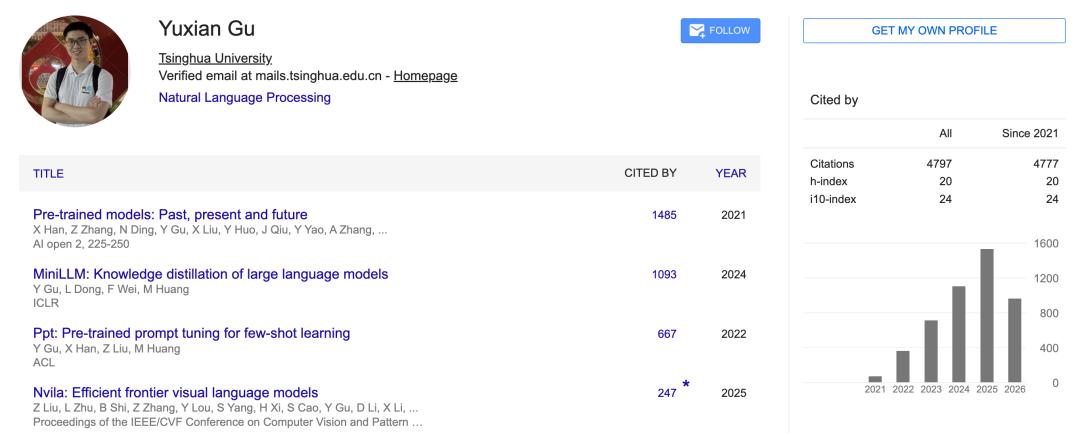
As the first author, Yuxian Gu has published papers at many top international AI academic conferences such as NeurIPS, ICLR, and ACL.
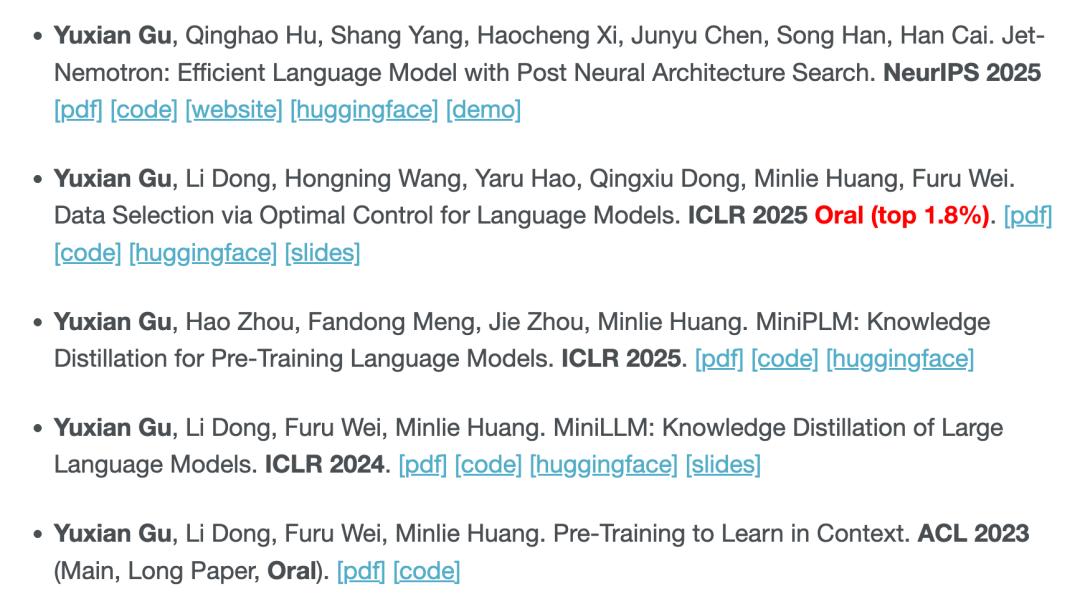
MachineHeart reported on "Jet - Nemotron" last year, a new series of hybrid - architecture language models that achieve state - of - the - art (SOTA) accuracy of full - attention models while also boasting excellent efficiency.
The core innovations of Jet - Nemotron are mainly reflected in the following two points:
Post Neural Architecture Search (PostNAS): An efficient post - training architecture exploration and adaptation pipeline that can be applied to any pre - trained Transformer model.
JetBlock: A new type of linear attention module whose performance is significantly better than previous designs such as Mamba2.
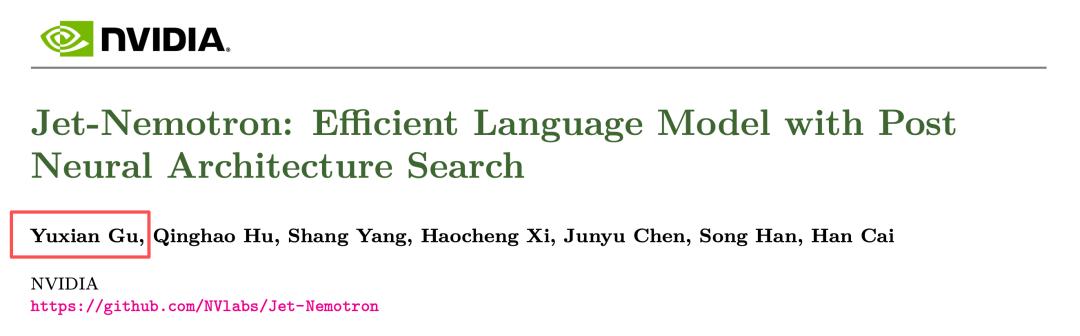
Paper address: https://arxiv.org/pdf/2508.15884
At that time, the 2B version of Jet - Nemotron could outperform the most SOTA open - source full - attention language models such as Qwen3, Qwen2.5, Gemma3, and Llama3.2, while achieving a significant improvement in efficiency. On an H100 GPU, its generation throughput was accelerated by up to 53.6 times (with a context length of 256K and the maximum batch size).
On the MMLU and MMLU - Pro benchmarks, Jet - Nemotron's accuracy also exceeded that of some MoE full - attention models, such as DeepSeek - V3 - Small and Moonlight, despite these models having a larger parameter scale.
Even earlier in 2024, Yuxian Gu and his collaborators proposed a knowledge distillation method for distilling large language models into smaller ones. First, they used the reverse Kullback - Leibler divergence (KLD) to replace the forward KLD target in the standard knowledge distillation method, and then derived an effective optimization method to learn this target.
They named the resulting student model "MiniLLM". A large number of experiments in the instruction - following scenario show that compared with the baseline method, MiniLLM can generate more accurate answers with higher overall quality, while having lower exposure bias, better calibration ability, and stronger long - text generation performance.
This method has been adopted by leading open - source communities and industrial platforms such as Google, Alibaba, and NVIDIA.
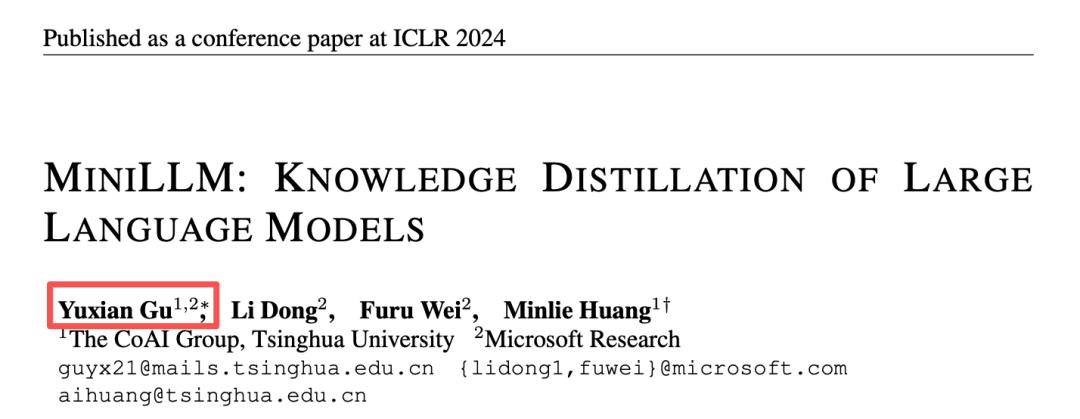
Paper address: https://arxiv.org/pdf/2306.08543
We also look forward to Yuxian Gu bringing more new achievements in the next stage of his "DeepSeek" journey.
This article is from the WeChat official account "MachineHeart" (ID: almosthuman2014). The author is MachineHeart, which focuses on AI talents. It is published by 36Kr with authorization.