Current State of the AI Economy
36Kr Global is a translation team under 36Kr, focusing on technology, business, career, lifestyle and other fields, with a spotlight on introducing cutting-edge foreign technologies, innovative perspectives, and emerging global trends.
Over the past 12 months, the generative AI economy has generated $1.1 trillion in sales. This growth rate is nothing short of staggering. On an annualized basis, its revenue run rate has exceeded $1.75 trillion.
It took us months to build this dataset. As far as we know, this is the industry's first bottom-up, deduplicated measurement of full-stack consumer and enterprise AI spending. Today, we are officially releasing this research in our inaugural State of AI Economy report.
The supply side of the AI market is relatively straightforward to observe. The suppliers of "gold rush shovels" — providers of all core components for AI data centers, including computer chips, memory, transformers, and cooling systems — are mostly publicly traded companies. Through their public disclosures, sales performance, and forward order books, we can broadly grasp the industry-wide investment in infrastructure construction.
However, mapping the demand side is far more challenging — and that is exactly the problem we dedicated the past few months to solving. We built a proprietary AI economy model that comprehensively examines total enterprise and consumer AI spending, to answer several of the most critical, hard-core questions in this AI wave:
How large is this market, exactly?
Is revenue growing sustainably?
To what extent can this revenue cover the upfront investment costs?
As Token (word unit) prices fall and quality improves in the future, how will the economic efficiency of the entire industry evolve?
Before diving deeper into the report, we believe it is necessary to break down the methodology behind this research.
Methodology
How We Calculate the Demand Side
A core principle in our model design is to avoid double-counting. We count the actual dollars paid by end customers. For example, if you spend $1 on Claude services from Anthropic, and Anthropic then spends 50 cents on Amazon cloud services to support that operation, we internally track both numbers, but when we release the final deduplicated data, we only count the $1. This avoids double-counting the value flowing through the supply chain.
This is no easy task. While calculating the supply side is simple, sorting out the demand side is extremely tricky. Most of the revenue flowing into the AI space goes to unlisted private companies, such as OpenAI, Anthropic, Cursor, ElevenLabs, and hundreds of others. Legally, they have no obligation to disclose information.
The remaining revenue flows to the large Hyperscalers that underpin these models: Amazon, Google, and Microsoft. Although they are public companies, they do not regularly or systematically disclose independent revenue from their AI business segments.
To pierce this fog, we carefully studied public statements from Hyperscalers, Neoclouds, their suppliers, and their customers, using only high-confidence factual details to derive our model. We also referenced well-documented leaks and corporate self-disclosures, assigning corresponding confidence scores to them.
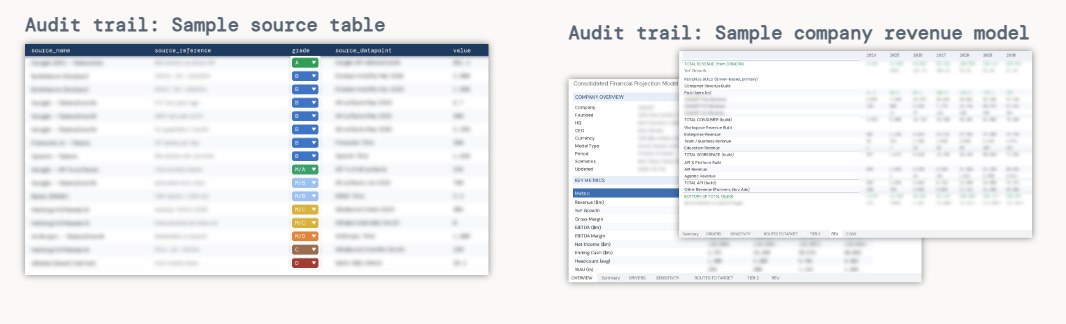
Ultimately, we built a line-item financial model for the companies and business units that contribute the most. Each model is essentially a broken-down financial plan, including an income statement, balance sheet, and cash flow statement, cross-referenced with external independent sources and internal consistency checks. This ensures the auditability of our data — we can clearly trace which data point, with what confidence weight, forms a specific forecast.
What We Did Not Include in Our Calculations
We did not include "internal AI efficiency gains," such as the increase in ad revenue for Meta or Google from optimized recommendation systems. We did model these segments, but they are not included in this report.
We also did not account for the efficiency improvements and cost savings that large tech companies achieve through internal AI tools. This data has not yet been tracked.
We excluded professional services and system integration fees. When a Fortune 500 company invests in AI, only a portion of the funds flows directly to AI companies. This does not represent the full scale of their overall investment, because a large portion of the funds goes to professional consulting and service firms that assist with implementation.
Although we have built a model for revenue in the Chinese market, the Version 1.0 report released this time does not yet include data from the Chinese market.
Core Data
Is This Revenue Real?
Over the past 12 months, after eliminating double-counting, the entire AI ecosystem has generated $1.1 trillion in revenue. This growth momentum is very healthy. If we annualize the revenue from the most recent month, the revenue run rate reaches $1.75 trillion.
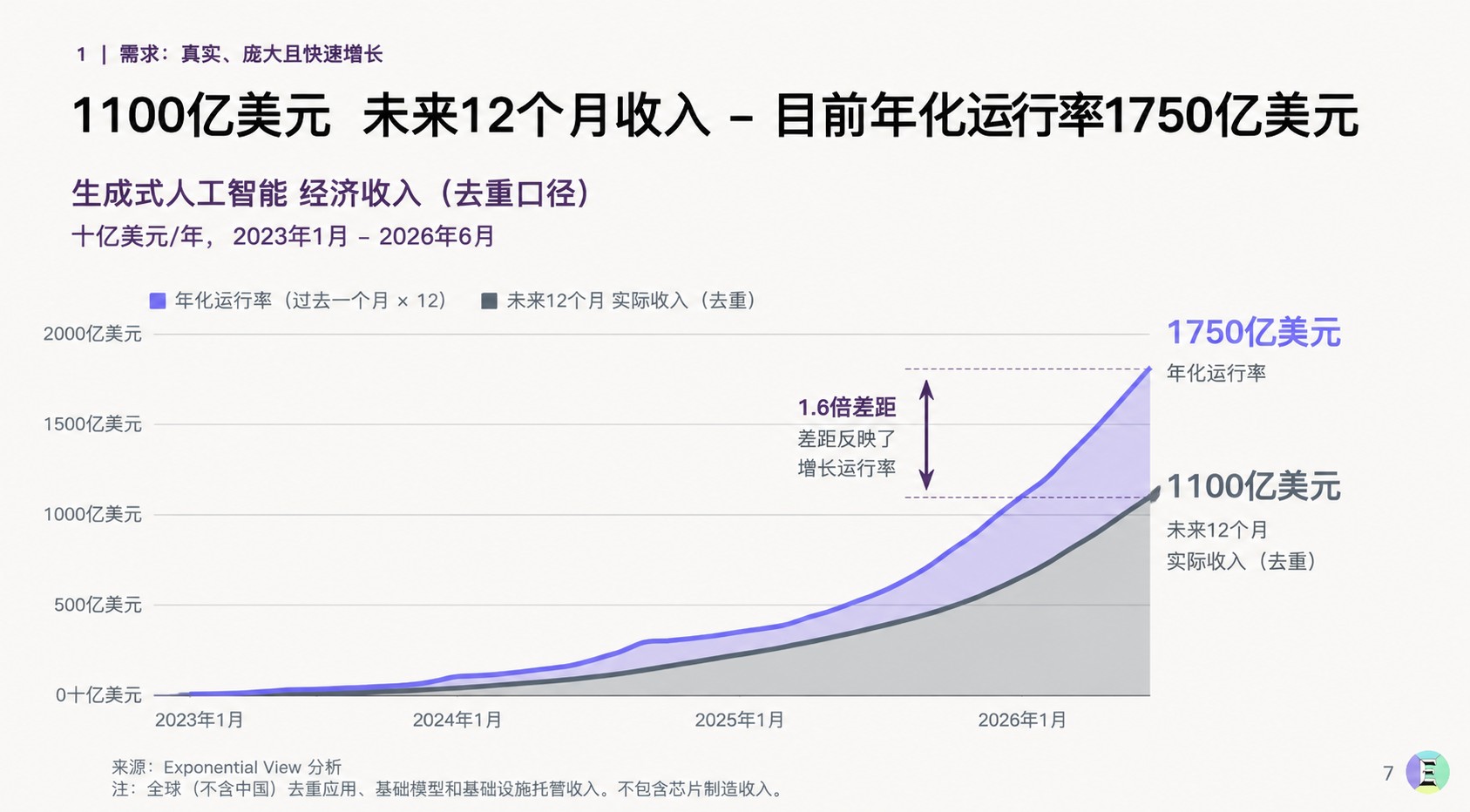
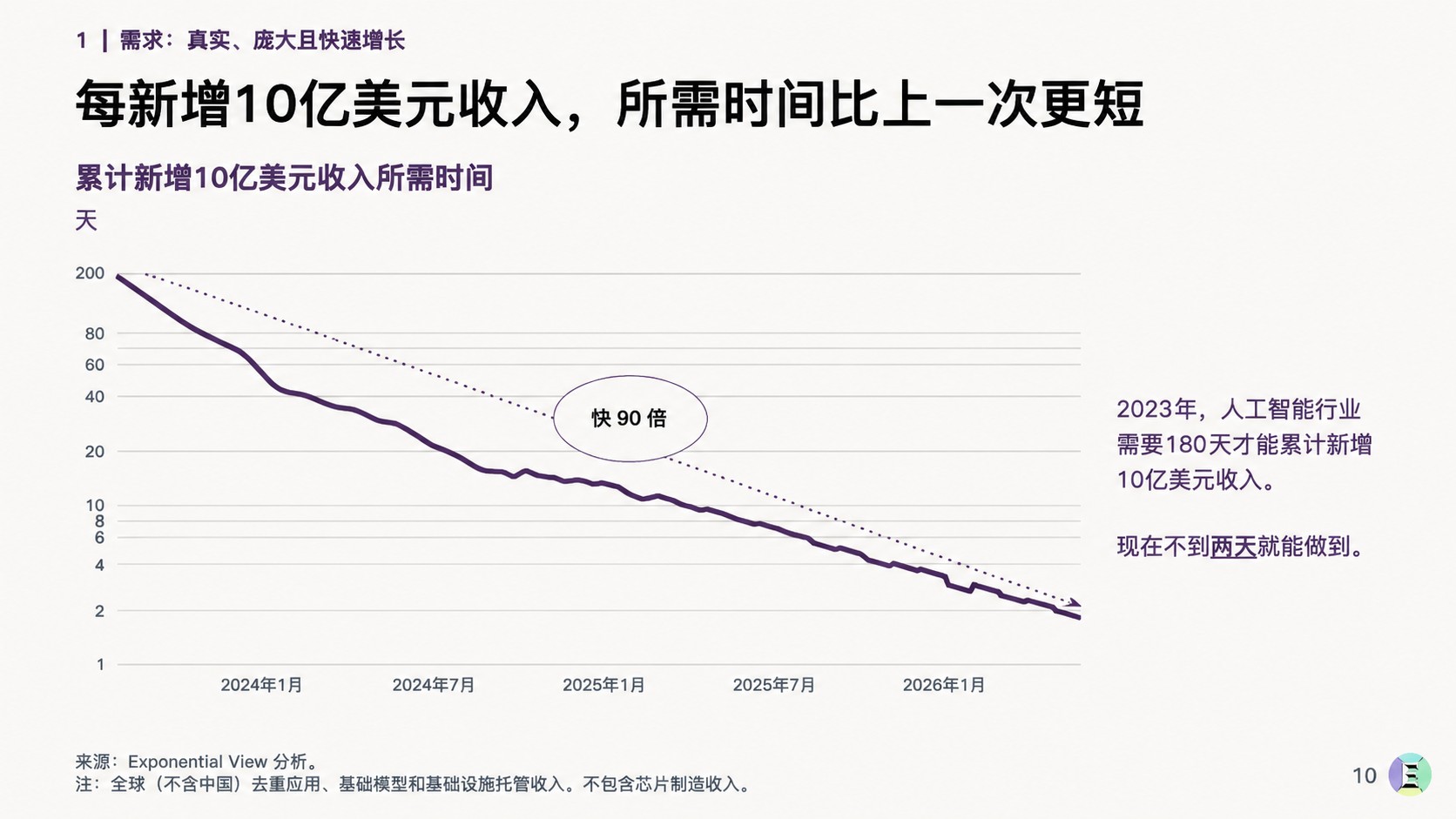
This revenue is growing faster than any previous IT-driven industrial wave, expanding at roughly three times the rate of the mobile internet or early internet waves.
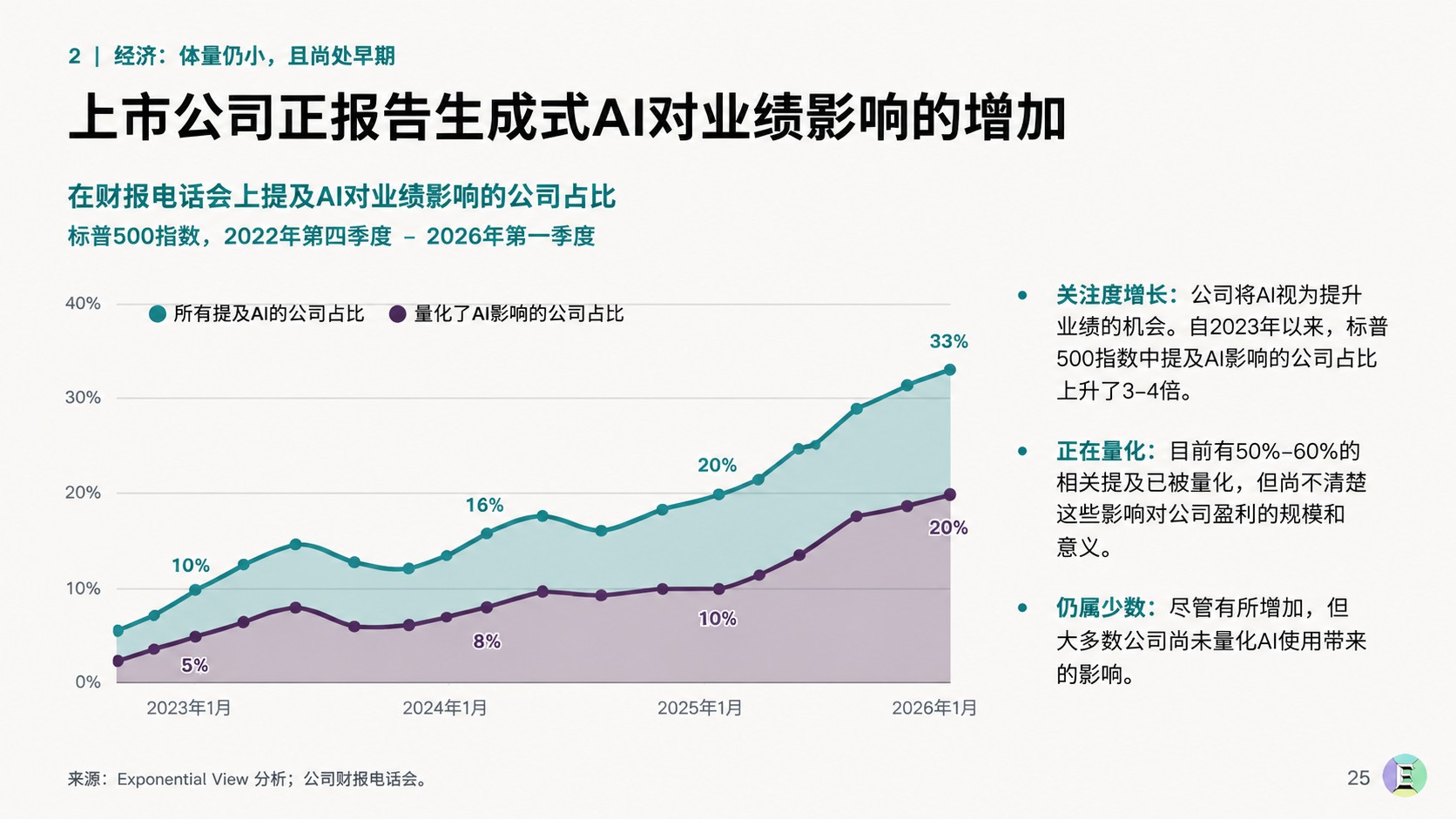
While many enterprises have moved beyond sporadic pilot phases, they are still in the early stages of large-scale expansion and deep integration. In our conversations with executives across industries in Europe and the U.S. — from industrial manufacturing to insurance, finance to pharmaceuticals — a common signal emerged: they plan to further increase their AI investment in the coming years. Companies are also talking about the impact of AI more frequently on earnings calls, though notably, half of the CEOs surveyed believe their job security depends on delivering a strong AI performance.
Can AI-Generated Revenue Cover the GPU Bill?
The next question we wanted to track is whether AI-generated revenue can cover the massive capital expenditures (CapEx) required to build infrastructure. Our model separates AI-specific capital expenditures from regular capital expenditures for major Hyperscalers and specialized AI cloud providers (i.e., Neoclouds). This adjustment is critical because before the birth of ChatGPT, these Hyperscalers were already spending roughly $120 billion annually on capital expenditures.
We isolated incremental investments into AI infrastructure, depreciating compute assets over 6 years and other infrastructure assets over 14 years. Our model shows that the AI revenue directly attributable to Hyperscalers currently just barely covers this depreciation expense.
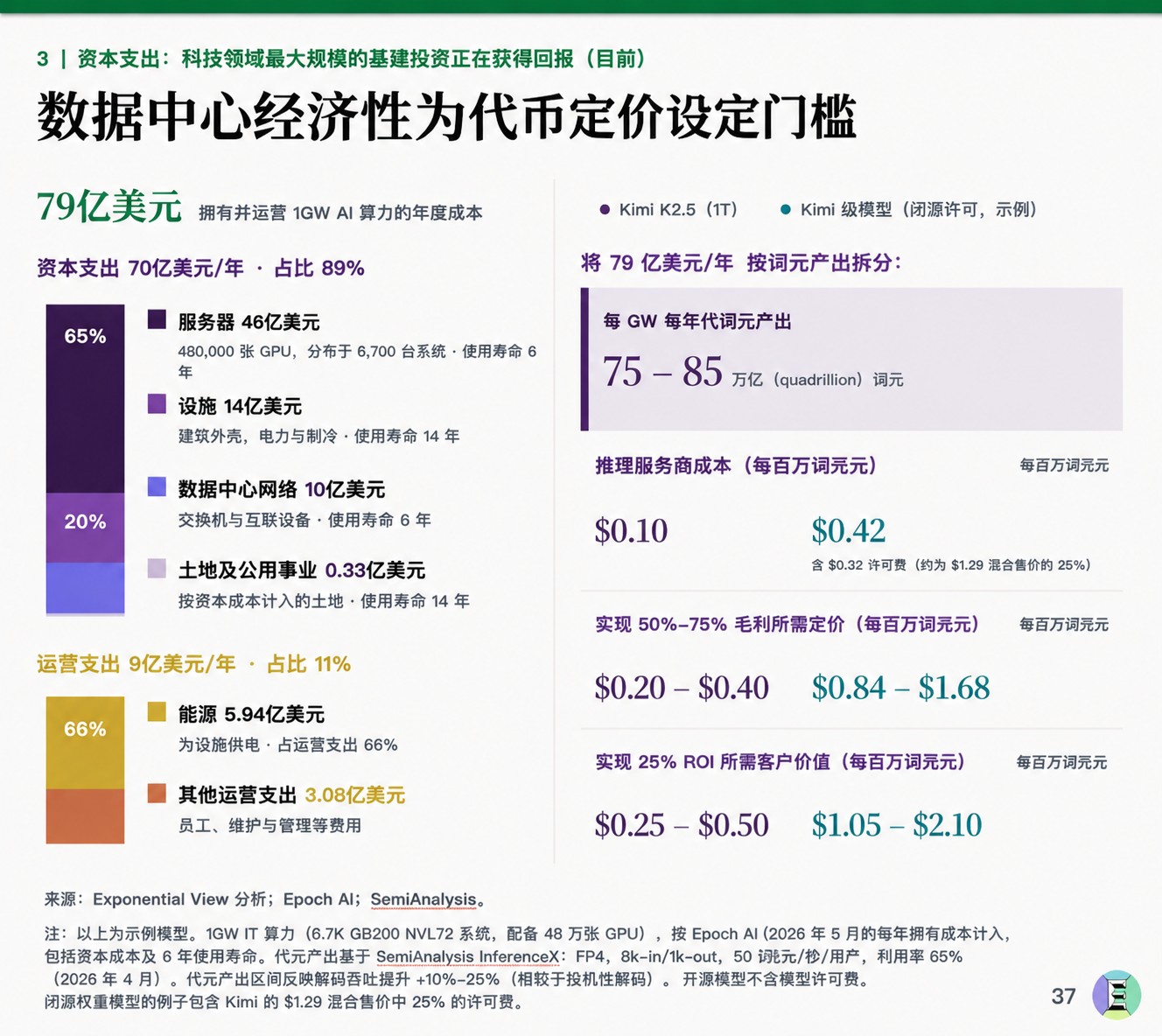
A 6-year depreciation period is entirely defensible. This longer asset lifespan primarily reflects two things: first, market demand still far outstrips available AI compute capacity; second, cloud providers are becoming increasingly sophisticated in managing and orchestrating large-scale GPU clusters. Both factors have a positive impact, and the second alone is sufficient to justify extending the economic life.
What Does the Future Hold for Tokens?
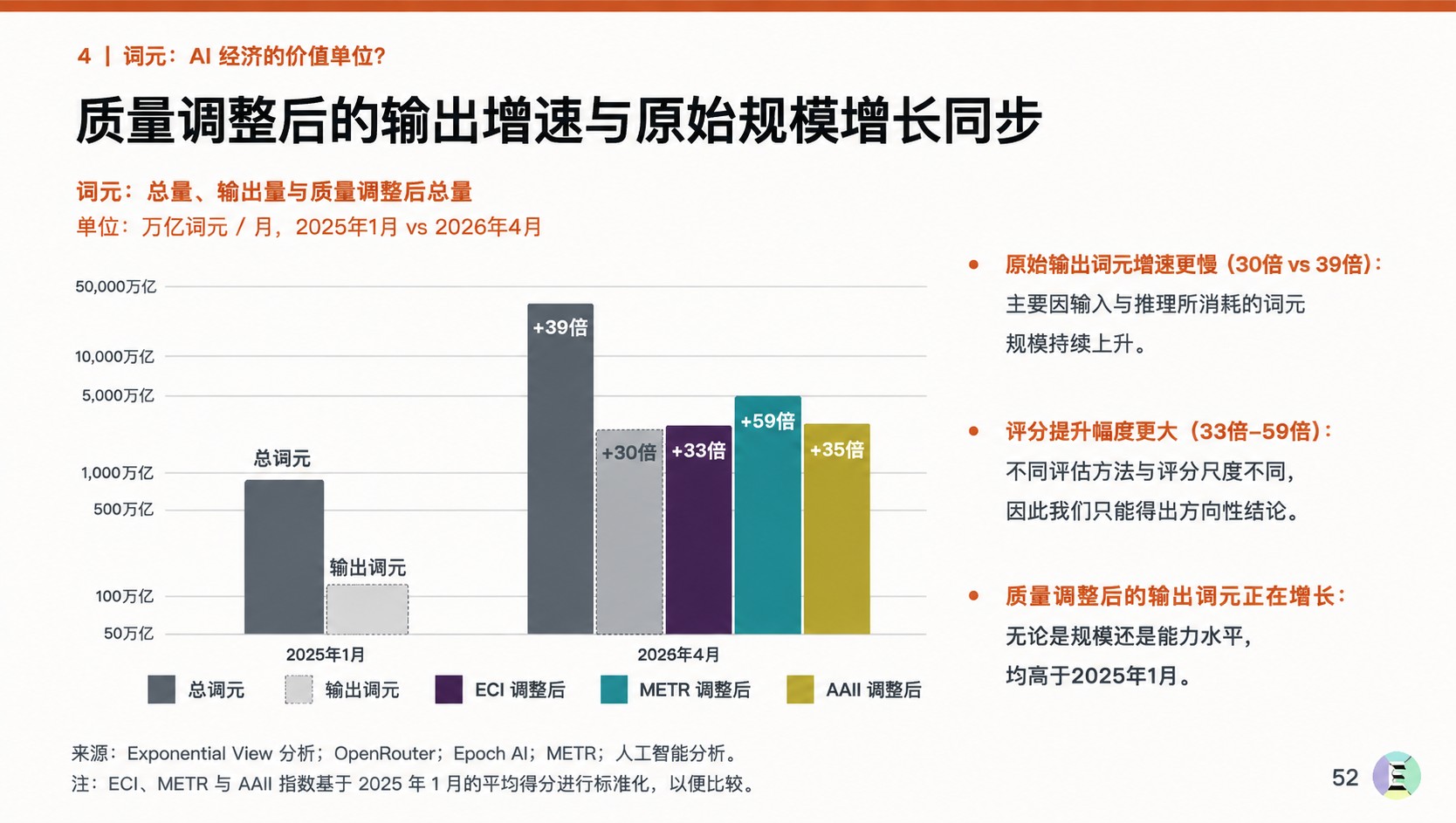
We also conducted an in-depth analysis of how the overall market size will evolve as Token prices decline. Demand elasticity shows that falling prices actually stimulate total spending to rise. We estimate that across various service providers, for every 10% drop in price, Token usage increases by 12% to 18%, so total spending continues to trend upward.
We note that while Token is a very practical billing metric, it does not accurately measure the true economic value of the "intelligence" circulating in the industry. By weighting Token production, the proportion of effective output actually presented to end users, and the comprehensive capabilities of underlying models, "quality-adjusted output Tokens" provide a more objective and accurate "intelligence quotient" for us to evaluate the AI economy.
What Else Does the Report Cover?
The report also delves into the following topics:
The impact of AI demand on the U.S. power industry, and how power utilization efficiency is being transformed;
The latest trends in Token costs, and how usage-based pricing models will further expand market boundaries;
Four potential scenarios that forecast the growth rate of AI demand under different trajectories of price and technological capability evolution.
Translator: boxi.