A new chapter for OTAs and ride-sharing: Tongcheng plans to make a tender offer for Dida
On June 29, Tongcheng Travel and Dida Chuxing jointly issued an announcement stating that Tongcheng Travel will initiate a voluntary conditional all - cash tender offer through its wholly - owned subsidiary, eLong, Inc. Currently, five core shareholders of Dida Chuxing have signed irrevocable commitments, corresponding to 53.7% of the issued total share capital, indicating a very high certainty for the transaction to be completed.
Meanwhile, the announcement clearly states that this acquisition does not aim for privatization, and Dida Chuxing will continue to maintain its listing status on the Hong Kong Stock Exchange.
On the next trading day, affected by the news of Tongcheng Travel's proposed tender offer, Dida Chuxing's stock price soared by approximately 88.19% in a single day, closing at HK$2.39 per share, and its total market value rebounded to approximately HK$2.453 billion.
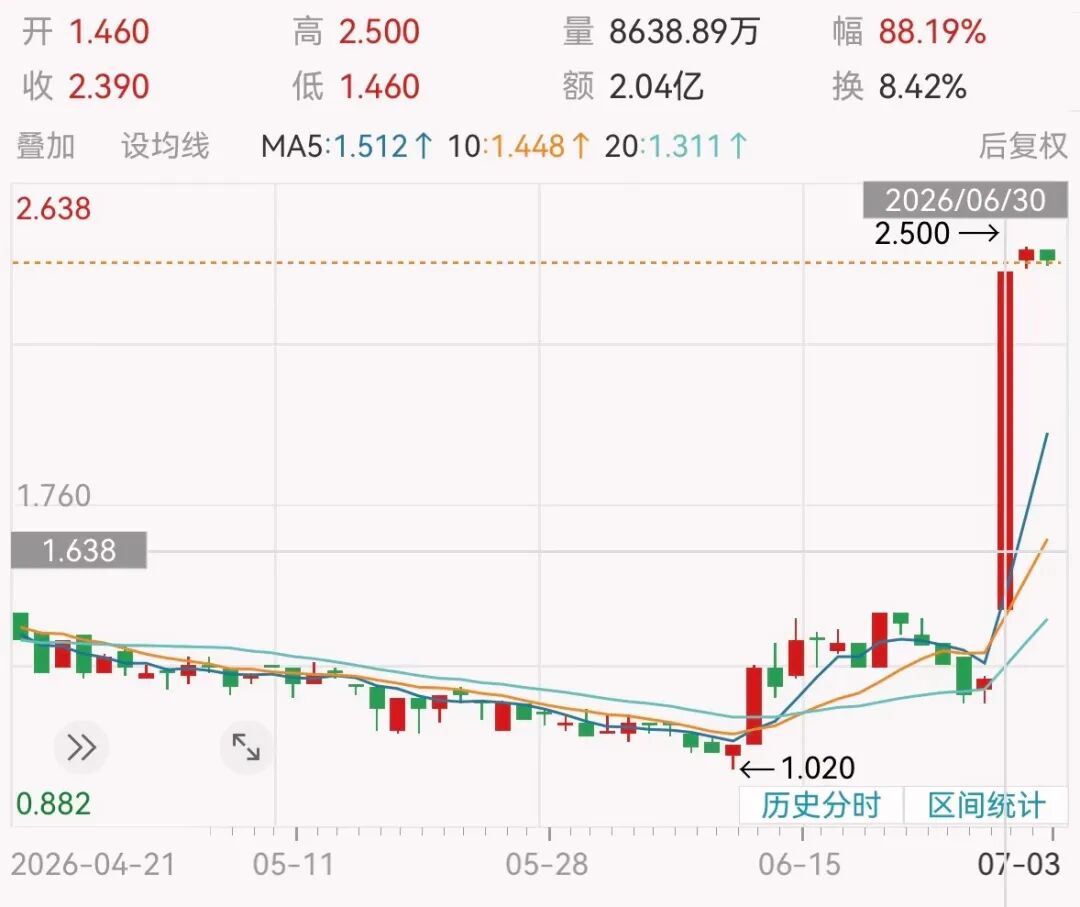
On the second day after the announcement, Dida Chuxing's stock price rose by 88.19%
The reaction in the capital market reflects investors' optimism about the potential cooperation. Although the market often interprets this transaction as Tongcheng "buying at the bottom," beyond the surface narrative of stock price fluctuations, the essence of this cooperation is that the two platforms complement each other's growth weaknesses: Dida Chuxing holds high - margin carpooling assets but has long been troubled by the cost of traffic acquisition; Tongcheng Travel has a large number of travel users but lacks high - frequency local travel scenarios.
The user groups and business chains of the two are highly complementary. This merger and acquisition is not a one - sided acquisition but a two - way construction of traffic and scenarios based on real business pain points.
OTA Partners with Carpooling: No More Mismatch in Traffic Supply and Demand
The core of the competition in the second half of the travel industry has long deviated from the early subsidy wars and shifted towards the in - ecosystem native traffic diversion ability.
Didi relies on the full - scenario ride - hailing service, Hello is associated with shared bicycles, and Gaode embeds navigation traffic. Only Dida Chuxing has long been an independent vertical platform, and all users need to actively download and open the app, always lacking a low - cost natural traffic pool. This is the core reason for its continuous pressure on revenue.
From the financial report data, Dida Chuxing's business model itself still has resilience. In 2025, its revenue was 502 million yuan, a year - on - year decline of 36.3%, but the annual adjusted net profit was 138 million yuan, achieving profitability for seven consecutive years. In the first half of 2025, the gross profit margin of its carpooling business reached 67.2%. In contrast, the gross profit margin of Caocao Chuxing was 8.4% and that of Didi was 19.2% during the same period.
The high gross profit margin benefits from Dida Chuxing's asset - light matching model. As a report by Frost & Sullivan shows, from 2021 to 2023, the total amount of subsidies for carpooling drivers and rewards for passengers on Dida only accounted for 1.8% of the platform's total transaction volume, lower than the industry average of 16.7%.
The asset - light model also makes Dida Chuxing's financial health very good. As of the end of 2025, the total cash and various financial assets on its books were approximately 1.841 billion yuan, and it had no interest - bearing liabilities.
However, the stable business foundation cannot cover up the growth weakness: As of the end of 2025, Dida Chuxing had a cumulative of 415 million registered users and 21 million certified drivers, but the overall order volume and transaction volume declined in that year.
Compared with the ecological traffic diversion logic of its peers, Dida Chuxing has no supporting business to undertake users, and the cost of customer acquisition through advertising is high. Even after the launch of aggregated ride - hailing and corporate commuting cooperation, it is only a scattered supplement and has not formed a stable increment.
Tongcheng Travel can just make up for this shortcoming. The financial report shows that in 2025, Tongcheng Travel's annual paying users reached 253 million, and the total number of service person - times exceeded 2.034 billion, and it enjoys a natural traffic entrance in the WeChat ecosystem.
Specifically at the business level, the scenarios they focus on are naturally compatible: After users book air tickets, train tickets, and hotels on Tongcheng Travel, there is a rigid demand for inter - city and station transfers. Carpooling can be directly embedded in the entire ticket - booking process, turning Dida Chuxing from an app that users need to actively open into a supporting native service in the travel process.
On the other hand, Dida Chuxing can also relieve the long - standing low - frequency operation dilemma of Tongcheng Travel. Usually, air tickets, hotels, and scenic spots belong to low - frequency consumption, and users open the platform a limited number of times a year, putting continuous pressure on the platform's user activity; while carpooling covers commuting and inter - city travel, which belongs to daily high - frequency scenarios.
Connecting Dida Chuxing is equivalent to giving Tongcheng an entrance to a high - frequency scenario. The 415 million travel users of the former are expected to reverse - divert traffic to Tongcheng Travel's hotel and ticket business, opening up the consumption chain of "daily commuting - weekend outings" and extending the user's lifetime value.
Completing the Ecosystem Shortcoming: Bridging the "Last Mile" of the Journey
Currently, Tongcheng Travel focuses on full - category travel bookings, covering long - distance travel needs such as air tickets, high - speed trains, hotels, scenic spots, and long - distance passenger transportation, but lacks the short - distance transfer ability before and after reaching the destination. Dida Chuxing specializes in inter - city carpooling and daily commuting carpooling, and has a private car capacity network across the country, which just fills the short - distance gaps at both ends of the travel chain - from home to the airport or station and from the station to the destination hotel.
If the acquisition is successful, the deficiencies at both ends of the journey can be made up, and a real "door - to - door" travel closed - loop can be constructed to cover the travel needs of all - domain users.
On this basis, the sinking market may become the most prominent sector for the business synergy value of the two platforms.
Data from Tongcheng Travel as of the end of June 2025 shows that 87% of the platform's registered users are from non - first - tier cities. These cities often have insufficient public transportation coverage and a large number of private cars, and residents have strong needs for inter - city commuting and short - distance outings, which just match the core applicable scenarios of Dida Chuxing's carpooling.
Dida Chuxing has now covered 366 cities across the country, and its sinking capacity network can meet the transfer needs of Tongcheng Travel's large number of users in low - tier cities, making up for the "last mile" shortcoming of sinking tourism consumption.
In terms of product service forms, Dida Chuxing's large number of driver resources can be linked with Tongcheng Travel's hotel, farmhouse, and scenic spot ticket resources in cities of all levels across the country to form a "carpooling + destination package"; Tongcheng Travel's current full - category tourism supply can also enrich the additional consumption options for Dida Chuxing's users, thereby optimizing Dida Chuxing's income structure - in recent years, the carpooling income of Dida Chuxing has long accounted for more than 90% of its total income, and the anti - cycle ability of its business is weak. After connecting to the all - domain tourism supply chain, the non - carpooling income is expected to continue to increase.
In addition, from the perspective of incremental space, currently carpooling only accounts for 4.4% of the domestic automobile passenger transportation market. Frost & Sullivan predicts that the industry scale will reach 103.9 billion yuan in 2028, with a compound growth rate of 29.4% from 2024 to 2028. If the acquisition transaction is successfully completed, Tongcheng Travel is also expected to catch the "carpooling" of this trillion - yuan track.
Layout in the Valuation Trough: Amplifying the Long - Term Profit Curve
Looking back at Dida Chuxing's more than two - year journey in the Hong Kong stock market, since its listing on June 28, 2024, its stock price has continued to weaken, and the market value has shrunk significantly before the acquisition announcement, more than 70% lower than at the beginning of its listing. Compared with the scale of 415 million users and 21 million highly - sticky drivers, the market's price - to - earnings ratio of only 9 times for it is underestimated.
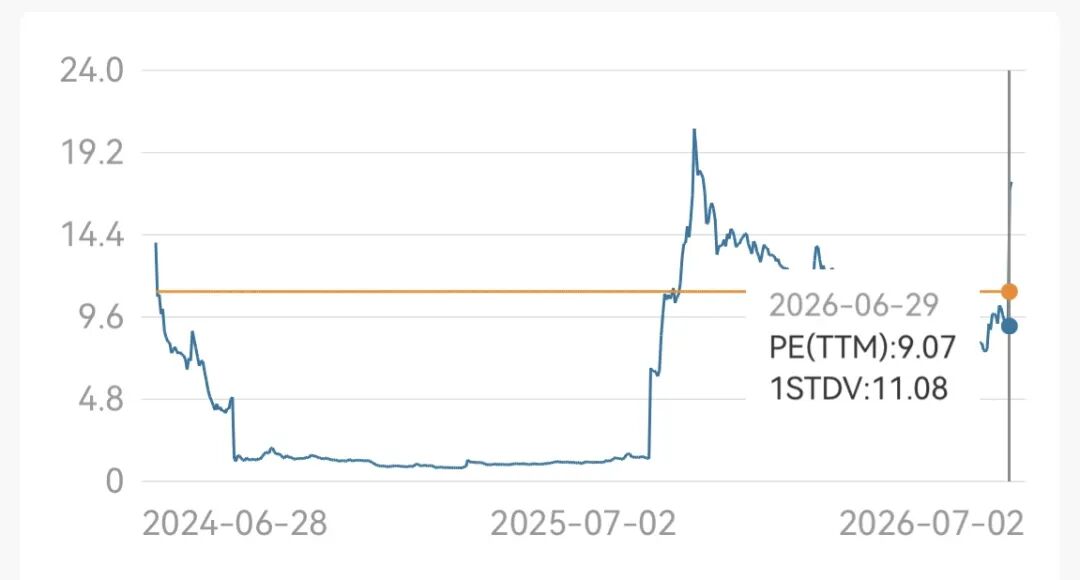
Before the announcement, Dida Chuxing's PE ratio was only about 9 times
After the acquisition announcement, Dida Chuxing's stock price soared by nearly 90% in a single day, which once again reflects investors' optimism about the long - term value of this collaborative cooperation.
In contrast, Tongcheng Travel's total revenue in 2025 was approximately 19.4 billion yuan, a year - on - year increase of 11.9%; the adjusted net profit was 3.4 billion yuan, a year - on - year increase of 22.2%. At the same time, the total balance of its cash and cash equivalents and short - term investments was approximately 9.951 billion yuan, which means it has abundant cash reserves, and the acquisition transaction will not put pressure on its own operations.
From the performance perspective, Tongcheng Travel's existing transportation and accommodation businesses together account for nearly 70% of its total revenue. If Dida Chuxing's high - margin carpooling assets with a gross profit margin of 67.2% are incorporated into the financial statements, it can improve its overall gross profit level. At the same time, the continuous user activity brought by high - frequency travel scenarios is also expected to drive the repurchase of the original hotel and tourism business, creating new revenue increments.
On the other hand, Dida Chuxing's past revenue has been highly dependent on carpooling matching commissions. In 2025, under the low - price competition in the industry, the orders and income shrank simultaneously. After connecting to Tongcheng Travel's all - domain tourism ecosystem, it can obtain commission income through ticket, hotel, and scenic spot distribution, reducing the risk of single - business fluctuations.
In addition, after obtaining the all - domain traffic import from Tongcheng Travel, the order volume of Dida carpooling is also expected to rebound, thereby diluting the platform's fixed costs and maintaining the high - gross - profit - margin advantage.
It is also worth noting that this announcement clearly retains Dida Chuxing as the listed entity. Tongcheng Travel integrates resources in a controlling manner, and Dida Chuxing operates independently and continues to connect with the secondary market. This means that the acquisition transaction will take into account both strategic synergy and independent development. Dida Chuxing's original carpooling compliance and risk control and driver operation systems will be completely retained, and the safety and matching barriers accumulated over the years will not be diluted.
Conclusion:
Overall, the core logic of this transaction is the inevitable result of the boundary integration of the tourism and travel industries. Dida Chuxing holds an asset - light and high - margin carpooling foundation but lacks a stable and low - cost traffic engine; Tongcheng Travel has a large number of users and an all - domain supply chain but lacks high - frequency local travel scenarios.
The combination of the two not only makes up for Dida Chuxing's long - term traffic shortcoming but also improves Tongcheng Travel's one - stop all - domain travel ecosystem.
For the same industry, this is the first time that an OTA has made a tender offer for a carpooling company listed on the Hong Kong stock market. If it is successfully completed, it will also provide a new model for the industrial integration of the tourism and travel industries: no longer relying on subsidy expansion but relying on scenario complementarity to achieve two - way reuse of traffic, capacity, and even the supply chain.