Bank of America: Meta's move to sell computing power aims to deliver a compelling AI return-on-investment narrative
Meta is planning to monetize its massive AI computing power assets. This layout is not only the prototype of a new business line but also a strategic signal to address investors' doubts about the return on high capital expenditures.
According to reports, Meta is formulating a plan to launch a cloud infrastructure business, offering external customers access to AI computing power and model services. After the news was announced, Meta's stock price soared by about 10% in a single day, far exceeding the approximately 0.25% increase of the S&P 500 index during the same period. The market responded positively to this potential new business line.
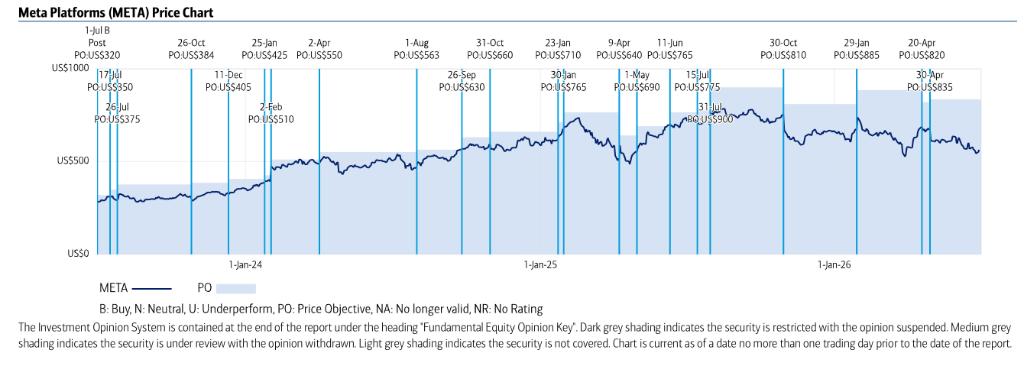
According to the news from the Chase Trading Desk, analysts Justin Post and Nitin Bansal from Bank of America Securities pointed out in a research report released on July 1st that the advancement of the cloud business helps to highlight the potential value of Meta's computing power assets and model R & D, thus alleviating investors' concerns about the company's continuous investment in AI infrastructure without seeing returns for a long time. Bank of America maintains its buy rating on Meta with a target price of $835.
01 Meta's Cloud Plan Emerges: Two Paths in Parallel
According to Bloomberg citing people familiar with the matter, Meta's cloud business plan currently has two directions. One is to provide AI model hosting services, allowing developers to access various models running on Meta's existing AI infrastructure, including its Muse Spark series of models, and charging based on the access volume. This model is similar to Amazon AWS's Bedrock product. The other is to directly sell raw computing power, which is more similar to emerging cloud computing service providers like CoreWeave.
The above plan is part of Meta's internal strategic initiative called "Meta Compute", which focuses on the construction, operation, and management of AI infrastructure. Meta's CEO has previously publicly hinted at business opportunities in the enterprise market and stated that the company is expected to sell computing power to the outside world at a price higher than the construction cost.
Bank of America pointed out in the report that from a more macro perspective, if Meta's capital expenditure in 2026 can support the construction of up to 3GW of computing power (estimated at about $40 - $45 billion per GW), establishing a cloud business platform in the near future will give the company greater strategic flexibility - once there is excess computing power, it can be rented out at a price of $10 - $15 billion per GW per year, providing positive support to the company.
02 Doubts about Competitive Positioning, Controversies over Strategies Unavoidable
Despite the enthusiastic market response, Bank of America also straightforwardly pointed out potential doubts. Meta's progress in self - developed chips seems to lag behind that of mature hyperscale cloud service providers such as Amazon, Microsoft, and Google. At the same time, the company itself is still actively purchasing computing power through third - party agreements, including a recent 1.6GW procurement agreement with Crusoe.
This phenomenon has prompted the market to question Meta's strategic logic: Can a company that still needs to purchase computing power externally establish a convincing computing power resale business? How will its competitiveness be positioned in the hyperscale cloud market?
Bank of America believes that Meta's ability to gain stronger market recognition in this field depends to a certain extent on the development of the cutting - edge capabilities of its large language models (LLMs) - the higher the model level, the stronger the external demand for Meta's computing power, and the more solid the business logic of the cloud business will be.
03 Improvement in AI Unit Economics: A Double - Edged Sword for Cloud Service Providers
Beyond Meta's cloud plan, there are also noteworthy signals on the cost side of AI computing power. According to The Information, OpenAI is said to have discovered a system - level optimization solution that reduces the inference cost of specific models by about half. This optimization is achieved through more efficient use of existing server infrastructure without the need for new hardware or the introduction of new model architectures. It is reported that OpenAI has applied this optimization to the traffic of ChatGPT in the unlogged - in state, and only a few hundred NVIDIA GPUs are needed to support the operation of the relevant traffic. Currently, it is not clear the specific principle of this method, nor is it certain whether it can be extended to logged - in users, API workloads, or compute - intensive inference products.
Bank of America believes that the improvement in computing power cost efficiency is beneficial to the overall direction of large Internet companies: If this technology can be promoted at the industry level, it will increase the effective output of existing computing power without increasing hardware investment, reduce the urgency of new capital expenditures, and improve the unit economic model of AI business. As the token consumption driven by agentic application scenarios increases significantly, the strategic value of computing power optimization will become more prominent.
However, for hyperscale cloud service providers, the decline in inference costs also poses a certain risk of price pressure. At the same time, a better gross margin structure and a broader addressable market are expected to drive the continuous growth of AI workload demand, which is still positive overall.
This article is from the WeChat official account "Hard AI", author: Focusing on technology R & D. It is published by 36Kr with authorization.