Honor of Kings, a 15-minute-per-match game, has become a refuge for math doctoral students.
Meng Xi is a fan of Honor of Kings. His highest rank is 1955 points in the Peak Competition. Meanwhile, he is also a doctoral student in mathematics.
Recently, he spent two weeks raising the combat power of the Yuanshi support hero from over 9,000 to 11,000 in one go.
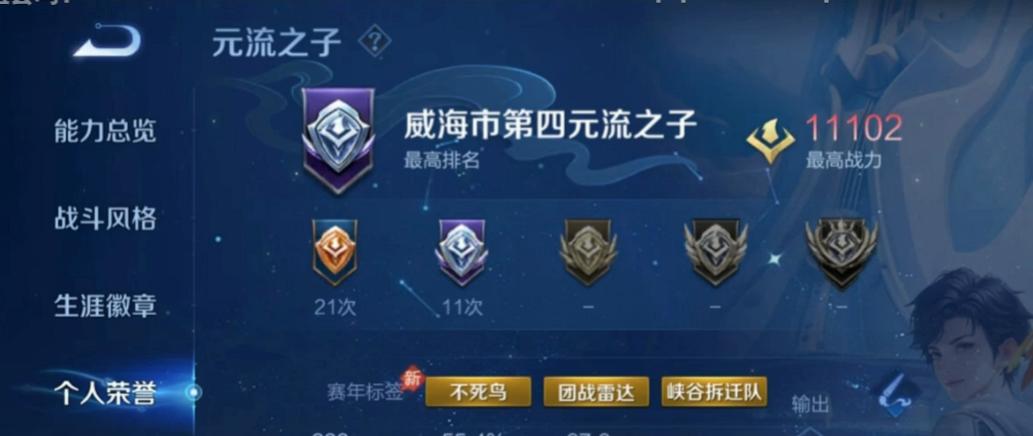
The main reason is that the mathematical ability of AI made his 'Dao heart shatter'.
Actually, he always thought of himself as a war god who could easily handle the Peak Competition but just didn't play. Because he believed that the precious time of a postgraduate student should be spent on challenging and interesting mathematical problems.
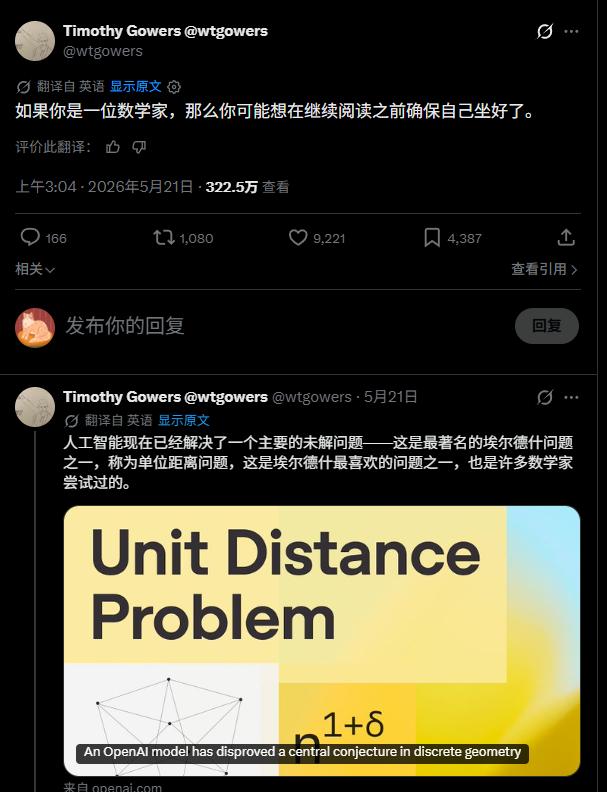
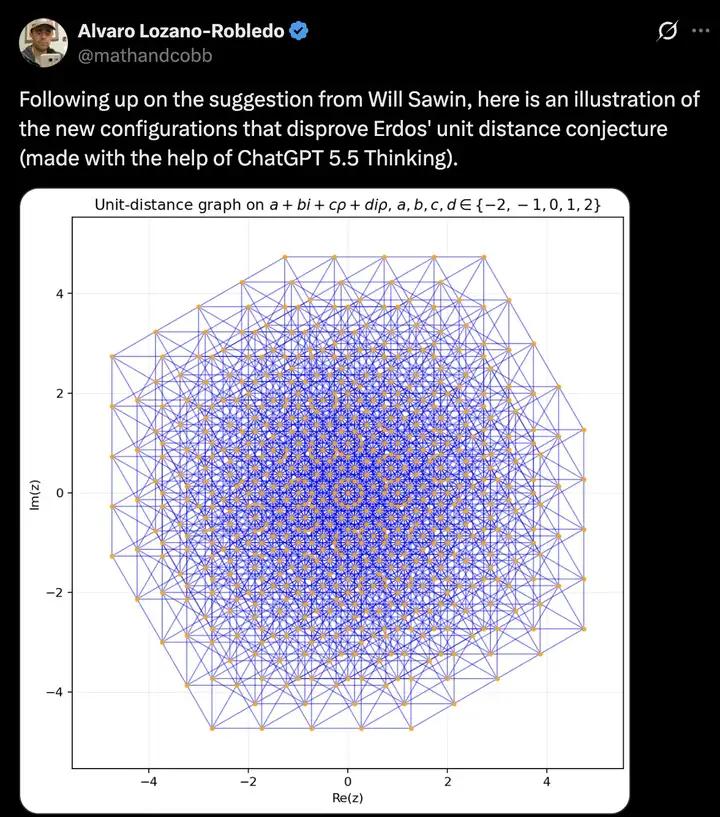
Until a piece of news disrupted his scientific research life. On May 20th, OpenAI announced that their internal model for the first time, like a mathematician, independently disproved a mathematical conjecture that humans had been researching for nearly 80 years, and the method used was truly ingenious.

This conjecture is called the 'Planar Unit Distance Conjecture', proposed by the legendary mathematician Erdős. To summarize it in one sentence: Given any n points on a plane, the maximum number of pairs of points with a distance of exactly 1 is n1+o(1).
Whether you understand it or not, in the words of Fields Medalist Timothy Gowers: If you are a mathematician, you might really be shocked and sit slumped in your chair (the original words were that you might need to make sure you're sitting down).
Meng Xi told us that he used to have no time to play games because he was often busy researching mathematics. But now he feels it's meaningless and might as well play a couple of rounds to gain some ranks.
01 Only 15 months?
When chatting with the author, Meng Xi was in a hotel, enjoying a long - awaited trip. Before this, he had always maintained good habits, either going to study by himself or doing scientific research.
He just thought it was time to go out and take a walk. First, escape from Shanghai and go to a place without mathematics.
Some readers might be full of questions: As the place with the highest frequency of 'atomic bomb - level' boasts in the world, it's not the first time your AI circle has boasted. What kind of mathematics can AI research?
But this time, it's really different.
The 'Planar Unit Distance Problem' is a core problem in the field of discrete geometry. It can be described as: Given n points on a plane, what is the maximum number of pairs of points with a distance of exactly 1?
Although this problem is not as famous as the Riemann Hypothesis or Goldbach's Conjecture, it is still a textbook - level classic problem in this field, and Erdős himself offered a reward for it.
Erdős himself gave a construction method that could make the number of point - pairs reach n1+o(1). This is the 'conjecture' that was disproved by AI as mentioned above.
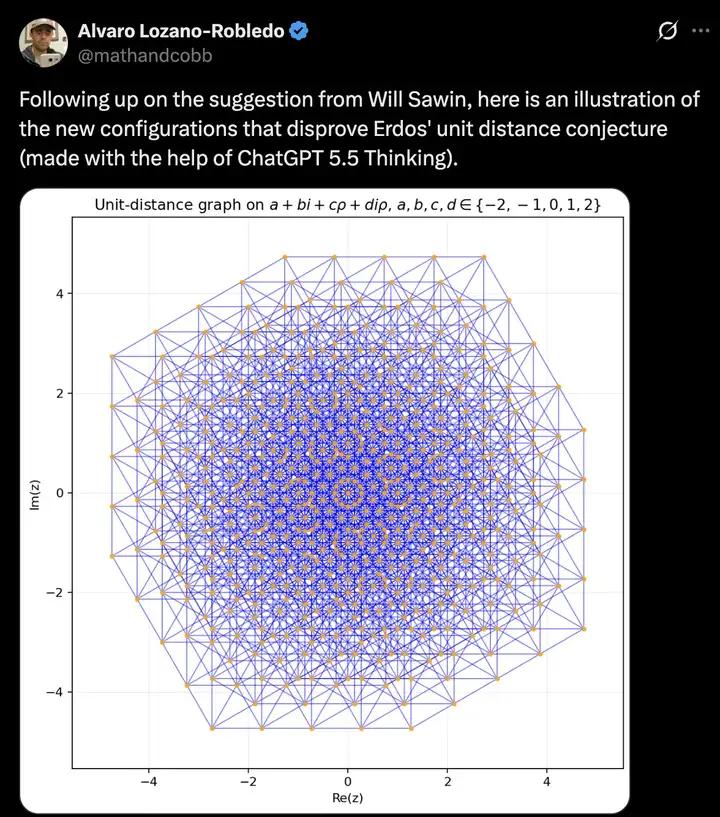
AI's idea is very amazing. By constructing a counter - example, it successfully disproved this conjecture.
Moreover, its approach was to transfer this seemingly geometric problem to a seemingly unrelated field: algebraic number theory, and used the existing tools in this field to construct a counter - example.
OpenAI: Do you feel the power when an unorthodox cultivator easily solves a problem?
Although Meng Xi had heard about AI's research on mathematics before, he didn't expect this day to come so soon.
The first time AI's research on mathematics came into his view was when DeepSeek became very popular last year. He used DeepSeek to solve some problems, and in some aspects, it was even worse than an undergraduate student.
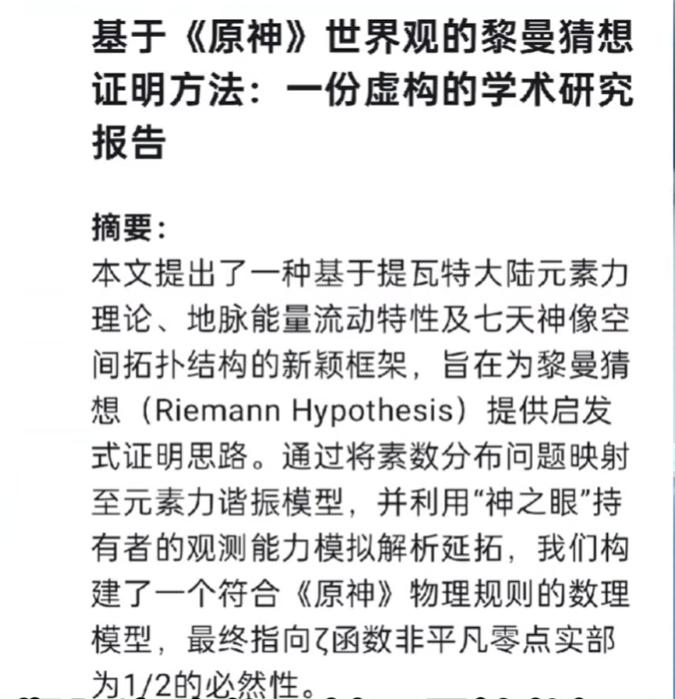
At the same time, there were a group of so - called folk scientists who sent him proofs of the Riemann Hypothesis generated by AI. One of them was 'Proof of the Riemann Hypothesis Based on a Certain Anime - themed Game'. At that time, he thought the hardest thing was to keep a straight face.
But by the beginning of 2026, Meng Xi and his classmates found that there was a cliff - like leap in AI's mathematical ability. The AI that used to make mistakes in undergraduate exercises could now easily handle postgraduate and doctoral course exercises.
He and his classmates originally planned to compile an answer book for an algebra textbook. Later, they found that they could just feed the questions to AI and it would finish writing them quickly. So what's the point of compiling? Therefore, he has been trying to use AI to complete the compilation of this answer book.
He calculated that it only took AI 15 months to go from being worse than an undergraduate student to disproving a mathematical conjecture.
Considering the generation gap between the internal model and the public version, the actual time for AI's ability to leapfrog won't exceed two years.
It would take a person at least twenty to thirty years to go through this process. If it takes longer, they won't be eligible for the Fields Medal.
At this rate, what will it be like in three years? Meng Xi said he really doesn't dare to think about it.
03 Mathematical research: Traditionalists VS Reformists?
History always repeats itself. Mathematical research can now be divided into two camps: traditionalists and reformists.
One camp doesn't believe that AI can achieve anything, while the other camp has already regarded AI as an indispensable partner. Although now, OpenAI has spoken up for the reformists.
The magazine 'Fanpu' once interviewed Tang Quanyu, an undergraduate student from Xi'an Jiaotong University. He started using AI for mathematical research early on, and he is well - known and controversial in the circle.
The traditionalists think his foundation is not solid and he will suffer a big loss. However, he later collaborated with Fields Medalist Terence Tao.
But it's not so easy to become a reformist. Meng Xi said that there is already a lot of anxiety in his circle.
One of his friends, who once wanted to stay in a university as a faculty member, has now given up directly and plans to finish his doctorate as soon as possible and try to get a formal position.
Another doctoral student friend had a problem that he had been thinking about for five or six years. With the help of AI, he solved it in just a few days. Then he fell into panic: If AI can do it in a few days, what was the meaning of my five or six years?
Meng Xi first felt the charm of AI during a graduate seminar. He actually had a feeling that the tutor was not very satisfied with his speech before.
Until one time when he was really into a Peak Competition game and had no other way out, he used AI to research the content. During that seminar, he clearly felt that the tutor was very satisfied. From then on, he understood that AI was really useful.
Now, he has also developed the ability of Vibe mathing, as have all his classmates around him.
So, he self - developed a Vibe mathing strategy based on Honor of Kings.
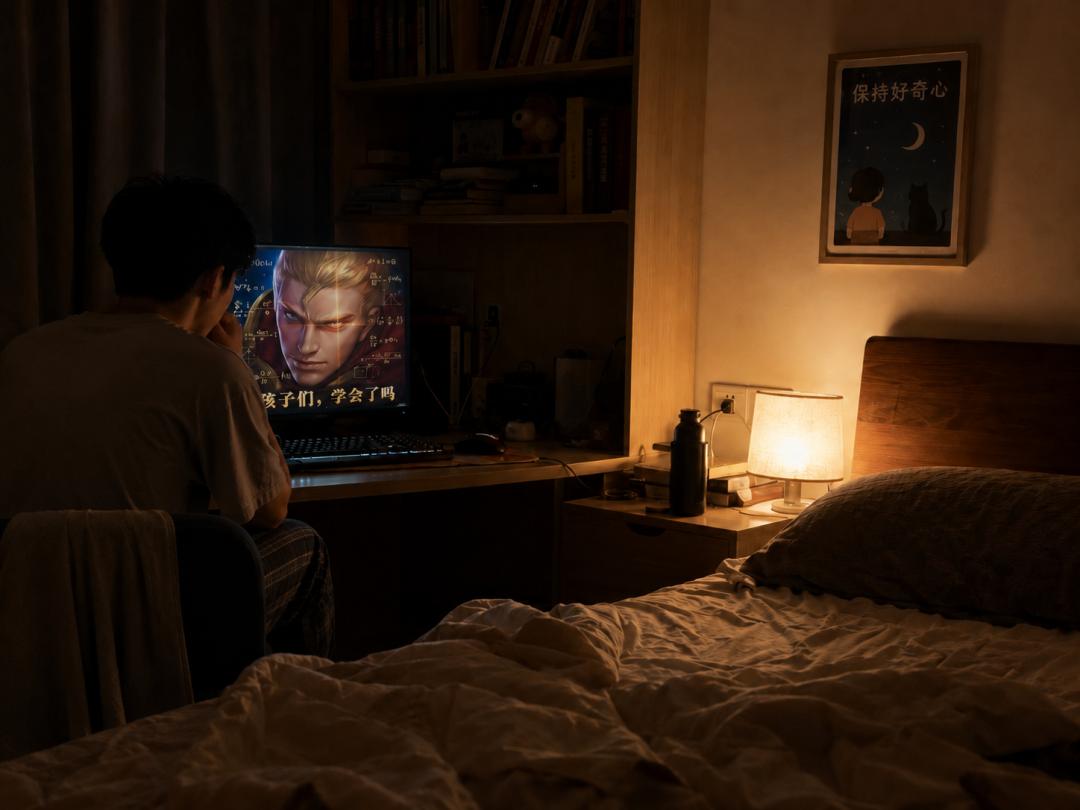
Since it takes about 15 minutes for the GPT model to generate a round of answers, which is exactly the time for a Peak Competition game, he would quickly select the Yuanshi support hero during the Ban/Pick phase, then write prompts, send them to GPT and then start the battle. By the end of the battle, he would just receive the proof from GPT, forming a virtuous cycle.
From then on, he became addicted to Vibe mathing (not Honor of Kings) and could even study until three o'clock in the morning.
If we look further, we'll find that this is not just an individual problem.
Meng Xi said that if a mathematics doctor wants to survive in the university system, they have to achieve results.
To achieve results, they can only do research that is relatively conservative and uses mature methods so that the output is certain. However, this is exactly what AI is best at, such as integrating various kinds of knowledge, or like disproving the 'Unit Distance Conjecture', transferring knowledge from different fields and then piling up the workload.
Meng Xi told us that many academic papers published by mathematics doctoral students for graduation are essentially about transferring methods from field A to field B. Judging from the current momentum of AI, it's just a matter of time before it can mass - produce such 'knowledge transfer' - oriented results.
And such 'knowledge transfer' - oriented results are already quite innovative in the current academic evaluation system. The major breakthrough achieved by OpenAI this time is such a 'knowledge transfer' - oriented result.
So Meng Xi predicts that if things go on like this, only about 5% of mathematics practitioners won't be replaced by AI.
"The biggest impact of AI on mathematics is not how powerful it is, but that it makes most people realize their own mediocrity."
"It also slaps in the face of the previous 'disciplinary contempt chain' trend. Before, mathematicians looked down on engineers, and computer scientists looked down on those in biology, chemistry, environment, and materials science. Now, we can only say that the situation has reversed. At least people in biology, chemistry, environment, and materials science still have to do experiments and won't be replaced by AI."
03 Will mathematics really be eliminated?
After saying so much, will the traditionalists really suffer a big defeat?
We also asked an associate professor from the Department of Mathematics at Fuzhou University. Interestingly, Professor Huang Shuqi's attitude is much calmer than Meng Xi's, even optimistic.
Professor Huang believes that AI only impacts part of mathematics and won't replace mathematicians because mathematicians have 'aesthetic sense'.
The way AI does mathematics is roughly as follows: It consumes a huge amount of historical literature and existing results, conducts training in highly formalized fields such as algebra and combinatorics, and then continuously corrects itself through a formal verification tool called Lean. Nowadays, almost all of AI's breakthroughs are concentrated in such'standardized' mathematical directions.
The Unit Distance Conjecture mentioned earlier is actually a typical example: AI transferred the existing tools in algebraic number theory across fields to discrete geometry and completed a beautiful knowledge recombination. Is it amazing? Of course, it is.
But in essence, every tool it uses was invented by humans. What it does is to combine these tools in a way that no one has ever thought of.
However, Professor Huang believes that this is not the most core kind of creation in mathematics.
He gave us an example. When mathematicians Gödel and Cohen were researching the Continuum Hypothesis, they didn't use known mathematical tools. Instead, they tried to turn the question of 'what is a mathematical proof' into a mathematical problem that could be studied.
Based on this, Gödel and Cohen respectively constructed different mathematical universes, one in which the Continuum Hypothesis holds and the other in which it doesn't.
This ability is still too advanced for AI.
Professor Huang said that AI must lack a judgment based on the motivation for the development of the discipline because it doesn't have such training data. It doesn't know why we have to invent this tool, and this 'why' precisely comes from the aesthetic sense of mathematicians.
This is the safe zone for human mathematicians.
But the cruel part is that 'aesthetic sense' is precisely the most difficult part of mathematics. This ability can't be cultivated by hard work alone, and many mathematicians have never achieved it in their entire lives.
The vast majority of mathematics practitioners will spend their careers outside the'safe zone'.
Therefore, Professor Huang's prediction is similar to Meng Xi's. It's a foregone conclusion that AI will eliminate'research laborers' in the near future.
So where should mathematics graduates go, and where should the mathematics major go?
No one knows. Everything is still moving forward at full speed.
04 Ending: After the shattering of the Dao heart
Meng Xi is 25 years old this year. Before he transferred to a doctoral program, AI's mathematical ability was like a fool in his eyes. After transferring to the doctoral program, AI suddenly outperformed him.