After Kuaishou's Keling secured $3 billion in financing following its spin-off, the second half of the AI video competition has officially begun.
On July 2nd, Kuaishou released an announcement on the Hong Kong Stock Exchange, stating that its Keling AI business entity, Beijing Keling, has completed a new round of capital increase. The initial financing amount is approximately 13.8 billion RMB (about 2 billion US dollars). Simultaneously, 15 additional investors have signed agreements to add 5.224 billion RMB, with the total subscription cap locked at 20.447 billion RMB (about 3 billion US dollars), corresponding to a pre - transaction valuation of 15 billion US dollars. Based on the 16.67% equity dilution in this financing, after all the funds are in place, Keling's post - investment valuation will reach 18 billion US dollars. After the financing is completed, Kuaishou still holds approximately 68.33% of the equity in Beijing Keling, maintaining its controlling position, and Keling's financial reports will continue to be consolidated into the group.
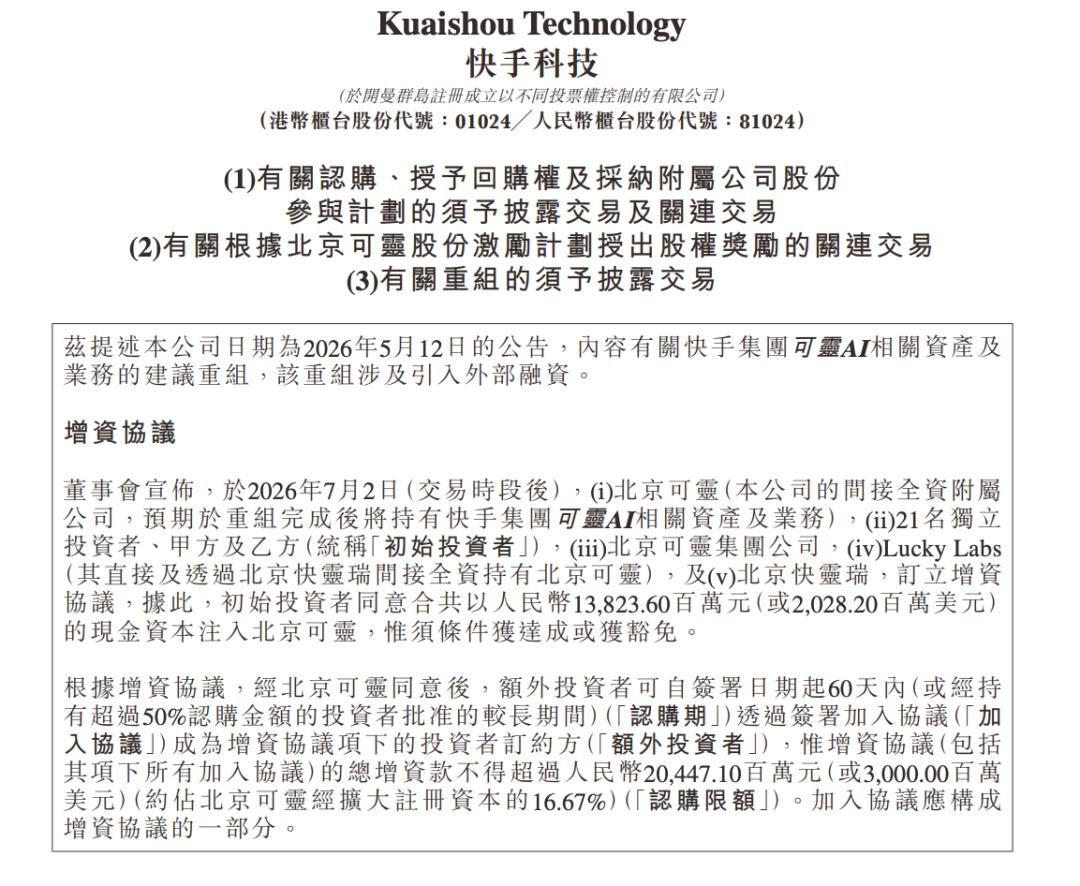
Along with the capital increase, there are also asset restructuring of Keling's business, an independent employee equity incentive plan, a governance structure with different voting rights for the same shares, and a clear long - term listing expectation.
For Kuaishou, this is a clear strategic spin - off. It has pushed the AI video generation business, which was originally embedded in the main website system, onto a track where it can face the market independently, raise funds independently, and be valued independently. For the entire AI video generation industry, the implementation of a 3 - billion - dollar - scale financing has directly raised the competition threshold of the track.
01 The Confidence of a $15 Billion Valuation: The Leap from an Internal Project to an Independent Company
With a pre - investment valuation of $15 billion and a post - investment valuation of $18 billion, Keling already belongs to the first tier in the global AI video generation track.
The post - investment valuation of $18 billion is equivalent to 75% - 78% of Kuaishou's current total market value. This is also the so - called "valuation inversion" that was widely discussed in the market in May: the growth of Kuaishou's mature short - video main business has slowed down, with a price - to - sales ratio of only 1.5 times, while the high - growth AI business enjoys a growth premium of dozens of times.
The two completely different valuation systems are naturally separated. Spin - off and independent financing are almost the only way to unlock the value of this asset.
The support for this valuation first comes from Keling's established commercial foundation.
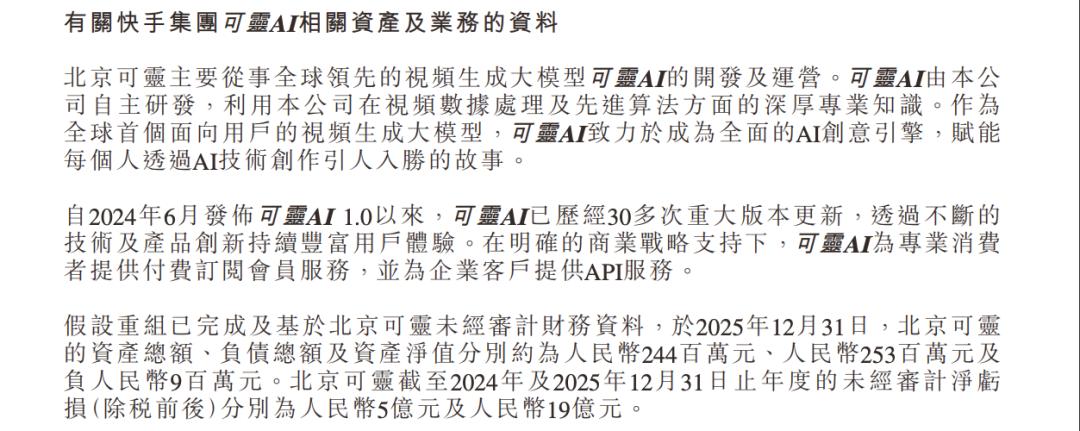
Data disclosed in the announcement shows that assuming the restructuring is completed, Beijing Keling's annual revenue in 2025 will be approximately 1.1 billion RMB. The growth curve picked up in the second half of the year. In December 2025, the monthly revenue exceeded 20 million US dollars, corresponding to an annualized revenue of 240 million US dollars. By March 2026, the annualized revenue run - rate had directly jumped to 500 million US dollars, with a growth of over 108% in half a year.
Currently, Keling's revenue comes from two parts: paid subscription memberships for C - end users and API services for enterprise customers. These two paths run in parallel. It not only validates the universality of the product through the C - end but also breaks through the commercial ceiling through the B - end, which differentiates it from most AI video companies that only focus on a single path.
However, on the other side of the high - speed growth is the pressure of losses caused by continuous large - scale investment.
In 2024, Keling had a net loss of 500 million RMB, and the loss widened to 1.9 billion RMB in 2025. As of the end of 2025, the company's total assets were only 244 million RMB, total liabilities were 253 million RMB, and the net assets were negative 9 million RMB, indicating an insolvent state.
Computing power procurement, expansion of the R & D team, and global market promotion all involve large and rigid expenditures. Relying on the group's support in the long run is unsustainable. This is also the core practical reason why Kuaishou must promote its independent financing.
What also supports this valuation is the team's experience and route judgment ability that cannot be seen from the financial statements.
Today's Keling, valued at billions of dollars, started in the "resource patchwork era" within Kuaishou. During the R & D stage of version 1.0, the team couldn't obtain enough high - end NVIDIA computing power cards. They had to piece together configurations with the company's existing AMD and other manufacturers' chips and made the DiT architecture work in a non - mainstream hardware environment.
In April this year, in a conversation between Zhang Peng, the founder of GeekPark, and Gai Kun, the senior vice - president of Kuaishou and the general manager of Keling AI Division, the latter mentioned that when Sora Demo amazed the world in 2024, the industry generally waited for the pace of Silicon Valley giants. However, their team made a counter - intuitive judgment: OpenAI would prioritize recalling its core resources to the language model, leaving a window of more than half a year for video productization. The team resolutely abandoned the original route and went all - in on the DiT architecture, eventually seizing the world's first user - available large DiT video model.
This decision - making ability of "daring before being able to" is also the most core asset in the era of large models.
The low - cost trial - and - error logic of traditional Internet companies, such as A/B testing and multi - route horse - racing, has become ineffective. The cost of a single large - model training starts at tens of millions of dollars, and the cost of trial and error is extremely high. The essence of competition is a competition between the technological vision and route judgment of leading figures. Capital is willing to pay for the $15 billion valuation, not just for the current revenue scale, but also for the team's ability to fight tough battles under resource constraints and make the right bets in the fog.
In the past, Keling was a technical business unit within Kuaishou, and its revenue and costs were hidden in the group's overall figures. It was difficult for the market to evaluate its value separately. If it had always remained within Kuaishou, even if Keling's annualized revenue reached 1.3 billion US dollars in the future, applying Kuaishou's 1.5 - times price - to - sales ratio, the valuation would only be 195 million US dollars. The technological barriers, global potential, and long - term industrial value would all be completely diluted by the valuation ceiling of the mature business.
This spin - off and financing essentially provide an independent valuation logic for the AI business.
The core of Kuaishou's main website is a content community, and its revenue comes from advertising, e - commerce, and live - streaming. The market gives it a valuation system for Internet platforms. However, Keling is an AI technology company that realizes monetization through model capabilities and technical services. Its growth curve and profit rhythm are completely different. After the separation, Keling can obtain a valuation more in line with the AI track and attract capital specifically invested in hard - tech and AI fields, without being bound by the parent company's business growth rate and profit expectations.
Another logic supporting the valuation is the talent incentive mechanism after independence.
The announcement shows that Keling has a share participation plan with a total stake of 15%, covering equity incentives, shareholding plans, and stock option plans. Among them, the initially awarded equity is about 7.45%. Gai Kun, the CEO, personally received 3% of the equity incentive, and Cheng Yixiao, the chairman, received 1%.
For an AI company, the stability of the core technical team and talents directly determines the product's iteration speed and technological ceiling. In Kuaishou's parent - company system, it is difficult for a subsidiary business to offer such a large proportion of equity for incentives. After independence, Keling has its own equity pool and can attract and retain AI talents in a more market - oriented way. This is a very practical competitive advantage in the current highly competitive large - model industry.
From the lineup of investors, we can also see the market's recognition of this deal. A total of more than 30 institutions have participated, and BAT has invested simultaneously. Two major entities of Tencent hold a total of 1.12% of the shares, Alibaba Cloud holds 0.87%, and Baidu holds 0.22%. In addition, dozens of local state - owned assets such as Shanghai Guofang and Beijing Artificial Intelligence Industry Fund, first - tier PEs such as CPE, CITIC Jingshi, and Sequoia, as well as cultural and entertainment industry capital such as Huace have all entered the market.
The collective entry of large companies shows that AI video generation has changed from a marginal technological exploration to a definite industrial direction, and everyone doesn't want to miss the leading players. The intensive entry of state - owned assets means that this track is in line with the long - term direction of technological independence and industrial upgrading.
It is worth noting the design of Keling's governance structure. According to the shareholders' agreement, the shares held by Gai Kun, the CEO, can enjoy up to ten times the voting rights, with an upper limit corresponding to 4% of the equity. This arrangement of different voting rights for the same shares is very typical in AI startup companies. It gives more decision - making power to the technical leader to ensure the continuity and stability of the technical route and avoid short - term capital demands from interfering with long - term R & D investment. For a technology - driven company, this is more important than short - term valuation figures.
Overall, the $15 billion valuation is not just for Keling's current technology and revenue, but also for its growth space as an independent company. Through the spin - off, Kuaishou has transformed an internal cost center into a value entity with independent financing ability, independent incentive mechanism, and independent valuation system. It retains the controlling stake to enjoy the growth benefits and shares the pressure and risks of R & D investment with the market.
02 With $3 Billion in Ammunition, What Will the Second Half of the AI Video Competition Be About?
Keling's capital increase of up to $3 billion has directly raised the financing ceiling of the entire track by an order of magnitude.
In the first half of 2026, the financing enthusiasm in the global AI video track continued to rise, but the single - round financing scale of leading players was basically concentrated in the range of $200 million - $300 million.
In the overseas market, Runway completed a $315 million Series E financing in February, with a post - investment valuation of $5.3 billion, which was the previous single - round financing record for a pure AI video company globally. The British company Synthesia, which focuses on enterprise - level digital humans, completed a $200 million Series E financing in January, with a valuation of $4 billion. The startup Pika completed an $80 million Series B financing in the same period, with a cumulative financing of $135 million. In the domestic market, PixVerse secured a $300 million Series C financing in March. Liblib (now renamed) completed a nearly $300 million Series B + financing in June, with a post - investment valuation of over $2 billion.
Keling's financing is approximately equal to the sum of the single - round financing of three leading companies: Runway, Synthesia, and PixVerse. The corresponding pre - investment valuation of $15 billion also far exceeds Runway's $5.3 billion and Synthesia's $4 billion, directly placing Keling at the top of the valuation list of global AI video companies.
In the past two years, capital was dispersedly investing in startup teams with different technical routes, betting on "who can develop a useful model." By 2026, capital has begun to clearly focus on the leading players, heavily investing in those that have established commercialization and have the potential to grow into independent industrial giants.
The direction of the $3 billion in funds is also very clear: The official stated uses are business expansion, daily operations, and team development. Broken down, the core is two things: continuously investing in the iteration of the underlying model and accelerating the commercialization of all scenarios.
In the AI video generation industry, two years ago, the competition was about who could generate longer videos and who could have more coherent pictures. Now, the industry consensus is that the core of the competition has shifted to inference cost, generation efficiency, and scenario adaptation ability. That is, whether one can generate video content that meets industry standards in batches at a lower cost and truly implement it in real production scenarios such as advertising, short dramas, e - commerce, and film and television.
Keling's current advantage lies in the support of Kuaishou's ecological scenarios.
Kuaishou itself is one of the largest short - video and short - drama platforms in China, and there is a natural demand for video content. Keling's model can be verified internally first and then exported externally. For example, in scenarios such as short - drama production, e - commerce product videos, and creator tools, Kuaishou itself is a major customer, which provides a commercial foundation for Keling. However, after independence, Keling needs to prove that its growth is not just dependent on the parent company's support but that it can obtain orders from a wider range of industry customers.
In the next few years, it will be a stage of rapid penetration of AI video generation technology into the industry.
The advertising industry has begun to use AI to produce materials in batches, the short - drama industry uses AI to reduce production costs, and the e - commerce industry uses AI to generate product display videos. These are all paid scenarios that have been established. However, deeper penetration, such as film - level content generation and industrial - level 3D video generation, still requires continuous breakthroughs in model capabilities. The $3 billion in funds is sufficient to support Keling's long - term investment in algorithms, computing power, and data without having to worry too much about short - term profit pressure. This is an advantage that many small and medium - sized teams do not have.
The repurchase clause in the announcement also gives a clear time expectation. If Keling fails to complete an IPO within 5 years from the latest payment date (that is, before October 2031), investors have the right to require a repurchase, with a repurchase interest rate of 8% per annum. This timeline is equivalent to giving Keling a 5 - year listing window. Capital has a clear exit expectation, which also forces the team to scale up and streamline the business model during this period. Currently, there is no pure AI video generation company listed globally. If Keling can stand out during this cycle, it is likely to become the world's first listed AI video company.
Another detail is Kuaishou's non - competition commitment. For 5 years after the completion of the restructuring, except for Keling, Kuaishou will not engage in other video generation model businesses. This is equivalent to Kuaishou putting all its AI video chips on Keling without leaving any backup. For Keling, this is full support and also a heavy pressure. The success or failure of Kuaishou's entire AI video strategy depends on this one company.
Keling's independent financing is also a typical microcosm of the development of domestic generative AI. Technology has evolved from an auxiliary ability within large companies to an independent commercial entity. The competition has shifted from comparing technical concepts to comparing commercialization and scale - up in real - world battles.
Gai Kun once told GeekPark that the evolution of AI video will go through three stages: first, develop tools to improve production efficiency, then achieve large - scale mass production of content, and finally, a new AI content platform will emerge. When the creation threshold is completely flattened and the content supply is extremely rich, the boundaries between games and film and television will gradually blur, and personalized and interactive content forms will reshape the relationship between people and content.
However, obtaining $3 billion in ammunition and locking in the exclusive support of Kuaishou's ecosystem does not mean that Keling can rest easy.
After all, Seedance, under ByteDance, has already achieved a significant leading position in terms of commercial scale and market share. Previously, it was reported that Seedance 2.0's monthly revenue had exceeded 1 billion RMB, corresponding to an annualized revenue (ARR) of about $2 billion, with a gross profit margin of about 70%. In terms of market share, calculated by the daily average computing power consumption, Seedance has occupied more than