Two earthquakes, and the "seismometer" in your pocket
At 6:04 p.m. local time on June 24th, in Venezuela, Patricia Aroir's phone rang in the Macaracuay community east of the capital, Caracas, suddenly popping up an alert she had never seen before.
“As soon as the phone received the signal, we rushed out to the street immediately, just in time before the earthquake,” the Italian embassy staffer later told reporters.
Almost at the same time, 39-year-old writer Pericles Sanchez also received the same alert. “We got the time to go out,” he told the Associated Press. “It was not until we were standing outside that we began to feel the increasingly strong shaking.”
The two of them had enough reaction time, half a minute in total. In Barquisimeto, a cultural center in the northwest of the country, a local netizen wrote on social media that only about five seconds passed from the moment the Google pop-up notification appeared to the moment the whole city suddenly shook violently.
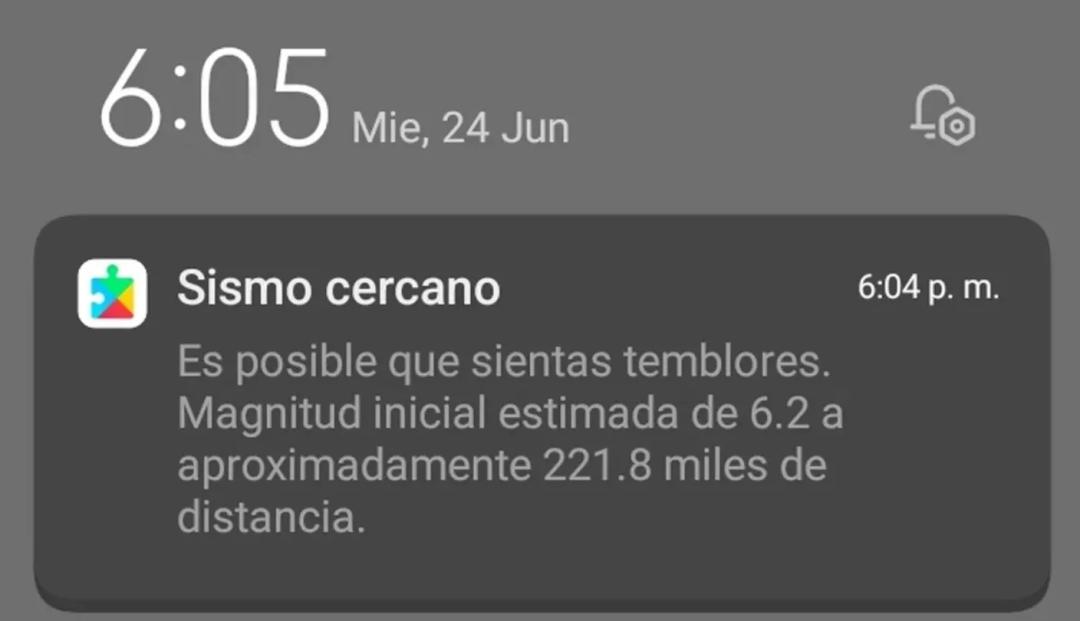
That evening, two strong earthquakes hit Venezuela one after another, about 39 seconds apart. The second one had a magnitude of 7.5 on the Richter scale, the strongest in the country in more than a century.
As of June 28th local time, the country's government announced that more than 1,400 people had died, about 3,500 were injured, and the number of residents significantly affected by the earthquake exceeded 12,000.
It is worth noting that the alert was not issued by the Venezuelan government or any earthquake authority in other countries or regions in South America. The Venezuelan earthquake research institution FUNVISIS is only responsible for post-earthquake records, not pre-earthquake warnings.
It was Google that warned everyone before the seismic waves reached the perceivable population. According to the post-event data, only about nine seconds passed from the moment the underground rocks began to break to the moment the first alert was pushed to millions of mobile phones.
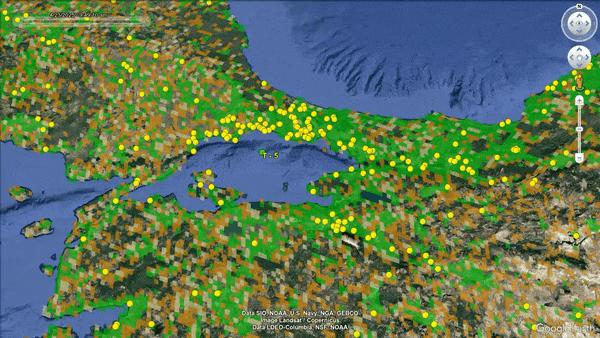
Turn 2 billion mobile phones into seismographs
There is a sensor in your mobile phone that can turn the screen upright when you turn it horizontally to watch videos and is also responsible for many functions you use daily, such as motion recording.
This is the accelerometer - the same sensor that can sense the slight vibrations underground before the actual seismic tremors reach your feet. It is the starting point of Google's Android Earthquake Alerts system for Android phones.
When the mobile phone is placed still, the accelerometer can sense extremely subtle movements - known as P-waves or longitudinal waves in the field of seismology - and then send the signal along with the approximate location back to Google's server.
The data from one mobile phone is not conclusive, but if hundreds or thousands of mobile phones within a specific geographic fence report similar vibrations at the same time, the server can make a judgment: a real earthquake may be occurring.
Immediately afterwards, within a millisecond scale, the system running on the server can calculate the relatively accurate epicenter location, magnitude, etc. through the different signals sent by these hundreds of mobile phones, and then push the alert to residents before the truly destructive S-waves/transverse waves spread to the surface and cause real damage.
Next, let's review what happened within half a minute when the earthquake occurred based on the data disclosed by Google after the earthquake:
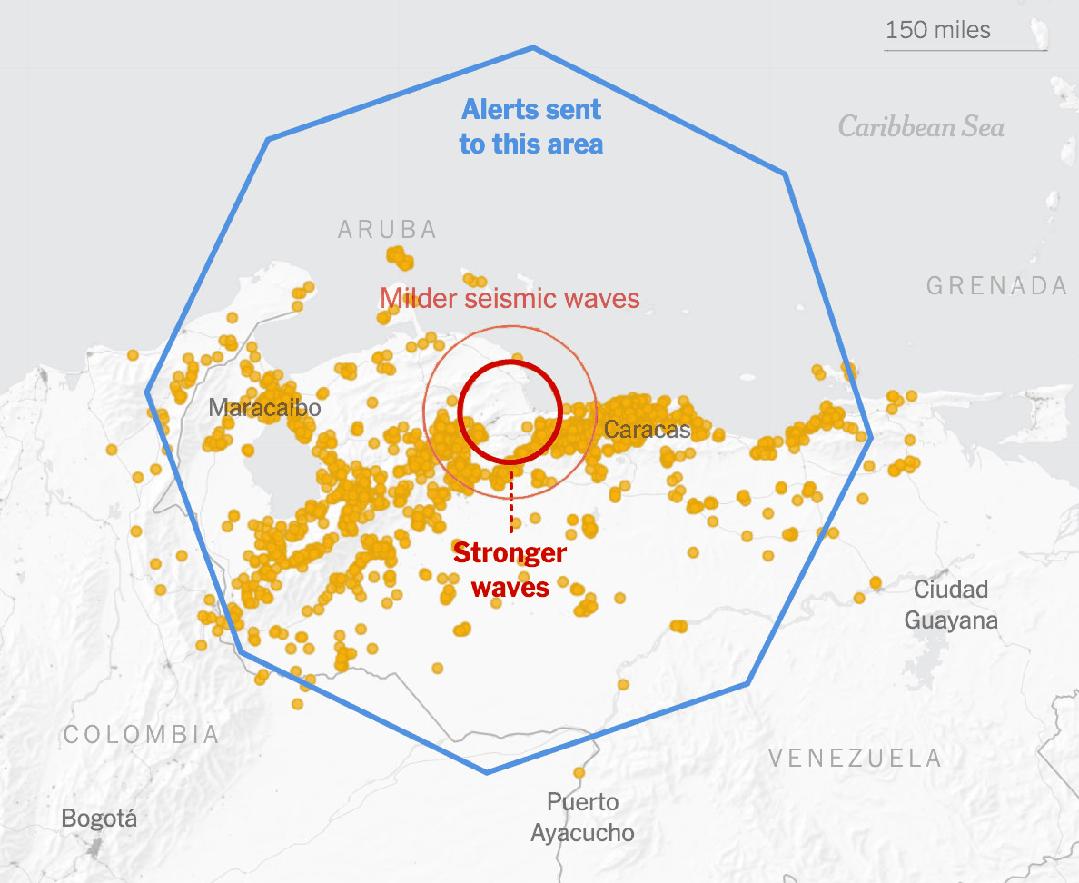
Three seconds after the source of the earthquake underground in Yaracuy State vibrated, a large number of mobile phones in multiple states and cities in the north of Venezuela had already felt the seismic waves and sent data back to Google's server, as shown in the following figure made by The New York Times: the yellow dots represent the locations of the mobile phones that reported the data.
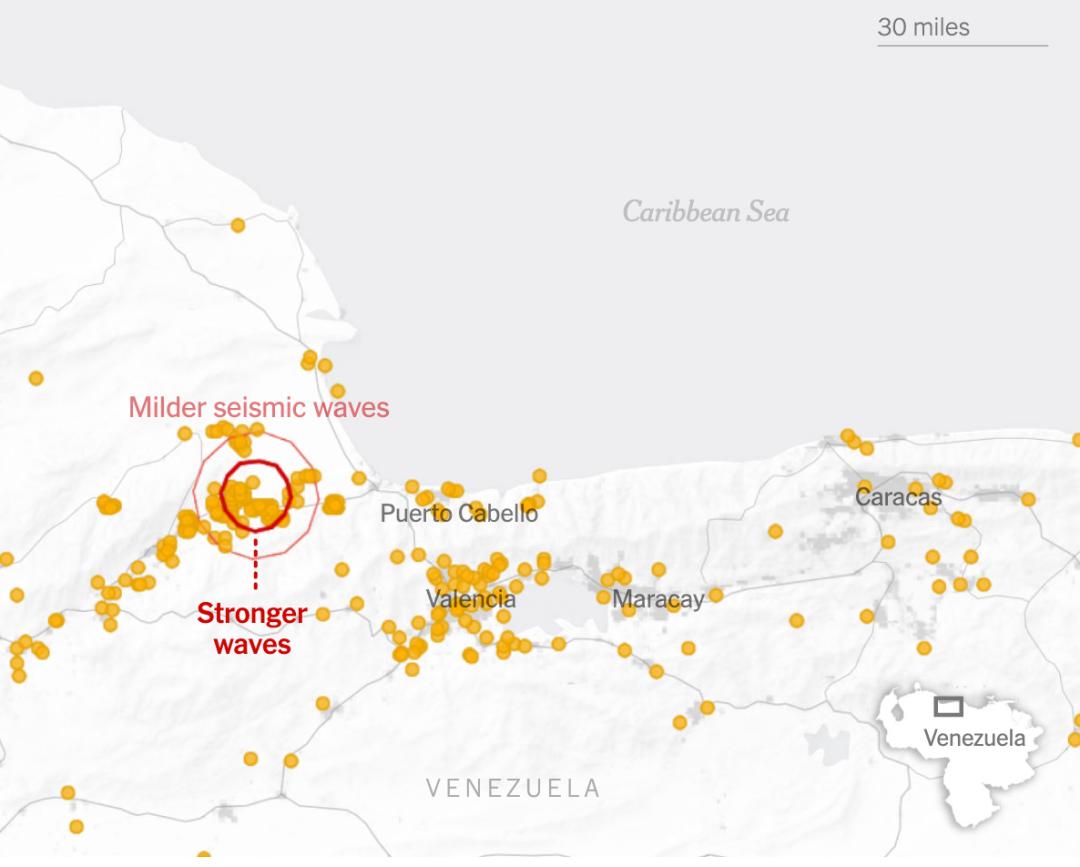
At about the third second, the accelerometers of the mobile phones detected P-waves with a speed of up to 4 miles per second but relatively weak intensity. These mobile phones that initially detected the seismic waves must be in a stationary state, such as placed on a table.
About nine seconds later, the Android Earthquake Alerts system had accumulated enough data and completed the calculations, so it was able to identify the earthquake and automatically issue the first batch of alerts. We also refer to the picture made by The New York Times: the mobile phones within the blue box received the alert notification at the 9th second. Meanwhile, more mobile phones in the neighboring areas also reported the seismic signals.
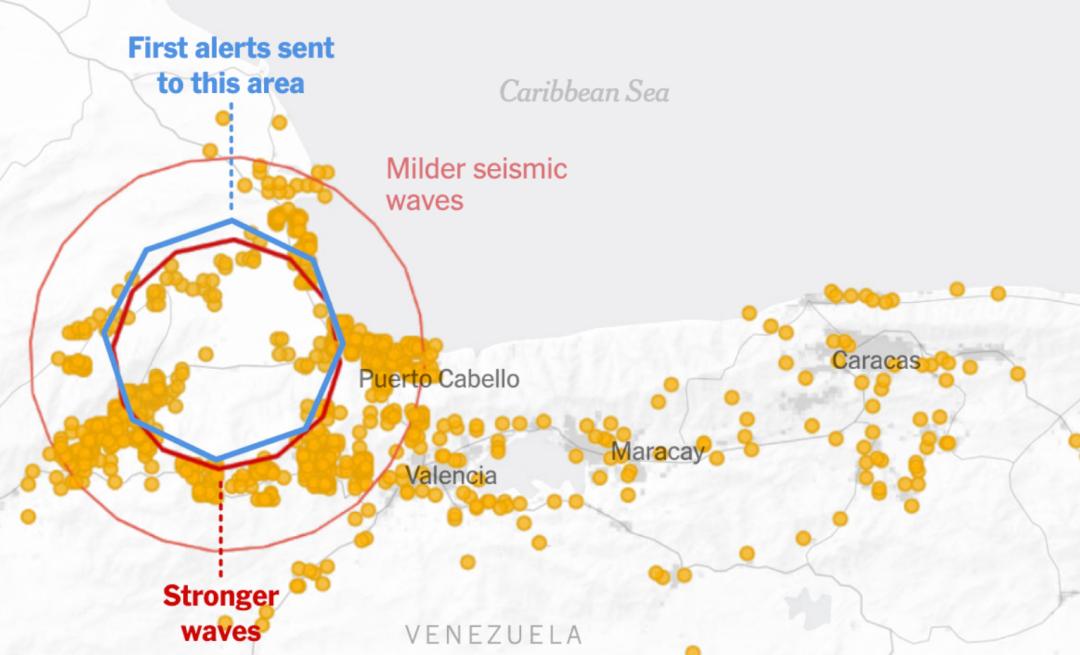
Google later revealed that a few seconds after the first earthquake, a second, stronger earthquake was also detected. The system recognized the increasing magnitude and issued more alerts. Since the seismic waves of the two events overlapped, the system regarded them as a single large earthquake event and pushed alerts to all mobile phones in the areas where the mobile phones that sent back the signals were located.
This is why 15 seconds and 21 seconds after the first earthquake, a large area in the north of Venezuela received alert notifications:
The Android operating system has about 70% of the global smartphone system market share. That is to say, if we don't consider the customized systems in specific national markets, there are at least more than two billion mobile phones in the world that can act as “temporary seismographs” at the hardware level at any time. According to Google's official information, the total number of terminals connected to the Android Earthquake Alerts system was only about 250 million in 2019, and it has reached 2.5 billion this year.
Interestingly, late at night is exactly the most effective time for this system. Considering that when users are sleeping, their mobile phones are usually lying on the bedside table for charging without moving, the sensitivity of perception is also the highest.
In July last year, the top academic journal Science published the report card of the Android Earthquake Alerts system. The paper submitted by Google showed that in the first three years of operation, the system detected an average of 312 earthquakes of various magnitudes per month, covering 98 countries. Among the cumulative 18,000 detections, more than 2,000 earthquakes worthy of warning issued alerts, with a total of about 800 million alerts pushed.
Among those who received the alerts, more than 1.5 million people filled out the post-event survey questionnaires, and 85% of them thought the system was “very useful.”
This is a quite remarkable achievement: the seismographs that were originally only used by authoritative institutions can now be carried in every ordinary person's pocket.
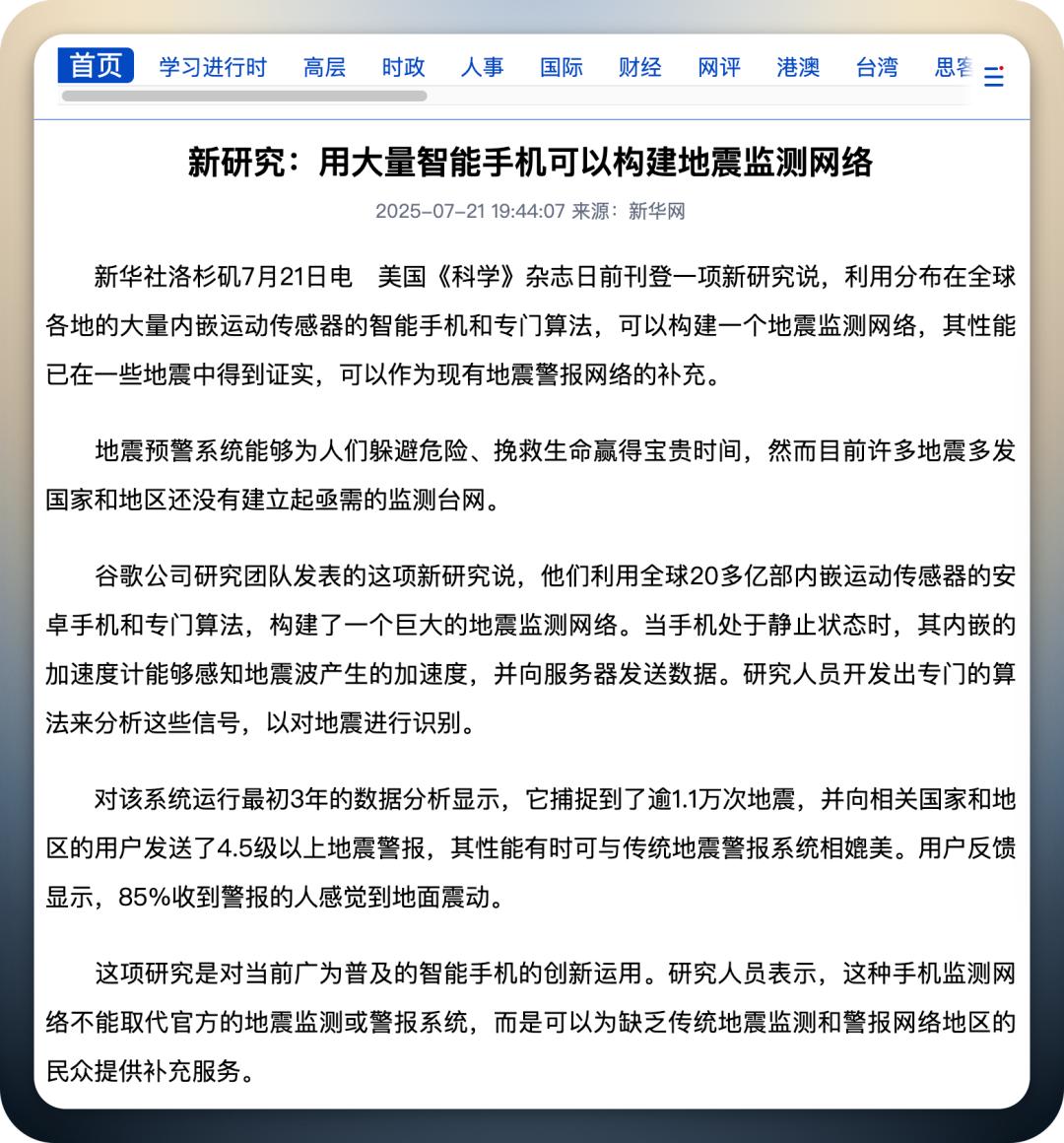
The essence of the Android Earthquake Alerts system is crowdsourcing sensing + signal processing + statistical regression.
Compared with the traditional seismic network that relies on a few seismographs buried underground, each worth hundreds of thousands of yuan, Google's system directly “recruits” 2.5 billion mobile phones around the world. If we only look at one mobile phone, the data must be rough and unreliable, but with a large number of samples, it is enough to make up for the quality of a single sample. This is called crowdsourcing sensing.
Every accelerometer in every mobile phone is constantly recording acceleration data. For earthquake early warning, most of it is noise. However, Google's STA/LTA algorithm for earthquake signals compares the average jitter in the past one or two seconds with the average jitter in the past few dozen seconds. If the ratio suddenly jumps significantly, there is enough reason to suspect that an earthquake wave has been detected. Extracting useful signals from noise and performing smart mathematical calculations on the earthquake waveforms is called signal processing.
There are already mature formulas in seismology. The system then uses these formulas to fit the data sent back by the mobile phones and can quickly calculate the epicenter and magnitude data that best explain the currently observed results through least squares regression. This is called statistical regression.
Race against seismic waves
As mentioned earlier, two types of seismic waves are released simultaneously when an earthquake occurs.
The one in the front is called the P-wave. It has a fast speed but mild shaking, and very few earthquake damages are caused by P-waves. The S-wave following behind carries most of the energy in an earthquake. Building collapses, casualties, and property losses are basically the consequences of S-waves.
The transmission of S-waves is usually about half as slow as that of P-waves. And most current earthquake early warning systems take advantage of this time difference.
The sensors near the epicenter - in this case, a large number of mobile phones - first sense the mild P-waves and immediately upload the data through the network. You can understand it this way: the data signal transmitted at the speed of light, even affected by the network speed, is still faster than the seismic waves themselves.
This is why Google's server can calculate the data and then push the alert, still reaching the residents farther away from the epicenter before the more destructive S-waves. Of course, from this logic, it is obvious that the farther away from the epicenter, the greater the lead time. Taking the capital Caracas as an example, which is about 180 kilometers away from the epicenter, it can gain up to about 30 seconds.
But we still have to pour cold water on this system: earthquake early warning does not equal earthquake prediction. It cannot tell you when, where, and what magnitude of earthquake will occur in the next few days, which humans still cannot do to this day.
What it can do is only to gain some time for you during the period after the earthquake has occurred but before the seismic waves reach your feet.
Regrettably, the closer to the epicenter, the less practical help this system provides for disaster avoidance and prevention. I believe everyone has understood this logic: from the sensor's capture, to the server's calculation, to the alert's delivery, each step takes time.
According to the calculation of the United States Geological Survey, within a 25-kilometer radius of the epicenter, even the fastest alert system today cannot catch up with the seismic waves. This area is therefore called the “early warning blind zone.”
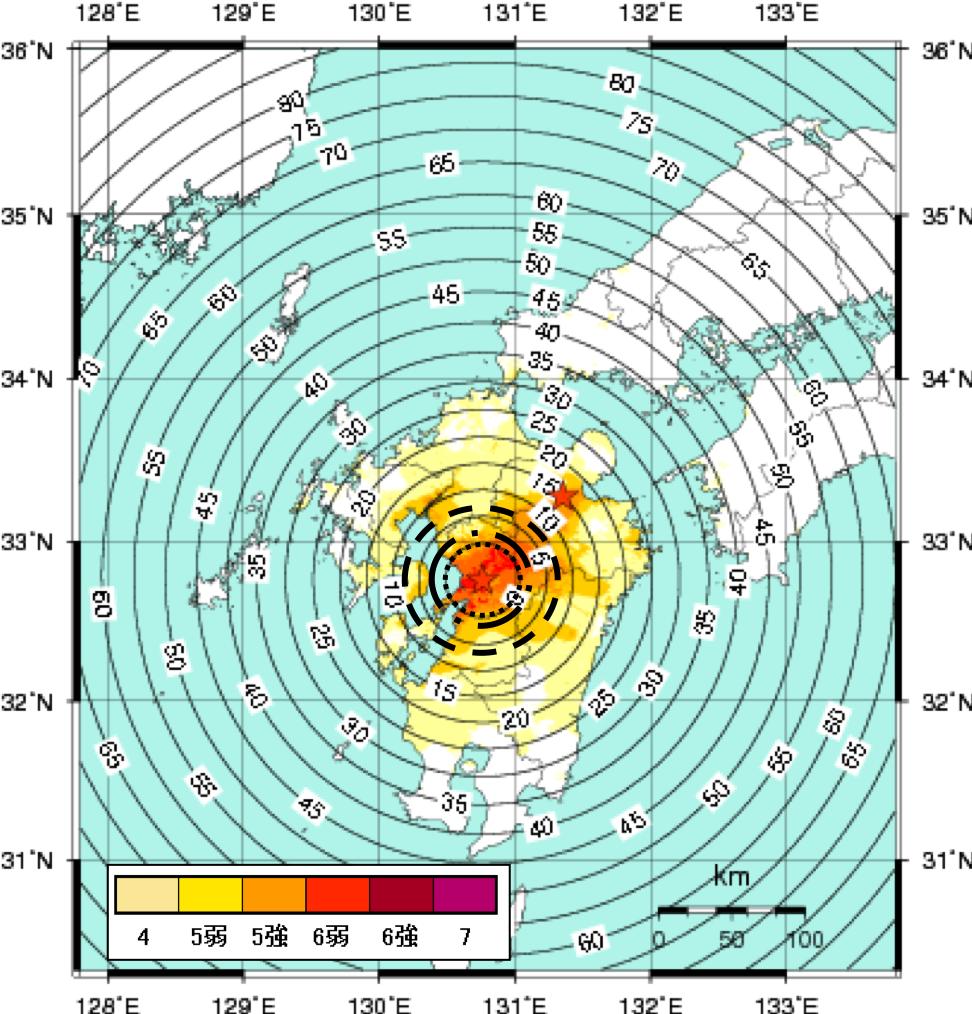
During the 7.0-magnitude earthquake in Kumamoto, Japan on April 16, 2018, most residents in the red area with the strongest seismic intensity did not have time to receive any early warnings. A total of 45 people died. Data source: United States Geological Survey
The “last mile” of earthquake early warning
The real challenge of earthquake early warning is how to push the alert to a person who may be driving, cooking, or sleeping within a short window period that may be only a few seconds?
This is a classic “last mile” problem and also where the major large-scale earthquake early warning systems really compete.
Everyone has a mobile phone, so obviously, the mobile phone is the most important target for pushing alerts. Currently, the mainstream earthquake early warning systems use the “cell broadcast” push mechanism. The base station directly sends a one-time broadcast to all compatible mobile phones in its area, without selecting numbers and not afraid of network congestion. Moreover, even if the mobile phone is set to Do Not Disturb or the ringtone is turned off, the cell broadcast will still ring. The only exception is when the mobile phone is in flight mode.
Currently, public early warnings in the United States, Japan, Taiwan (China), etc., including but not limited to earthquakes and child crimes (Amber Alerts), are all completed through cell broadcast.
China was the first to bring earthquake early warnings into the living room.
At midnight on June 17, 2019, a 6.0-magnitude earthquake occurred in Changning, Yibin, Sichuan. Before the seismic waves arrived, the air-raid warning horns in hundreds of communities in Chengdu simultaneously issued early warnings and countdowns. At the same time, the users' TVs also popped up a countdown, and their mobile phones received the estimated magnitude. At that time, citizens held their mobile phones and filmed the countdowns outside the windows, and the videos went viral overnight.
At that time, the China Earthquake Early Warning Network notified Yibin 10 seconds in advance and Chengdu about 61 seconds in advance. For the people in Sichuan who have had painful memories of earthquakes, many of them realized for the first time that earthquakes can be early warned! Although the lead time is still only a few seconds to a few dozen seconds, it is enough for people to make their first reactions.
Nowadays, the earthquake early warning ability has been integrated into the devices of almost all mainstream smart consumer electronics brands: mobile phones of brands such as Huawei, Xiaomi, OPPO, and vivo have built-in earthquake early warning at the system level. The data comes from the China Earthquake Early Warning Network, which can break through the mute setting and does not require an additional app to be installed.
The same goes for set-top boxes and smart TVs. When a perceptible earthquake occurs in the area, they will pop up a full-screen window and give a voice broadcast, informing the estimated intensity and the countdown of the seismic waves.
Regrettably, the Chinese mainland version of the iPhone currently has no system-level early warning. Users need to install a third-party app by themselves to get the alert reminder.
At the national level, the China Earthquake Administration announced in September last year that the national earthquake early warning project had been completed, with more than 18,000 detection stations deployed, forming the world's largest early warning system established by a single country. In terms of time delay, second-level early warning covers more than 90% of the population in key dangerous areas. Since its operation, the national earthquake early warning project has issued 359 earthquake early warnings for earthquakes of magnitude 4 or above.
The difficult balance between speed and accuracy, and human factors
It seems that the global earthquake early warning system, from underground to the living room and then to the mobile phone, has been established, but it is still far from perfect.
Back to Google's Android Earthquake Alerts system, it really had a glorious moment in Venezuela last week, but it also experienced extremely embarrassing moments in the previous few years.
At around 4 a.m. on February 6, 2023, a 7.8-magnitude earthquake hit Turkey and Syria. People were