Breaking: Alibaba AI production line undergoes major restructuring, with Chen Yusen, born in 1992, taking charge of three core Agent business lines
According to a report by Zhidx on July 2nd, today, Alibaba confirmed that it is merging three of its enterprise-level Agent products. Based on the desktop AI intelligent agent tool "QoderWork", Alibaba is deeply integrating the capabilities of the enterprise collaborative office Agent "Wukong" incubated by DingTalk and the Agent execution engine "MuleRun" from an internal startup at Alibaba Cloud.
This integration took place after the leadership change at DingTalk and may become a key turning point for Alibaba's AI to B strategy to shift from multiple exploratory attempts to focused breakthroughs. It is reported that Alibaba aims to create a new AI product for enterprise productivity scenarios. The new product will be fully responsible by Chen Yusen, a post-90s who just took over as the CEO of Alibaba's Wukong Division and DingTalk in mid-June.

Chen Yusen, CEO of Alibaba's Wukong Division and DingTalk
Why is Alibaba merging the three Agent products at this stage? The direct reason may be to concentrate internal resources. From the product positioning perspective, QoderWork, launched in January 2026, focuses on office productivity. Wukong, launched in March 2026, emphasizes enterprise collaboration based on DingTalk. MuleRun, which was launched as early as September 2025, focuses on Agent execution and process reuse. However, there is functional overlap among the three in enterprise productivity scenarios, and it is difficult to form a synergy when operating separately.
The pressure of external competition is also urgent. The year 2026 is regarded as the first year of the explosion of desktop Agents. Competitors such as ByteDance's Coze and Feishu Agent, and Tencent's WorkBuddy are all accelerating their layouts. Alibaba may be using a unified flagship product to cope with the competition. Therefore, it has chosen to end the internal competition and concentrate its efforts on major tasks.
There are already certain conditions for the integration of the three. In mid-June, Chen Yusen, a post-90s technology geek, just took over as the CEO of DingTalk and the Wukong Division, and quickly promoted the merger of the MuleRun and Wukong teams, preparing the conditions for further incorporating QoderWork into the picture. In addition, the three products have each completed the verification from 0 to 1. At this time, the window for integrating a unified enterprise-level Agent native platform is relatively mature.
Why are the three products being integrated based on QoderWork? This may be a consideration of user data and product positioning.
From the perspective of user data, according to a report by Zimubang, Alibaba CEO Wu Yongming once revealed in an internal meeting that QoderWork's daily active users, weekly active users, and Token usage ranked first among all AI tools in the group. It can be said that it is currently the most successful Agent product verified by the market within the Alibaba system.
At the same time, QoderWork's product positioning is more in line with the "OS-level" vision. QoderWork is positioned as a "desktop intelligent agent", using local execution + MCP protocol, which can directly operate users' local files and applications, and has the potential to become an "operating system-level entrance". In contrast, Wukong is more inclined to SaaS collaboration, and MuleRun is more inclined to the cloud execution environment. Wu Yongming has previously made it clear that QoderWork is the "interface to connect large models and the digital world".
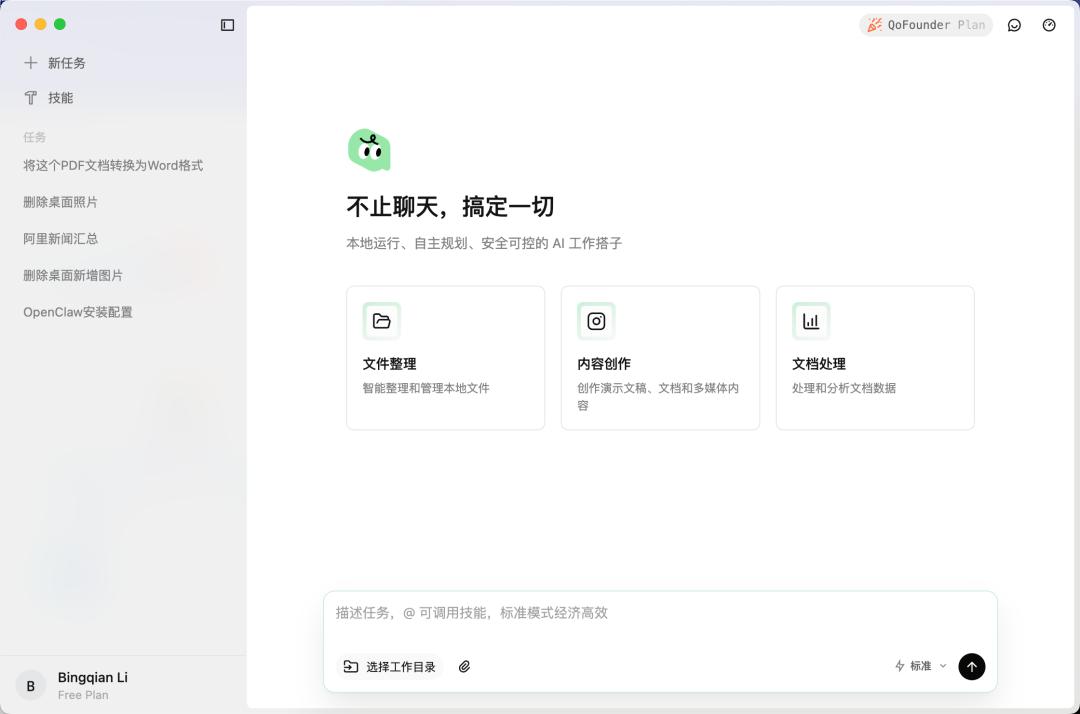
Screenshot of the QoderWork page
It can be predicted that Chen Yusen may adopt layered integration of capabilities for the three products, connecting "desktop + cloud + organization": The desktop interaction and local execution of QoderWork serve as the "front desk", the Agent self-evolution and process reuse capabilities of MuleRun serve as the "middle platform engine", and the enterprise data, collaborative relationships, and organizational structure of Wukong/DingTalk serve as the "back-end base". When creating MuleRun, Chen Yusen advocated an Agent route of "SOP (Standard Operating Procedure) first, large model second", and this concept may continue in this new AI product.
The challenges faced by the integration can also be anticipated. In terms of product genes, how to integrate personal efficiency and enterprise security and compliance between QoderWork, which prioritizes local operations, and Wukong/MuleRun, which focuses on cloud collaboration, is a major problem. In terms of team culture, considering the cultural frictions during the merger of the three parties from Alibaba Cloud, internal startups, and DingTalk SaaS is necessary. In terms of user retention, if the function alignment or user experience lags behind, users may be lost to competitors. In terms of commercialization, the pricing logic of the personal version and the enterprise version is very different, and a unified charging model needs to be reconstructed.
As of now, Alibaba has officially responded to this merger. The existing product services of QoderWork, Wukong, and MuleRun will be seamlessly upgraded in the future, and all user rights and interests will not be affected, so as to smoothly transition through the integration period.
This article is from the WeChat official account "Zhidx" (ID: zhidxcom), written by Li Shuiqing and edited by Yun Peng. It is published by 36Kr with authorization.