A trillion-dollar bet on semiconductors – is South Korea truly panicking this time?
The thing that Koreans can least tolerate is probably losing.
On June 28th, the South Korean team was eliminated from the World Cup group stage. President Lee Jae-myung severely criticized the team on social media for "failing to meet the expectations of the people" and demanded that the South Korean Football Association conduct a thorough investigation into the reasons for the defeat.
The next day, Lee Jae-myung regained his composure and stood side by side with Samsung Electronics Chairman Lee Jae-yong and SK Group Chairman Choi Tae-won on the press conference stage, bowing 90 degrees to thank them for their huge investment plans.

The picture shows the site of the "Three Super Projects" report meeting. Image source | Internet
At this press conference, the South Korean government, in conjunction with two companies, presented a sky-high investment plan equivalent to 2.33 times South Korea's GDP. The total investment of the South Korean government in this plan was 146.1 trillion won (approximately 6.4 trillion yuan), with most of it being poured into semiconductor production. Just the semiconductor production base in the southwest region alone accounted for 80 trillion won.
However, if you are familiar with the history of the semiconductor industry, you will notice an anomaly.
In the past three decades, the South Korean semiconductor industry has been good at "counter-cyclical investment." During the trough period of the industry, South Korean semiconductor companies increased their capital expenditure and expanded production capacity, seizing the market with their low-cost advantage.
When the cycle recovered, the newly added production capacity was just released, and they harvested excess profits by raising prices and maintaining sales volume.
In the past two years, the growing demand for AI computing power has brought the memory chip into a super boom cycle, and the price has been rising continuously. According to the previous scenario, the giants should start to "squeeze the toothpaste," slowly releasing production capacity to maintain high profits for as long as possible.
But why is South Korea making such a large-scale investment during the prosperous period of the industry? Looking back at the four-decade history of East Asian competition in the semiconductor industry, the answer is not hard to find.
01 The "Competition History" of Semiconductors between Japan and South Korea
The semiconductor business has been a money-burning game since its inception. A single wafer factory often requires tens of billions of dollars to start. Every step, from the factory building, equipment, to tape-out, is a money pit.
Without the support of the whole nation, latecomers can't even get a seat at the table.
In East Asia, Japan was the first country to understand the "national system + industrial capital" model.
In the early 1970s, IBM announced the development of the "Future System" using very large-scale integrated circuits, leaving Japan behind in terms of technology. At the same time, the US government pressured Japan to open its computer and semiconductor markets, which can be called the "Black Ship Incident of Semiconductors."
Cornered, Japan quickly came up with a countermeasure.
In 1976, the Japanese Ministry of International Trade and Industry adopted the "national system + industrial capital" model, joining hands with five major companies, Hitachi, NEC, Fujitsu, Mitsubishi, and Toshiba, to raise 72 billion yen (approximately 236 million US dollars) and establish the "VLSI Technology Research Institute."
The goal was very simple: to catch up with the United States.
The effect was immediate.
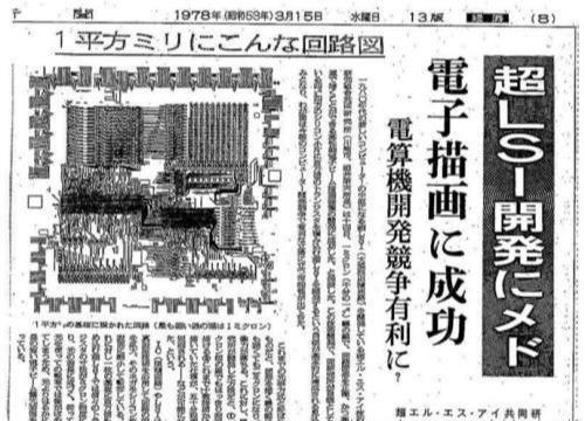
The picture shows a Japanese newspaper reporting the breakthrough in very large-scale integrated circuits in 1978. Image source | Internet
By the end of 1982, Japan's 64K DRAM already accounted for 66% of the international market. By the late 1980s, Japan had captured 80% of the global DRAM market, pushing American manufacturers such as Intel into a corner.
At that time, South Korea was not even in Japan's competitive radar.
But just when the Japanese semiconductor industry was at its peak, a South Korean publicly announced his entry into the semiconductor industry in Tokyo.
He said, "I want to promote the semiconductor business based on the unique tenacity and creativity of our nation."
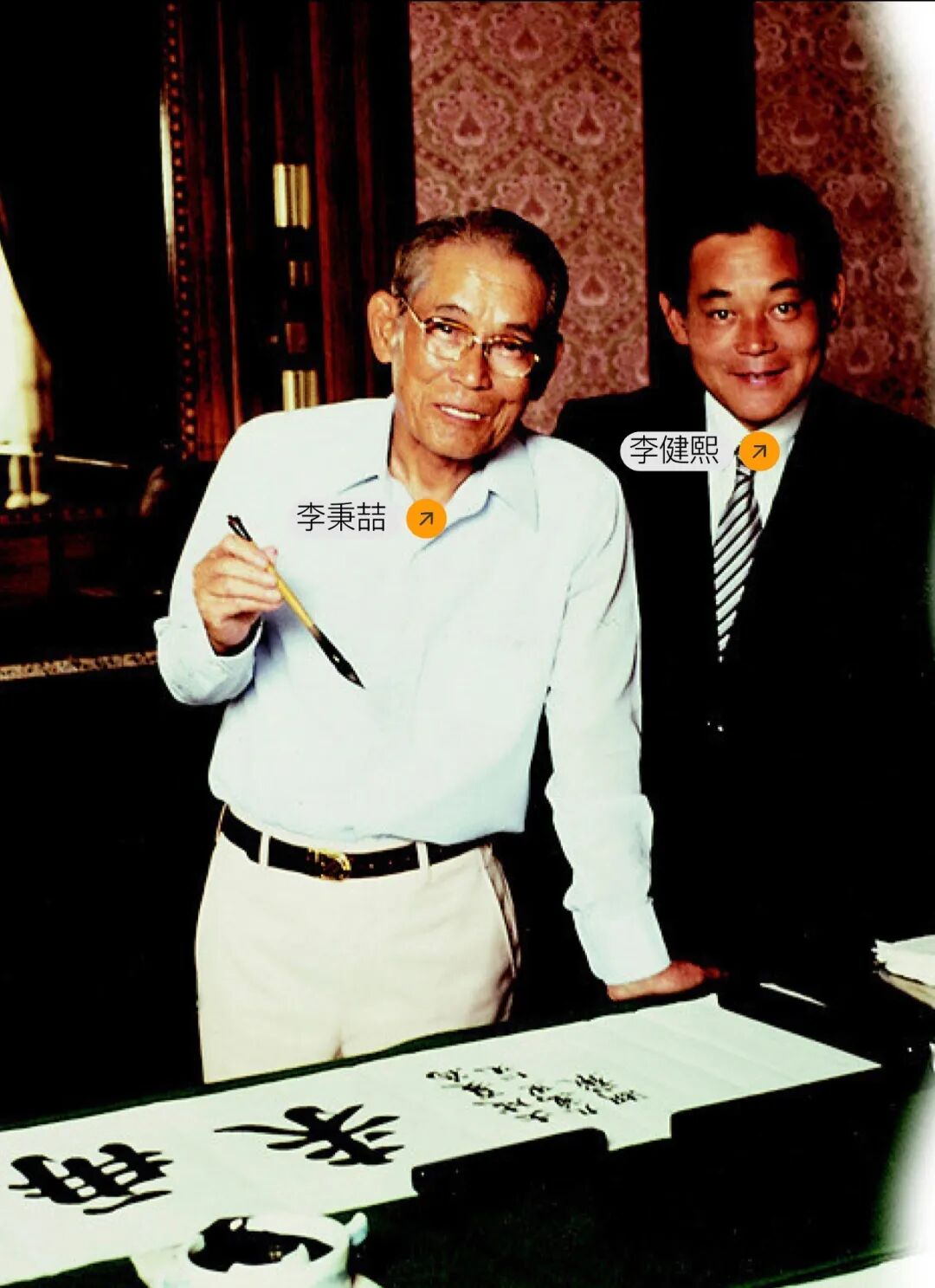
The picture shows Samsung Group founder Lee Byung-chul and his third son Lee Kun-hee. Image source | Internet
This old man was Lee Byung-chul, the founder of Samsung, and this speech later became known as the "Tokyo Declaration."
But in Tokyo at that time, on the Japanese's most proud home ground, no one took this seriously.
American Intel even mocked him as a "delusional megalomaniac," and the CEO of Japanese Mitsubishi publicly stated that the semiconductor industry was not suitable for South Korea at all.
At that time, Samsung could only barely produce low-end integrated circuits for household appliances and didn't even have a proper DRAM production line.
But this "delusion" that was laughed at made the entire Japanese DRAM industry tremble in less than a decade.
At that time, the global chip industry was firmly occupied by American Micron, Japanese Mitsubishi, and Sharp. These American and Japanese companies tightly closed the door to technology. To obtain the entry-level technology, Samsung sent batch after batch of researchers to companies like Micron and Sharp.
The process was humiliating.
Micron once verbally promised to provide relatively outdated design drawings for 4 million US dollars, but later reneged on the promise on the pretext of "peeping at documents" and kicked out the Samsung personnel from the company.
As for Sharp, although it seemingly agreed to Samsung's request, it actually kept a tight watch and didn't even allow Samsung personnel to approach the latest production line.
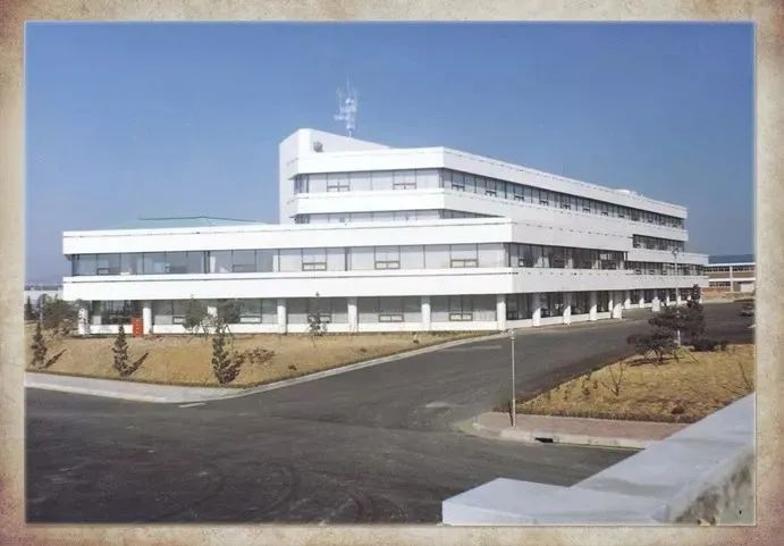
The picture shows the Suwon R & D Center built by Samsung in 1979. Image source | Internet
Samsung's researchers couldn't even obtain basic data such as the area of the factory. One researcher recorded the approximate area and other parameters of the factory bit by bit through the spacing between his fingers, his height, and the number of steps.
For example, he measured that the width of the factory production line was 30 steps and the length was 222 steps.
However, an insider who had worked in Samsung Semiconductor for many years later recalled, "These data were obviously not enough for building a high-tech factory."
No one expected that this "delusion" laughed at by the entire industry would make the entire Japanese DRAM industry tremble in less than a decade.
The turning point of victory and defeat lies in the switch of the industrial logic.
Japanese DRAM manufacturers had extremely high and strict quality requirements because the customers at that time were mainly banks, railways, and telegraph companies.
These customers had only one requirement for DRAM: it must never break down.
Relying on this extreme quality, Japan defeated the United States in the 1980s and captured 80% of the global DRAM market.
But the turning point of Japan's national fortune also started from this time.
The "Plaza Accord" in 1985 led to a significant appreciation of the yen, severely weakening the export competitiveness of Japanese products.
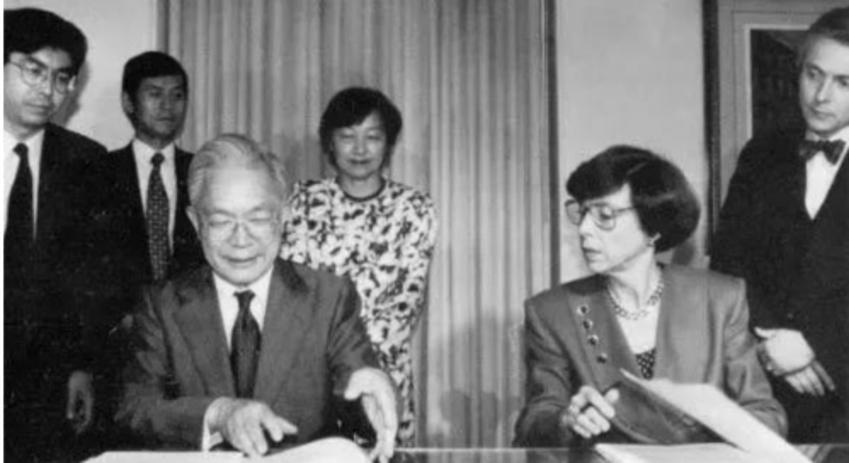
The picture shows the signing of the semiconductor agreement between the United States and Japan. Image source | Internet
Immediately afterwards, in 1986, the United States launched an anti-dumping lawsuit against Japanese semiconductor companies, and the two sides reached an export restriction agreement. Japan was tied up, and the expansion ability of the Japanese semiconductor industry was severely overdrawn.
The external market was also changing. In the 1990s, personal computers replaced mainframes as the mainstream.
PCs are consumer electronics. They don't need the "aviation-grade" quality of zero failures in 25 years. Being able to last for 5 years is enough. Being cheap, in large quantities, and having fast iterations are the key.
The "craftsman spirit" that pursues quality has instead become a stumbling block in the large-scale development of the industry.
The South Koreans seized this opportunity and also started to use the "national system + industrial capital" model to counterattack the Japanese memory industry.
In 1983, the South Korean government began to implement the "Very Large-Scale Integrated Circuit Technology Joint Development Plan." Led by the South Korean Institute of Electronics Technology, large enterprises such as Samsung, Hyundai, and LG participated, along with 6 universities. Over 3 years, 110 million US dollars were invested, with the government bearing 57%.
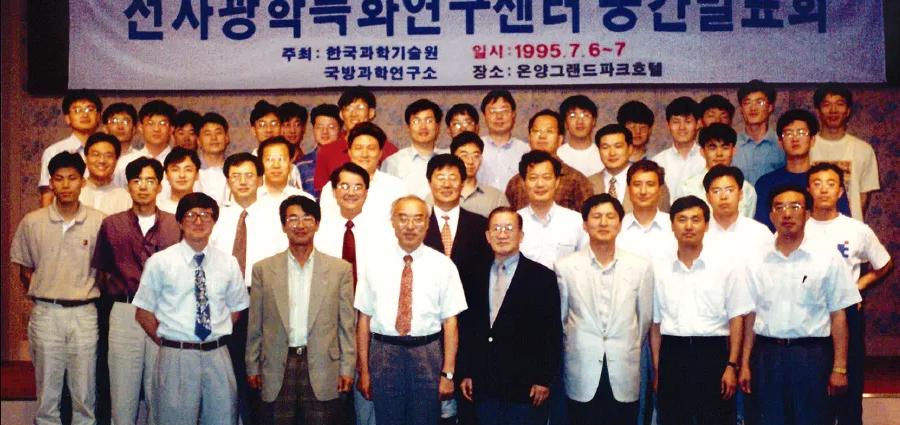
The picture shows a group photo of the personnel of the South Korean Electro-Optics Center, an institution aiming to develop thermal imaging, optical fiber, and laser technologies. Image source | Internet
In 1992, Samsung was the first to launch the world's first 64M DRAM, surpassing Japanese NEC and becoming the world's largest DRAM manufacturer. In 1993, Samsung's production efficiency exceeded that of Japan, officially topping the global DRAM market.
Now it was Japan's turn to panic.
In 1999, in order to counter the strong rise of South Korean Samsung, the Japanese government took the lead in integrating the DRAM businesses of Hitachi, NEC, and Mitsubishi Electric to establish Elpida.
After its establishment, Elpida developed rapidly and became the world's third-largest DRAM manufacturer. Even during the 2009 financial crisis, the Japanese government passed an amendment to the "Industrial Revitalization Law," injecting 30 billion yen into it and providing 100 billion yen in financing guarantees.
The speed of the government's blood transfusion couldn't keep up with the speed of blood loss in the memory price war. In desperation, Elpida President Sakamoto Yukio made a desperate decision to come up with a 1.6 trillion yen expansion plan, trying to take a gamble for a last glimmer of hope.
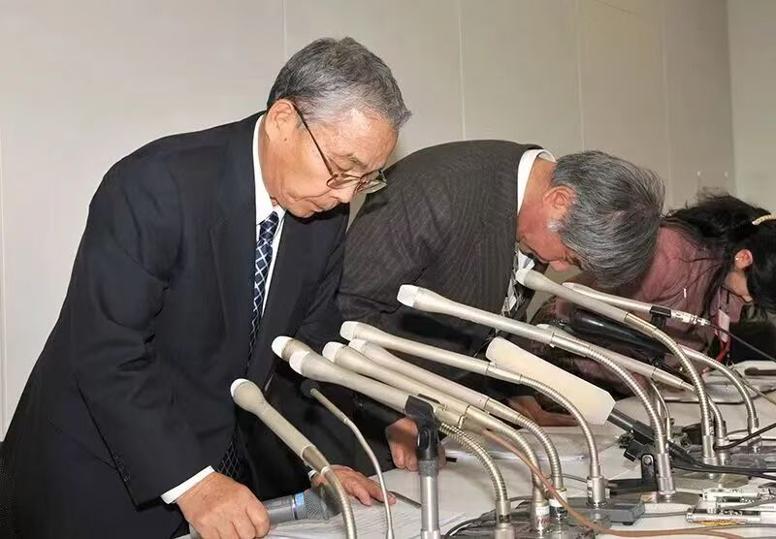
The picture shows Elpida President Sakamoto Yukio at the bankruptcy press conference. Image source | Internet
It is rumored that when Elpida's president sought help, a Japanese official institution coldly replied, "Japan doesn't need memory. It can just buy it from South Korea."
In February 2012, Elpida, with a debt of up to 448 billion yen (approximately 5.5 billion US dollars), applied for bankruptcy protection. In July of the same year, it was acquired by Micron Technology, one of the current three memory giants, for approximately 2.5 billion US dollars.
Since then, the memory industry has formed a tripartite pattern of "Samsung, SK Hynix, and Micron."
Looking back at this history, the essence of victory and defeat is a competition of efficiency between two "national system + industrial capital" models.
Japan used this model to catch up with the United States and reached the top in the 1980s; South Korea used the same model to counterattack Japan and took its place in the 1990s.
Every time the throne changes hands, it is the latecomer who uses more determined investment and more tenacious endurance to outlast the predecessor.
02 The Two Pillars of Chinese Memory
In 2016, the iron curtain pattern of the global memory market had been maintained for more than a decade.
Samsung, SK Hynix, and Micron controlled more than 95% of the high-end market. The patent wall, capital barrier, and process gap were like three impregnable walls, preventing latecomers from even getting close to the table.
But in this year, the cities of Wuhan and Hefei almost simultaneously pressed the start button.
Changjiang Storage in the south and Yangtze Memory Technologies Co., Ltd. (YMTC) in the north, one targeting NAND flash memory and the other breaking through DRAM memory, were like two quenched cones, trying to carve out a gap in the airtight oligopoly pattern.
But none of their starting roads was smooth.
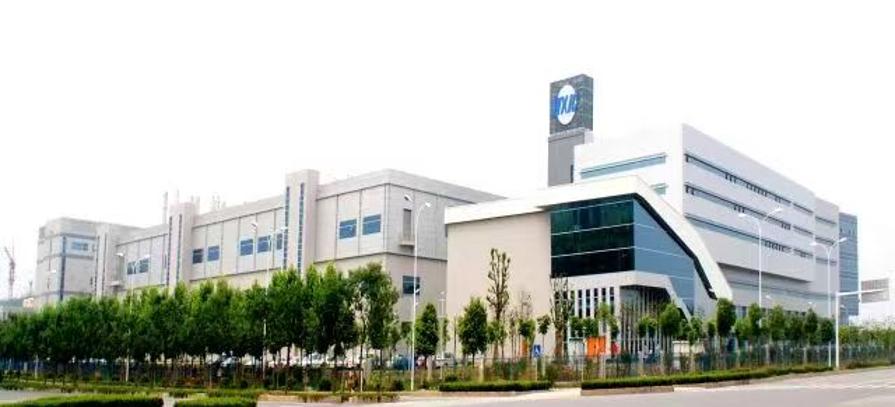
The picture shows the Wuhan Xinxin Integrated Circuit factory building. Image source | Internet
Changjiang Storage started from Wuhan Xinxin, a "veteran team" that had endured losses for ten years.
In 2006, promoted by Zhang Rujing, the founder of Semiconductor Manufacturing International Corporation (SMIC), Wuhan Xinxin was officially established.
The provincial government of Hubei, the municipal government of Wuhan, and the East Lake High-tech Development Zone jointly invested to build the first 12-inch integrated circuit production line in central China on a barren grassland, giving birth to a "spark" of independent intellectual property