36Kr Exclusive | Teams from Tsinghua University and the Chinese Academy of Sciences, in collaboration with West China Hospital, have developed a health care and transfer robot to further expand their presence in the home-based elderly care scenario
Author | Qiao Yujie
Editor | Yuan Silai
Hard Kr has learned that Shenzhen KeliDian Technology Co., Ltd. (hereinafter referred to as "KeliDian Technology") recently completed a strategic financing round, led by Lihe Science and Technology Innovation and co - invested by a platform under Jiangsu Zhongke Institute of Intelligent Science and Technology Application. The funds from this round of financing will be mainly used for product R & D iteration, core team building, and promotion of commercialization.
KeliDian Technology is headquartered in Shenzhen. It is a technology company focusing on the "AI + robot" elderly care scenario, and has laid out two product lines of home companionship and in - hospital rehabilitation for the elderly population. At present, the company has launched an active companion robot for the home - based elderly care scenario and a rehabilitation walking and transfer robot jointly developed with West China Hospital of Sichuan University. Both products have completed the development of engineering prototypes and are advancing small - batch trial production and commercialization.
As the aging population deepens, the silver - haired economy is becoming an important emerging market. The industry expects that the market scale of China's silver - haired economy is expected to exceed 30 trillion yuan in 2035. Driven by the national strategy of "actively responding to population aging" and relevant support policies, rehabilitation robots have also become one of the rapidly growing segments.
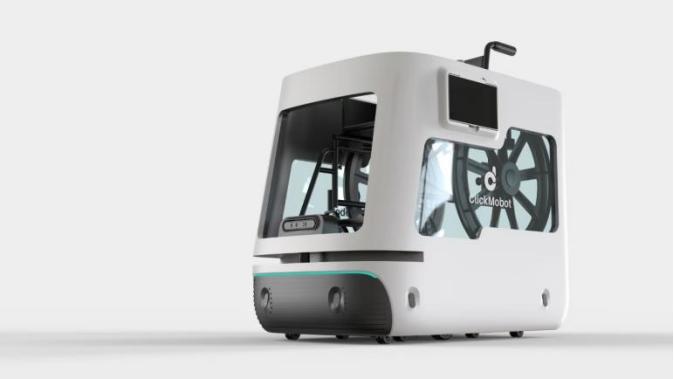
Among them, the GR - 150 rehabilitation walking and transfer robot jointly developed with West China Hospital of Sichuan University is mainly targeted at medical and elderly care institutions. Based on high - precision SLAM positioning and navigation and multi - sensor fusion technology, it can achieve indoor autonomous navigation and unmanned movement, providing intelligent transfer and mobility assistance services for disabled and semi - disabled patients. At present, the company has relevant independent intellectual property rights, with dozens of patents and software copyrights accumulated, and is applying for a Class II registration for medical devices in China.
(Image source/Enterprise)
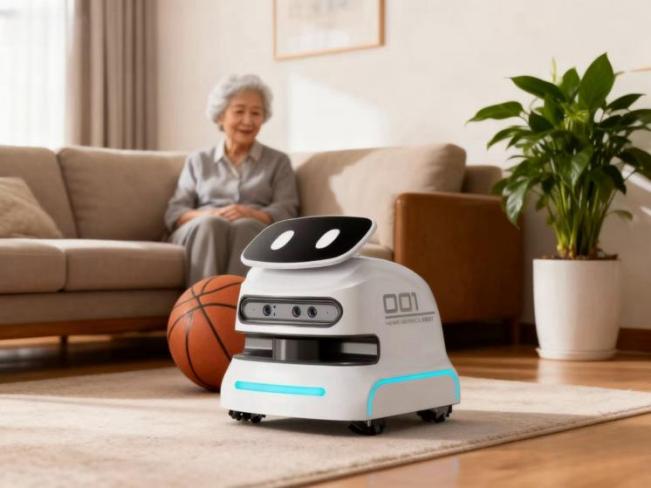
The second - generation home - based elderly care companion robot launched for the family scenario is positioned as a family intelligent companion assistant, integrating health monitoring, emotional companionship, cognitive assistance, and safety inspection. The product supports active interaction, can recognize when the user returns home, give voice greetings, and accompany the user at night. It also has the ability to detect falls and issue abnormal alarms. At the same time, the robot is equipped with an interactive screen that can play videos, music, and remind the user to take medicine.
(Image source/Enterprise)
In terms of underlying technology, the product has been specifically developed around the needs of elderly users. In response to the characteristics of the elderly, such as slow speaking speed, non - standard pronunciation, repeated sentences, and the use of dialects, the company has independently optimized the NLP/NLU engine to improve voice understanding ability. In terms of health monitoring, by combining biological radar or infrared thermal imaging technology with AI algorithms, it can achieve health warning functions such as sleep apnea screening and heart rate variability analysis. In terms of human - machine interaction, by integrating voice emotion recognition, text emotion analysis, and facial micro - expression recognition, a multi - modal emotion computing model is constructed to enhance the companionship experience.
According to the company, the companion robot product has received procurement intentions from some nursing homes, insurance companies, and channel agents. According to the plan, the company expects to complete the final product design in the third quarter of 2026, start small - batch mass production in the fourth quarter, and gradually achieve large - scale revenue in 2027.
In terms of the team, Wang Yuheng, the founder and chairman of KeliDian Technology, has a background in international investment banking and serial entrepreneurship. He is on the Forbes China's Top 100 Most Influential Chinese Elites list. He worked in an international investment bank for 5 years, and later founded the Canadian food delivery platform Nomme (later acquired by DoorDash) and the AI social ordering platform ClickDishes (which has been included in a Harvard Business School business case). He is mainly responsible for the company's strategic planning, financing, and global layout.
Zhang Tengteng, the CEO and CTO of the company, is a post - doctoral fellow at Tsinghua University, a doctor from Harbin Engineering University, and a master from the Chinese Academy of Sciences. He has long been engaged in research on pattern recognition, robot perception and decision - making control, mobile robots, and AI deep learning. Gong Xinyi, the co - founder and chief scientist, is a professor at Hangzhou Dianzi University, with a master's and doctor's degree from the Chinese Academy of Sciences and a bachelor's degree from Tsinghua University. He has long - term scientific research accumulation in the field of intelligent control and robots, providing academic and technical support for the company's technology R & D.
The following is an excerpt from the exchange between Hard Kr and founder Wang Yuheng:
Hard Kr: There are already many players in the elderly companionship track. What are your advantages?
Wang Yuheng: We believe that many products in the current market still focus on single functions, such as health monitoring and vital signs collection, and most of them rely on wearable devices. Our positioning is not to create a single monitoring hardware, but a family intelligent butler - type robot, which becomes the core entrance connecting various intelligent devices and services.
In the future, both health - wearable devices and smart home devices can be linked with the robot. The robot can not only perform functions such as health monitoring and risk warning, but also rely on the connected large - model system to have natural conversations with the elderly, provide emotional companionship, and answer various questions in daily life, such as weather inquiries and life advice, realizing the integration of companionship, interaction, and management capabilities. Compared with products focusing on a single vertical scenario, we emphasize the open and integrated platform capabilities and hope to make the robot the intelligent center in the family.
Secondly, the company's core founding and technical teams are from Tsinghua University and the Chinese Academy of Sciences, with strong capabilities in algorithm and underlying technology R & D. Thirdly, we attach great importance to product design and user experience. The products currently on display are still functional verification prototypes. In the future, we will continue to invest in industrial design, interaction experience, and emotional expression to make the robot truly integrate into family life.
We believe that it will still take a long time for humanoid robots to be widely used in family scenarios. The companion robot we developed can enter family scenarios faster and earlier, providing more practical services for the elderly and becoming an important transitional product in the process of intelligent upgrading of family robots.
Views of the investors
Lihe Science and Technology Innovation said: KeliDian Technology is a highly potential team we discovered in the intersection of the silver - haired economy and embodied intelligence. The founding team has both the AI technical foundation of Tsinghua University and an international business vision. The in - depth cooperation of the core product with West China Hospital reflects its solid path for clinical implementation. We are optimistic about the huge market space of rehabilitation robots in the context of China's accelerating aging population and look forward to KeliDian Technology becoming a leading enterprise in this field.