36Kr Exclusive | Former DJI Scientist Launches Startup, Secures Hundreds of Millions in RMB Funding Across Four Rounds in Half a Year, Backed by Yunzhou Capital and Jinqiu Fund
Author | Ou Xue
Editor | Yuan Silai
Yingke learned that SPARO, a company focusing on general aerial intelligence, has completed four rounds of financing worth hundreds of millions of yuan in half a year. After the seed - round investment from Glory Path Capital, Jinqiu Fund, Alibaba, Hony Capital, GLP Yinsan Capital, and Yunshi Capital have successively joined in. In terms of the use of funds, the current - stage financing will be mainly used for expanding the team building of key positions, promoting the commercialization and large - scale delivery of product lines, and accelerating the continuous iteration of the technology platform.
SPARO was founded in February 2026, focusing on general aerial intelligence and committed to evolving aircraft from traditional remote - controlled tools into aerial intelligent agents capable of understanding the environment, making decisions, and autonomously completing tasks.
The core team of SPARO comes from top global research institutions and leading enterprises such as DJI and Huawei, with more than a decade of cutting - edge technology accumulation and industrialization experience. The company has built a full - stack technology system including multi - modal perception, end - to - end cerebellum, world navigation model brain, and dexterous operation and swarm collaboration, enabling aircraft to complete tasks in complex environments such as areas without GPS signals, low - light conditions, and dynamic changes, and realizing cross - scenario, cross - platform, and cross - form applications.
Zhang Fu, the founder of SPARO, is a typical "academic + industry" compound talent. He has been selected as one of the top 1% scientists globally by Clarivate and ranks fifth globally and first among Chinese scholars in the influence ranking of global robotics scholars in the past five years on ScholarGPS. He is currently a tenured associate professor at the University of Hong Kong and the head of MaRS Lab.
Beyond academia, he served as a senior consulting scientist at DJI for eight years, deeply participating in the core technology R & D and productization of leading enterprises in the industry such as DJI, covering multiple key directions such as flight control systems, multi - sensor fusion, and lidar. The relevant open - source technologies he developed have been verified and used by dozens of enterprises such as Unitree and Meituan.
From the perspective of industry development, in the first half of the aircraft industry, the competition was about engineering maturity and cost - effectiveness, and leading enterprises have pushed these two dimensions to the extreme. However, in Zhang Fu's view, the real second half of the industry has just begun, and the core variable is shifting from hardware parameters to autonomous capabilities.
"Today's drones can also perform tasks, but they can only do 'observation' tasks, carrying cameras and lidar to observe, and have no way to truly change the environment," Zhang Fu told Yingke. "Operability means it can intervene in the world."
In his view, there are no truly intelligent aircraft on the market at present. "Because it's very difficult."
Zhang Fu's choice of this track is based on two underlying judgments: "This task is difficult enough, which means there are high barriers. Limited by weight, size, and power consumption, integrating perception and decision - making capabilities on a very small chip for drones is much more difficult than for ground robots."
Another reason is related to the essence of business: "Aerial intelligent agents can go to places where humans can't or have difficulty reaching, which means they are inherently irreplaceable."
Yingke learned that the core technological barrier of SPARO lies in a full - stack self - developed architecture covering perception, cerebellum, brain, and data:
In terms of perception, SPARO's multi - modal fusion perception solution deeply couples multi - source information such as lidar, vision, and inertial navigation, achieving centimeter - level positioning without GPS and maintaining stable perception in degraded scenarios such as low - light and thick smoke. The algorithm reduces the dependence on feature extraction, better adapting to complex scenarios such as weak textures and drastic changes in lighting, and the computing efficiency is more than ten times higher than traditional solutions.
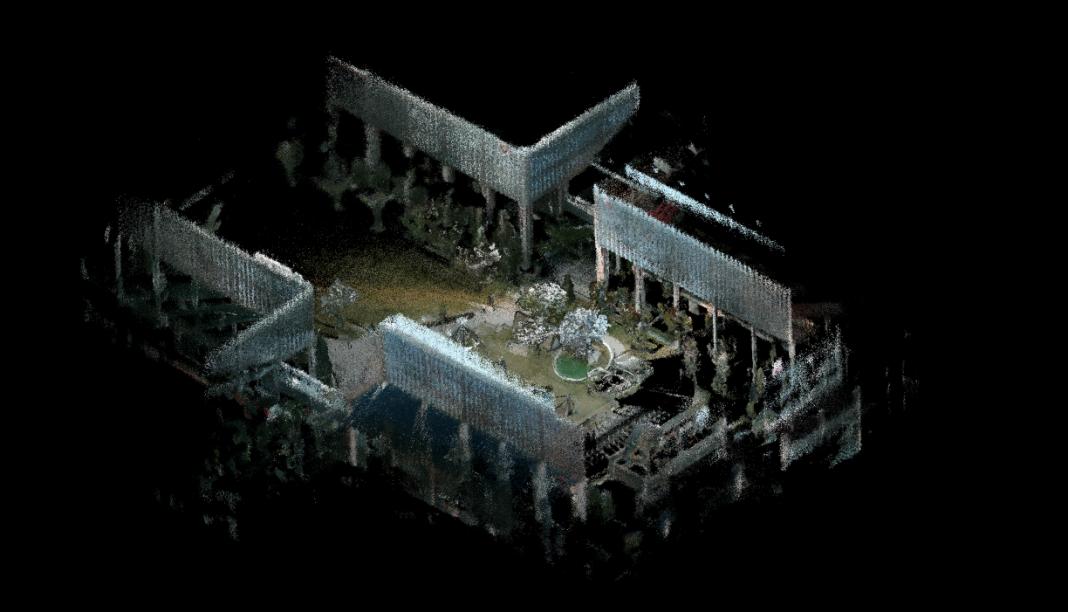
Real - time modeling and understanding of unfamiliar environments (Source/Enterprise)
In terms of decision - making, based on the end - to - end cerebellum, SPARO has compressed the obstacle - avoidance response delay to less than 5 milliseconds - the reaction time of human pilots is about a hundred milliseconds. This means that the aircraft can still make real - time judgments and avoid dynamic obstacles during high - speed flight at 20 meters per second.
In terms of the brain, SPARO is building a general aircraft brain based on the World Navigation Model. Traditional SLAM solves the problems of "where I am and what the surroundings are like", while the World Navigation Model solves "how this space operates and what will happen next" - the aircraft not only maps but also understands the geometric structure, semantic attributes, and dynamic changes of the space. The data collected by real aircraft is iteratively trained in the simulation environment and then deployed back to the real world, forming a data flywheel of "becoming smarter with more flights".
In terms of dexterous operation and swarm collaboration, the aircraft can learn to grasp, perch, and adjust after collisions like birds, and can have physical interactions with the environment. At the same time, through a distributed architecture, it can achieve swarm collaboration of thousands of aircraft. From single - unit dexterous operation to swarm intelligence, it has the ability of large - scale aerial operations.
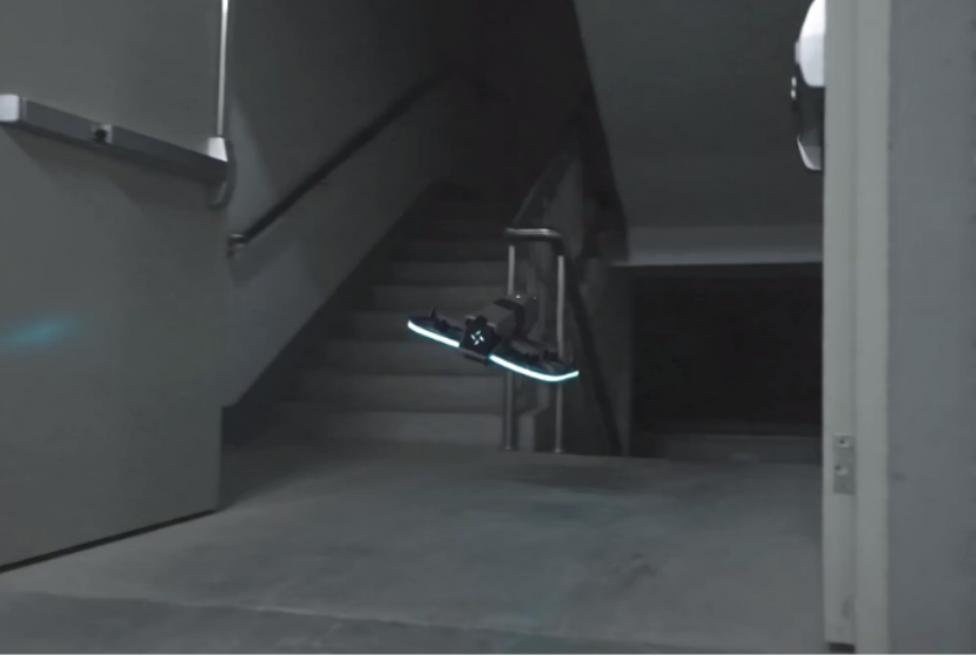
The product working indoors (Source/Enterprise)
Zhang Fu told Yingke that in just half a year since its establishment, SPARO has accumulated dozens of seed customers and partners, including drone and logistics distribution enterprises.
The following is a dialogue (edited) between Yingke and Zhang Fu, the founder of SPARO:
Yingke: What are the core differences between aerial intelligent agents and traditional drones?
Zhang Fu: Compared with traditional drones, we have three core differences: First, generality, which means it can fly across different scenarios and platforms, such as indoors, underground, and in the near - earth ultra - low altitude; second, it can think independently, without human remote control, and can reason about the world and make decisions on its own; third, it is operable, not only able to observe but also able to intervene in the environment, such as performing repair and cleaning work.
Yingke: How do you view the relationship with leading enterprises like DJI?
Zhang Fu: DJI is a benchmark enterprise in the drone field, defining a mature flight platform. However, we are working on an incremental market and new product categories. The relationship between us is not simply a substitution of the same kind but different focuses in the intelligent evolution of aircraft. Our characteristics mainly lie in three aspects: the ability of original technological innovation, especially source technologies; the ability to transform cutting - edge technologies into mass - produced products; and the core technologies accumulated over the past decade.
Yingke: What are the plans for the next two or three years?
Zhang Fu: The product layout is mainly divided into two parts. The whole aircraft will first run through the complete closed - loop from perception to task execution in the real environment to verify the reliability of the entire link. The aerial intelligent module will lightly package the positioning, perception, navigation, and obstacle - avoidance capabilities, enabling it to empower various flight platforms such as multi - rotors, eVTOLs, and fixed - wings in a plug - and - play manner.
More importantly, we need to build an ecosystem. Through the verification ability of the whole aircraft, the replication ability of the module, and the S2R simulation platform for developers and ecosystem partners, we will build a complete infrastructure for the technological R & D and large - scale implementation of aerial intelligent agents.
Views from investors:
(Exclusive seed - round investor) Glory Path Capital said: Professor Zhang Fu's team consists of top scholars who are globally scarce and have both the underlying algorithms of multi - modal SLAM and the end - to - end system capabilities of drone whole aircraft. FAST - LIVO has become one of the de facto industrial benchmarks in the global robotics field. The biggest bottleneck in current aerial embodiment is to achieve autonomous perception in complex environments, which is exactly the technical strength of Professor Zhang's team. We are optimistic about SPARO's ability to engineer and productize top - notch academic achievements and look forward to the company creating a general aerial intelligent base truly for real - world operation scenarios.
Jinqiu Fund said: Jinqiu has invested in more than ten companies related to embodied intelligence. SPARO's unique positioning is in the perception - understanding - task execution in the vast space above 2 meters. Just as AI has brought about a paradigm shift in the robotics field, we also firmly believe that with the development of multi - modal perception, navigation, and then the autonomous thinking and task execution of "flight intelligent agents", it will soon arrive. After meeting Professor Zhang Fu at the University of Hong Kong, we made a decision within ten days. We are convinced that AI technology will become a new variable in the drone field, bringing new and huge opportunities. Professor Zhang Fu is the top - notch global academic team we have seen in this blue - ocean field, and their iteration speed in productization and commercialization has also impressed us deeply.
Gu Yu, Investment Director of Hony Capital: As an early investor in SPARO, what we value is not just a new hardware product but the team's systematic accumulation in the underlying technologies of flight intelligent agents. Professor Zhang Fu and the HKU MaRS Lab team have long been deeply involved in aerial robots, forming leading capabilities in multi - modal perception fusion, high - precision positioning and mapping, end - to - end navigation and control, etc., and have the engineering experience to transform cutting - edge research into mass - producible products. We believe that the next - generation flight platforms will evolve from "controlled devices" to intelligent systems with autonomous perception, real - time decision - making, and reliable execution capabilities. SPARO is bringing these core technologies into real scenarios, promoting the transition of flight robots from technology verification to large - scale application. We look forward to the team continuously defining the product form and industrial value of this generation of flight intelligent agents.
GLP Yinsan Capital said: We have long been optimistic about the development opportunities in the field of aerial embodied intelligence, which represents the evolution direction of space - general intelligence and reconstructs the low - altitude industry paradigm. The SPARO team has globally leading academic research capabilities and excellent industrialization experience in the field of aerial intelligent agents. Relying on GLP's logistics and computing power infrastructure ecosystem and Yinsan Capital's industrial resources, we look forward to jointly empowering through "capital + industry" to help SPARO start a new era of embodied intelligence + drones.
Li Xiang, Investor of Yunshi Capital said: We have long been concerned about disruptive innovation opportunities at all levels of the air, space, land, and sea. At the singularity of the integration of AI and the physical world, SPARO combines the low - altitude economy and embodied intelligence, reshaping the flight trajectory and full - process complex operations of autonomous drones through a learning - driven new paradigm. Founder Zhang Fu and the core team have the scarce ability to go from - 1 to 100 multiple times from scientific research to the successful launch of popular products in the cutting - edge field of hardware - software coupling, and have pushed the perception ability of drones in unknown and complex physical three - dimensional spaces to the extreme. We will accompany the team all the way, support them in continuously breaking through the barriers, and promote smaller, more intelligent, and clustered aerial intelligent agents to thousands of households, defining the general space control trajectory of the new era.