The merger of Dida by Tongcheng is essentially the same as Tencent's acquisition of Ximalaya and Meituan's acquisition of Dingdong.
In the past two years, mergers and acquisitions in the Internet technology industry have entered a new round of active periods.
Tencent acquired Himalaya, and Meituan acquired Dingdong Maicai. Recently, Tongcheng Travel and Dida jointly issued an announcement that Tongcheng has launched a tender offer for Dida.
Behind these acquisitions, there is a common logic: The leading companies in the industry are all complementing their own ecosystems.
Tencent's acquisition of Himalaya is to make up for the short - board of long - audio content and improve the "listening" ecosystem; Meituan's acquisition of Dingdong Maicai is to acquire its front - end warehouses and supply chain to complete its instant retail ecosystem; Tongcheng's acquisition of Dida aims to complete the "last - mile" travel and complement the travel service ecosystem.
So, the question arises. At this current time point, Why do these giants want to complement their own ecosystems through mergers and acquisitions?
Let's take Tongcheng's tender offer for Dida as a case and conduct an in - depth analysis.
Is the acquisition of Dida a "bottom - fishing" move?
First of all, whenever a large company makes an acquisition, finance is an important factor to consider.
When Tencent acquired 100% of Himalaya's equity with $1.26 billion in cash plus 5.2% of Tencent Music's Class A common stock, Himalaya's profitability continued to improve.
In the case of Meituan, when it acquired Dingdong Maicai, the latter achieved GAAP - compliant profits for seven consecutive quarters, and its cash reserve on the books exceeded 3 billion yuan.
It can be seen that The buyers are all buying assets with financial certainty at a suitable price.
How about Tongcheng's acquisition of Dida?
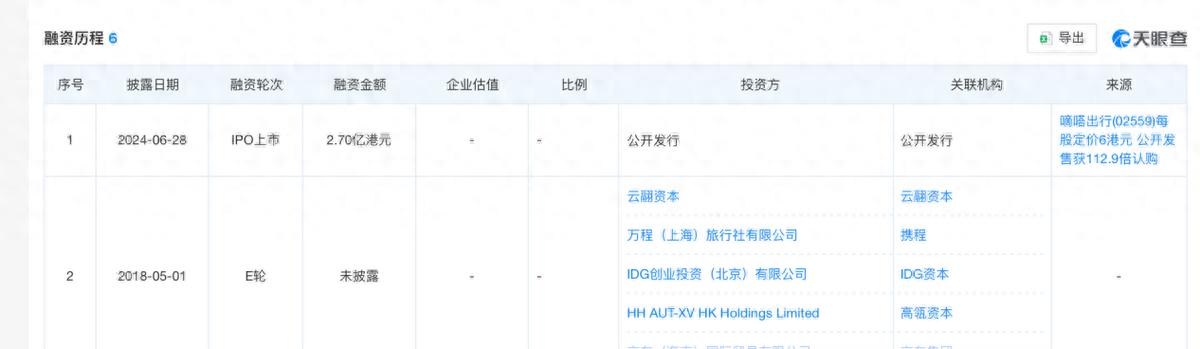
According to Tianyancha APP, Dida went public in 2024, with an issue price of HK$6 per share. At the time of issuance, it was over - subscribed by 112.9 times.
In the whole year of 2025, Dida Chuxing achieved an operating income of 502 million yuan, a year - on - year decrease of 36.2%, hitting a new low in the past five years. The net profit attributable to the parent company was 130 million yuan, a year - on - year decrease of 87.1%; the adjusted net profit was 138 million yuan, a year - on - year decrease of 34.6%.
If we look at the paper data, it seems that Dida is the opposite of Dingdong Maicai and Himalaya. But in fact, this financial data is misleading. In 2024, about 870 million yuan of Dida's net profit of 1.004 billion yuan came from non - recurring gains and losses such as changes in the fair value of preferred stocks, which had nothing to do with the main business.
That is to say, the decline in Dida's main business profit is actually not as severe as the paper data shows.
Dida's gross profit margin for its carpooling business is 67.2%, while Didi's gross profit margin in 2025 was 19.19%. Dida has 967 million yuan in cash on its books and has no significant debt pressure. Although the scale of its main business profit is not very large, its financial situation still has a certain degree of certainty.
Tongcheng's tender offer with a 12.8% premium at this time, although not a typical "bottom - fishing" move, is by no means a "bail - out" either. Moreover, what Tongcheng really values is Dida's user value.
As of 2025, Dida App has more than 415 million registered users, and there are 21 million certified private car owners. In terms of total transaction volume, Dida occupies about 31% of the carpooling market in China.
This user volume and its potential are obviously not in line with the financial data and the performance in the secondary market. The reason may be that the competition in the online car - hailing industry is too fierce, and players like Didi, Hello, and Gaode have brought relatively large share pressure.
In the past few years, after several rounds of subsidy wars, Didi, Hello, and Gaode have indeed snatched a lot of the market. Needless to say, Didi has a large user base and strong user habits. Hello has Alipay as a super entrance, and Gaode itself is a traffic entrance. It is difficult for Dida to compete with these super apps.
Therefore, from Dida's perspective, Tongcheng has 253 million annual paying users, and combined with Dida Chuxing's 400 million registered users Although it may not necessarily turn Dida around overnight, the scale of this traffic pool can at least stabilize the existing market share and the basic customer base, and continuously realize monetization.
Beyond the financial impact, a more important reason for Tongcheng's tender offer for Dida may be: Strategic synergy.
The term "strategic synergy" has been over - written by the media, but for large companies, it means real benefits. So - called synergy, in essence, is "Buying traffic, reducing costs, and reusing capabilities."
This is the case for Tencent's acquisition of Himalaya and Meituan's acquisition of Dingdong Maicai.
Tencent's acquisition of Himalaya has obtained 300 million monthly active users of Himalaya. It is much more cost - effective than directly investing in customer acquisition to build a traffic pool of hundreds of millions of users;
At the traffic level, with the same logic, if Tongcheng merges with Dida and activates Dida's 400 million users, does it also mean that its own traffic pool will be upgraded by an order of magnitude? This may be much more cost - effective than directly investing in customer acquisition to increase the monthly active users by two or three hundred million.
It's not just about reducing traffic costs. There is also a lot of room for reusing system capabilities.
Meituan is not short of traffic. Why does it still need to acquire Dingdong Maicai? It is to complete the jigsaw puzzle of its instant retail strategy.
In the instant retail battlefield, subsidy wars have been fought, and various strategies have been tried, which have also increased the costs. Meituan is in urgent need of cost reduction.
But for Meituan, the cost of the distribution system is a rigid expenditure. How can it reduce costs?
The answer is to expand the ecological boundary.
The same goes for OTA platforms.
After all, travel and transportation are naturally inseparable, and the cost - reduction effect is still very obvious. Strategically, completing the key "last - mile" ground transportation link in the ecological closed - loop is also a clear move by Tongcheng.
The starting point of travel is always "transportation". Products and services such as air tickets, hotels, tickets, and car - hailing are actually a complete ecological chain.
Or rather, For an OTA platform, doing the car - hailing business is actually like an e - commerce platform expanding its product categories. From air tickets and hotels to car - hailing is like an e - commerce platform expanding from books to clothing and then to 3C products. In this process, all product categories share a set of platform system capabilities. As the GMV scale increases significantly, the cost can naturally be reduced.
This is the "ecological efficiency" of large companies.
In the e - commerce industry, only a few players like Alibaba, JD.com, and Pinduoduo can cover all product categories. In fact, there are not many that can truly connect this ecological chain.
The same is true in the OTA industry. In fact, Tongcheng's merger with Dida to complete the "last - mile" in the ecological closed - loop is also for higher "ecological efficiency".
For Dida, this merger is the ultimate solution to its customer - acquisition dilemma. Instead of struggling alone and competing with various super entrances, it is better to actively integrate into a powerful tourism and transportation ecosystem.
For Tongcheng, this merger may be an important layout to complete its ecological efficiency map. However, at present, it has just reached the stage of announcing the tender offer, and it remains to be seen whether there will be any changes in the subsequent process.
The purpose of the merger is not only about the "last mile"
From the above financial and strategic perspectives, an OTA platform's merger with a transportation platform is actually more of a situation that is "unexpected but reasonable".
What I'm more curious about than the business logic of Tongcheng's acquisition of Dida is: "Why is it happening now?"
The real answer may be hidden in the history of Internet technology development.
In the history of the commercial development of Internet technology Behind each round of industry merger and acquisition boom, there is a new technological revolution.
For example, from the 3G to 4G era, and from the PC Internet to the mobile Internet era, Baidu acquired 91 Wireless, Microsoft acquired Nokia's mobile phone business, and Alibaba bought UC; from the 4G to 5G era, Facebook acquired Instagram, Alibaba acquired Youku Tudou, Meituan acquired Mobike, and Tencent took control of Huya and Douyu...
These acquisitions are scattered in different fields, with different acquisition scales and industry influences, but their core goals are the same In the new technology era, companies should cover their products and services in the scenarios closest to users as soon as possible.
The same is true today.
Currently, Internet technology is moving from the 5G era to the AI era. Behind the new round of merger and acquisition boom, everyone seems to want to seize the opportunities in the AI era.
In the AI era, an important change is that the way users interact with platform products and services has fundamentally changed.
For example, in the mobile Internet era, users actively open apps, search, and click. Whether it's buying a ticket, playing a song, or ordering a takeaway, it's all a single - demand task, and users need to complete it actively.
At this time, the platform only needs to provide single - category services.
In the AI era, the underlying logic has changed. Users issue instructions through the AI entrance, and the AI executes automatically. At this time, users' needs will be more complex.
At this time, the competitiveness of your AI product = the breadth of meeting users' needs + the degree of service completion.
For example, in a business - trip scenario, the user's demand may be "I'm going on a three - day business trip to Beijing next week. Please arrange everything for me." At this time, a complete "end - to - end" solution is needed.
In this process, if the AI can solve the problem completely within its own ecosystem, users will continue to use it. But if the AI says "Please jump to a certain app", users are likely to be lost.
From this logic, whether it's content, e - commerce, or OTA platforms all need a more complete user experience to access the AI entrance.
And this recent merger and acquisition boom may also be the giants' attempt to complete the "scenario jigsaw puzzle" in the competition for the next - generation AI interaction entrance.
You see, Tencent Music has more than 500 million monthly active users, but it mainly focuses on music and lacks a podcast ecosystem. If it is connected to AI, when users want to listen to podcasts after listening to music, Himalaya has to complete the service.
The same is true for Meituan. One of the reasons for its acquisition of Dingdong Maicai is that when users say to the AI butler "I want to cook three dishes and one soup tonight. Please help me buy the groceries and deliver them to my home", Dingdong Maicai can naturally take over.
The same applies to OTA platforms.
Currently, the leading OTA platforms objectively need to complete the jigsaw puzzle of transportation services to embrace the new AI era.
Especially now, WeChat AI is coming.
After WeChat AI is officially launched in the future, all industries will have an opportunity to connect to AI.
For domestic AI applications, Doubao has 368 million users, Qianwen has 162 million users, and DeepSeek has 127 million users. After WeChat AI is fully launched, the number of users will reach 1.4 billion.
With a user base of 1.4 billion, a complete mini - program ecosystem, and strong user habits, WeChat has the ability to end the competition in terms of AI - linked services.
For Tongcheng, the OTA platform with the largest scale in the WeChat ecosystem, it is very important to timely supplement the ability to meet users' needs for buying air tickets, booking hotels, buying tickets, and hailing cars in a whole - system way.
Currently, Tongcheng's WeChat mini - program has 285 million users, and it exclusively occupies the "Train and Air Tickets" and "Hotels" entrances in the WeChat wallet. It is one of the most important OTA service entrances in the WeChat ecosystem.
In the AI era, Tongcheng may also become the most important OTA service provider in the WeChat AI ecosystem.
Tongcheng has taken some early steps in responding to WeChat AI.
On June 20th, WeChat gradually opened the internal - testing qualification for "Xiaowei" and launched its native AI assistant. On June 8th, Tongcheng Travel announced that it would soon fully connect to the WeChat AI intelligent agent ecosystem and become one of the first OTA platforms to connect to the WeChat AI ecosystem.
For Tongcheng, the most pressing issues at present may be whether this transaction can finally pass regulatory approval and be completed, and whether there will be new challenges in this process.
Finally
Each technological iteration redefines "user needs", and each round of merger and acquisition boom is essentially a collective bet on the next era.
The business mergers and acquisitions in the AI era have just begun and are far from over.
History never favors prophets, but it always rewards those who make the right choices at the right time. Has the OTA industry made the right choice in the AI era?
Time will tell.
Disclaimer: This article is based on the company's legally disclosed content and publicly available information for commentary. However, the author does not guarantee the completeness and timeliness of this information. Additionally, the stock market is risky, and investors should exercise caution. This article does not constitute investment advice, and investors should make their own decisions.