The 2.5-trillion market is booming, and the industrial internet sector sees a full board of daily limit-ups.
On June 30, eight departments jointly issued the "Implementation Opinions on Promoting the High - quality Development of the Industrial Internet", which directly stirred up waves in the A - share industrial Internet sector.

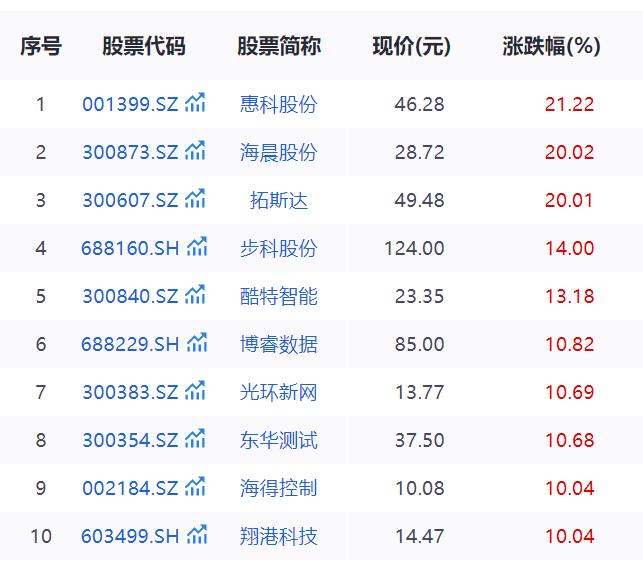
As of the close on July 1, more than a dozen stocks such as Huike Co., Ltd., Haichen Co., Ltd., and Tuosida Co., Ltd. hit the daily limit. Capital voted with real money for the era dividend of new - type industrialization.
The "Golden Age" of the Industrial Internet Has Arrived
Why can a policy set off a market frenzy? The answer lies in the triple resonance of industrial transformation, technological change, and trillions of incremental growth.
In 2017, the country first drew a "three - step" blueprint for the industrial Internet. By 2025, the first - step goal had been exceeded - the scale of the core industry exceeded 1.6 trillion yuan, 1,260 5G factories were built, and the average production capacity of benchmark factories increased by 25% while the production cost decreased by 19%.
When the industry completed the pilot demonstration stage, AI, 5G - A, and computing power networks reconstructed the underlying logic of manufacturing. Shortcomings such as insufficient adaptation in segmented industries and difficulty in releasing the value of industrial data became prominent. A set of systematic new regulations covering infrastructure, technology, applications, and the ecosystem became an inevitable requirement for industrial advancement.
What most attracted the market in the document was a clear and quantifiable growth blueprint. By 2030, the added value of the core industrial Internet industry will exceed 2.5 trillion yuan, creating a nearly trillion - yuan new market; 50,000 industrial 5G private networks will be deployed nationwide, 5 international - level comprehensive platforms will be built, and all 207 industrial sub - categories will achieve digital coverage. By 2035, a globally leading industrial Internet system will be established to fully support the construction of new - type industrialization.
Different from past fragmented support, this policy focuses on the integration of "AI + Industrial Internet" and seizes the opportunity of new - quality productivity. The new regulations propose to promote the integrated construction of industrial computing power networks and industrial networks, build scenarios for the implementation of industrial large - scale models and industrial intelligent agents, and break through industrial data silos relying on the identification and resolution system, so that factory data can be upgraded from simple collection to the core production factors driving production optimization, flexible customization, and green manufacturing.
Previously, industrial digitization mostly stayed at the level of equipment networking and online management. However, the in - depth integration of AI into the core links of production processes, R & D, and design means that the industrial Internet has changed from an "icing on the cake" auxiliary tool to a necessity for the survival and upgrading of manufacturing enterprises.
The policy defines five clear investment lines: 5G industrial private networks will drive the demand for communication modules and network integration; leading industrial platforms will enjoy the dividends of increased concentration; industrial large - scale models and intelligent agents will open up new incremental tracks; industrial data rights confirmation and network security will become mandatory requirements; and the digital transformation of industrial chains and clusters will release the potential of the sinking market.
The industrial Internet is connected to both a manufacturing powerhouse and a network powerhouse, and it is the core foundation for the integration of the real economy and the digital economy. This document is not only a short - term catalyst for the market but also an action plan for the digital transformation of the manufacturing industry in the next decade.
Industrial Ups and Downs and Capital Games in the Digital Wave
As of July 1, 438 industrial Internet concept stocks in the A - share market outlined a complete industrial map.
From the perspective of industry distribution, the penetration of the industrial Internet has long broken through the single - technology track and formed a full - industrial - chain coverage pattern.
The machinery and equipment industry, with 112 stocks, occupies nearly a quarter of the seats and has become the core base for the implementation of the industrial Internet - from industrial robots to intelligent equipment, from precision manufacturing to automated production lines, the digital transformation of traditional mechanical industries is the most solid industrial foundation for the industrial Internet.
Following closely are the computer industry with 75 stocks, the power equipment industry with 42 stocks, and the communication industry with 37 stocks, representing the software foundation, energy scenarios, and communication infrastructure of the industrial Internet respectively.
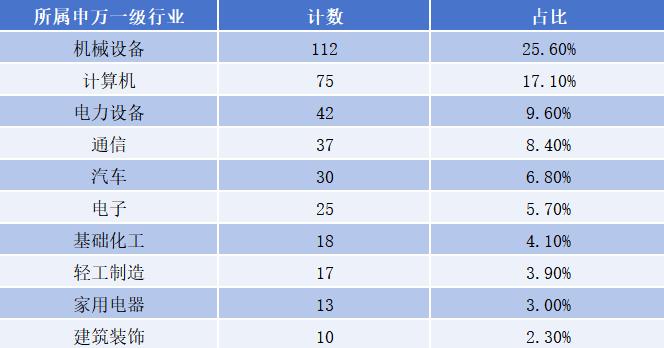
This distribution clearly shows that the industrial Internet is not a single - technology concept but a full - chain industrial revolution covering "hardware - software - network - scenarios", and each link has corresponding listed companies seeking value realization paths in the capital market.
In terms of the regional pattern, the development of the industrial Internet is highly correlated with the regional manufacturing foundation and the level of digital economy development, forming three major clusters centered on the Yangtze River Delta, the Pearl River Delta, and the Beijing - Tianjin - Hebei region.
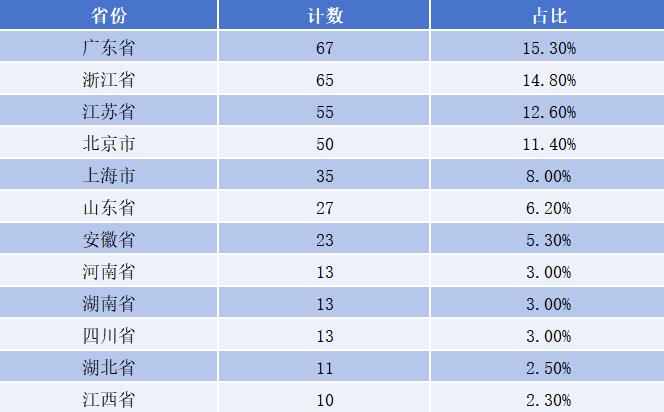
Guangdong Province ranks first with 67 stocks, followed by Zhejiang with 65 stocks and Jiangsu with 55 stocks. Beijing and Shanghai together have 85 stocks, and the number of stocks in these five provinces and municipalities accounts for more than 60%.
Behind this data is the early start of digital transformation in the manufacturing industry in the Pearl River Delta, the in - depth integration of high - end manufacturing and the digital economy in the Yangtze River Delta, and the coordinated implementation of scientific research resources and industrial scenarios in the Beijing - Tianjin - Hebei region.
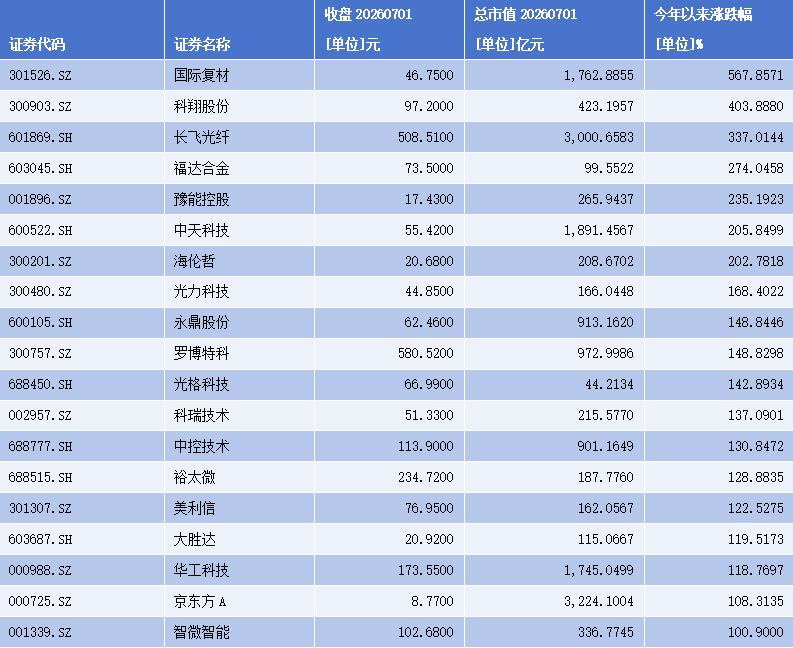
The ups and downs of the capital market are vividly reflected in the rise and fall data. Since the beginning of the year, International Composite has led the way with a 567.86% increase, followed by Kexiang Co., Ltd. and Changfei Fiber Optic Cable Co., Ltd. with increases of 403.89% and 337.01% respectively.
All these stocks with doubled increases have solid industrial support: International Composite's new - material business is deeply integrated with industrial digitization, and Changfei Fiber Optic Cable's computing power network and communication infrastructure have become the core foundation of the digital economy.
It is worth noting Fuchun Dyeing and Weaving. On July 1, the stock hit the daily limit during intraday trading and has touched the daily limit 5 times in the past year. It has a strong capital - game nature and has become a rare target in the industrial Internet sector for traditional manufacturing to cross - border into the lightweighting of humanoid robots.
This company, headquartered in Wuhu, Anhui, is the world's largest cheese yarn dyeing factory and the only listed company in China with cheese yarn as its main business. According to the information disclosed by the company on the Interactive E - platform on May 7, 2026, its PEEK material precision injection - molding project focuses on the lightweighting of humanoid robots and has received sample orders from a planetary reducer company. This means that this textile enterprise, which was originally unconnected with robots, has successfully entered the humanoid robot supply chain through the cross - border application of new - material technology.
Fuchun Dyeing and Weaving's first - quarter report in 2026 was amazing: its revenue was 873 million yuan, a year - on - year increase of 30.32%; its net profit attributable to the parent company was 73.2974 million yuan, a year - on - year surge of 1415.88%. In the future, with the formation of the "dual profit curves of traditional digitalization and robot - related increment", the company's profitability is expected to be further enhanced.