Electric vehicles are getting so huge that they can no longer fit in parking spaces.
"There's a kind of pain called having a neighbor buy a large vehicle." The popularity of this topic on social platforms has remained high.
Clicking in, the screen is full of the bitter experiences of owners in old communities. A neighbor happily gets a large vehicle, but the parking space gap is limited. When opening the car door, there's only a small crack left. One has to climb in and out from the passenger seat and always worry about being hit by an opening door. If both neighbors on the left and right drive SUVs, it's almost impossible to park decently when coming back late. Every day, people are looking forward to car companies quickly popularizing the "automatic parking when leaving the vehicle" function.
"Cars are getting bigger and bigger, and there aren't enough parking spaces." "I often sigh that domestic cars on the road are as big as giants one by one."... Through data collation, DT Business Observation found that these complaints and observations on social media are not isolated cases but a trend happening in the entire industry.

(Image source: Xiaohongshu)
Cars are getting bigger and bigger, and new energy SUVs are the main force
According to the data disclosed by the Passenger Car Association, in 2025, the length and width of most types and classes of cars have increased.
On average, compared with 2023, in 2025, the length of each SUV and MPV has increased by 4 cm on average, and the body width has increased by 1 cm and 2 cm respectively.
Although the average size of sedans has decreased, the size change is "polarized". The A00 and A0 class cars have shrunk significantly, while the ABC class cars are steadily increasing.
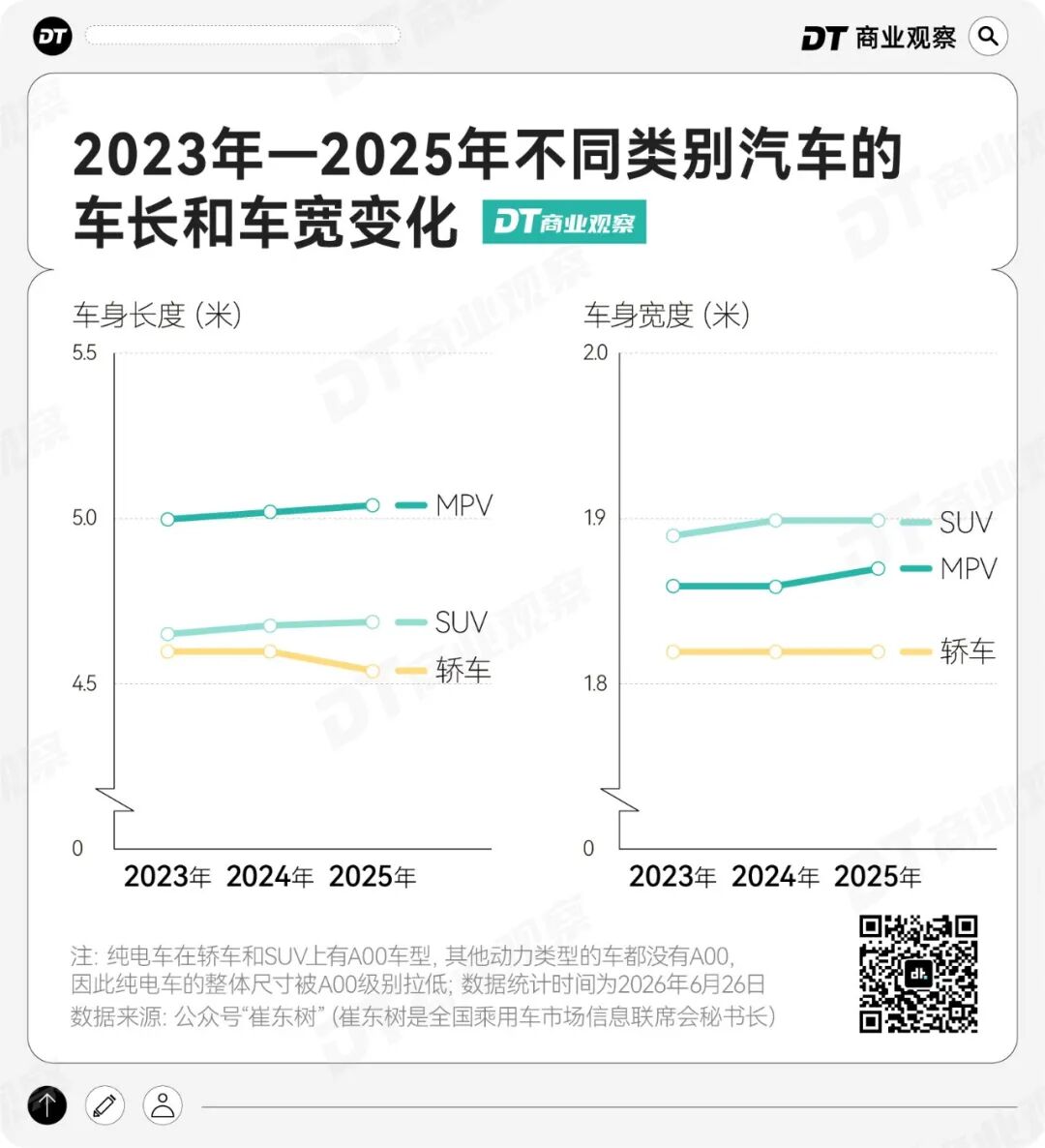
This is not difficult to understand. After all, consumers who choose A0 and A00 class sedans are those with less demand for space. SUVs and MPVs emphasize space and comfort and are often used in business or family travel scenarios. "Space" itself is one of the product features.
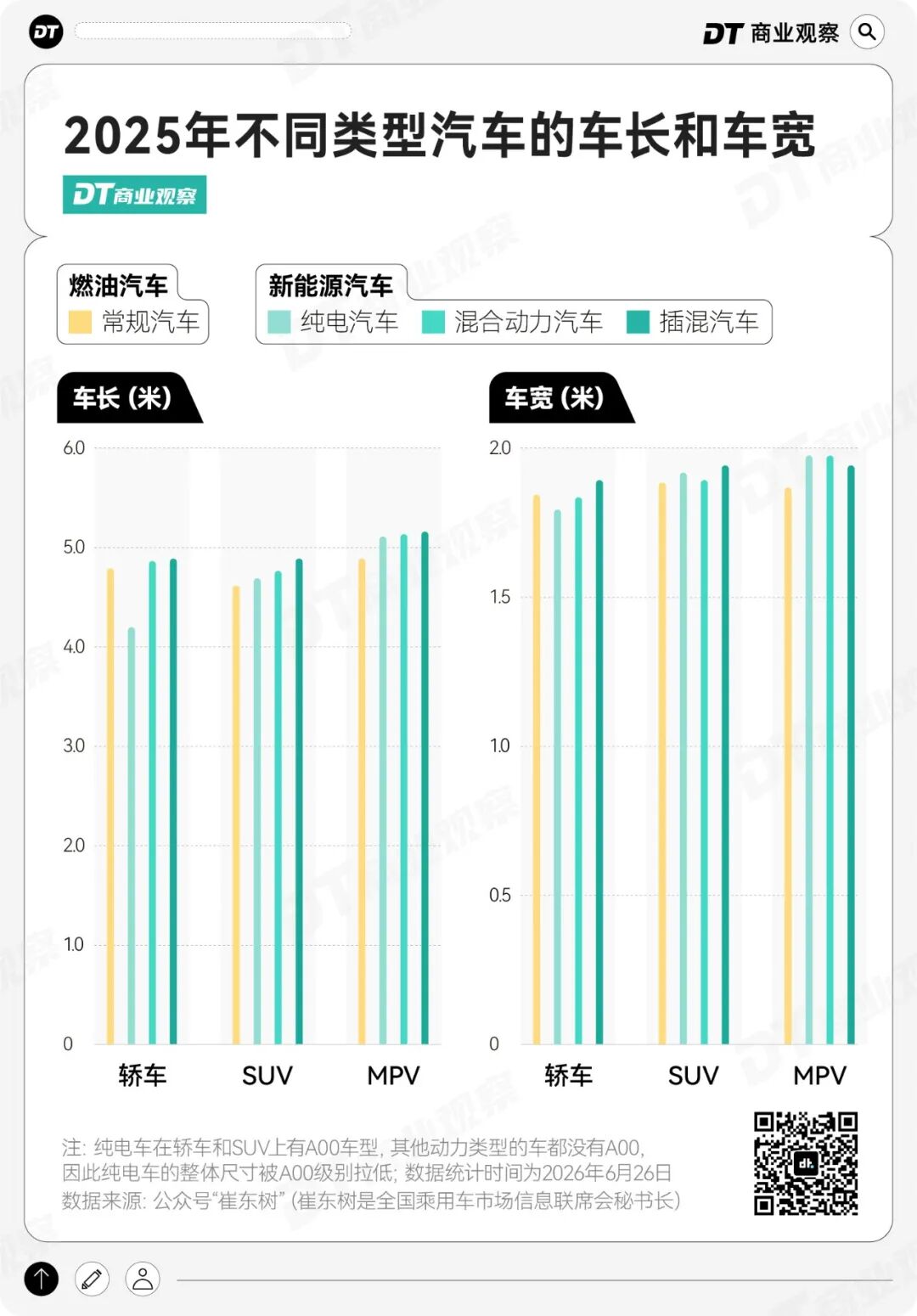
It's worth mentioning that although electric cars don't have the configurations of fuel - powered cars such as engines and gearboxes, the energy density of batteries is significantly lower than that of gasoline. This results in new energy vehicles actually needing more space to hold the batteries.
Therefore, new energy vehicles of the same class tend to be slightly larger in volume than fuel - powered vehicles. For example, among B - class SUVs, the average length of fuel - powered vehicles in 2025 is 4.85 meters, while the average lengths of pure - electric, plug - in hybrid, and hybrid vehicles are 4.86 meters, 4.94 meters, and 4.99 meters respectively.
This also means that in the trend of cars getting bigger and bigger, new energy vehicles are the "biggest of the big".
This year, car companies are still increasing their efforts to build large vehicles.
According to statistics from Caijing, in the first five months of 2026 alone, there were 31 new and redesigned "532" models with a length of over 5 meters, a wheelbase of over 3 meters, and a width close to 2 meters, nearly four times the total number in 2025.
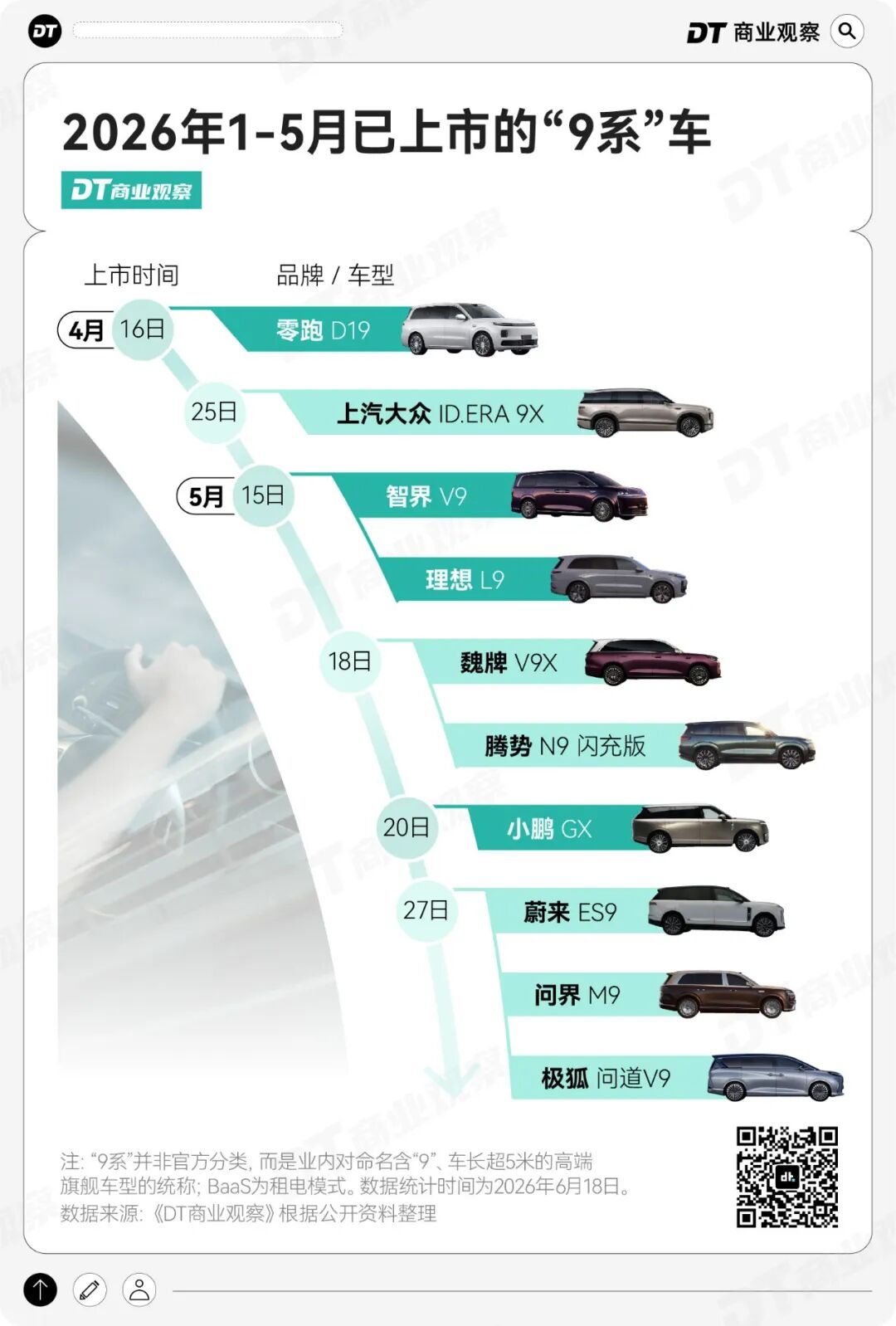
A more intuitive feeling comes from the new cars launched in the first five months of 2026.
In just these five months, there were 10 new "9 - series" cars positioned as high - end and large - sized. Brands have all pushed the size of their flagship models to the extreme.
Some cars are over 5.3 meters long, some are over 2 meters wide, and the wheelbase is generally over 3.1 meters. These figures were at the level of Mercedes - Benz GLS, BMW X7, and the extended - version Range Rover a few years ago.
On June 25th, the Huawei - affiliated company launched the currently largest mass - produced MPV in the world - the Zunjie V800.
It is over 5.4 meters long, over 2 meters wide, and has a wheelbase of over 3.4 meters. All three data have refreshed the size records of mass - produced MPVs, and both the length and wheelbase are the largest among global mass - produced MPVs.
Family travel + range anxiety, there is indeed a market demand for large vehicles
The most direct reason for new energy vehicles getting bigger and bigger is naturally that there are people willing to buy them.
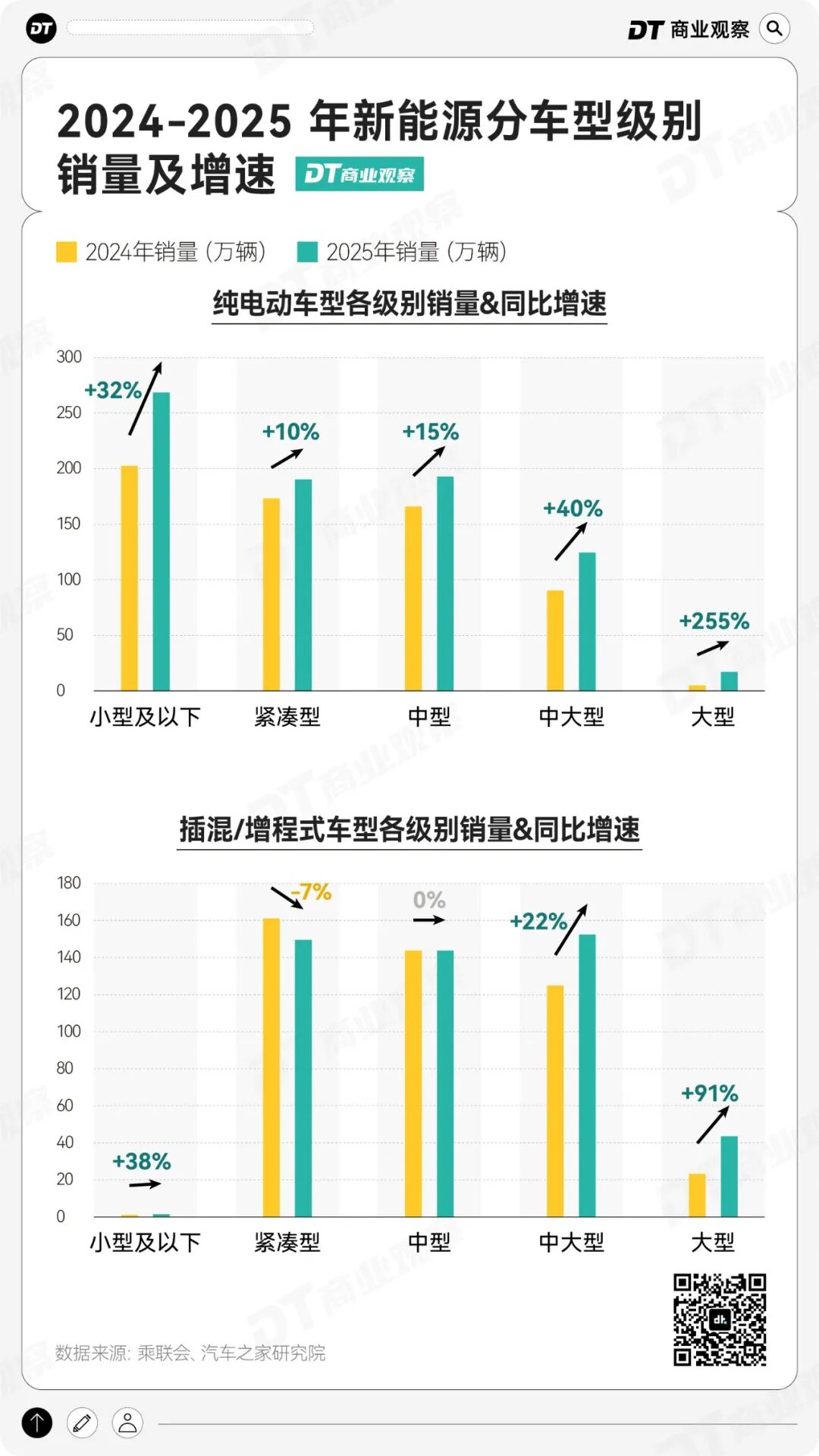
Data from the Passenger Car Association shows that the sales growth of medium - large and large new energy SUVs is very prominent. In 2025, among pure - electric and plug - in hybrid/extended - range vehicles, the sales of medium - large SUVs increased by 40% and 22% year - on - year respectively, and the sales of large SUVs increased by 255% and 91% year - on - year respectively. In the first quarter of this year, 110,000 large SUVs were sold, a year - on - year increase of 169%.
Although to some extent, this is because the sales base of large SUVs is relatively small, it is still enough to show the strong demand.
So, which groups are actually buying these large vehicles?
According to data from the Passenger Car Association, in the first half of 2025, more than 70% of the sales in the medium - large SUV market came from six - seat models. Family users, especially families with two or three children, are the main consumer groups.
Research data from Caixin Think Tank also outlines the daily use of large vehicles. In 2025, the scenarios with relatively high usage of new energy large SUVs are as follows:
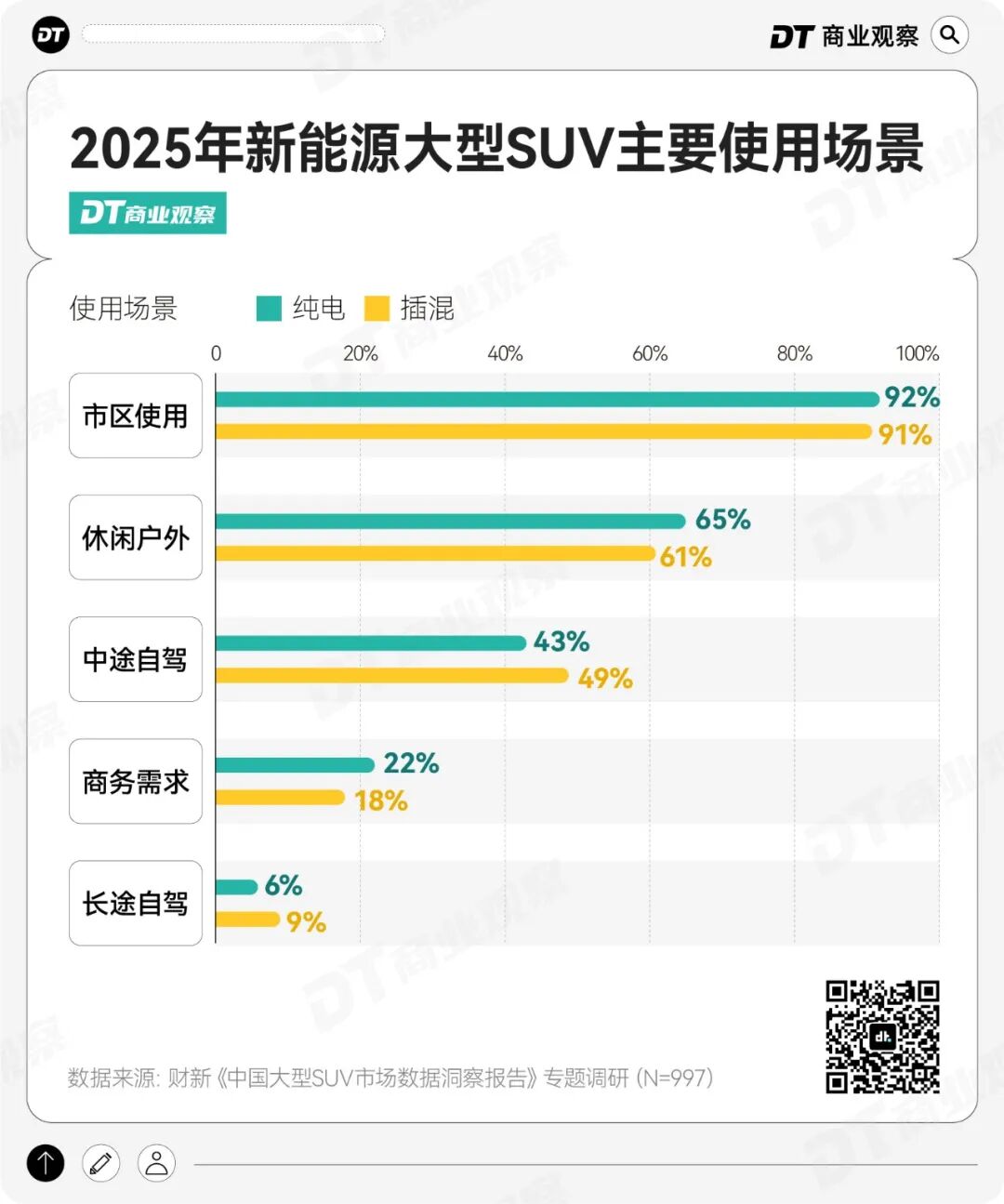
Among them, the scenarios of urban use and leisure outdoors often refer to family cars. For example, picking up and dropping off children, commuting to work, and taking the whole family to the suburbs for camping on weekends. This requires new energy vehicles not only to be able to accommodate the whole family but also to have a certain amount of rear - seat space to hold outdoor supplies.
@Wang Yi usually puts down the back seats of a six - seat car and uses it as a four - seat car in daily life. There are some children's toys in the trunk. But during holidays, the advantage of the six - seat car is brought into play. Even with parents on board, there is still enough space.
In the scenarios of mid - or long - distance self - driving, the vehicle's range ability becomes a hard indicator.
During holidays, there are always real complaints on social platforms such as "traffic jams on the highway and the electric car suddenly breaks down" or "only two kilometers away from the service area, but the battery is already out of power, and one has to call a tow truck". This range anxiety directly forces car companies to continuously install larger battery packs in new energy vehicles.
The "2026 McKinsey China Auto Consumer Insights" report shows that among the key purchase factors of electric vehicles, range and charging time rank first.
Research by the Auto Home Research Institute also found that more than 60% of users hope that the range of pure - electric models can be over 500 kilometers.
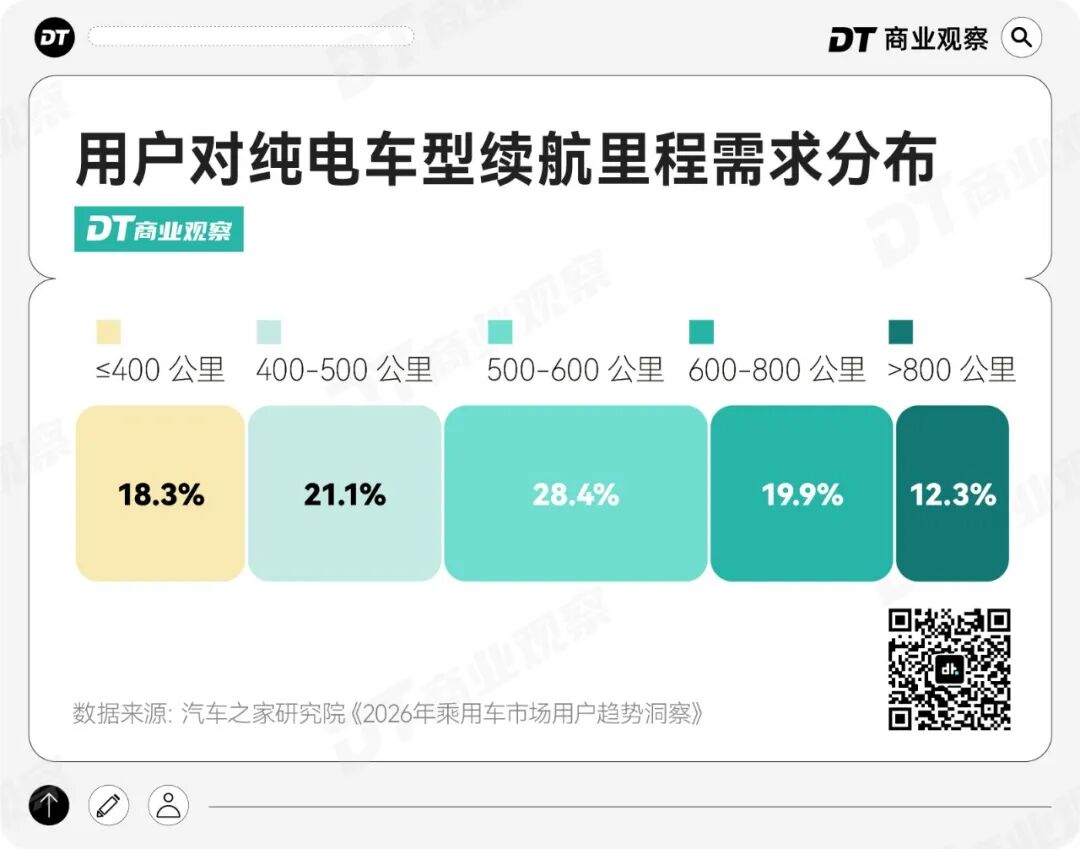
If calculated based on a 500 - kilometer range, the industry's normal situation requires the battery pack to be 110 - 140 mm thick, about the thickness of a Xinhua Dictionary.
Meanwhile, in order to accommodate large - capacity battery packs, the chassis thickness is passively increased, the vehicle's posture is likely to look bulky, and the headroom inside the car will also be squeezed. Considering the balance of visual effects and riding experience, car companies can only increase the overall height of the vehicle synchronously.
Of course, increasing the vehicle's range is not just about "piling up batteries". Improving the energy density of the battery pack, reducing the vehicle's weight, and optimizing the body design to reduce wind resistance are also important ways to increase the range.
But the problem is that for many enterprises, under the dual constraints of R & D cycle and cost, "piling up batteries" may still be the fastest - acting and lowest - risk engineering solution.
The industry's profit margin has fallen below 4%. Selling large vehicles is a more profitable business
In addition to being driven by market demand, car companies actively build large vehicles also out of profit considerations.
According to data from the National Bureau of Statistics, the profit margin of the automotive industry fell to 4.1% in 2025 and further dropped to 3.2% in the first quarter of 2026, far lower than the average level of industrial enterprises above the designated size in the country (about 4.9%).
Most compact models have compressed costs to the limit and can hardly make money. In this case, "large vehicles" have become an important support for brands to obtain profits.
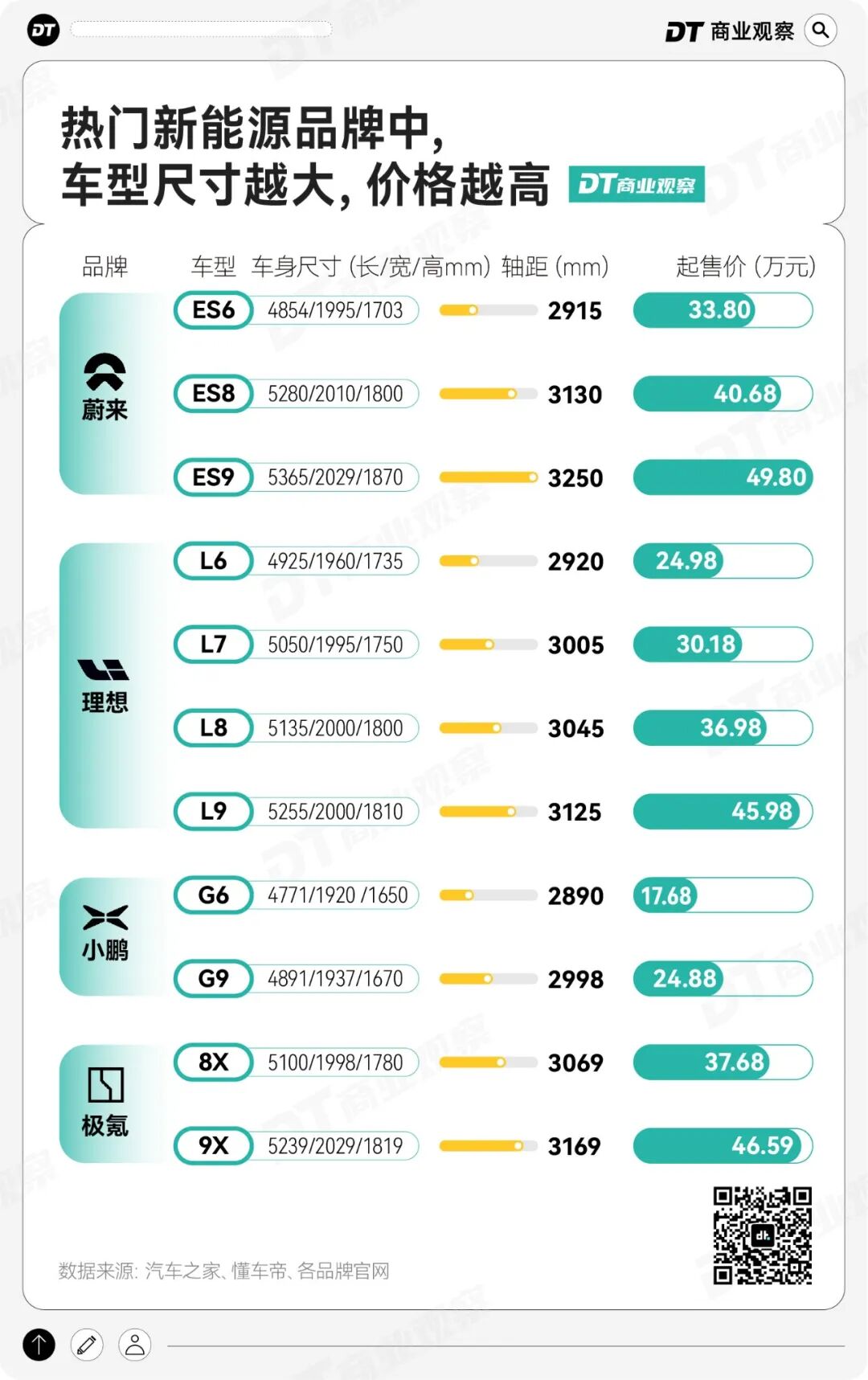
Through comparing cars of popular new energy brands, DT Business Observation found that within the same brand, the larger the vehicle size, the wider the pricing space and the higher the corresponding profit margin.
The NIO ES6 is sold for 338,000 yuan, and the ES9 is sold for 498,000 yuan. The starting price of the Li L6 is 249,800 yuan, and the L9 is priced at 459,800 yuan. The situations of XPeng and Zeekr are similar. From the small - sized to the large - sized models, the prices keep rising.
NIO achieved its first quarterly profit in the fourth quarter of 2025, and the gross profit margin of the whole vehicle reached 18.1%. The biggest contributor behind this is the ES8. This flagship model with an average price of over 400,000 yuan delivered nearly 40,000 vehicles in that quarter, accounting for about 30% of the total sales, and the gross profit margin per vehicle was close to 25%.
In the first quarter of 2026, NIO's gross profit margin of the whole vehicle further increased to 18.8%, reaching a new high in the past four years. The Wenjie M9 is also a profit pillar. The 2025 financial report shows that the gross profit margin of SERES' new energy vehicle business reached 28.76%.
It can be said that large size is the most intuitive physical basis to support the "high - end" and "premium" of automobile brands. To some extent, it is even an inevitable choice for brands to stay in the game.
The cost of "large" vehicles
Although large vehicles have a sharp increase in sales and high profits, there is also a cost behind them.
For consumers, the most direct pain point is parking, as mentioned above. According to the current "Code for Design of Garage Buildings", the standard parking space size for small motor vehicles is 2.4 meters wide and 5.3 meters long.
It should be noted that the 2.4 meters here refers to the distance between the centerlines of the markings of adjacent parking spaces, not the net usable width of the parking space. After the actual marking, the available space inside the white lines on both sides is often only 2.1 to 2.3 meters.
When a new energy vehicle with a width close to or even over 2 meters is parked in, the remaining space on both sides can almost be ignored. After parking, in the best - case scenario, the door can only be opened a small crack, and people have to squeeze out sideways. In the worst - case scenario, they have to get out from the passenger seat.
Multi - level mechanical garages are even more troublesome. The normal width limit is only 1.9 meters, and the weight limit is 2000 kilograms. The curb weights of popular medium - large new energy SUVs on the market generally exceed 2.4 tons. Not to mention whether the width can fit in, they are first excluded by the weight limit.
Driving is also not easy. Cars over 5 meters long and nearly 2 meters wide need to be extra careful when meeting other cars on narrow roads, which is a great test for novice drivers.
For the industry, there are also many problems.
A large number of brands are flocking to the 5 - meter - class track, and the vehicle sizes, configurations, and functions are highly similar. The competition can only be limited to superficial configurations such as large screens, refrigerators, and seats. In the view of fuel - car user @Wu Qi, car companies' mass - production of large vehicles now is like mobile phone brands competing for large screens and multiple cameras in the past. If a brand doesn't have these features, it seems to be left behind, but they are all the same, and