SemiAnalysis: The Dual Realities of Nvidia's Rubin Platform
The semiconductor research institution SemiAnalysis has successively released two judgments, outlining the "ice and fire" sides of opportunities and challenges in NVIDIA's future.
The latest forecast released by SemiAnalysis on the X platform on June 30 shows that NVIDIA's revenue from its data center computing business in the second half of fiscal year 2027 will be about 20% higher than the Wall Street consensus estimate. The core support for this optimistic judgment lies in the resolution of the HBM4 memory supply issue that previously restricted the large - scale shipment of the Rubin platform. Meanwhile, the front - end wafer production capacity has been reserved, clearing substantial obstacles for the performance explosion in the second half of the year.
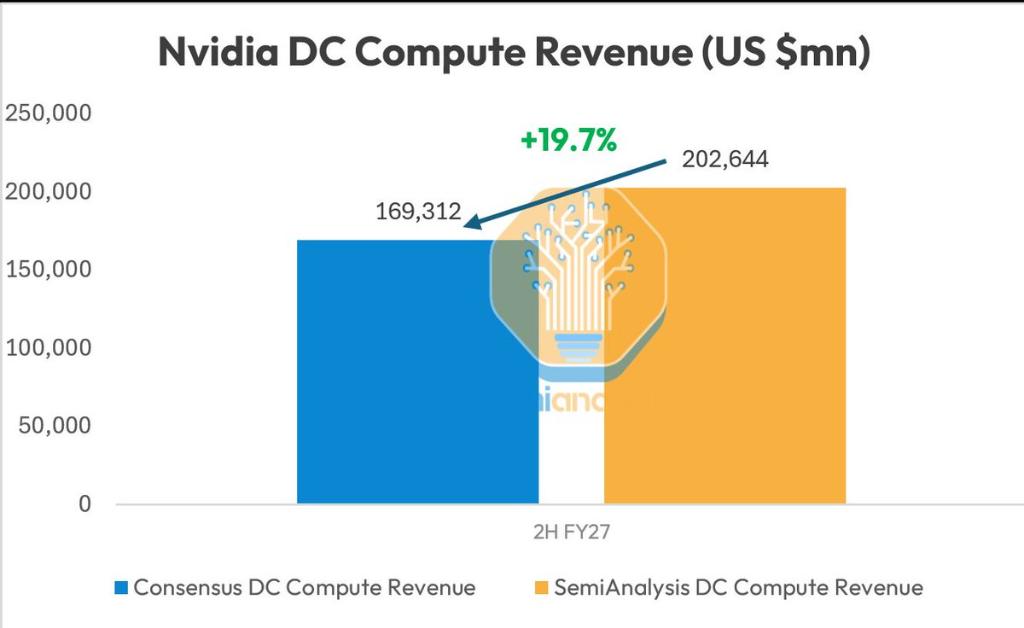
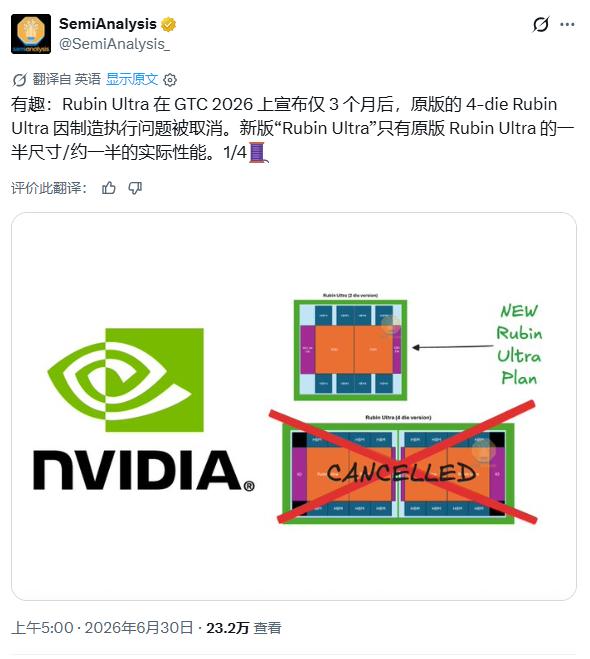
However, in the morning of the same day, SemiAnalysis disclosed another piece of negative news: About three months after its release at GTC 2026, NVIDIA's original 4 - chip Rubin Ultra was cancelled. The size of the new version of "Rubin Ultra" has been reduced to half of the original, and its actual performance has also been halved.
On one hand, there is an optimistic upward revision of revenue after the supply bottleneck is lifted; on the other hand, there is a pessimistic correction of the technical route after the flagship product is downsized. These two diametrically opposite judgments from SemiAnalysis have set completely different narrative coordinates for NVIDIA from the two dimensions of performance realization ability and technical moat.
01 The HBM4 bottleneck has been resolved, and the Rubin platform is expected to see large - scale shipments in the second half of the year
SemiAnalysis made the latest forecast through its Accelerator Model, indicating that NVIDIA will experience a large - scale expansion in the second half of this year.
The institution predicts that driven by the strong performance of the Rubin platform, NVIDIA's revenue from its data center computing business in the second half of fiscal year 2027 will be about 20% higher than the market consensus estimate. The HBM4 issue that once affected the progress of Rubin has now been resolved, and the front - end wafer supply has been reserved in advance. This means that the previously postponed Rubin platform will enter a rapid growth stage.
SemiAnalysis specifically pointed out that the logic of its forecast is significantly different from that of traditional sell - side analysts. Most Wall Street institutions tend to establish relatively conservative profit forecasts to leave room for companies' subsequent "better - than - expected" performance, while SemiAnalysis's conclusions are more based on first - hand research in the industrial chain, aiming to be closer to the real market dynamics.
Its Accelerator Model has built a cross - verification system of information covering the entire chain. The data sources cover supply chain links such as material suppliers, wafer manufacturing, key components, and server manufacturers. At the same time, it combines the actual procurement and deployment situations of large - scale cloud service providers and cutting - edge AI laboratories to conduct multi - dimensional verifications on the supply - demand relationship.
It is worth noting that this model not only focuses on NVIDIA but also covers AI chip manufacturers such as Broadcom, AMD, MediaTek, and Marvell, and continuously tracks the overall evolution of the AI computing power industrial chain in combination with the HBM Model.
02 The CUDA moat is being eroded, and the downsizing of Rubin Ultra reflects the rise of self - developed ASICs
However, another comment from SemiAnalysis about Rubin Ultra previously triggered extensive discussions in the market.
The institution said that NVIDIA originally planned to design the Rubin Ultra with 4 computing chips. About three months after its release at this year's GTC, the original plan was adjusted, and the scale of the new version was significantly reduced compared with the original design, which is related to the difficulty of advanced packaging manufacturing.
SemiAnalysis believes that what is more worthy of attention is not the downsizing of Rubin Ultra itself, but the change in the industrial competition pattern reflected by this event. The institution pointed out that in the past year, NVIDIA's greatest competitive pressure no longer comes only from traditional GPU manufacturers such as AMD, but more and more large - scale cloud providers and AI model companies are starting to use self - developed ASICs to build dedicated chip systems for specific scenarios such as training or inference.
For example, Anthropic has currently formed a multi - platform computing power architecture composed of Google TPU, Amazon Trainium, and NVIDIA GPUs. Among them, a large number of Claude model training runs on the TPU platform, and more and more Claude Code inferences are deployed on Trainium, while NVIDIA GPUs mainly undertake general computing tasks such as cutting - edge research. SemiAnalysis pointed out that it was unimaginable a year ago that TPU and Trainium could grow to their current scale, and now the CUDA moat is being slowly eroded.
This article is from the WeChat official account "Hard AI", author: Focused on technology R & D. It is published by 36Kr with authorization.