With profit margins below 5%, but patent royalties as high as 10%: Can the smart terminal industry withstand the pressure?
In the grand narrative of the global technology industry, smart terminals have always been the most dynamic and ruthless battleground. Currently, the global communication industry is entering the deep - water zone of 5G and accelerating its evolution towards 5.5G and even 6G. Recently, the rulings of a series of patent licensing lawsuits between ZTE and Samsung in multiple regions around the world have been released one after another, attracting high - level attention from the entire technology manufacturing industry.
For the industry, although there are some positive developments, such as German courts beginning to handle the royalty rate issue cautiously (albeit from the perspective of FRAND trials and settlement suggestions), and Chinese and British courts continuing to hear cases related to royalty rates. However, it is not difficult to find that parallel judgments made by relevant courts in different jurisdictions on almost the same cases show significant differences in both the final royalty rate ranges determined and the handling of key issues. Some fact - finding methods and judgment results in the licensing disputes of Standard Essential Patents (SEP) are inevitably transmitting huge survival pressures to the industrial chain.
The increasingly severe royalty rate stacking, the drastic fluctuations in business expectations, and the superimposed effect brought about by the transformation of former industrial entities into Non - Practicing Entities (NPEs) are gradually converging into a Damocles sword hanging over the entire smart terminal industrial chain. This is not only related to the financial statements of two multinational giants but also concerns the vital interests of hundreds of thousands of upstream and downstream enterprises, millions of practitioners, and end - consumers around the world. The smart terminal industry is facing an unprecedented "life - and - death test."
01 Intensifying Royalty Rate Stacking: High Costs and Increasing Pressure on Hardware Manufacturers
In the current field of smart terminals such as smartphones, patent licensing has become an extremely complex "journey through the technological jungle." A smartphone not only needs to implement 2G/3G/4G/5G cellular communication standards but also must be compatible with short - range communication standards such as Wi - Fi, Bluetooth, and NFC, as well as audio - video codec standards such as HEVC/VVC and AV1. Behind each standard, there are dozens or even hundreds of right - holders or patent pools claiming to own Standard Essential Patents (SEP).
Royalty Rate Stacking: The Unbearable Theoretical Upper Limit
Currently, the main standards for which smartphones need to pay patent fees include:
Cellular Communication Standards: According to the publicly announced 5G royalty rate statements of major patent holders (such as Nokia, Ericsson, and Qualcomm), the cumulative licensing fee for a single 5G mobile phone can reach an upper limit of $15 - 20.
Wi - Fi Standards: With the popularization of Wi - Fi 6/7, relevant patent pools (such as the Sisvel Wi - Fi 6 patent pool) and independent right - holders have all claimed fees, with the royalty rate for a single device ranging from $0.5 to $2.
Audio - Video Codec Standards: There are multiple patent pools (such as MPEG LA, HEVC Advance, and Velos Media) and independent NPEs behind standards such as HEVC (H.265), VVC (H.266), and AV1, and the cumulative royalty rate can reach $1.5 to $3.
Other Standards: Including Bluetooth, NFC, wireless charging (Qi standard), etc.
If the upper limits of the royalty rates unilaterally claimed by these right - holders are simply added up, the total theoretical patent fees for a mid - to - low - end smartphone with a selling price of $200 - 300 may account for 10% to 15% of the total selling price of the device, or even higher. From the relevant judgment results of the recent ZTE - Samsung case, whether it is the 7.8% - 8.5% based on the robustness test under the hedonic price regression model or the 8% directly recognized by some overseas courts based on the claims of the right - holders, the cumulative royalty rate for the 5G cellular communication standard alone is already at a high level. When the judgment objectively confirms or accepts such a high single - item licensing fee rate, it undoubtedly exacerbates the real - world pressure of royalty rate stacking (Royalty Stacking) and further transfers it to the sales price, imposing potential additional burdens on consumers. The cumulative royalty rates for the 5G standard in the relevant court judgments of the ZTE - Samsung case are as follows:
Cumulative Royalty Rates for the 5G Communication Standard Industry:
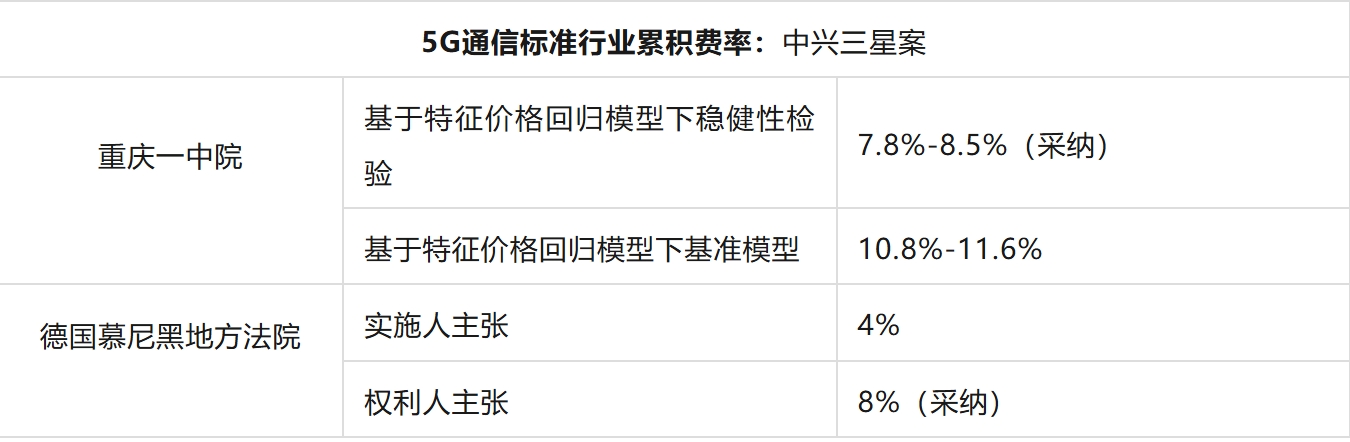
The cumulative royalty rate ranges for the 5G cellular communication standard in Germany and China are between 7.8% and 11.6%. Considering standards such as Wi - Fi and audio - video, the total cumulative royalty rate for smartphones will obviously exceed 10%, and may reach 15% or even 20%. This not only deviates from the commercial reality of the industry but also violates the fair and reasonable original intention of the FRAND principle.
The Era of Slim Profits: Shrinking Survival Space
In sharp contrast to the high - profile patent royalty rate claims is the extremely thin profit margin of the smart terminal manufacturing industry.
According to data from market research institutions such as Counterpoint, in the global smartphone market, except for a very small number of leading enterprises such as Apple, which enjoy high brand premiums, the comprehensive net profit margins of the hardware of the vast majority of terminal manufacturers in the Android camp (including Samsung's mid - to - low - end product lines and other domestic mobile phone brands) have long hovered below 5%, and in many cases, they are on the verge of break - even. Recently, Apple adjusted the prices of its product series due to the sharp increase in memory prices, which shows that even a giant like Apple has difficulty digesting the drastic changes in upstream costs. However, not every manufacturer has the ability to easily transfer cost changes to consumers. Similarly, manufacturers also have difficulty digesting or transferring the significant changes and uncertainties in patent licensing fees to consumers on their own.
Pricing Imbalance: The Urgent Need to Return to Commercial Reality
In the current resolution of patent disputes, in addition to considering the "willingness" of implementers and their unilateral behavior and financial performance, it is also necessary to conduct a comprehensive assessment of whether the royalty rates claimed by right - holders will lead to "royalty rate stacking." Reasonable judicial pricing should be based on commercial reality. It is difficult for terminal manufacturers to easily transfer such significant hidden cost changes to price - sensitive consumers.
Ignoring the profit situation of the terminal industry, especially that of manufacturers in a highly competitive environment who have achieved extreme cost control through lean operations, will ultimately crush the industrial entities that are the carriers of innovation. When the average profit margin of an industry is less than 5%, and the fluctuation range and magnitude of the cumulative patent licensing fees far exceed this figure, this is no longer just a matter of "profit distribution," but more about the healthy and sustainable development of industrial entities. Without a prosperous terminal industry, the upstream patent technologies will lose the soil for monetization. When determining royalty rates, if judicial judgments can keenly observe this commercial reality, carefully evaluate high - rate claims that deviate from industry reality, and balance the interests of all parties through a reasonable judicial pricing mechanism, it will help avoid the "killing the goose that lays the golden eggs" dilemma and safeguard the symbiotic and prosperous innovation ecosystem of the upstream and downstream industries.
02 Frequent Approval of Top - Level Royalty Rates: Disordered Expectations and Challenges for Industrial Planning
The core value of laws and business rules lies in their predictability and certainty. For heavy - asset, long - cycle, and extremely complex supply - chain manufacturing enterprises, only in an environment with stable expectations can they carry out long - term business planning and R & D investment. However, in the current practice of SEP litigation judgments, some royalty rate determination methods are bringing great uncertainties to the industry.
The Chain Reaction Caused by Adopting the "Upper - Limit Royalty Rate": Breaking the Natural Boundary of the Game
In the rulings related to FRAND royalty rates, determining a "reasonable" royalty rate is a world - class problem. German courts did not analyze or discuss the core issue of the cumulative royalty rate in their judgments and easily adopted the "upper - limit royalty rate" claimed by the right - holders directly. The court stated that "based on the investigation results of the previous procedure, the committee believes that an 8% royalty rate should be applied," and its reasoning logic seems to be a black box.
From the perspective of industrial economics, if the overall industry's bearing capacity is not comprehensively calculated and the various assumptions of the top - down approach are not rigorously tested under commercial pressure, directly using the high - end quotes of right - holders as the judgment benchmark will objectively break the original business game boundary. Once this determination method forms a demonstration effect, it will prompt global patent holders to adopt more aggressive quoting strategies in future negotiations because they expect that even if the case goes to litigation, there is a high probability of obtaining the endorsement of a high - level royalty rate. This "ratchet effect" (the royalty rate can only go up and not down) will make the intellectual property costs of the entire industry show an irreversible unilateral upward trend.
The Drastic Compression of Business Negotiation Space: The Uncontrollable Risk of Cost Expectations
The frequent approval of high - level royalty rates sends a strong signal to the market, further widening the power gap at the negotiation table. If judicial judgments can penetrate and review the rationality of royalty rates based on commercial reality, it will help maintain the real logic of market transactions and prevent the industry from falling into a vicious cycle. Under the deterrence of the injunction procedure, in addition to considering the performance of implementers in the negotiation process, it is also crucial to conduct a substantial and in - depth economic review of the "historical comparable agreements" provided by right - holders and their "upper - limit royalty rates."
If the upper - limit royalty rate claimed by the right - holder is directly adopted and an injunction is issued only because of some processing flow defects of the implementer, it may significantly compress the space for the implementer to conduct a substantial defense on the rationality of the royalty rate, thereby affecting the certainty of legal expectations. This model is likely to send a one - sided signal to the market, making some right - holders tend to raise their quotes, trying to obtain high - price endorsements through litigation strategies rather than the real commercial value of the technology itself. This will make it difficult for implementers to have an equal space for discussion in actual negotiations and to clarify the boundary of reasonable games. Eventually, they will be in a dilemma of either accepting an excessively high quote or facing the risk of an injunction.
03 Selective Adoption of Business Agreements: Mechanism Bias and Imbalance of the Global Business Ecosystem
The essence of the intellectual property system is a precise interest - balancing mechanism. It should not only give innovators sufficient rewards to encourage continuous R & D but also ensure that the public and implementers can obtain the application of technology at a reasonable cost, thereby promoting industrial prosperity. However, from the conclusions of some recent multinational litigation judgments, the balance mechanism of the global licensing ecosystem is facing a severe test.
The Imbalanced Agreement under the Threat of an Injunction: A Distorted "Reasonable" Reference System
In the judicial practice of some jurisdictions, the requirement for the "good faith" of implementers is extremely high. A slight hesitation or procedural defect may lead to the complete ban on the sale of products. On the contrary, the review of whether the quotes of right - holders comply with the FRAND principle is relatively lenient. This double - sided bias in procedure and substance makes the balance severely tilt towards the patent holders. When German courts recently turned their attention to the royalty rate issue cautiously, this imbalance still exists significantly. In the handling of some specific issues, it seems to be an objective analysis of certain problems, but in fact, it favors the right - holders. For example, denying the view that only those with proper patent layouts in the place of production and sales are entitled to collect licensing fees on the grounds that it may lead to an unnecessary patent race is inconsistent with the basic logic of the territoriality of patent protection. In essence, it expands the actual scope of rights of right - holders and is more beneficial to them. Another example is the adoption of the cumulative royalty rate. It is pointed out that implementers generally recognize 4% and right - holders generally recognize 8%, so 8% is adopted without sufficient analysis and explanation from the court itself, which also reflects the imbalanced position of the German court in favor of right - holders. In addition, in the ZTE - Samsung case, the German court believes that when the price is low due to historical negotiation factors (ZTE was under sanctions), relevant factors need to be excluded. However, it does not point out whether contracts signed by implementers under the threat of an injunction or due to inexperience in negotiation should also have the impact excluded. The German court is well - known for its efficient injunction - issuing mechanism. The licensing agreements reached under such extreme pressure often have distorted royalty rates that do not reflect the real technical value of the patents. These distorted "historical comparable agreements" full of compromise and helplessness are used by right - holders as evidence to prove the "reasonableness" of their royalty rates. This asymmetric treatment also reflects the imbalance in the German judicial judgments towards implementers and right - holders.
Dual Treatment of Reference Standards: Benchmark Calculation Deviating from the Overall Industry Picture
Judiciary should be the decisive force in reshaping this balance. When hearing such cases, courts must introduce more scientific and refined economic analysis methods. When applying the top - down approach, some assumptions should be strictly reviewed and adjusted to ensure the flexibility of the application of relevant methods and the commercial rationality of the application results. Only through this "precise balance" can the royalty rate stacking be effectively curbed and the harmonious coexistence of the interests of all parties be ensured. A more delicate balance is not only about the balance between right - holders and implementers but also requires equal treatment of the interests of different jurisdictions, regions, and entities. Judicial pricing should fully respect and carefully consider the real business logic and industrial status of major global manufacturing countries and consumer markets, avoiding artificially raising the global SEP licensing royalty rate benchmark due to the limitation of a single perspective.
04 Former Giants Turned Hunters: Model Alienation and Worsening Dilemma of One - Way Charging
If there was a "cross - license" buffer mechanism for mutual restraint in the patent game between traditional communication giants, in recent years, the transformation of a large number of "former industrial entities" into NPEs (Non - Practicing Entities), catalyzed by the current high - rate judgment trend, has further deteriorated the industrial environment and become another heavy burden on manufacturing enterprises.
The Collapse of the Mutual Restraint Mechanism: From "Cross - License" to "One - Way Harvesting"
Companies represented by BlackBerry were once pioneers and hardware manufacturing giants in the smartphone era. However, after losing in the market competition and exiting the terminal hardware manufacturing market, their large patent portfolios have become tools for them to obtain benefits.
These companies either spin off their patents or directly transform into pure patent operation companies and initiate lawsuits everywhere. When they were industrial entities, they were both patent holders and implementers. When negotiating with other giants (such as Samsung), both parties could offset most of the licensing fees through patent cross - licensing, thus keeping the actual cash payment within a reasonable range. However, after they exited the hardware market and completely became NPEs, this mutual restraint mechanism instantly collapsed. NPEs no longer produce any physical products and therefore do not need to implement any patents of others. Their only demand is to maximize cash returns. This "one - way charging" model of "the bare - footed are not afraid of the shoed" makes terminal manufacturers completely lose their bargaining chips at the negotiation table, and the original ecological balance is completely broken.
"Breaking into Pieces" Driving up Overall Costs: Patent Privateering and Transaction Frictions
The transformation of former industrial entities into NPEs has made the problem of royalty rate stacking even worse. To maximize their interests, they often adopt the strategy of "patent privateering," splitting patent packages and selling them to multiple different NPEs or entrusting them to different patent pools for operation. This "breaking into pieces" strategy is extremely smart commercially but highly destructive to the industry. It not only increases the negotiation costs and litigation response costs of terminal manufacturers but also makes the licensing fees originally belonging to one company be repeatedly calculated multiple times, skillfully bypassing the industry's tacit understanding of the upper and lower limits of the royalty rate for a single entity.
05 Suggestions: Calling for a Global Perspective to Bring Patent Licensing Back to Commercial Rationality
The series of patent royalty rate cases between ZTE and Samsung are by no means just a commercial friction between two multinational giants. They are a microcosm of the global technology industry in the period of reshaping intellectual property rules. The original intention of intellectual property protection is to encourage innovation. This goal should not be divorced from the real commercial soil, and "royalty rate stacking" and excessive claims by NPEs should not become an unbearable burden for the industry. The "devils" in the details of patent pricing are quietly eroding the already thin profits of terminal manufacturing and may even shake the healthy foundation of the entire smart terminal ecosystem.