400 billion DeepSeek, how to spend the 50 billion raised?
On the evening of June 29, DeepSeek announced that the official version of V4 would be officially launched in mid-July.
The announcement stated that in order to allocate resources more reasonably and improve service stability, the API pricing strategy will be adjusted synchronously after the release of the official version, and a peak-valley pricing mechanism will be introduced.
In the past two weeks, there have been two other major events related to DeepSeek:
First, on June 16, DeepSeek completed its first round of external financing since its establishment, raising a total of 51 billion yuan. Its valuation is nearly 400 billion yuan, breaking the principle set by founder Liang Wenfeng of "no financing, no listing, and no commercialization".
Second, just over a dozen days after the financing, on June 27, the DeepSeek team jointly published a paper titled "DSpark: Confidence-Scheduled Speculative Decoding with Semi-Autoregressive Generation" with Peking University. Founder Liang Wenfeng is on the list of authors.
If the task of the first half of DeepSeek was to prove that it could develop a world-class large model, in the second half, when "capital" and "technology" converge, DeepSeek has to use the financing money to prove to the world that it is a truly commercial company.
After 50 billion yuan in financing, DeepSeek starts to recruit more people
Since the financing, Cui Tianyi, the new head of the DeepSeek Harness team, has been extremely busy.
On the evening of June 25, DeepSeek posted large-scale recruitment information on social platforms, covering 7 major categories including algorithms, R & D, operation and maintenance, products, data engineers, and functional departments, with a total of 33 positions. The work locations include Beijing and Hangzhou, and all positions accept interns.
On various social platforms such as DeepSeek's official website and official account, Boss Zhipin, X, and Xiaohongshu, you can see this alumnus of Liang Wenfeng from Zhejiang University, who joined the team in March this year, actively recruiting and taking the time to "refute rumors".
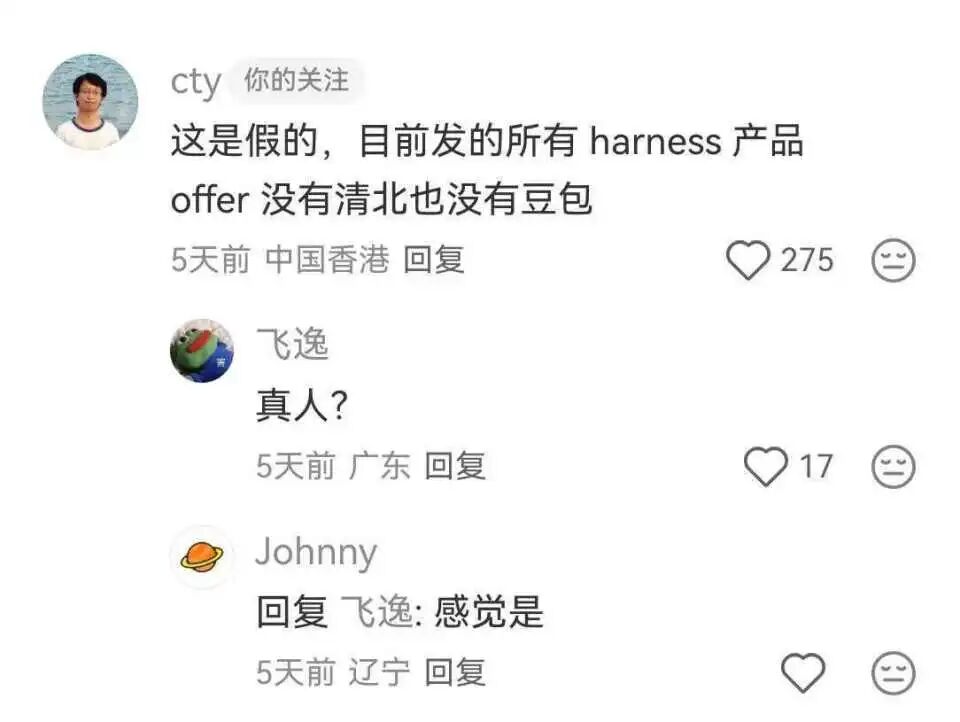
This is a screenshot of Cui Tianyi responding on Xiaohongshu to the comment that "DeepSeek only recruits people with Tsinghua-level education and experience with Doubao".
Previously, DeepSeek was more like a silent, low-key technician working quietly, backed by the quantitative private equity fund "Magic Square Quant" founded by Liang Wenfeng. Magic Square Quant had an annualized return rate of 56.55% in 2025 and managed assets of over 70 billion yuan, which meant that DeepSeek did not need to rely on external capital.
In the eyes of the outside world, DeepSeek seemed "not short of money".
The potential reason for Liang Wenfeng to change his attitude towards financing may be the loss of core talents and the intensifying talent war in the market.
As a reference, Zhipu, the "first large model stock" that has been listed, had a total market value of nearly HK$1 trillion as of June 30, and the market value of MiniMax also exceeded HK$130 billion.
In contrast, the stock options in the hands of DeepSeek's employees are still worthless. The company has no external financing, no listing, and no external valuation reference.
"Without financing, its valuation won't increase. Even if employees have stock options, their value won't rise. Compared with Zhipu, MiniMax, and some other large model teams, whose valuations have skyrocketed or will skyrocket after listing, it's certain that DeepSeek will lose its employees," said a senior industry insider close to DeepSeek when talking about the reason for financing at this juncture.
The cost of retaining talents is also a significant expense.
In 2025, DeepSeek's greatest competitive advantage came from a team of over a hundred highly educated "geniuses". Dozens of top researchers, together with the founder Liang Wenfeng, who has a strong sense of technological idealism, created DeepSeek - R1.
This year, on one hand, major Internet companies are continuously offering high salaries to "poach" top AI researchers. On the other hand, the market demand for AI talents has soared. Public data shows that the median monthly salary for algorithm positions generally exceeds 24,000 yuan, and the monthly salary of top talents exceeds 50,000 yuan. The premium for AI talents continues to expand.
Among the positions in this large-scale recruitment, in addition to full-stack development/algorithms, AI core system R & D, operation and maintenance, and products, it is worth noting that functional departments such as HR, legal, finance, procurement, and administration are also expanding.
The signal released by the all-round "expansion" is that DeepSeek is still improving its organizational capabilities as a technology company.
Transitioning from "product-driven" to "organization-driven" is also an inevitable path for many technology companies. After the organization matures, the platform improves, and the talent incentive mechanism is established, large-scale product dividends will begin to be released.
Completing the 50 billion yuan financing is, on one hand, necessary to retain talents, and on the other hand, provides the basic conditions for improving the organizational structure. However, in this process, can DeepSeek "turn around lightly" and still maintain the efficiency of a "small team operation" and the flexibility of the decision-making chain after the expansion? This is the first question that DeepSeek needs to answer in the "second half".
DeepSeek moves towards heavy assets
Among the 33 positions in the recruitment information posted on June 25, some positions are worthy of attention, namely the IDC (Internet Data Center) data center team, which is involved in infrastructure construction.
As early as mid-April, DeepSeek posted its first batch of data center positions in Ulanqab, Inner Mongolia, including senior data center operation and maintenance engineers and senior data center delivery managers. In June, DeepSeek added the position of "IDC design and planning engineer".
From data center operation and maintenance, delivery to design and planning, since this year, DeepSeek's talent layout has extended from models to computing power infrastructure construction.
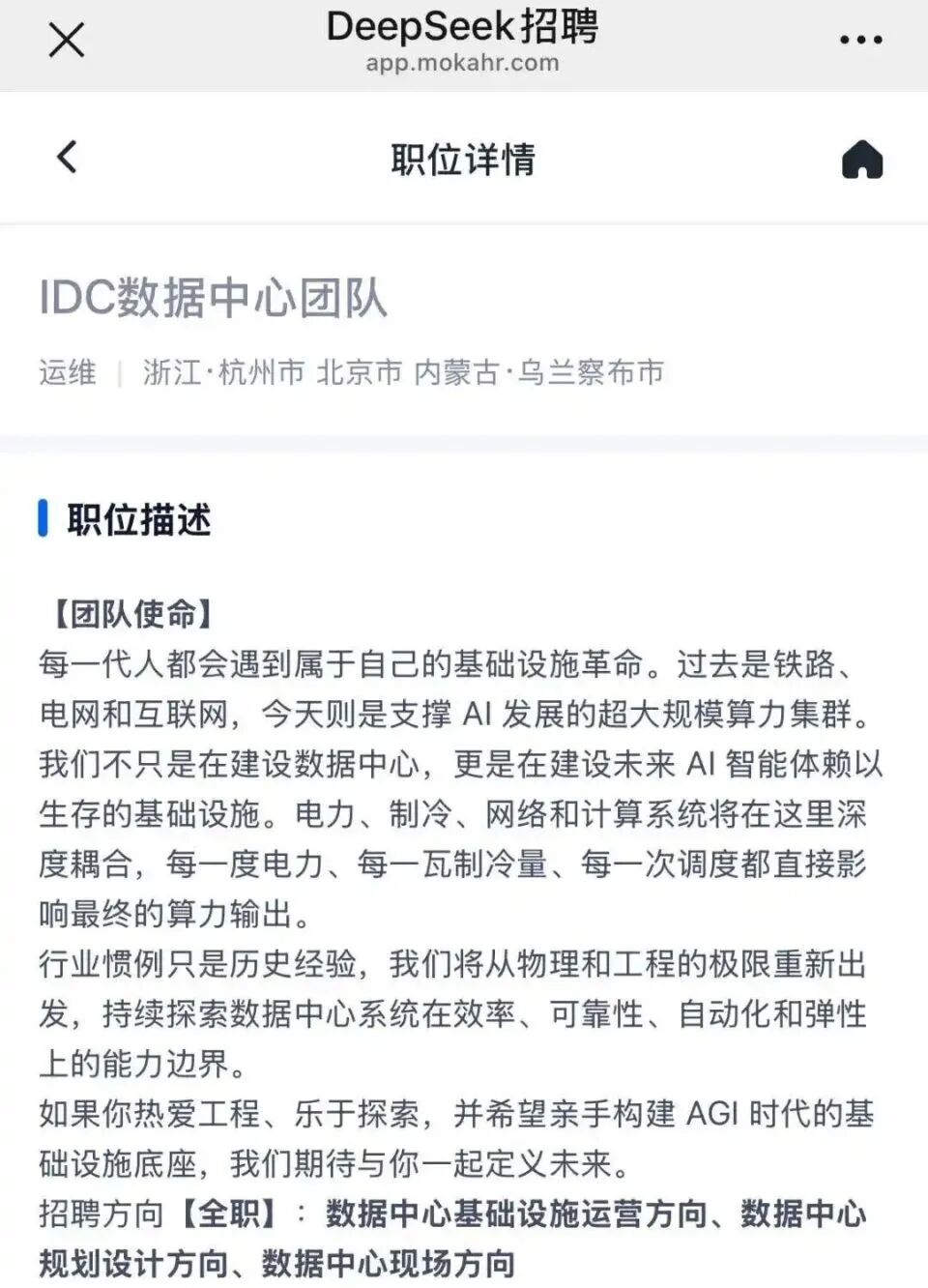
This is the recruitment information for the DeepSeek IDC data center team.
As large models enter the stage of large-scale training and inference, the competition among AI model companies will inevitably enter the "infrastructure" hardware competition. This has forced DeepSeek to join the heavy-asset "money-burning" game of building its own computing power clusters, just like the leading large model companies at the forefront of Silicon Valley.
According to public data, US technology giants Alphabet, Amazon, Meta, and Microsoft are expected to invest a total of about $650 billion this year to expand their artificial intelligence-related infrastructure. Anthropic and OpenAI have also repeatedly emphasized in their publicly disclosed financial documents that they will continue to increase investment in computing power infrastructure.
For example, Anthropic is expected to pay about $1.25 billion per month to SpaceX just for data center capacity leasing, which amounts to $15 billion a year, not including GPU procurement, network, and operation and maintenance costs.
Pan Helin, a member of the Expert Committee on Information and Communication Economics of the Ministry of Industry and Information Technology, pointed out in a previous interview that in the current wave of AI investment, financing for large model companies is an inevitable trend. "Not only DeepSeek, but Google has also raised $80 billion. The industry has entered the heavy-capital stage."
In order not to fall behind in the construction of heavy computing power capital, DeepSeek must "open up new sources of funds", obtain financing, and then invest in the construction of infrastructure such as computing power and data centers.
It is worth noting that DeepSeek's construction of computing power infrastructure is carried out under the restriction of overseas advanced computing power exports. This means that the above-mentioned computing power will be driven by domestic chips. When DeepSeek V4 was released, DeepSeek mentioned the exploration of domestic computing power on its official website and in its technical report.
At the end of May, Huawei proposed the "Tao (τ) Law", attempting to break through the bottleneck caused by the slowdown of Moore's Law through full-stack collaborative optimization of devices, chips, and systems. Domestic large models are also accelerating the adaptation to domestic computing power. The goal of exploring domestic computing power is to build "autonomous and controllable AI infrastructure".
On the eve of AGI
For a basic model company like DeepSeek, capital and organization alone are not enough to support long-term leadership. The key is to continuously produce original technologies.
A senior computing power industry insider also emphasized that DeepSeek's large-scale financing this round is to incentivize the team and retain core talents. "Only with sufficient financing can a good model be trained and a leading position be established."
Papers are an important microcosm of DeepSeek's exploration of new technologies.
According to incomplete statistics, in the past two years, DeepSeek has publicly published about 27 core technology papers. The research directions cover MoE (Mixture of Experts), reinforcement learning, large code models, mathematical reasoning, multi-modal, etc., almost corresponding to each generation of its core models and key technological breakthroughs.
On June 27, DeepSeek quietly updated a paper related to the new technology "DSpark" on GitHub.
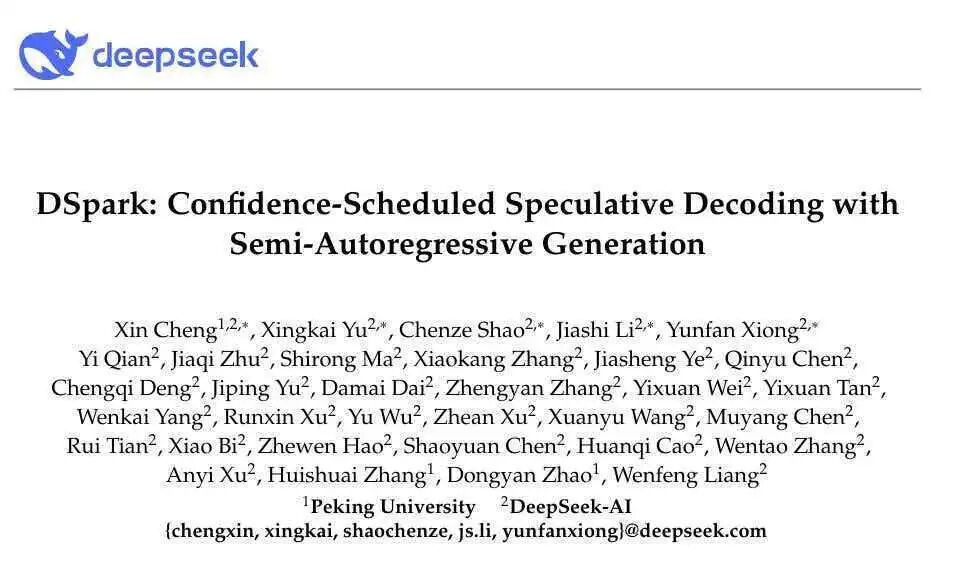
In the paper, DeepSeek proposed a brand - new inference acceleration framework "DSpark", which significantly improves the inference speed and system throughput of large models without changing the model's capabilities.
Different from previous papers, this one does not iterate on a new model. Instead, it adds a speculative decoding module based on the original DeepSeek - V4 - Pro and DeepSeek - V4 - Flash, focusing on the optimization at the engineering implementation level.
DeepSeek intends to deploy DSpark in the DeepSeek - V4 online service system to reduce the waste of computing power caused by invalid verifications when handling real user traffic.
The paper mentions that "without changing the underlying model architecture, the generation speed is increased by 60 - 85%." For an AI company that has to process a large number of API requests every day, every reduction in computing power cost means an increase in profit margin.
According to a report from VentureBeat in February this year, the cost of model training will only get higher. Dario Amodei, the CEO of Anthropic, predicts that the training cost of the next - generation cutting - edge models will reach $5 - 10 billion.
The above - mentioned senior computing power industry insider said that DeepSeek will also enter the same "money - burning" stage of model training.
Financing is inevitable to support DeepSeek's model training and iteration.
Many media have interpreted that by releasing a new paper just over a dozen days after the financing, DeepSeek seems to be proving that the company's core rhythm remains unchanged and its R & D team still maintains a high - frequency output.
Whether it is launching new models, building data centers, or transforming from a "genius laboratory" into a commercially - operated AI company, the end - goal of DeepSeek's evolution is AGI.
In an interview with "Anchao Waves" in 2024, Liang Wenfeng clearly stated: "What we are doing is AGI (Artificial General Intelligence). Large language models may be the inevitable path to AGI."
During the free period, users can tolerate problems such as response failures, conversation interruptions, and API rate limits. Once the official version of DeepSeek V4 is launched in July, users' requirements for stability will also increase. If these problems persist, it will directly affect whether users are willing to integrate DeepSeek into their real - world workflows and business systems.
In the paid - service segment, developer ecosystem, and enterprise scenarios, DeepSeek's engineering capabilities will face more stringent tests. Whether the model can truly be applied on a large scale is also a threshold that must be crossed to enter the AGI era.
While users hope that DeepSeek can reduce costs and increase efficiency for Chinese large models, DeepSeek has its own calculations: it is in a critical period of AGI. The primary goal is to retain talents, followed by continuously training models and iterating new technologies. It also cannot lose the "battle" for data center infrastructure.
Relying solely on Liang Wenfeng's quantitative private equity fund, Magic Square Quant, is far from enough.
In 2026, it is an inevitable choice for DeepSeek to start financing. As the recruitment announcement posted by DeepSeek on the evening of June 25 reads:
"Humanity is currently on the eve of AGI."
Next, DeepSeek will face a longer - term and more money - burning AGI competition. Can it continue to "lead the way" in the AGI process as it did in the "large model" competition? This is the second question that DeepSeek needs to answer in the "second half".
This article is from the WeChat official account "Tencent Technology". The author is Xie Ruirui, and the editor is Xu Qingyang. It is published by 36Kr with authorization.