Why was this AI pathology startup sold for 5 billion yuan in an all-cash deal?
One pathological section, examined by two pathologists, may sometimes yield two different conclusions. This subjectivity is not an isolated case. According to a study by Elmore et al. published in the British Medical Journal in 2017, in lesion categories with high diagnostic difficulty such as melanocytic lesions, the consistency and accuracy among different pathologists are even less than 50%.
Meanwhile, the training cycle for pathologists is long, and the growth of their numbers is slow, leading to an increasingly widening gap between supply and demand. When the "gold standard" is no longer stable, both clinical diagnosis and drug development are calling for a more objective and standardized solution.
PathAI is a company dedicated to addressing these pain points. The team uses artificial intelligence algorithms to analyze pathological sections, aiming to eliminate subjective differences and standardize diagnosis. Currently, it has launched the world's first AI-driven pathological drug development tool certified by both the FDA and EMA.
On May 7th, Roche Diagnostics announced the signing of a definitive merger agreement with PathAI, acquiring this AI pathology company with a one-time payment of $750 million (approximately RMB 5.099 billion) and an additional milestone payment of up to $300 million, with a total consideration of $1.05 billion (approximately RMB 7.139 billion). This transaction is expected to be completed in the second half of 2026.
The logic behind the acquisition lies in the complementary resources of both parties. Roche Diagnostics has a globally leading companion diagnostic business and oncology drug pipeline, while PathAI provides a complete technology stack from digital pathological image management to AI-assisted diagnosis and then to the evaluation of endpoints in drug clinical trials. The integration of the two can connect the entire process from section staining, scanning, intelligent analysis to the issuance of reports for companion diagnosis, supplementing Roche Diagnostics' existing digital pathology product portfolio and improving laboratory efficiency.
According to the official announcement, Roche Diagnostics will rely on its global channels to implement AISight globally. PathAI can also leverage Roche Diagnostics' complete infrastructure and compliance resources to accelerate the implementation of its products in laboratories and pharmaceutical companies at home and abroad.
Why did Roche Diagnostics choose PathAI? The answer lies in PathAI's assets, team, products, and platform positioning.
Three Core Assets: Data, Compliance, and Laboratory Capabilities
PathAI is a company that develops AI software and digital pathology systems. It was founded in 2016 and is headquartered in the United States. Its business covers diagnostic workflows, clinical research, and drug development. Its mission is to improve patient outcomes through AI-driven pathology, making diagnosis more accurate, matching patients with more effective treatment plans, and facilitating the approval of more life-saving drugs.
Different from most AI medical companies that choose a single track, PathAI established a dual-driven business model of "diagnosis + drug development" from the very beginning. It serves both anatomical pathology laboratories on the clinical side and biopharmaceutical companies on the research side.
What supports this business model are the three core assets accumulated by PathAI.
Firstly, there is a huge asset of annotated data. The company has established a proprietary network consisting of more than 450 certified pathologists, who have cumulatively contributed more than 32.5 million pieces of annotated medical image data, covering more than 20 organ types and various staining protocols, for the training and validation of AI models.
Secondly, there is compliance capability covering the entire process. PathAI has obtained ISO 13485 and ISO 27001 certifications. Its digital pathology platform, AISight Dx, has received FDA 510(k) approval and CE-IVDR certification, and can be used for primary clinical diagnosis. In the fields of drug development and auxiliary diagnosis, PathAI's products have also been certified by the FDA and EMA. This shows that PathAI's products can not only be used in laboratories but also directly serve as endpoint evaluation tools for clinical trials and are accepted by global drug regulatory agencies.
Thirdly, there is end-to-end laboratory operation capability. Through acquisitions and self-construction, PathAI has mastered the full-chain capabilities from wet laboratory services to the deployment of algorithms in clinical trials, and can provide customers with a full-process solution from tissue reception to digital scanning and then to algorithm deployment.
In terms of market validation, 90% of the top 15 global biopharmaceutical companies have adopted its technology. The company has participated in more than 100 translational research projects, and 26 clinical trials are using its algorithms, covering two major fields: oncology and metabolic associated fatty liver disease. In 2025, the company launched the Precision Pathology Network, the world's first digital anatomical pathology laboratory network, aiming to connect dispersed laboratories through a unified technology platform and unlock the value of real-world pathological data.
From data assets to compliance certifications, from laboratory operations to the cooperation network with pharmaceutical companies, PathAI has built a complete set of digital infrastructure around pathology. This is exactly what Roche Diagnostics values - it is not a scattered set of technologies that need to be integrated but a mature platform that can be directly and completely embedded into Roche Diagnostics' system.
Former Roche Diagnostics Executives in Charge of Medical and Growth
PathAI's leadership team combines expertise in multiple fields such as engineering, machine learning, life sciences, medicine, and regulation, and has rich industrial backgrounds in companies like Roche Diagnostics and AI medical startups.
Andrew Beck, the founder and CEO, holds a bachelor's degree in history from Brown University, a medical degree, and a master's degree in biostatistics. He completed specialized training in anatomical pathology and molecular genetic pathology at Stanford University and obtained a doctorate in biomedical informatics. He has served on the faculty of the Department of Pathology at Harvard Medical School and published more than 110 papers. His cross - disciplinary trajectory is itself a microcosm of PathAI's mission of "reconstructing pathology with technology".
The core executive team bears a distinct "Roche Diagnostics imprint". Before joining PathAI, Eric Walk, the Chief Medical Officer, served as the Chief Medical and Scientific Officer at Roche Diagnostics/Ventana Pathology Systems, leading the development and FDA approval of more than 20 510k and PMA IVD tests, companion diagnostics, and digital pathology algorithms. Nick Brown, the Chief Growth Officer, comes from Flatiron Health, a cancer data platform company acquired by Roche Diagnostics in 2018. He served as the head of international business at Flatiron. After the acquisition of PathAI, this executive team with a Roche Diagnostics industrial background is expected to reduce integration resistance and accelerate organizational integration.
In addition, Brandon Eldredge, the Chief Financial Officer, once served as the Chief Clinical Business Officer at Massachusetts General Hospital and Brigham and a senior vice president at Syneos Health. Chris Kirby, the General Counsel, holds a Doctor of Jurisprudence and a Master of Public Health degree and has more than 20 years of legal and business management experience in the healthcare and life sciences fields. Liz Storti, the Chief People Officer, led the company's $240 million financing and promoted multiple acquisition integrations. Together, they have built the governance foundation required for PathAI to move from a technology startup to a large - scale enterprise.
At the technical level, Anand Sampat, a machine learning expert, has an academic background from the University of California, Berkeley, and the Stanford Artificial Intelligence Laboratory. He co - founded the open - source machine learning platform Datmo, focusing on environmental consistency and experimental reproducibility in AI development. After joining PathAI, he is responsible for the machine learning research and development of new product lines. Abdo Mahmoud, the Chief Product Manager, has more than 7 years of experience in building AI products. Nick Anderson, the Vice President of Regulatory Affairs, comes from the Department of Industrial Engineering at the University of Louisville and has worked at the FDA for more than 10 years. They cover the complete ability chain from algorithm research and development, product design to regulatory implementation.
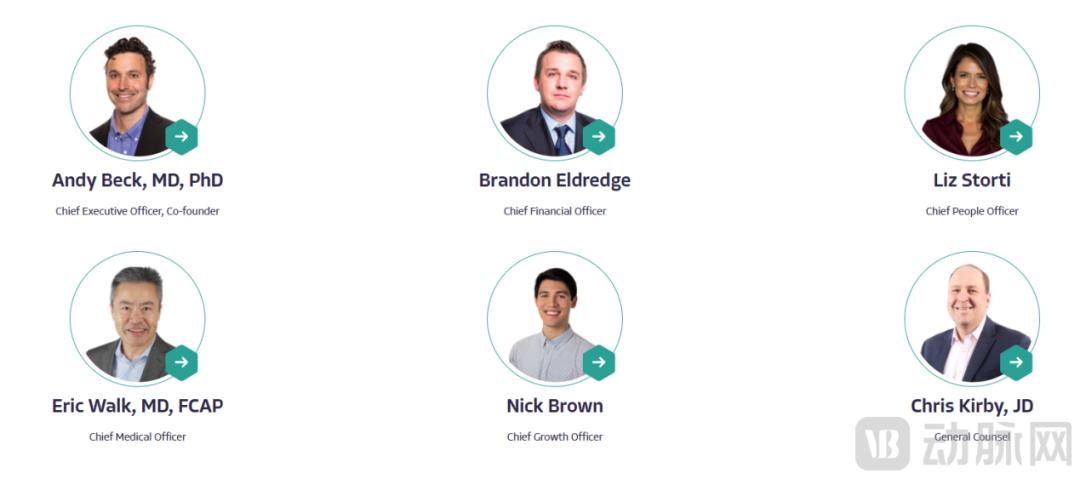
Leadership team situation (Source: PathAI official website)
In addition to the core management team, PathAI has also built a proprietary contributor network consisting of more than 450 board - certified pathologists. They are deeply involved in data annotation and model validation work, including the formulation of annotation specifications, the consensus review of difficult cases, and the validation of algorithm outputs, ensuring that the AI model always iterates on the track of clinical reality.
Parallel Development of Pathology Laboratories and Biopharmaceuticals
PathAI's product system revolves around its core digital pathology platform, AISight. AISight is a cloud - native image management system that is compatible with mainstream scanners and laboratory information systems.
Based on AISight, PathAI has built two mutually synergistic business ecosystems. On the one hand, it provides workflow management and AI - assisted diagnostic tools for anatomical pathology laboratories. On the other hand, it provides AI - driven translational research algorithms and clinical trial services for the biopharmaceutical industry.
■ Anatomical Pathology Laboratories: Making Daily Workflows Smarter
At the laboratory end, PathAI provides a toolset to improve the efficiency of daily diagnosis and quality control.
In terms of workflow optimization, the quality control tool ArtifactDetect can automatically screen for various slice artifacts such as folds, bubbles, and abnormal staining, and match rectification plans such as rescan and re - coverslipping. Currently, it has processed more than 1 million slices globally, equivalent to saving the manpower of 1.5 full - time quality inspectors, and each laboratory can reduce the verification work of 75 invalid slices per day.
TumorDetect is used for case prioritization. It can automatically identify cases suspected of malignant tumors and move them to the top of the pathologist's work list. A simulation study showed that TumorDetect increased the proportion of malignant cases reviewed in the morning from 50% to 71%. AIM - TC automatically calculates indicators such as the total tumor area and the percentage of tumor nuclei on H&E slices, helping to determine whether the sample meets the requirements for NGS testing.
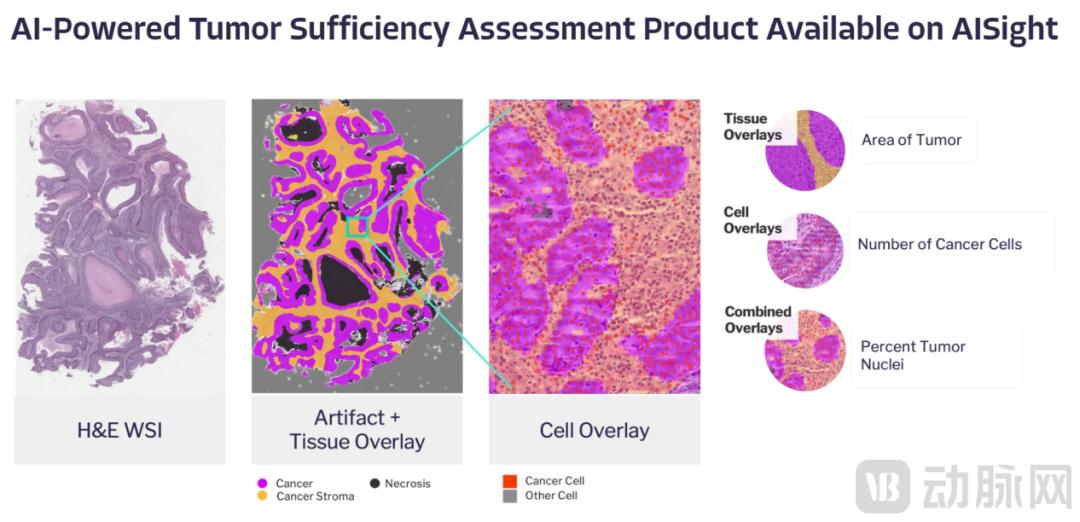
AI - driven tumor sufficiency assessment products provided by AISight (Source: PathAI official website)
In terms of biomarker quantification, the AIM - PD - L1 series covers multiple cancer types such as non - small cell lung cancer, head and neck squamous cell carcinoma, melanoma, and urothelial cancer, and is compatible with multiple antibody clones. The AIM - IHC breast panel integrates four key indicators: HER2, ER, PR, and Ki - 67, achieving automated scoring.
In terms of auxiliary diagnosis, PathAssist Derm is aimed at the field of dermatopathology. It provides AI - based specimen orientation, prioritization, and key measurements, and received FDA Breakthrough Device Designation in March 2026.
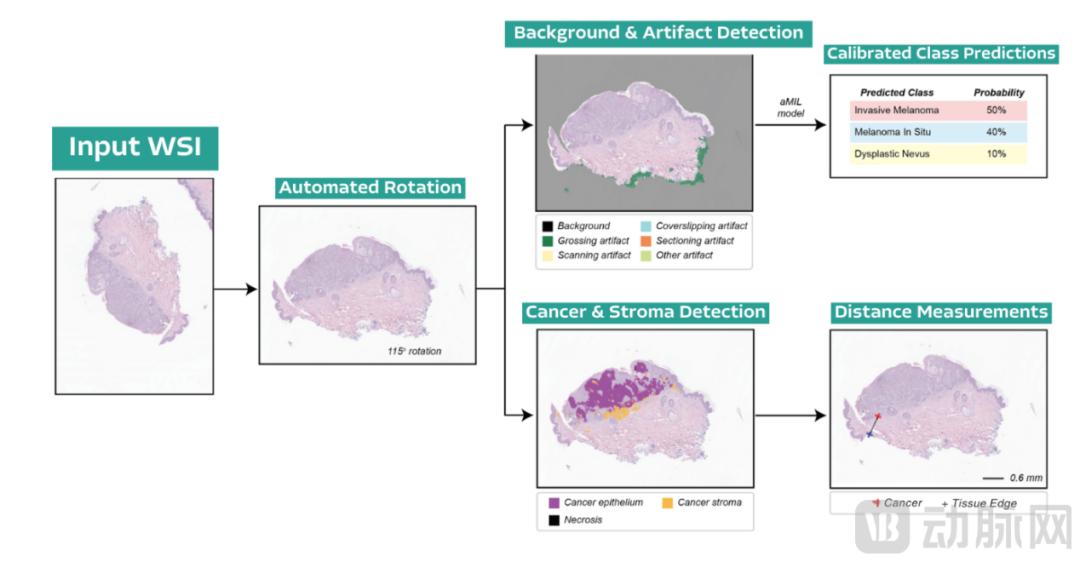
Example of the AI analysis process of PathAssist Derm (Source: PathAI official website)
In addition, AISight integrates more than 40 third - party pathological algorithms such as DeepBio, Mindpeak, Paige, and Visiopharm to create a one - stop AI integration platform. Laboratories can call various top - notch intelligent diagnostic tools as needed without switching between multiple systems.
■ Biopharmaceuticals: Covering the Entire Chain from Translational Research to Clinical Trials
At the pharmaceutical end, the value of PathAI lies in transforming pathological images into quantifiable R & D assets.
In terms of translational research, PathExplore relies on the self - developed PLUTO model of PathAI to analyze the tumor microenvironment at single - cell precision. A single H&E slice can output more than 600 interpretable and quantifiable features, covering 14 cancer indications. Currently, more than 150,000 slices have been analyzed, contributing to the publication of more than 50 academic achievements. LiverExplore and IBDExplore, derived from the same technology system, are aimed at MASH and ulcerative colitis respectively, providing quantitative analysis of more than 1,000 features.
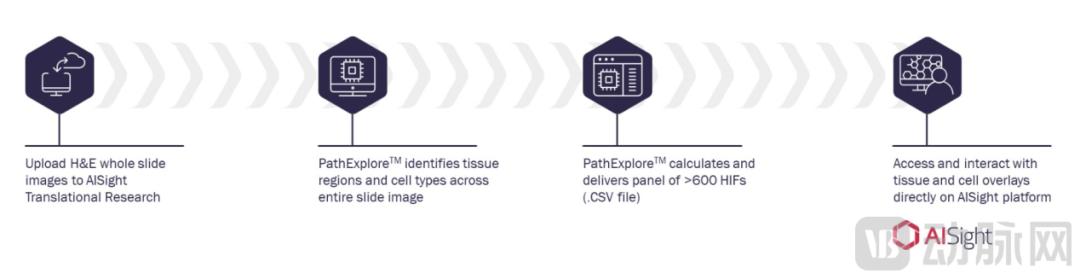
PathExplore workflow (Source: PathAI official website)
At the level of clinical trial services, PathAI operates a central pathology laboratory that meets CAP/CLIA and GCP/GCLP standards, providing full - process services from tissue reception to AI - assisted slide reading and then to report generation.
The compliant cloud platform AISight brings together 80% of global central laboratory suppliers, enabling remote central slide reading and AI indicator calculation.
■ The First AI - Driven Pathological Drug Development Tool Certified by Both the FDA and EMA
The most milestone - worthy product is AIM - MASH AI Assist. It is trained based on more than 5,900 liver biopsy samples from six different clinical trials and can help pathologists evaluate the disease activity and fibrosis stage of MASH patients. Data shows that the algorithm is 100% repeatable and outperforms human pathologists in multiple test indicators.
In 2025, it obtained dual certifications from the EMA and FDA, becoming the first and only AI - driven pathological drug development tool recognized by the two major regulatory agencies. This means that in large - scale global clinical trials, sponsors can use fewer and more consistent pathologist resources to complete enrollment screening and endpoint evaluation, accelerating the drug development process.
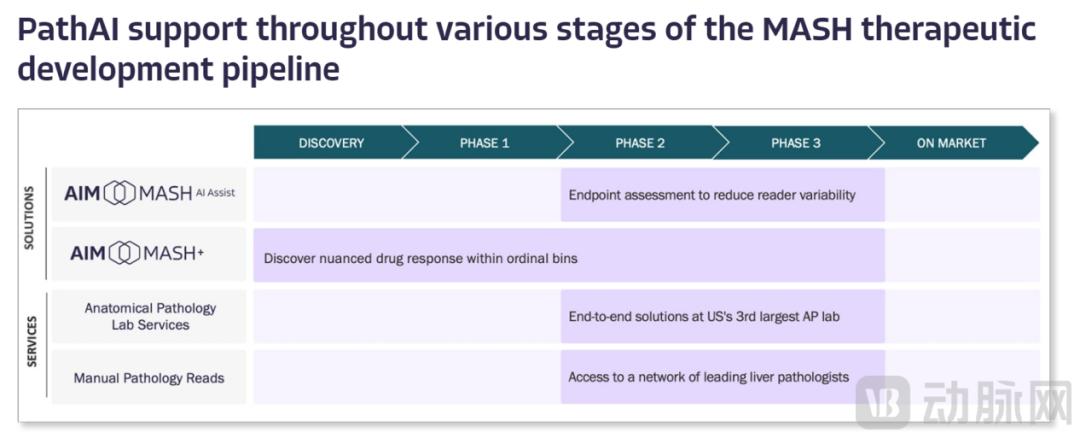
PathAI provides support at all stages of the MASH treatment development process (Source: PathAI official website)
In fact, the two business lines play a synergistic effect and jointly feed back PathAI's own product system. The daily diagnosis at the laboratory end generates a large amount of pathological data, which is processed and then incorporated into the real - world database to support the training and optimization of algorithms at the pharmaceutical end. The algorithms that have been rigorously validated in compliant clinical trials at the pharmaceutical end can not only improve the clinical reliability of the algorithms but also flow back to the laboratory to become auxiliary tools for pathologists' daily diagnosis. Thus, a closed - loop is formed, including data supply from laboratories, algorithm implementation and validation by pharmaceutical companies, and the feedback of mature technologies to pathological diagnosis and treatment.
Six Rounds of Financing for $355.2 Million
PathAI has transformed AI from a concept into a daily tool on pathologists' workbenches and a standard evaluation method in pharmaceutical companies' clinical trials. Roche Diagnostics' acquisition of it with a $750 million upfront payment is not only an endorsement of a technology company but also indicates the trend that "digital pathology will become the core infrastructure for diagnosis and drug development".
Since its establishment, PathAI has completed a total of 6 rounds of financing, with a total amount of $355.2 million. The main investors include General Catalyst, General Atlantic, D1 Capital Partners, Kaiser Permanente, LabCorp, Adage Capital Management, Polaris Partners, etc. Among them, LabCorp's strategic