UBTECH's AI companion costs 990,000 yuan, which 200 million single people cannot afford to "love"
The top - tier AI companion is priced at 990,000 yuan. Ubtech has put a price on loneliness.
Would you be willing to pay 990,000 yuan for an "AI companion"?
On June 3rd, Ubtech, the "first stock of humanoid robots", offered a "powerful AI remedy" to single people, but with an astonishingly expensive bill.
Ubtech has launched the full - sized ultra - biomimetic humanoid robot U1 series. The top - tier male version is priced as high as 990,000 yuan, and the female version is 880,000 yuan.
On one hand, there is an "AI companion" that claims to be able to empathize, have memory, and provide emotional value. On the other hand, there is an exorbitant price higher than sky - high betrothal gifts. Is this commercial adventure under the guise of "emotional companionship" a precise move in the loneliness economy, or a capital story divorced from reality?
990,000 yuan is more expensive than sky - high betrothal gifts. Ubtech can't capture the mass market
From "industrial robots" to "emotional partners", Ubtech has placed a new bet.
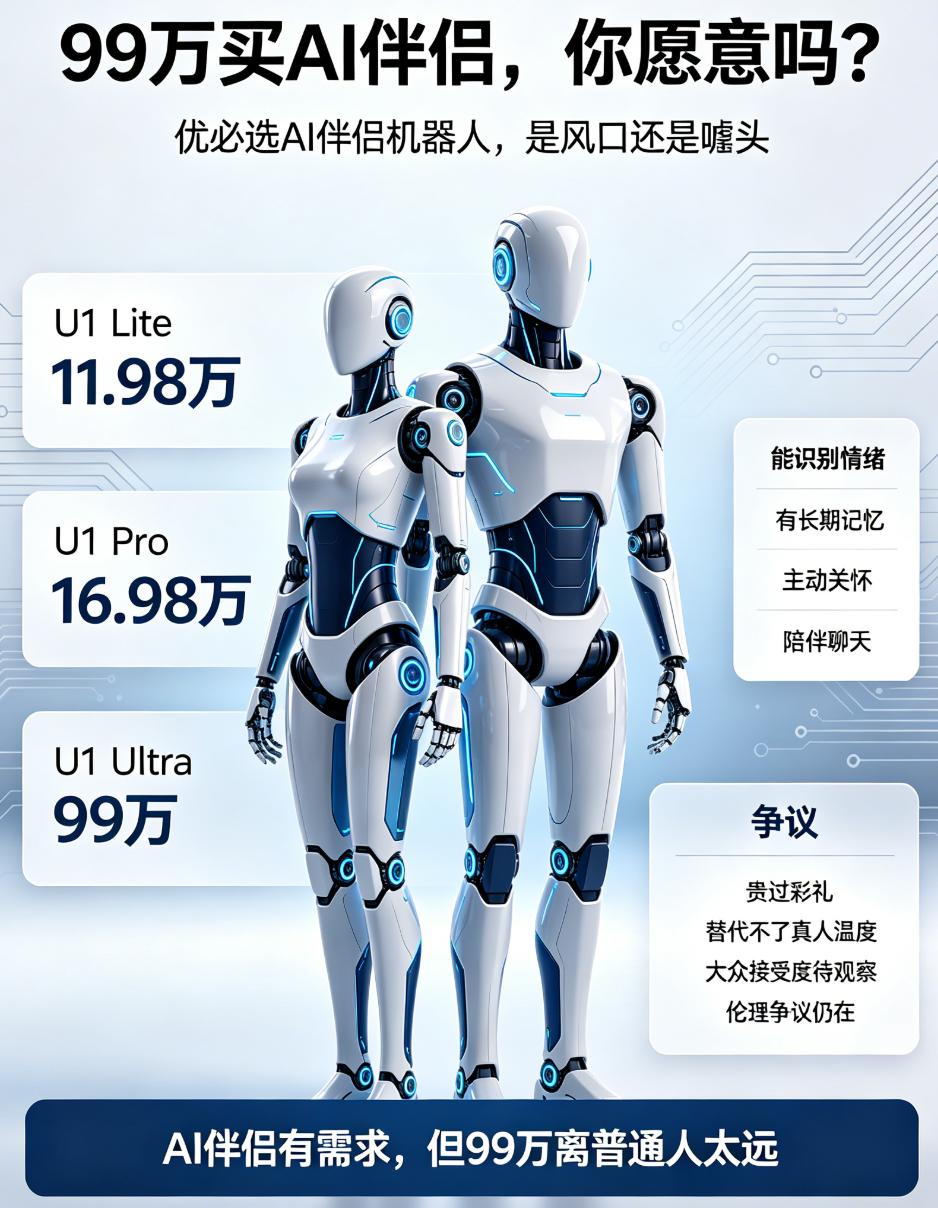
The price range of the newly released U1 series is comparable to that of "entry - level to flagship models" in consumer electronics:
The half - body U1 Lite is priced at 119,800 yuan;
The high - end full - body U1 Pro is priced at 169,800 yuan;
The high - dynamic full - body U1 Ultra is priced at 990,000 yuan for the male version and 880,000 yuan for the female version.
Founder Zhou Jian revealed that as of before the press conference, the total pre - orders of the newly released U1 humanoid robot across all channels had reached 13,361 units.
The U1 series has also started pre - sales on JD.com. The U1 Pro comes in two genders: the male version is 183 cm tall and weighs 42 kg, and the female version is 168 cm tall and weighs 35.2 kg. With perfect proportions, the male is handsome and the female is beautiful, and the appearance is delicate down to the hair.
According to the observation of "Finance Story Collection", the pre - order volume of the U1 Pro has reached 5,467 units, with a deposit of 3,000 yuan.
However, it's hard to say how many pre - orders will be converted into final sales. The page clearly states that users can refund the deposit at any time before the pre - sale ends on July 15th.

For Ubtech, this is a clear strategic shift. Founder Zhou Jian said straightforwardly that he doesn't want to simply make sex robots, but rather create companion products with complex movements, natural interactions, and rich facial expressions. "Maybe people will choose to fall in love with it in the future." "If my next generation, my children, choose to be with a robot, I completely understand."
Behind the optimistic statement is Ubtech's difficult situation.
As one of the earliest domestic enterprises to layout humanoid robots, Ubtech has lost nearly 5 billion yuan in the past five years and has never made a profit. The company urgently needs to find a new growth point.
The full - sized biomimetic companion robot is the differentiated track it has chosen.
What supports the highest price of one million yuan is a set of technological packaging of "biomimetic hardware + emotional AI".
At the hardware level, the U1 series is equipped with 88 high - precision degrees of freedom joints throughout the body, which can cover 90% of human basic movements. The self - developed biomimetic expression drive system attempts to eliminate the stiffness of traditional robots.
In terms of AI capabilities, the product is equipped with an emotional large - scale model designed for long - term companionship, which can recognize more than 20 fine - grained emotions with an accuracy rate of over 90%.
Coupled with functions such as a cross - time - space memory bank and proactive care without a wake - up word, the official is trying to create a perfect "AI companion" that can "read the situation" and grow and iterate with the user.
The application scenarios are diverse, covering consumer scenarios such as daily companionship, emotional support, lifestyle aesthetics, and social assistance, as well as business scenarios such as reception, elderly care companionship, psychological therapy, cultural and tourism exhibitions, scientific research and teaching, and high - end housekeeping services.
According to Zhou Jian's standard, a qualified companion robot should have an appealing appearance, a suitable personality, rich knowledge reserves, short - and long - term memory capabilities, and ultimately provide stable emotional value to users.
However, it doesn't make sense to spend 990,000 yuan on a "dummy". In the context of domestic marriage, this price far exceeds the marriage threshold in most regions.
According to a report from the Chinese Academy of Social Sciences, the average increase in betrothal gifts across the country has exceeded 50% in the past decade.
Even in Jiangxi, where the betrothal gift level is relatively high, the average amount is only between 200,000 and 300,000 yuan, and the peak in some areas is about 500,000 yuan.
In other words, the budget for buying a top - tier U1 Ultra male version is enough to pay for two high - value betrothal gifts and still leave some money for living expenses.
In reality, when people pay the cost for marriage, they get real emotional connections and long - term family building.
No matter how high the degree of biomimetics is, the 990,000 - yuan AI companion is essentially an electronic product: it has a fixed hardware wear - and - tear and technology iteration cycle and cannot generate real empathy and love.
Spending nearly one million yuan to buy a "companion symbol" is obviously not a rational choice.
What's more subtle is the label "For adults only" on the product introduction page. If it is mainly for adult functions, the pricing logic of 990,000 yuan far exceeds that of similar products. If it is mainly for pure emotional companionship, it is difficult to support such a high premium.
The vague positioning makes the high price even more embarrassing.
Companion robots: a thousand - billion - yuan opportunity with four major challenges
Ubtech is very optimistic about the prospects of companion robots.
Tan Min, the general manager of Ubtech's Youworld, said boldly: "The human - machine companionship economy is the first rigid - demand scenario in human history with no upper limit on emotional value, no boundaries on companionship, and full - life - cycle coverage. It is estimated that the market for super - biomimetic robots in China will explode from the tens of billions level to the trillions level from 2026 to 2036."
In fact, not only Ubtech, but also from tech giants to startups, are all trying to upgrade robots from 'tools' to 'partners'.
In April last year, Samsung joined hands with Google to release the household AI family companion robot - Ballie. In April this year, Samsung's AI intelligent companion robot Project Luna made its debut in Milan.
However, the positioning of the above two series of products is actually more like a "butler" rather than a "companion", and the pricing is very affordable - the estimated price is only about 2,000 US dollars. But due to the immaturity of the products, they have not been launched yet.
Apple is also taking action.
It is reported that Apple will launch a desktop AI companion robot in 2027, with the internal code name "Pixar Lamp". It is equipped with a new - generation Siri, can chat naturally like a human, proactively give life advice, and help you plan your itinerary. It also supports FaceTime calls, and the camera can automatically track people. The goal is clear: to be the user's "digital family member".
From lightweight home assistants to full - sized biomimetic humanoids, the "AI companion" track is getting more and more crowded.
Supported by the loneliness economy, there is indeed a real demand for companion robots.
The "2021 Annual Consumption Report of Qingshan Capital" shows that the number of single - person households in China has reached 92 million, and the proportion of single - person households in the total number of households has increased from 6% to 25% in just 25 years.
According to the prediction of the Shell Research Institute, by 2030, the number of single - person households in China will reach 150 - 200 million, and the number of single young people aged 20 - 39 will increase to 40 - 70 million.
At the same time, there are more than 200 million single adults and 320 million elderly people over 60 in China. These two groups together form the potential user pool for AI emotional companionship.
Huafu Securities predicts that the global sex robot market will exceed 30 billion US dollars in 2025.
The large group of single and lonely people and the continuously expanding gap in emotional needs have made the "AI companion" a business with great imagination space.
However, although the prospects are promising, the challenges are also significant. There are four major obstacles ahead, and the commercialization is far from mature.
The first is the experience barrier - sophisticated algorithms cannot replace the warmth of real people.
Currently, AI companionship is essentially a data - driven programmed feedback. Even if it can accurately recognize emotions and say warm words, it cannot generate real empathy and love. No matter how smooth the biomimetic movements are, they cannot reach the delicacy and flexibility of real people.
For users who pursue deep - level emotional value, there is an insurmountable experience gap between "being like a real person" and "being a real person".
The second is the cost - performance barrier - the high pricing is divorced from mass consumption.
The core audience of companion robots is ordinary single young people and families, but the pricing from more than 100,000 to nearly one million yuan directly blocks most people out.
Even Ubtech's entry - level model priced at 119,800 yuan far exceeds the price range of mainstream consumer electronics, and the one - million - yuan pricing is comparable to a house in a second - tier city.
Without a civilian price, it is doomed to be difficult to become a mass - market business.
The third is the acceptance barrier - it is difficult to change the social stereotype.
Although the official repeatedly emphasizes the positioning of "emotional companionship", the full - sized biomimetic humanoid form makes it difficult for the public to get rid of the stereotype of a "high - end silicone doll".
For most people, placing a humanoid companion robot at home is still a private and hard - to - talk - about choice. It will take time to change the public's perception.
The fourth is the ethical barrier. Will the popularization of AI companions further undermine the intimate relationships in the real world and further hit the birth rate?
According to the data from the Ministry of Civil Affairs, the number of marriage registrations in China in 2024 was only 6.11 million, a year - on - year decrease of 20.5%.
A survey by Zhenai.com shows that nearly 80% of single people voluntarily choose to stay single without external pressure and lack the motivation to enter marriage.
When an obedient, considerate, and never - quarreling AI companion becomes an easy option, will young people become more dependent on virtual companionship and completely give up emotional management in the real world?
This potential impact on marriage and child - bearing willingness and social connections is a public question that the entire industry has to face.
In summary, for Ubtech, launching a top - tier AI companion priced at 990,000 yuan seems to be an attempt to break through in a different way: using high - profile topics to attract capital attention, using high pricing to test the high - end market, and using a differentiated track to avoid the price war in the industrial robot market.
However, whether it is technology, price, or social perception, it is still far from mature.
This article is from the WeChat official account "Finance Story Collection" (ID: cjgshui). The author is Wan Tiannan, and the editor is Chen Jiying. It is published by 36Kr with authorization.