Claude Code officially announces its next major upgrade: while you are chatting, the system completes all tasks in the background
Claude Code is making "working in the background" a standard feature!
Just now, Boris Cherny, the creator of Claude Code, posted a message on X: In the next version of Claude Code, sub - agents will run in the background by default.
You can chat with Claude while having sub - agents finish tasks in the background. Want an agent to run in the foreground? Just tell Claude.

This statement made many developers suddenly realize one thing: Claude Code is evolving from a "question - answer dialog box" to a workflow engine that can schedule multiple task lines simultaneously.
While you're still discussing the architecture plan with Claude, the sub - agents have already refactored the code, completed the tests, and opened the PR in the background.
You just need to look at the results after chatting.
Does it sound like science fiction?
No, this is Boris Cherny's daily routine. He hasn't written a single line of code by hand for eight months. On some days, he manages thousands or even tens of thousands of AI agents simultaneously.

"You're no longer the one writing prompts for Claude," he said. "It's another Claude that writes prompts."
Some netizens said they've already started using this feature.
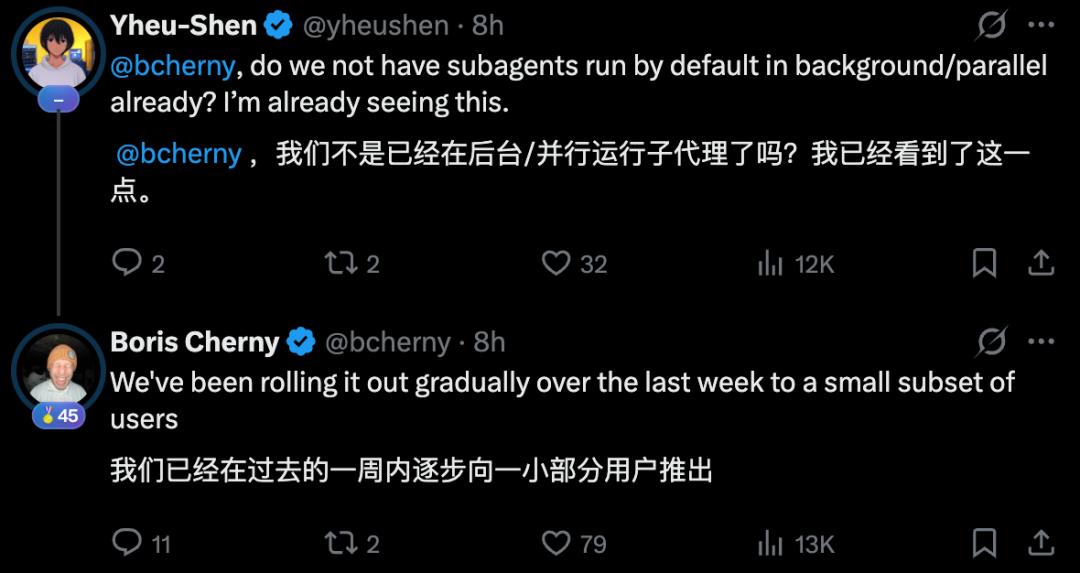
Netizens also said this feature is very important. It prevents them from getting bored while waiting for the agents to process and allows them to plan for the next step.

Claude Code is on a rapid rise
Looking back at Claude Code's evolution in the past six months, the "background sub - agents" are not a sudden gimmick but a natural step forward.
Boris Cherny's design philosophy when creating Claude Code was: It's not about chatting; it's about infrastructure.
In April, Anthropic made the "scheduled tasks" of Claude Code an official feature: Routines.
You can package a prompt, a code repository, and a set of connectors into a fixed process. It can be triggered hourly, nightly, or weekly. You can also run it through API calls, GitHub events, or even external Webhooks.
More importantly, it runs on Anthropic's cloud - hosted infrastructure. Even if you close your laptop, the agents will still keep working.
This means cron and hooks are back. But this time, what runs on schedule is not just scripts, but a group of AI workers that can read code, modify code, and open PRs.
The role of engineers has also changed: Previously, engineers would turn off their computers before going to bed and continue coding the next day. Now, they dispatch a group of agents before going to bed and review a bunch of PRs in the morning.
At the end of May, Claude Code took this logic a step further: Dynamic workflows.
For tasks like large - scale migrations, full - library audits, and complex research that a single dialog box can't handle, just say "use a workflow" in the prompt or enable ultracode. Claude will generate an orchestration script for the current task, schedule dozens to hundreds of sub - agents in the background to advance in stages, conduct parallel cross - validations, and finally consolidate the results into a report or a set of changes.
This is no longer "one AI writing code." It's "one AI writing the script, and a group of AIs working according to the script."
Now, the step of "running background sub - agents by default" essentially packages all the above capabilities into an out - of - the - box default behavior: You don't need to manually say "run in the background." It runs in the background by nature.
You just need to focus on what you really should do - think about the next step.

One engineer becomes three
How powerful is Claude Code? The most convincing evidence is not the demos but the story of Anthropic being "bitten back" by it.
VentureBeat published a significant article on June 27th with a straightforward title: Claude Code turns each engineer into three. Now the company needs more product thinkers.

Anthropic recently told its growth team: Hire more product managers, not more engineers.
The reason is simple. Claude Code has tripled the effective output of the engineering team. A five - person team can now do the work of fifteen to twenty people.
The bottleneck is not in writing code but in the people who decide what code to write.
Traditionally, the ratio of product managers to engineers is about 1:8. Now that each engineer's daily output has tripled, this ratio has effectively become 1:20 in practice.
Product managers can't keep up with assigning tasks to engineers. It's a ridiculous picture to imagine engineers sitting around waiting for requirements after finishing coding.
Spotify's 20 million lines of code are taken over by Claude
The real - world example of Spotify best illustrates how powerful the "background sub - agents" are.
Niklas Gustavsson, the vice president of engineering at Spotify, revealed a set of numbers in an interview with Boris Cherny:
Spotify deploys to the production environment about 4,500 times a day. 73% of pull requests are AI - assisted, and the PR frequency has increased by more than 75%.
His daily work style is to open 5 to 10 Claude sessions simultaneously, with each corresponding to an independent git working tree. He lets multiple agents work in parallel in the background and only focuses on reviewing diffs and making decisions.
All of this happens in a super - monolithic repository with over 20 million lines of code.
Niklas admitted that he was originally worried that the agents would get lost in such a large codebase. But unexpectedly, everything went smoothly. Claude can even "find inspiration" from other code in the repository and know how to write.
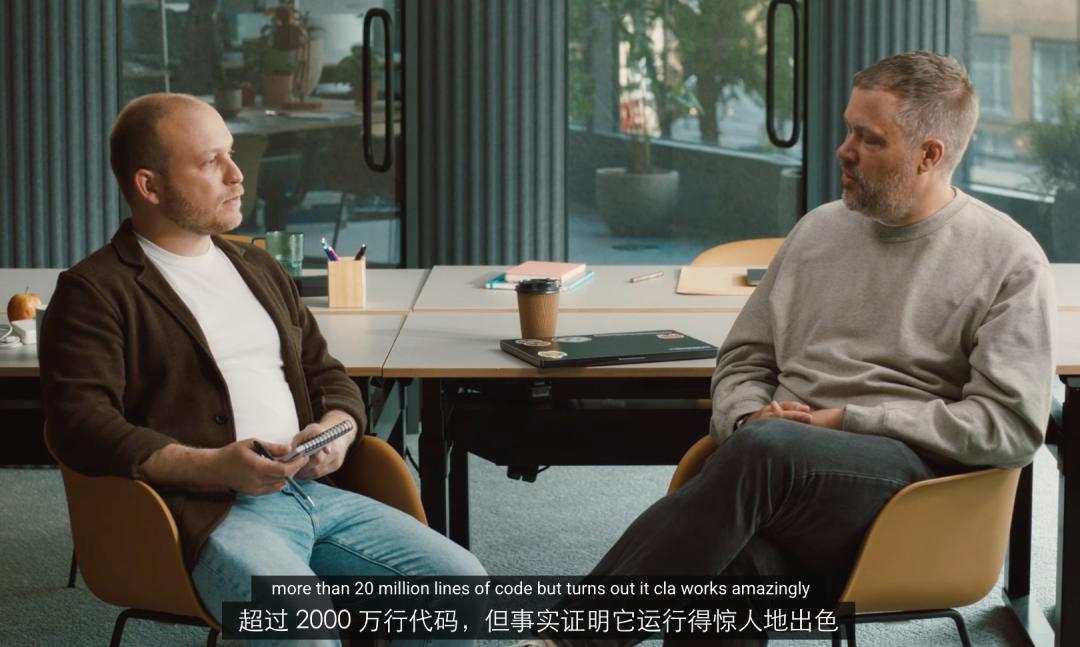
His advice to his peers may not sound exciting, but it's extremely practical: The more consistent the codebase and the more unified the toolchain, the better Claude performs.
If there are ten ways to write the same thing in the repository, Claude will also get confused. This is the same logic as improving the efficiency of human engineers in the past decade, except that now there's a new player - AI.
What's more interesting is that Spotify has opened up this capability to non - engineers.
They've built an infrastructure that allows product managers, designers - anyone - to describe an idea in natural language, and Claude can directly implement an end - to - end prototype in the real mobile and backend code.
Niklas revealed that even Spotify's co - CEO has submitted his own prototype.
Previously, it took convincing an entire engineering team to validate an idea. Now it can be done in just one or two hours.
When "chatting while working" becomes the default setting
Niklas said this can be traced back to five or six years ago. At that time, the team found that the growth rate of the codebase was seven times faster than the number of engineers, forcing them to think in advance about whether machines could maintain code instead of humans.
As a result, he found that what he really enjoys is not coding itself but solving problems.
Now he has several agents running in the background simultaneously, allowing him to free up time to figure out what to do next, talk to customers, and create more prototypes.
This exactly confirms the judgment behind Boris Cherny's tweet: When background sub - agents become the standard, "writing code" is no longer the most important thing for engineers. "Deciding what to do and judging whether it's right" is.
When "chatting while working" evolves from an individual developer's skill to the common working style of a 2,900 - person engineering team, AI programming tools have quietly reached a new level -
Engineers' output has tripled, but the most scarce resource is no longer those who can write code but those who know what code to write.
References:
https://x.com/kimmonismus/status/2071667876415623534
https://venturebeat.com/infrastructure/claude-code-turned-every-engineer-into-three-now-companies-need-more-product-thinkers
https://x.com/ClaudeDevs/status/2071671418245492926?s=20
This article is from the WeChat official account "New Intelligence Yuan". The author is ASI Revelation. It is published by 36Kr with authorization.