After not writing code for half a year, the father of Claude Code says: In 3 years, the number of people coding will surge 100 times
It's often said that with AI now able to write code, programmers' jobs are at risk. However, Boris Cherny of Anthropic argues that what truly matters has never been the job title, but the role you're playing at this very moment.
The task of writing code is being rapidly conquered by AI.
Boris Cherny is the one with the most authority to speak on this matter. He's better known as the "father of Claude Code," the programming agent that has swept Silicon Valley, which he developed himself.
Since creating Claude Code, he hasn't written a single line of code for six months. In these six-plus months, 100% of the code under his name was written by Claude.
As early as February on Lenny's Podcast, Cherny made a bold prediction: Within a year, the title of "software engineer" will start to disappear, replaced by roles more akin to "builders."
However, the disappearance of the title doesn't mean that software engineers will lose their jobs.
Four months later, on the Platformer podcast, he didn't retract this prediction; instead, he took it a step further.
When asked, "Will there be more or fewer engineers in three years?" he gave a counterintuitive answer: These people may no longer be called "engineers," but the number of those writing code and using agents will be 100 times that of today.

On the Platformer podcast, Boris Cherny (left) predicted that the number of people writing code and using agents in the next three years will be 100 times that of today.
If they're not called "engineers," then what should they be called? Recently, Cherny shared his answer on X.
He said that as functions such as engineering, product, design, and data science start to "merge," when he looks at his Claude Code team, he no longer sees "job titles," but five types of people.
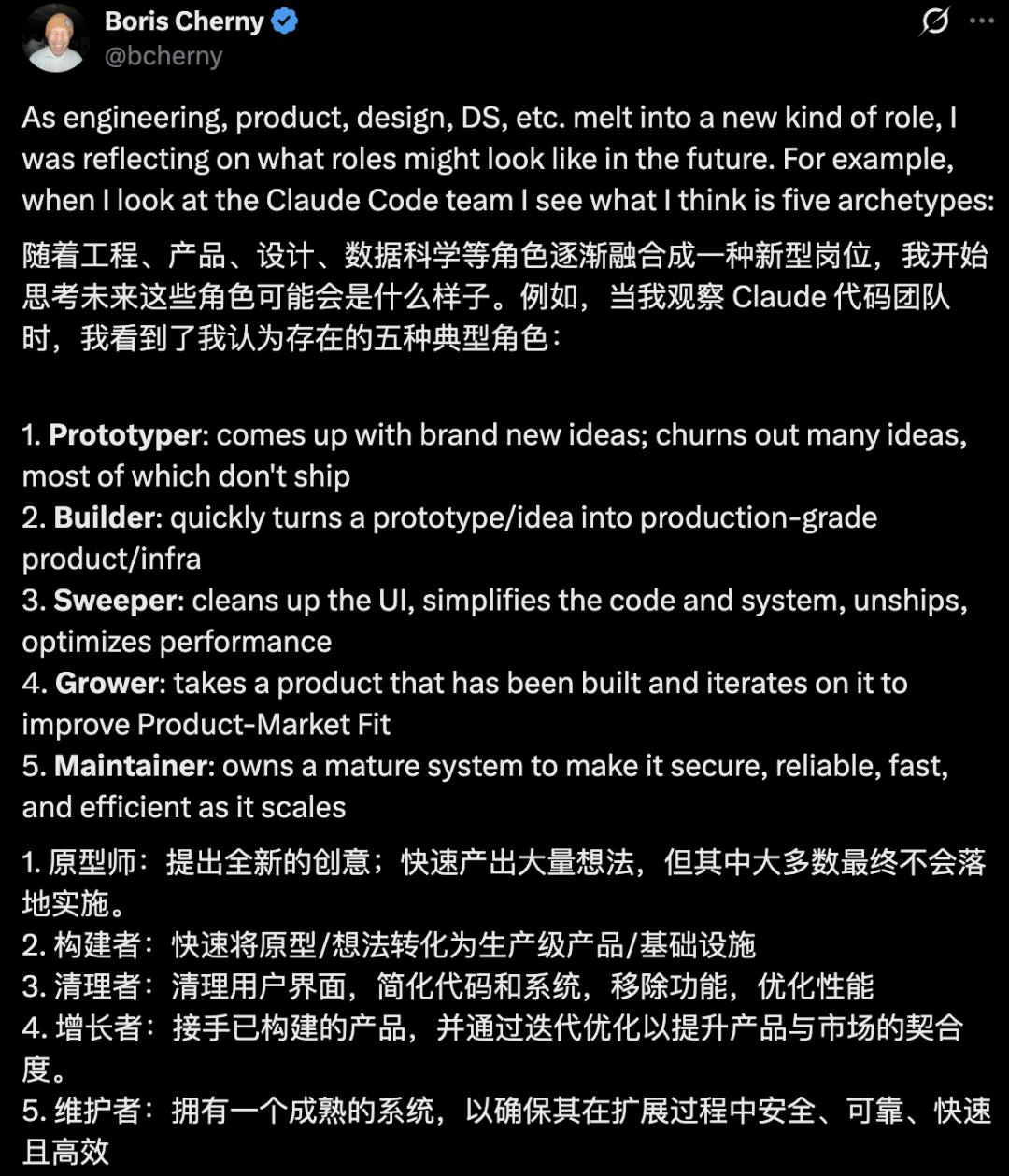
This list is worth the attention of every developer.
Kun Chen, a senior engineer with experience at Meta and Microsoft, replied that he's never one to label people with "roles" because it's easy for people to fit into a category and think, "Oh, that's what I do," and then stop questioning themselves.
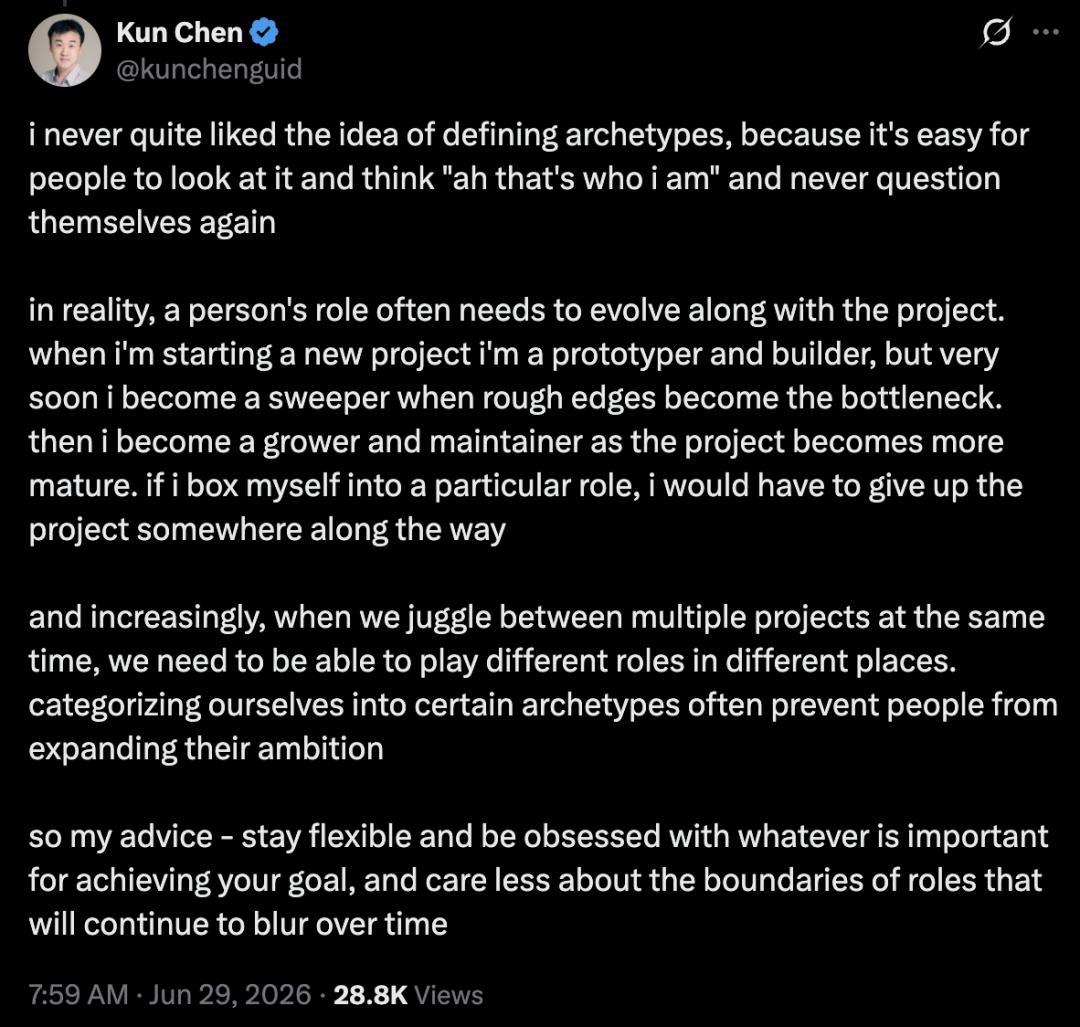
In Kun Chen's view, roles should evolve with the project:
At the start of a new project, he's a prototyper and a builder; when detailed issues arise, he immediately becomes a sweeper; when the project matures, he turns into a grower and a maintainer. Locking oneself into a single role means having to let go of the project midway.
Cherny fully agrees with Kun Chen's view: Roles naturally change with projects and time.

Both of them have observed the same thing: In the programming world, the boundaries of job titles are blurring, and a person's identity is no longer determined by their business card.
This is exactly what Cherny's list implies: The yardstick for measuring developers has changed, from "what job title you have" to "what role you're playing at this moment."
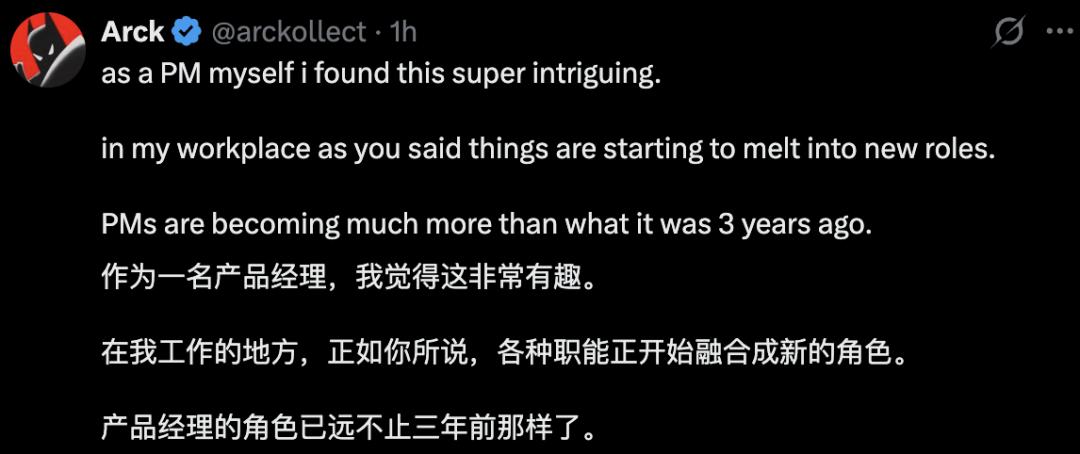
This change isn't limited to engineers.
A product manager commenting under Cherny's post said that this also resonated with him: Just as Cherny said, in his team, job titles are merging into new roles, and today's product managers are no longer the same as they were three years ago.
The same goes in reverse.
When Anthropic released Fable 5, the Claude Code team also mentioned a detail: After Fable 5, developers were pushed into the role of product managers.
Previously, they focused on whether Claude wrote the code correctly; now, they focus on whether it's doing the right thing.
It's not just the programming profession that's experiencing the blurring of boundaries.
The Five Roles in the Claude Code Team
Cherny has described each of these five roles.
Role 1, Prototyper.
They're the ones who come up with new ideas, throwing out dozens of concepts in one go, most of which won't make it to production.
Role 2, Builder.
They transform a rough prototype into a product and infrastructure ready for the production environment.
Role 3, Sweeper.
They clean up the interface, simplify the code, retire useless functions, and optimize performance bit by bit.
Role 4, Grower.
They take over an established product and refine it to improve its product-market fit (PMF).
Role 5, Maintainer.
They safeguard a mature system, ensuring it remains secure, reliable, and fast as it expands.
Cherny specifically noted that many people take on two to three roles simultaneously, and these roles have nothing to do with job titles.
Within Anthropic, some designers are in the first role, some in the second, and some in the third. The same goes for engineers, PMs, and data scientists, who are spread across these five categories.
What defines you isn't the title on your business card, but the work you're doing at this moment.
He also added a common role combination formula:
A new product that hasn't found its PMF needs people skilled in roles 1 + 2 + 3. A mature product that's already up and running relies more on roles 3 + 4 + 5.

Everyone Wants to Be a Prototyper
These five roles are of equal importance, but in the developer community, they're treated differently.
Prototypers who come up with ideas seem smart, and builders who can create something from scratch seem capable. That's why most job postings and resumes emphasize these two types of roles.
Someone replied under Cherny's post, saying that sweepers are the most undervalued and least-hired role, and every team is hoarding prototypers like they're collecting Pokémon.

Hardly anyone wants to take on the remaining three roles, especially the sweeper role.
Deleting code, retiring functions, cleaning up others' messes, and optimizing slow parts of the system aren't glamorous tasks. They can't be used to boast in weekly meetings, and the best you can get for doing them well is a "the system didn't break down."
A developer bluntly stated that sweepers are the most undervalued and least-recruited role.
However, AI coding has disrupted this ranking.
While everyone is still competing to come up with the best ideas, the truly scarce role has become the sweeper who wraps things up.
The Most Unappealing Job Is Becoming the Most Crucial
The reason is quite simple.
When a model can generate a prototype in minutes and write thousands of lines of code in one go, "coming up with ideas" and "building from scratch" are exactly what AI is best at and the first tasks it takes over.
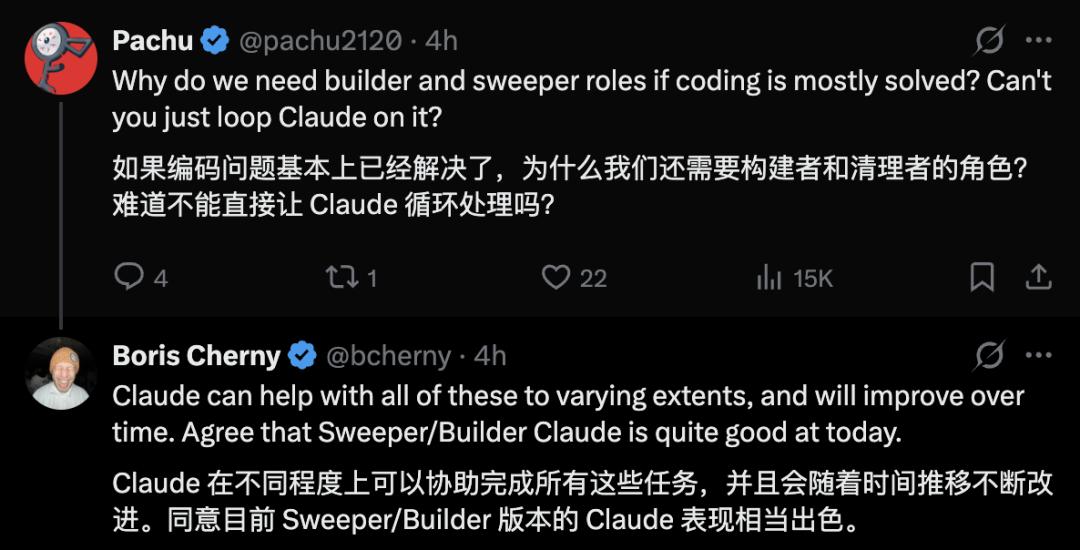
Someone asked under Cherny's post, "Since coding is basically solved, what do we need builders and sweepers for? Can't we just let Claude run in a loop?"
Cherny's answer was straightforward: Claude can indeed take over these tasks to varying degrees and will only get better. Sweeper Claude and Builder Claude are already doing a pretty good job today.
However, just because he acknowledges that the machine can do the job well doesn't mean humans can step back. While the machine can do the cleaning work, it can't take on the responsibility. Deciding which line of code to delete, spotting AI errors at a glance, and taking responsibility when something goes wrong still require human intervention.
The more AI can handle the dirty and tiring work, the more valuable the role of the sweeper, the one who can make decisions and wrap things up, becomes.
There's an easily overlooked detail here: The productivity boost brought by AI isn't mainly about "doing the same work faster," but about "doing a lot more work."
More features are launched, more code is added to the repository, and more experiments are conducted. Once the generation process speeds up, the mess also grows. Who will clean it up? The sweeper.
What's even more concerning is that the code review process is weakening at a visible pace.
According to Business Insider, in the past six months, the proportion of AI-generated code that goes directly into production without separate human review has increased significantly, and the survival rate of this code is even higher.
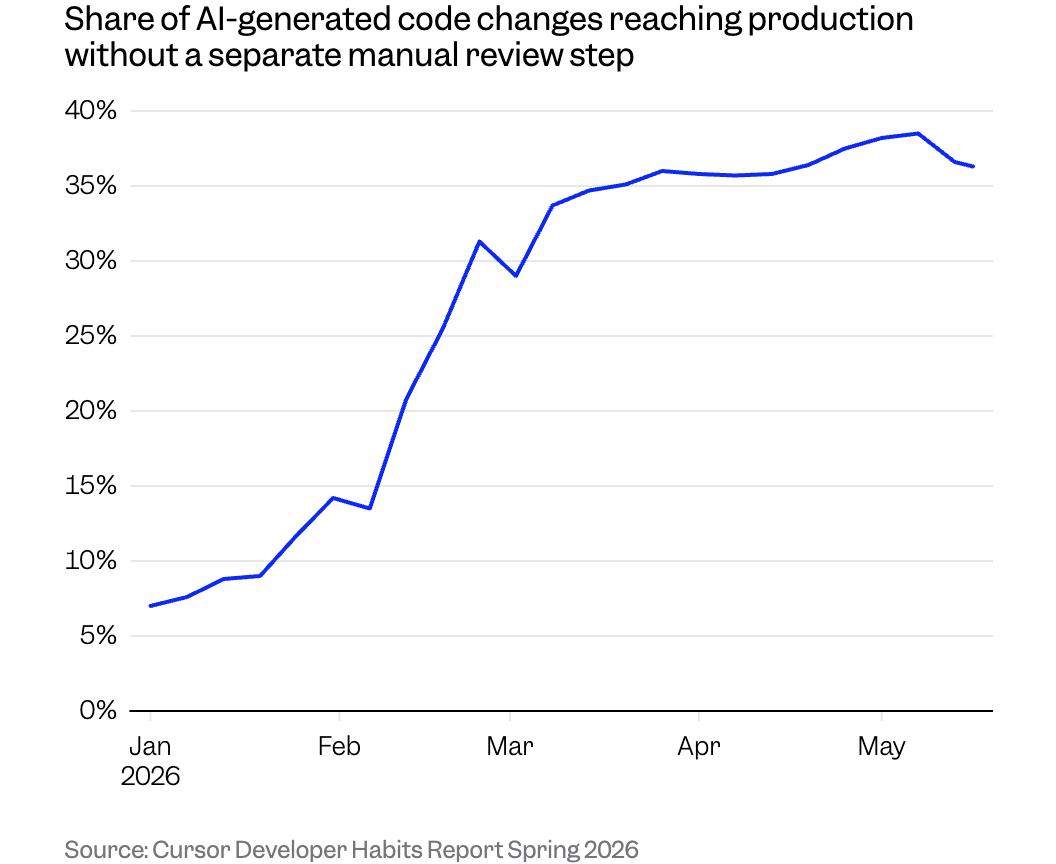
Since the beginning of 2026, the proportion of AI code changes that enter the production environment without independent human review has soared from about 7.0% to nearly 38.5%, more than quintupling in six months. The human "review before release" checkpoint is being skipped on a large scale. (Source: Cursor "Developer Habits Report" Spring 2026 Edition)
Developers are becoming more daring to hand over entire processes to the agents to run on their own.
After removing the human review checkpoint, someone still has to take responsibility for the hidden bugs, performance bottlenecks, and security vulnerabilities in the system.
This is exactly the job of the sweeper.
The generation process is becoming cheaper, while the responsibility-taking process is becoming more valuable.
A widely circulated saying in the developer community sums this up: The best engineer isn't the one who writes code the fastest, but the one who knows when not to trust AI.
Software Engineers Are "Melting," But Your Work Remains
Taking this list a step further, the question becomes more pointed.
Since coding is basically solved and prototypers and builders can be replaced by AI, can one person with an army of agents replace an entire multi-role team?
Someone actually asked Cherny this question under his post: "What's stopping me from taking on all five roles with the help of agents?"
Cherny's answer was that Claude can "cover these roles to varying degrees" and will "continue to improve," but it won't "completely replace" them.
However, he's made the direction clear: Job titles and positions are blurring, but the work remains, just reorganized into more detailed roles and tasks.
So, let's go back to Cherny's list.
The five roles he listed won't disappear; only the title of "software engineer" will.
As AI takes over more of the idea-generation and framework-building work, what's left for humans is the role of wrapping things up and spotting problems when AI makes mistakes.
Moreover, the roles humans play will continue to change with projects: Today's sweeper may be tomorrow's prototyper for the next project.
Who you are is defined by what you're doing at this moment.
Reference materials:
https://x.com/bcherny/status/2071379474277613732?s=20
https://www.businessinsider.com/ai-coding-agents-cursor-human-review-2026-6
This article is from the WeChat official account "New Intelligence Yuan", author: ASI Revelation. It is published by 36Kr with permission.