Established for 9 months with 440 million yuan of on-hand orders, "SatStar Aerospace" has completed two consecutive rounds of financing of hundreds of millions of yuan | 36Kr Exclusive
Text | Azhi
A dark horse has emerged in the field of spectral quantitative remote sensing.
36Kr Future Industry has exclusively learned that Shanghai Puxing Aerospace Technology Co., Ltd. (hereinafter referred to as "Puxing Aerospace"), a provider of optical payloads and micro-nano satellite system solutions, has recently completed two rounds of financing, namely Angel + and Pre - A, with a cumulative scale of hundreds of millions of yuan.
The Pre - A round was jointly led by Guotai Haitong, Shangrong Capital, and Sinan Fund, with Xuhui Capital, Lianrong Zhidao, and Jinpu Investment following up. Old shareholders Lenovo Holdings, Dingnong Technology, and Puhua Capital also participated in additional investment. The investors in the Angel + round were Lenovo Holdings and Puhua Capital.
Puxing Aerospace is an enterprise that we have been paying long - term attention to. Within 9 months of its establishment, it has completed a total of 3 rounds of financing, with a cumulative capital scale of nearly 300 million yuan. Founder He Xiaojun revealed that a new round of financing has been launched, and it is expected to complete two more rounds of financing within the year to provide financial support for the construction of the 1024 - satellite Puxing constellation and the company's subsequent development.
This company, which has been established for less than a year, is seizing the window period of the industry's explosion with an extremely fast financing speed.
Quantitative, a Trillion - Dollar Application Market
How to understand what exactly Puxing Aerospace is trying to do?
The core keyword is "quantitative".
In the field of commercial aerospace, in the past decade, whether it was SpaceX, Planet Labs, or Rocket Lab, successful commercial companies have opened up new growth poles in the market by finding new paths and defining new paradigms. If the satellite communication represented by Starlink solves the problem of "connection", then the remote - sensing satellite constellation represented by PlanetScope solves the problem of "seeing".
In fact, "seeing" is just the first step. As the remote - sensing industry enters the era of high spatial resolution, qualitative remote - sensing services with "photographing" as the core task and clarifying "what the target is" mainly served the government and the military in the past. The market capacity largely depends on the government budget. Expanding the demand on the commercial and public ends is the key to opening up a new growth pole in the remote - sensing industry. However, the commercial end needs quantifiable decision - making basis. Simply put, it is from "seeing" to "measuring accurately". For example, customers in industries such as finance and quantitative analysis need quantitative remote - sensing services that can directly improve the profit margin of transactions.
From a technical perspective, the leap in quantitative ability mainly comes from the performance improvement in three dimensions:
Firstly, the subdivision of the spectral dimension. Theoretically, every substance has a unique spectral fingerprint. As long as the spectral resolution is high enough, accurate identification can be achieved. Traditional remote - sensing satellites usually have one panchromatic channel (black and white) plus a few spectral channels such as red, green, blue, and near - infrared, which can only roughly distinguish surface types. However, high - resolution spectral remote - sensing satellites can have dozens or even hundreds of spectral channels, achieving the "integration of spectrum and image" and identifying the subtle spectral "fingerprints" of ground objects to support quantitative analysis.
Secondly, the guarantee of radiation accuracy. The data obtained by satellites is not only images but also physical quantities after strict radiometric calibration and atmospheric correction, such as surface reflectance, chlorophyll concentration, and water suspended sediment content. This requires the satellite to be equipped with a high - precision optical main payload and a radiometric calibration device to complete high - precision radiation traceability. At the same time, on - orbit synchronous atmospheric measurement is carried out to eliminate the atmospheric interference in the transmission path of imaging light, ensuring that the remote - sensing images have high radiation accuracy and can accurately reflect the spectral characteristics of ground objects. In fact, without radiation accuracy, no matter how the spectral dimension is subdivided, it is difficult to meet the needs of the commercial end.
Thirdly, the improvement of coverage frequency. For aerospace remote - sensing data sets to truly empower all industries and achieve a decreasing marginal cost, it is necessary to build a data set with relatively fine time, space, and spectral dimensions. However, traditional remote - sensing is limited by weather conditions, the number of satellites, and mission - driven factors. The time series of images is incomplete, resulting in a too - sparse time dimension, making it impossible to quantitatively analyze the change law of surface characteristics over time and difficult to use as the main decision - making basis.
Simply put, to upgrade from qualitative remote - sensing to quantitative remote - sensing, it is necessary to crack the spectral "fingerprint", eliminate the atmospheric "noise", and have a high coverage frequency that is not mission - driven to solve the industry pain points of missing dimensions, insufficient accuracy, and lack of timeliness.
This is also the problem that Puxing Aerospace is currently solving.
As a team that was the first in China to master real - time spectral quantitative remote - sensing technology and promote the mass production of spectral quantitative remote - sensing satellites, Puxing Aerospace focuses on the R & D and mass production of multi - category optical remote - sensing payloads and 20 - to 50 - kilogram business - type micro - nano satellites.
Puxing's planned product matrix covers three major sectors: payload products, satellite products, and technical services:
The payload product line includes multiple products in two categories: earth - imaging and non - earth - imaging. Representative products include high - resolution spectral cameras, atmospheric synchronous detection spectrometers, hyperspectral spectrometers, and situational awareness cameras; The satellite product line mainly includes spectral quantitative remote - sensing satellites, scientific exploration satellites, and situational awareness satellites; Technical services cover on - board verification, payload hosting, and data platform services.
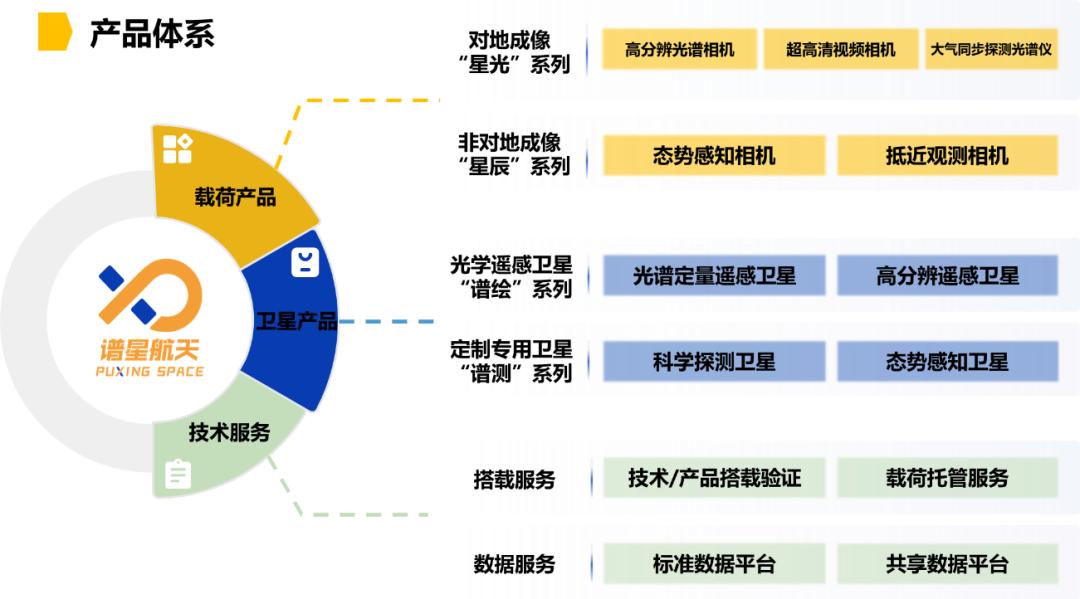
Puxing Aerospace's product system
Currently, the payload and satellite sectors are the key focuses for the current business promotion.
In the past six months, multiple core products of Puxing Aerospace have completed project - establishment demonstration and detailed design and entered the stage of prototype development and manufacturing. The latest progress we learned is that Puxing Aerospace is currently making intensive efforts around the development and verification of the customer's first - launch satellite. At the same time, the detailed design of two spectral quantitative remote - sensing verification satellites of the company has also been completed, and they are planned to be launched in the first quarter of 2027.
Build a "Super Pigeon Flock"
In 2006, He Xiaojun graduated from the School of Communication Engineering of Jilin University and was recommended for postgraduate and doctoral studies at the Changchun Institute of Optics, Fine Mechanics and Physics, Chinese Academy of Sciences. The next year, he was selected to join the newly established small - satellite team. In 2014, China's first commercial satellite company was established with this team as the core.
Before founding Puxing Aerospace, He Xiaojun had been deeply involved in the field of optical payload and satellite R & D for 18 years. He served as the chief designer of multiple satellite models in leading commercial aerospace companies, and has presided over the development and launch of a total of 55 satellites. As the main person in charge, he set new domestic records for multi - satellite launches with "26 satellites in one rocket" and "41 satellites in one rocket" twice in a row, mastered the core technologies of the entire process of payload and whole - satellite development, and has the ability of high - complexity system integration and contract fulfillment and delivery.
During this period, he also tracked and studied the latest trends in the remote sensing field in Europe and the United States to find new ideas for technological innovation.
He found that since 2024, commercial aerospace enterprises represented by the US Planet, Spain's Xoople, India's Pixxel, and Canada's Wyvern have all shifted their strategic focus to the commercial market. "This shift stems from a common industry pain point: a single government budget can no longer support the commercial closed - loop of large - scale constellations. Only by deeply exploring the core value of remote - sensing images in enterprises' cost - reduction and efficiency - improvement and using large - scale commercial applications to support satellite operations can a virtuous cycle of the industry be achieved."
In He Xiaojun's view, taking agricultural product futures trading on the commercial end as an example, the annual trading volume is in the level of hundreds of trillions of dollars. "Even if Puxing only increases its profit by one - thousandth, it is an extremely considerable figure. The development ceiling of the commercial market is so high that it is almost invisible, which forms a continuous and strong driving force for the technological iteration and service upgrading of remote - sensing satellites."
In fact, some foreign companies have verified this direction. For example, Planet, the world's largest commercial remote - sensing constellation operator, operates PlanetScope (often called the "pigeon flock"), which consists of more than 200 Dove/SuperDove satellites and can achieve daily global coverage of the earth's land and key sea areas. Its advantages lie in time resolution and scale, but at present, its shortcoming is still the weak spectral dimension and quantitative ability. It has also been transforming to data services in recent years, but limited by the generational gap in satellite hardware, the transformation needs some time to be implemented.
Looking at the domestic market from the perspective of industry trend changes, He Xiaojun believes that with the rapid development of China's commercial aerospace industry, whether it is the supply side, the demand side, or the technology side, it has entered an acceleration cycle with basic conditions in place.
From the supply - side perspective, with the maturity of the commercial aerospace industry chain, the cost of satellite manufacturing and launch has decreased significantly. In the past, the cost of a traditional high - resolution remote - sensing satellite was hundreds of millions of yuan, but now the manufacturing cost of a 50 - kilogram micro - nano satellite has dropped to the level of several million yuan, and the launch cost has also decreased from more than 100,000 yuan per kilogram to the range of 50,000 - 70,000 yuan. When "being able to build and launch" becomes a reality, constellation networking becomes economically feasible. Puxing Aerospace's planned networking plan for 1024 satellites is also based on the premise that the cost is controllable and has room for continuous decline.
From the perspective of demand space, the domestic remote - sensing industry needs to find new incremental markets. For example, agriculture needs to accurately measure the growth and pests of crops, the mining industry needs to lock in ore - prospecting target areas, the financial industry needs high - frequency and accurate yield forecasts to assist in futures trading, and the environmental protection industry needs to monitor water pollution and atmospheric composition in real - time... In fact, the demand on the commercial end has always existed, but it has been unable to be effectively met due to the limited quantitative ability of satellites and the effectiveness of constellations.
From the perspective of technological development, a new variable is the emergence of the capabilities of large AI models. The development of deep learning and computer vision enables machines to automatically extract features, build models, and complete classification and recognition from massive spectral data, which was almost impossible to achieve relying only on manual interpretation in the past.
He Xiaojun mentioned, "People can't understand hyperspectral data. Information mining and extraction can only be done by AI algorithms. Without AI, there is no application of hyperspectral data. Without hyperspectral data, AI can't mine enough information."
So from a technical perspective, spectral quantitative remote - sensing is also one of the most promising combination points of "AI + aerospace" for industrial implementation.
Based on the above trends and industrial foundation, Puxing Aerospace established its core strategy since its establishment: to deeply combine the "quantitative ability of optical remote - sensing" with the "engineering ability of satellite mass production", and plan to launch a total of 1024 hyperspectral quantitative satellites in batches to build the world's first hyperspectral quantitative remote - sensing constellation with full - sky coverage, providing customers with hourly atmospheric monitoring, full - sky coverage hyperspectral images, and high - precision route monitoring services.
"Puxing Aerospace needs to network thousands of satellites to achieve high - timeliness and high - performance coverage, which is the origin of Puxing's plan for 1024 satellites." He Xiaojun mentioned that currently, the industrial foundation is complete, the market demand is clear, and the team's experience and technical reserves are mature. However, for a start - up company, to achieve the goal of "networking thousands of satellites", a large amount of financial support is also needed.
"We are very lucky to catch the excellent window period of the great explosion of China's commercial aerospace." He Xiaojun mentioned that currently, Puxing Aerospace is well - prepared in terms of funds, and will complete two more rounds of financing by the end of this year to ensure the company's accelerated progress in subsequent payload R & D, constellation construction, and remote - sensing applications.
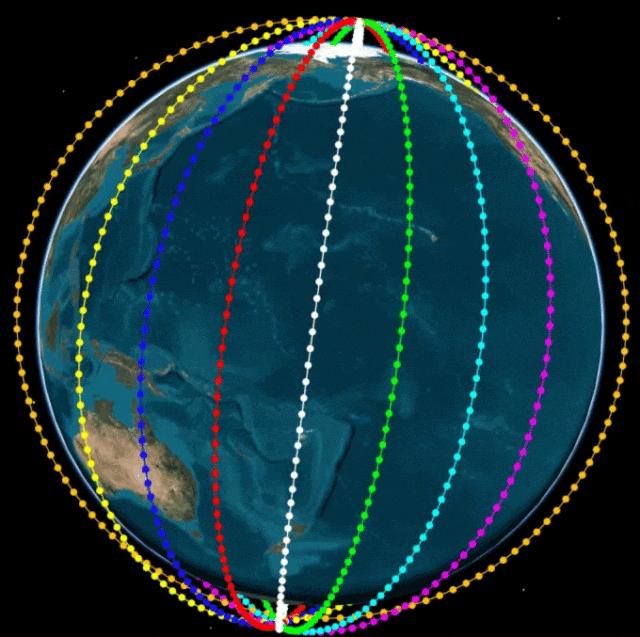
Configuration diagram of the "Puxing Constellation"
Make Money Earlier
Completing the constellation construction and providing continuous operation services is a long - term goal. But before that, the entrepreneurial team also needs to answer a question: How does the company survive?
In the era of mobile Internet, countless value connections were created. Relying on scale expansion, the marginal cost approached zero infinitely, achieving exponential explosion and growth. The situation changed rapidly. As long as the general direction was right, a war could be won quickly by burning money. However, in the era of hard technology, there is no shortcut of burning money for time from technology verification to engineering scale - up.
How to survive? The subtext of this question is that today's start - up companies cannot rely solely on external blood transfusion. From day one, they may need to think about where your customers are and what products to make money from.
In fact, in Puxing Aerospace's product sequence, the three sectors of payload, satellite, and technical service follow a progressive logic, from selling payloads, selling satellites to selling services, and finally becoming a spectral quantitative remote - sensing data operator with the ability to develop core payloads and satellites.
In the first stage, selling payloads to make money from technological innovation, providing users with characteristic optical payloads, supplementing the early cash flow to support R & D, and rapidly iterating products through on - orbit verification.
In the second stage, selling satellites to make money from engineering scale - up, encapsulating the capabilities into a standardized whole - satellite platform, increasing the order value, polishing a mature manufacturing - end supply chain and constellation operation ability for subsequent satellite networking, and gradually training AI processing and analysis ability while "accumulating data".
In the third stage, selling services to make money from continuous subscriptions. As the "Puxing Constellation" gradually achieves the networking goal, its business focus will also shift from hardware sales to remote - sensing data operation and remote - sensing information services. Relevant institutions in the financial and quantitative fund fields are expected to become its first - batch paying customers.
It is reported that although Puxing Aerospace is still in the stage of payload verification and the development of the first - launch satellite, there are already customers from the application end who have pre - ordered its on - orbit services.
The latest business progress we learned is that as of now, Puxing Aerospace has signed formal contracts with a total value of 440 million yuan, covering satellite customization, payload development, and technical services.
The scale of the intended orders in the negotiation stage is 620 million yuan, and the scale of the business intended orders under demonstration is 820 million yuan. In addition, in terms of constellation co - construction and sharing, Puxing has also reached strategic cooperation intentions with several enterprises.
He Xiaojun mentioned, "Benefiting from the accurate market positioning, the company's overall order pool is relatively well - stocked. Currently, many customers actively contact Puxing. This trust from the demand side is also the greatest affirmation of the Puxing team's past resume and engineering ability."
It is reported that the company's first order worth over 100 million yuan comes from a situational awareness constellation project. The first - launch satellite developed by Pux