How much worse is the domestic Lixun graphics card priced at 3000 yuan compared to the 5060Ti at the same price point?
Almost three years ago, a graphics card called Moore Threads S80 made its debut, showing everyone that domestic manufacturers could also produce independent graphics cards.
Although its performance and drivers still lag far behind those of top - tier manufacturers like NVIDIA and AMD, we are, after all, starting from scratch, and the process from nothing to something is always a long one.
After that, including Tony, we began to wonder if there would be a second domestic graphics card manufacturer brave enough to launch a new graphics card.
So, three years later, we finally saw a company called Lisuan Technology launch its own retail graphics card — the Lisuan LX 7G100.
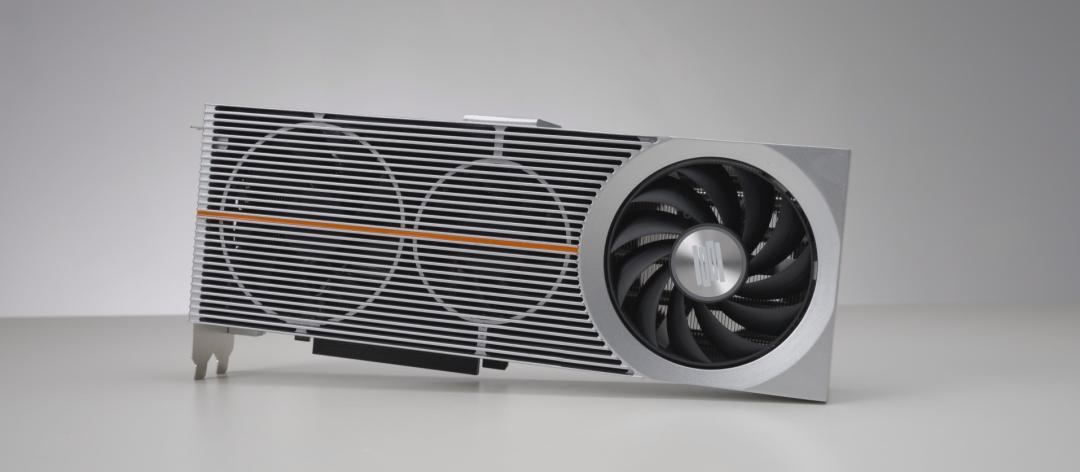
This graphics card, priced at 3,000 yuan, once again caught the attention of many hardware technology enthusiasts, as there are many questions they want to know, including but not limited to —
What is its actual performance? How is the driver adaptation progressing? Can it play games? How much does it lag behind NVIDIA graphics cards in the same price range? And how much progress has it made compared to Moore Threads S80?
So, on the day the Lisuan LX 7G100 was released, we placed an order out of our own pocket to buy this graphics card, just to test it for everyone!
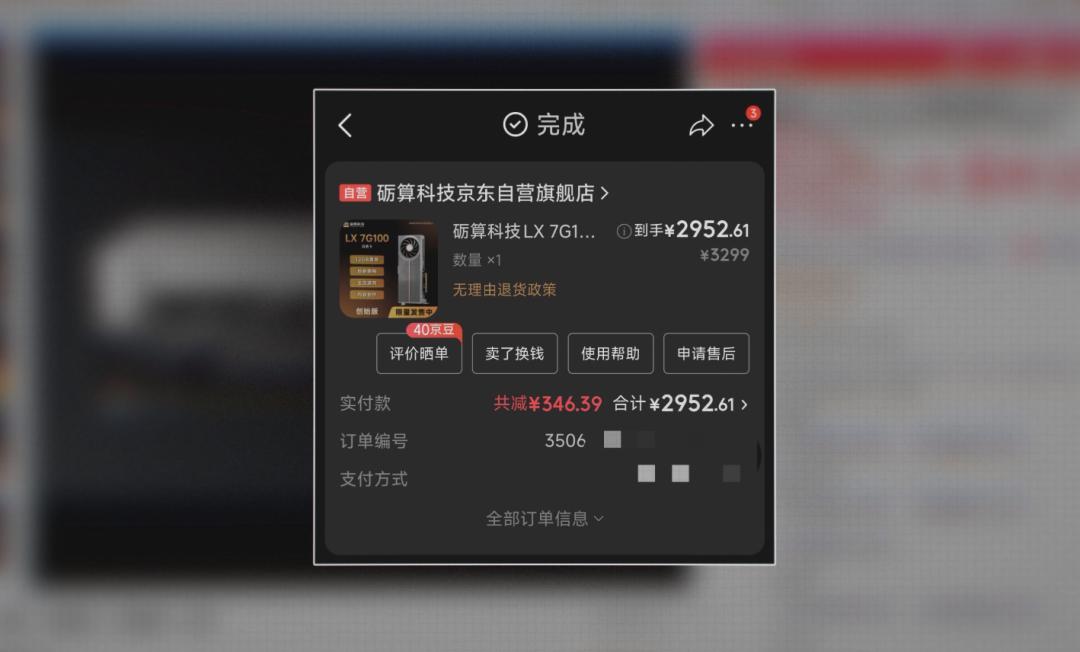
Moreover, adhering to the principle of "the more excitement, the better", we also brought in the Moore Threads S80 and the NVIDIA RTX 5060 Ti for a new round of tests.
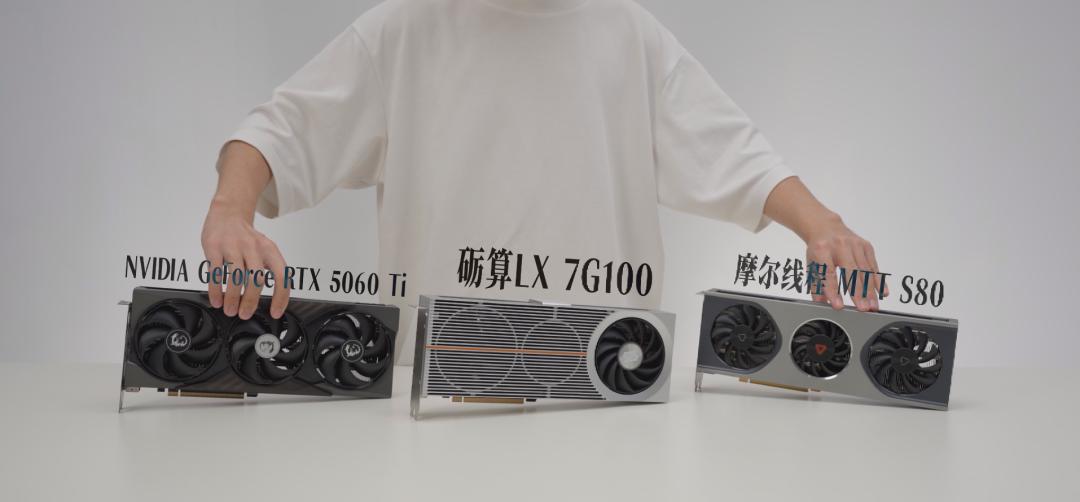
We did this not for anything else, but just to see how much progress this Lisuan graphics card has made compared to previous domestic graphics cards and how big the gap is compared to the benchmark in the same price range.
Here's a quick summary in advance: This is a domestic graphics card with both good and bad aspects. It makes constant strange noises, and there are frequent black screens and flickering, but it can run "Cyberpunk 2077" smoothly at 2K resolution... Yes, it's at high - quality 2K resolution.
However, before revealing the actual test data of "Cyberpunk 2077", let's warm up with 3D Mark first. In several tests of 3D Mark, the gap is quite significant...
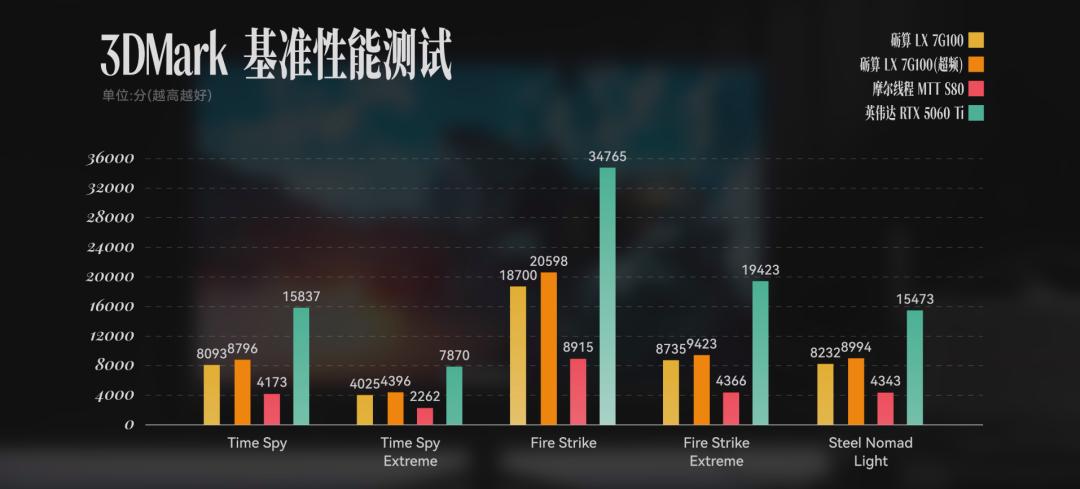
The score of the Lisuan 7G100 is twice that of the Moore Threads S80, and the scores of the 5060 Ti in most test items are also twice that of the Lisuan 7G100. It can only be said that the gap is obvious...
Even when the overclocking mode is enabled, it still can't win despite its best efforts.
Next, we ran a video rendering benchmark in the productivity direction. No one would buy the Moore Threads or Lisuan for video editing, right? Right?
This time, the result is rather mediocre. The score of the 7G100 is even a bit lower than that of the S80, while the score of the 5060 Ti is extremely high...
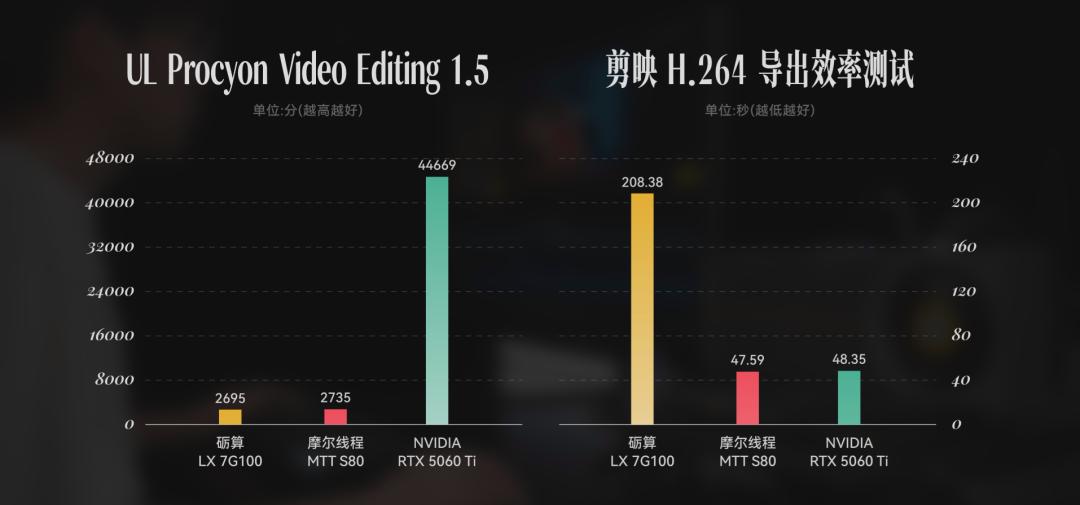
With such benchmark scores as a basis, just when we thought that the two were just "amateurs competing" in video - related tasks, it turned out that the export speed of H.264 4K 30 - frame videos in Jianying using the Moore Threads graphics card was even one second faster than that of the 5060 Ti. It's a bit amazing...
However, the Lisuan 7G100 took a full 3 minutes and 28 seconds, which is quite puzzling because, in fact, the Lisuan graphics card has H264 hardware decoding, but Jianying doesn't know how to call it...
It can't be said that it's a complete failure, but it's certain that the cooperation between the two manufacturers during this initial release is not good enough. The graphics card has been officially released, but the support from Jianying hasn't been arranged yet. We can only hope that it will be improved as soon as possible...
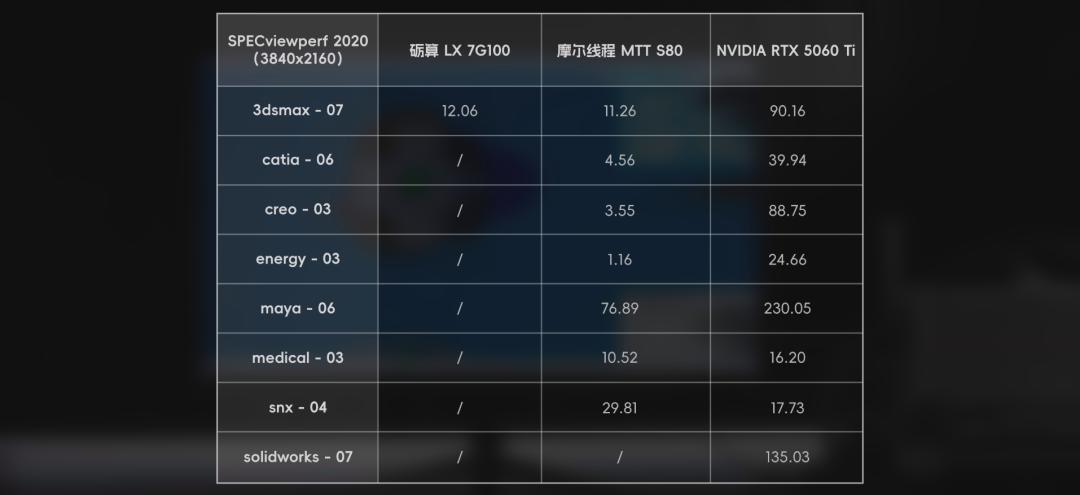
Not only in terms of rendering speed, when we tested the productivity benchmark software SPECviewperf 2020, there were a total of 8 test items. The 7G100 only successfully measured the score of 1 item, while the S80 could measure 7 items, and the 5060 Ti completely outperformed them. It's like they are in two different worlds.
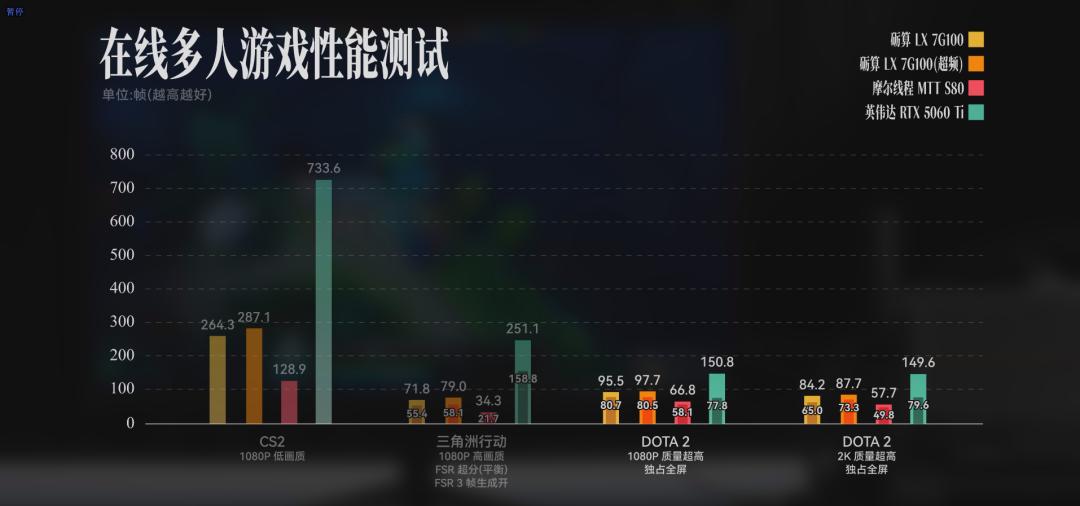
Next is the game comparison session that many people are looking forward to. We are also very curious about how big the gap is between the gaming performance of the Lisuan 7G100 and the 5060 Ti.
Let's start with CS2. Just when we thought that the 200 - plus frames per second of CS2 on the Lisuan graphics card was quite high, the 5060 Ti could directly reach over 700 frames per second...
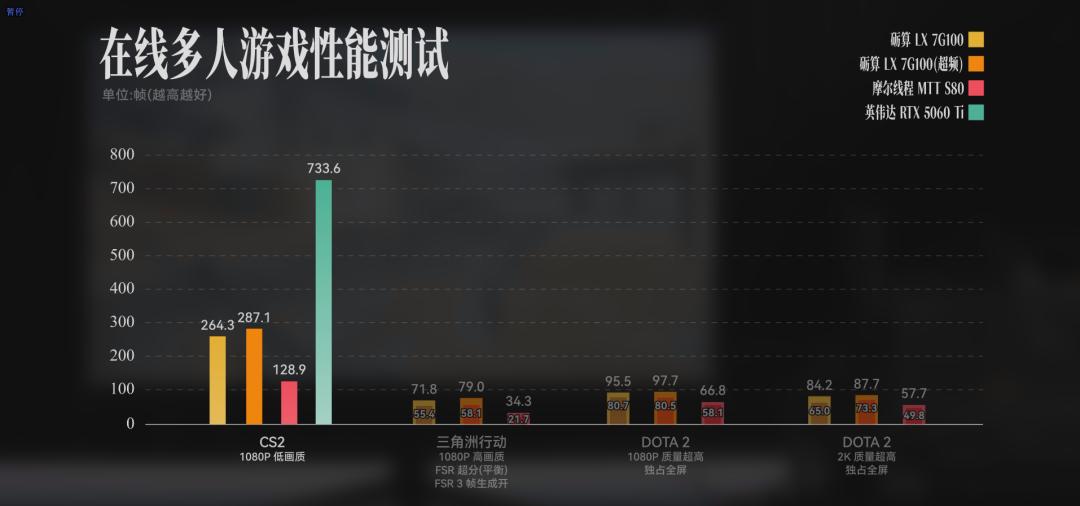
The frame rate in "Delta Force" also increased several times. The Lisuan graphics card could only reach 80 frames per second after overclocking with all its might, while the other card could easily reach over 200 frames per second. This is the gap, friends...
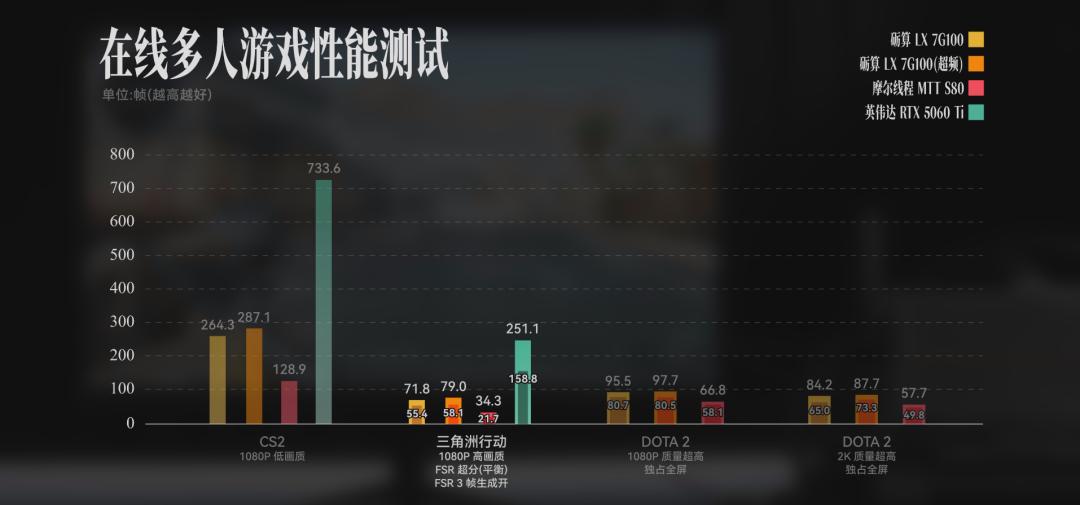
DOTA 2 is still the most "equalizing" game. In comparison, there is only a difference of 50 frames. However, after increasing the image quality from 1080P to 2K, the frame rate of the 7G100 dropped by 10 frames, while the 5060 Ti hardly changed.
So far, the preliminary game tests are over. The following AAA - level games will really put the graphics card to the test.
Moreover, to keep up with the times, we gave the Lisuan graphics card a surprise test by trying "Forza Horizon 6" and "007: First Blood", which were just released recently!
Well... it turned out that neither of these two games could be launched. It was all in vain.
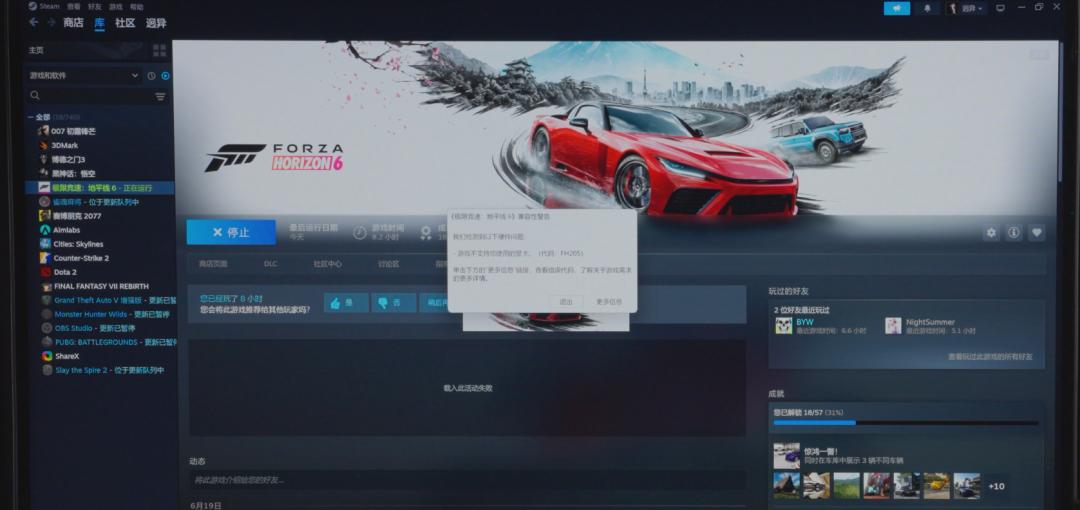
Although the driver was updated later, "Forza Horizon 6" could be run, but the frame rate was only a pitiful single - digit...
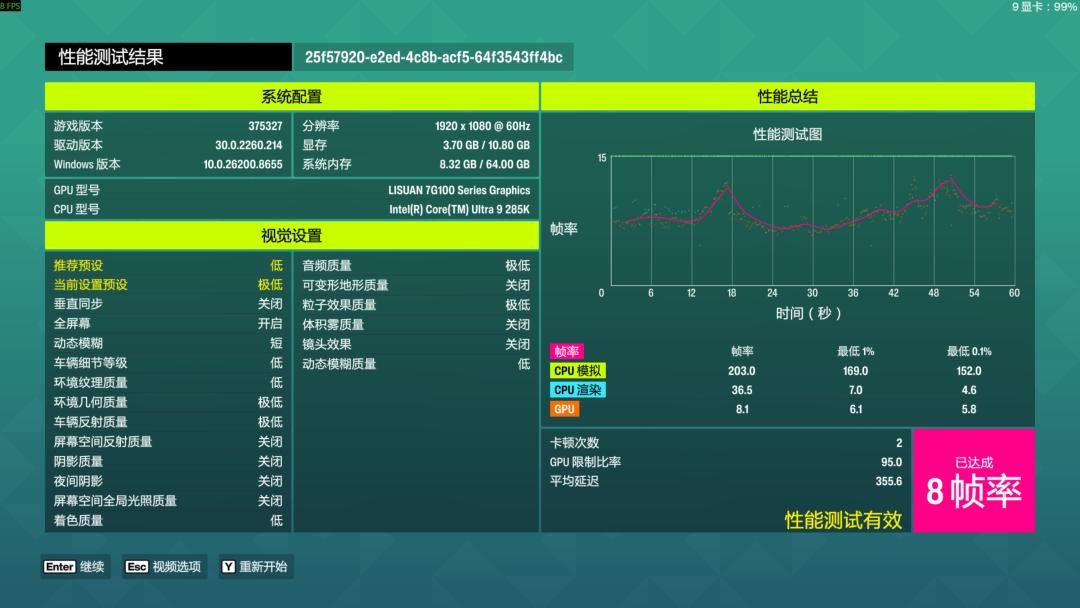
However, this is in line with our expectations. Even NVIDIA frantically updates its drivers every time a new game is released, not to mention our domestic graphics cards that are just starting out. We can only say, "Understanding is everything..."
Since the new games can't run, let's continue with the classic "Cyberpunk 2077". This time, I can tell you very responsibly that the Lisuan graphics card gave us a big surprise in this part!
Let's start with 1080P high - quality settings. Even without enabling anything, the Lisuan 7G100 can already reach over 40 frames per second, while the S80 can only reach a pitiful dozen frames per second.
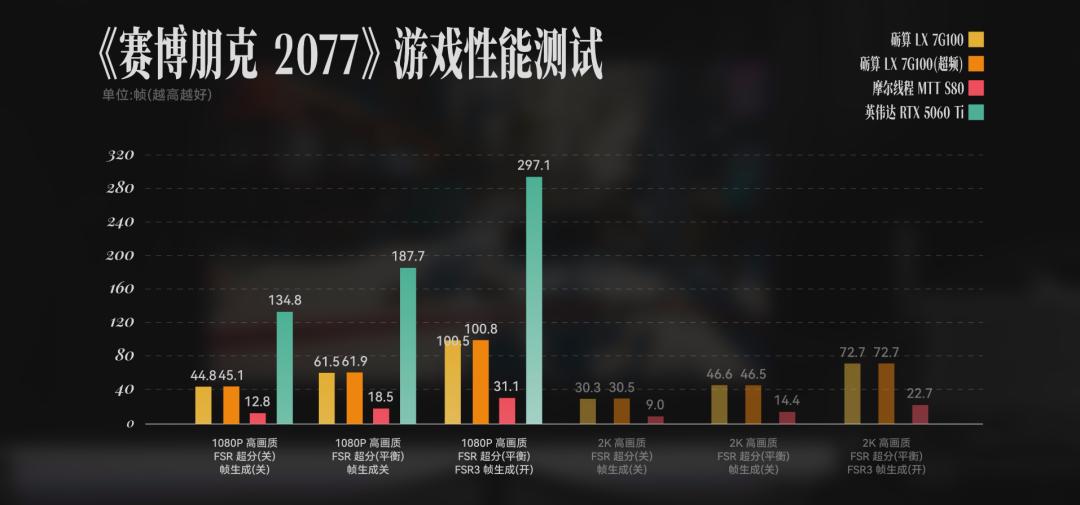
Even more surprisingly, after enabling frame generation, the frame rate of the 7G100 can actually break through the 100 - frame mark. This is indeed stronger than we expected...
At this time, I don't know whether to say that the Lisuan graphics card has better game adaptation or that AMD's FSR is really too powerful.
However, the 5060 Ti still wins without any suspense. Although the 7G100 can use FSR and frame generation to increase the frame rate, the 5060 Ti can increase it even more...
So, the question is, if we seriously increase the resolution to 2K, can the 7G100 still hold up?
The answer is yes!
Not only can it hold up, but it can even reach 72 frames per second after enabling frame generation!
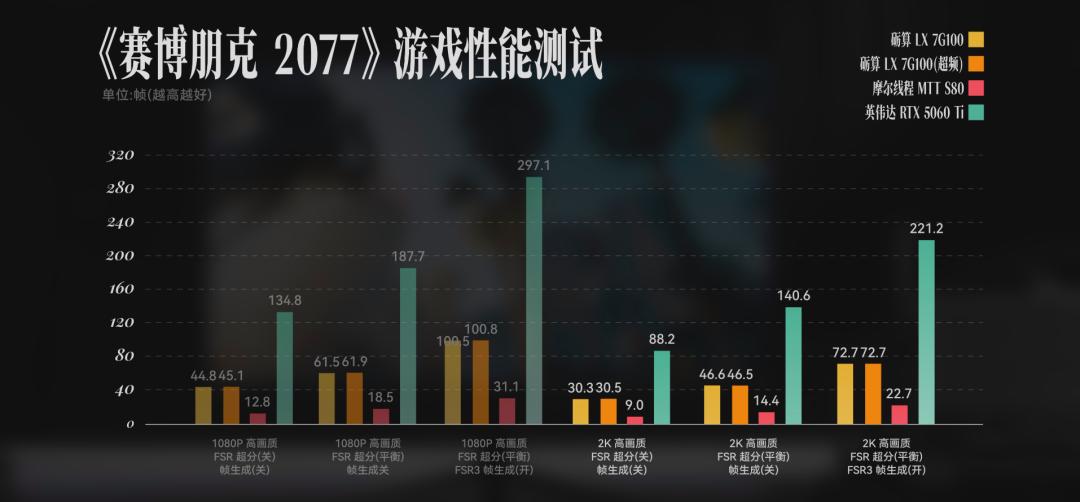
We can actually play "Cyberpunk 2077" at 2K resolution and high - quality settings with a frame rate of over 70 frames per second on a domestic graphics card. This progress is simply a leap compared to the Moore Threads S80.
However, the gap is also obvious. The 5060 Ti can already reach over 80 frames per second without enabling anything, and it can even reach over 200 frames per second with all settings enabled.
We also tested "The Dark Pictures Anthology". However, the test results of this game didn't give us much of a surprise. It can only be said to be mediocre. At 1080P high - quality settings, even with overclocking and FSR enabled, it can only reach 37 frames per second. After enabling frame generation, it can barely reach the 60 - frame passing line.
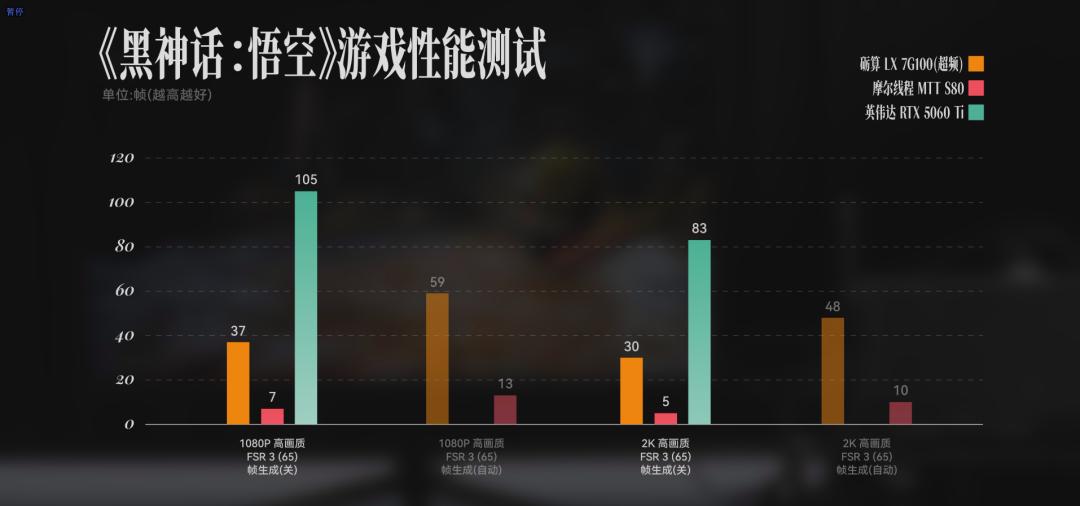
At 2K resolution, it's even worse, only hovering between 30 and 40 frames per second. However, compared to the single - digit frame rate of the Moore Threads S80, this progress is still quite significant.
So far, we can make a preliminary summary of the Lisuan LX 7G100 graphics card. That is, its performance is indeed not bad, but there is still a lot of room for improvement in terms of drivers.
Whether it's for video decoding, adaptation to productivity software, or various games of different sizes, driver and software adaptation are always difficult problems that domestic graphics card manufacturers must find a way to solve.
