MCU for optical modules has become a critical component
Recently, MCUs for optical modules have attracted significant attention.
Price hikes are the most obvious signal. Since the beginning of this year, many domestic MCU manufacturers have issued price increase notices. In the communication field, price increases generally range from 15% to 20%, and for some special - specification products, the price has even been raised by over 50%. The industry estimates that the overall price of domestic optical communication MCUs has increased by about 40% since the start of this year.
The impact is also evident on the order side. A large number of overseas AI power supply and optical communication companies are starting to purchase domestic MCU chips on a large scale to meet the rapidly expanding demand for computing power and AI power supplies.
The boom in AI computing power construction has boosted the shipment volume of AI servers. Consequently, the demand for optical modules has skyrocketed, leading to a shortage of supporting MCUs. Leading manufacturers were the first to respond. GD32 has launched dedicated MCUs for optical modules, covering a wide range of application scenarios from traditional low - speed to new - generation high - speed optical modules; Nationstech has introduced the dedicated main - control MCU N32H493 for optical modules, which features multi - voltage adaptation, strong computing power, high - speed communication interfaces, high - performance analog capabilities, and industrial - grade reliability.
What does an MCU do in an optical module?
As the core device for optoelectronic signal conversion, the optical module undertakes the crucial task of converting electrical signals into optical signals and then restoring optical signals back to electrical signals. High - speed data communication routes are handled by devices such as optical chips, Drivers, TIAs, DSPs/Retimers, and SerDes. The MCU is not on the main data communication path; it is responsible for module status management.
This management work mainly includes four categories:
First, monitoring. The MCU needs to read parameters such as the internal temperature, voltage, laser bias current, transmitted optical power, and received optical power of the module, and report them to the host through the management interface. Most of the optical module temperature, Tx/Rx power, and voltage - current data seen in network devices come from this monitoring system.
Second, control. The MCU controls laser enablement, transmission shutdown, reset, low - power mode, power supply timing, and alarm output. It also participates in some analog control through peripherals such as ADCs, DACs, comparators, operational amplifiers, and PWMs. In low - speed modules, the MCU may directly participate in laser bias and tone - modulation control; in high - speed modules, it is more responsible for configuration, monitoring, status switching, and coordination with peripheral devices.
Third, protocol. The relationship between the host and the optical module is not simply a power - supply relationship but involves a complete management protocol. Early modules mainly relied on specifications such as SFF - 8472 and SFF - 8636; after high - speed modules entered the QSFP - DD and OSFP eras, CMIS became the key interface. The module needs to inform the host of its capabilities, speed, application mode, power - consumption level, temperature status, link status, and alarm information. The MCU firmware needs to support these protocols and state machines.
Fourth, maintenance. High - speed modules are becoming more like online - manageable system nodes. Firmware upgrades, dual - Bank design, abnormal recovery, fault logging, secure boot, and module identity authentication have all started to be part of customer requirements. AI data centers require 7×24 - hour operation, and the module cannot cause link problems due to a single upgrade failure, an abnormal status switch, or a temperature drift.
Therefore, the positioning of optical module MCUs is clear: they are the internal management controllers of the module and also the interface layer between the module and the host system.
In the era of low - speed optical modules, the technical requirements for MCUs were relatively manageable. In many applications, a small - capacity Flash, a small number of ADCs/DACs, an I2C interface, temperature sensing, and basic DDM functions were sufficient. Both 8 - bit MCUs and low - end 32 - bit MCUs could meet some of the requirements.
High - speed modules have changed this situation.
Firstly, the firmware complexity has increased. 800G and 1.6T modules need to support more complex state machines, more application modes, stricter host compatibility, and private commands from different customers. The firmware is no longer just simple register configuration but a complete module management software. Flash capacity, SRAM capacity, dual - Bank design, online upgrade, and read - write protection have become important.
Secondly, the number of interfaces and voltage domains has become more complex. High - speed optical modules have more internal devices. The MCU needs to communicate with devices such as DSPs, Drivers, TIAs, power - supply chips, temperature sensors, EEPROMs, and Flash. Although I2C is still fundamental, the requirements for MDIO, SPI, I3C, 1.8V I/O, and multi - channel bus isolation have increased. Especially in high - density modules, small - package and low - power features are no longer just advantages but basic requirements.
Thirdly, the requirements for analog peripherals have been raised. When evaluating an optical module MCU, one cannot only focus on the CPU core and clock speed. ADC accuracy, DAC stability, temperature drift, reference voltage, comparator response, operational amplifier integration, and EMC performance all affect the consistency of module monitoring and control. High - speed modules have high power consumption and high heat density, and temperature and optical power drift are more obvious, placing higher requirements on sampling, calibration, and compensation.
Fourthly, reliability and security have become selection criteria. Module manufacturers and cloud providers are concerned not only about whether the MCU "can operate" but also about batch consistency, long - term stability, firmware maintainability, abnormal recovery ability, and supply - chain controllability. Once a module is deployed in a data center, the maintenance cost is much higher than the price of the chip itself.
This is why the MCU for optical modules is evolving from an application of general - purpose MCUs to a specialized sub - category of dedicated MCUs.
The MCUs used in optical modules need to meet the high - performance and high - reliability requirements of optical communication systems, and thus have stricter standards in terms of chip size, analog - function integration, and reliability. There are very few domestic manufacturers that can enter the field of high - end and high - speed main - control MCUs for 800G/1.6T optical modules.
Who is manufacturing MCUs for optical modules?
ADI in the United States first defined the high - reliability standard for optical communication MCUs; ST has achieved "high - reliability" at a lower cost through long - term verification.
ADI's optical module MCUs are at the high - end level in the first echelon of the industry. Since its entry into the optical communication field in 2005, ADI's local R & D team in China has completed the design of all four generations of optical module controllers. The annual shipment volume of about 20 models from the first three generations exceeds 2 million units.
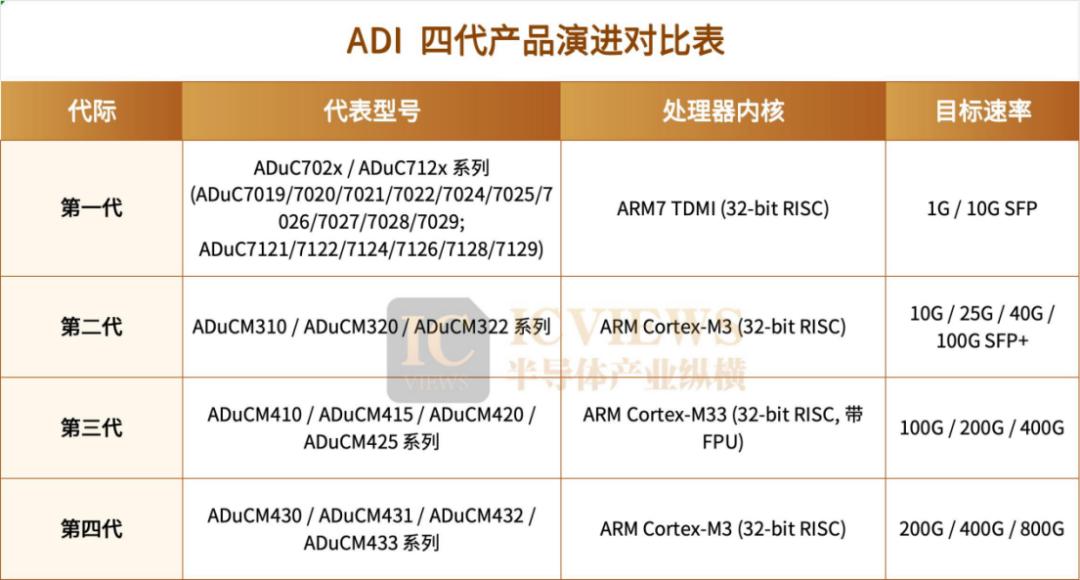
ADI's core advantages lie in high - precision analog integration and ultra - low power consumption. It is the mainstream control chip for high - speed and silicon optical modules of 200G, 400G, 800G, and above. ADI's optical module controllers have undergone a clear four - generation evolution path. The fourth - generation ADuCM43x series is specifically developed for 200G, 400G, 800G DML/EML and silicon optical modules, integrating an ARM Cortex - M3 core and a rich set of peripherals. It is a star solution in the current data - center optical module market.
It is understood that in the data - center field this year, ADI will focus on breaking through the core bottlenecks of optical communication technology, closely follow the evolution trend of optical modules from 800G to 1.6T, 3.2T, and co - packaged optics (CPO) technology, and deeply explore the field of optical module control links to meet the needs of the Chinese market and help customers shorten the product R & D and launch cycle.
STMicroelectronics does not have models specifically for optical modules, but the STM32H5 series has become the de - facto standard choice for optical module applications due to its I3C interface, high performance, and small package. ST introduced a new communication interface, I3C, in the STM32H5. It is an upgrade of the I2C communication interface, also based on two buses, SDA and SCL, but with higher performance and compatibility with I2C. The STM32H5 is the industry's first MCU series to integrate an I3C peripheral, compatible with the I3C Revision 1.1 specification 20. This first - mover advantage has laid a technical foundation for ST in the high - end market.
Among domestic manufacturers, the layout of domestic optical module MCUs has entered a hierarchical stage. One group of manufacturers is accumulating shipments and customers in low - speed and medium - speed modules; another group is launching dedicated products for 800G/1.6T modules, aiming to enter the high - speed module design cycle.
GD32 is one of the domestic manufacturers with the clearest layout for optical module MCUs. GD32's MCUs have a relatively high market share in the domestic optical module market, and most customers in the industry are using GD32 MCU products.
GD32 started R & D on optical module MCUs in 2018 and launched its first dedicated MCU. By 2022, the cumulative shipment of its dedicated optical module MCUs reached the tens of millions level. This accumulation is crucial. Optical module MCUs do not win the market solely based on specifications. Customer verification, firmware adaptation, production testing and calibration, and abnormal case handling will all contribute to the engineering capabilities.
This year, GD32 released the GD32E512 and GD32E252 series. The GD32E512 series is designed for high - speed optical modules, using an Arm Cortex - M33 core with a maximum frequency of 120MHz, supporting I3C, offering a 3×3mm small package, and integrating multiple I2C, MDIO, ADC, DAC, comparator, and operational amplifier channels. The GD32E252 series is for low - speed optical modules, using a Cortex - M23 core and emphasizing high integration, low power consumption, wide temperature range, and EMC capabilities. In the field of optical modules, GD32's MCU products have a comprehensive layout from low - speed to high - speed optical modules. In the investor activity record, GD32 stated that the MCUs in the domestic optical module market have basically been localized.
Nationstech is another notable optical module MCU manufacturer. Nationstech has launched the N32H493 series of dedicated microcontrollers (MCUs) for the 800G/1.6T high - speed optical module market. It is the first domestic product with a 1M Flash and a dual - Bank architecture, and its multiple BGA packages are compatible with mainstream overseas solutions. Currently, this product is in the market promotion and customer testing stage.
Meanwhile, in response to the higher requirements for security, stronger computing power, and a more complete ecosystem from 1.6T and higher - speed applications, Nationstech has pre - arranged the N32H5 series. Based on the ARM Cortex - M33 core, it has 2MB Flash + larger SRAM, a new I3C interface for next - generation high - speed interconnection, and can connect multiple sensors (temperature, voltage, optical power) simultaneously, with faster speed, fewer pins, and lower power consumption.
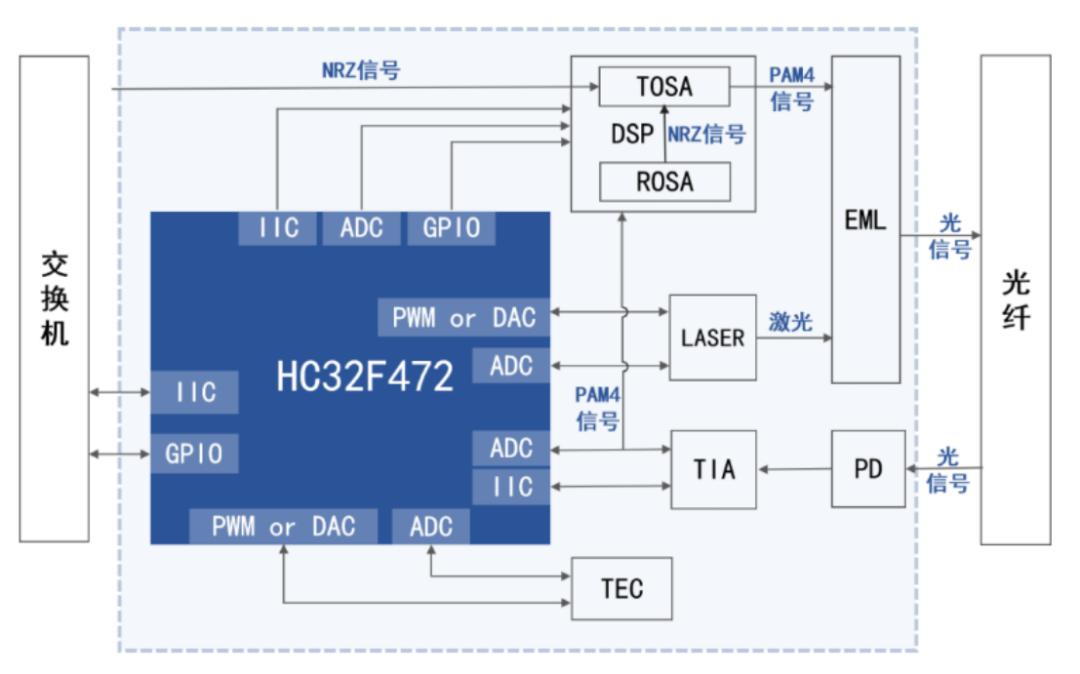
Application block diagram of 100G and above high - speed optical modules by Xiaohua Semiconductor
Xiaohua Semiconductor's HC32F472 series is a high - performance general - purpose MCU, but its resource configuration meets the control requirements of some high - speed optical modules. This series uses a Cortex - M4 core, offers a BGA64 small package, integrates multiple communication interfaces including I2C, SPI, QSPI, and MDIO, and also supports encryption functions such as AES, HASH, and TRNG. This represents another domestic approach: using a high - performance general - purpose MCU platform to cover optical module applications and then adapting the package, peripherals, firmware, and reference design according to customer needs.
Domestic optical module MCUs: Seize the opportunity
There are two core reasons for the current shortage of MCUs: Firstly, the boom in computing power construction has led to a sharp increase in the shipment volume of AI servers, and the demand for power - module control chips has also increased accordingly; secondly, the demand for 800G and 1.6T high - speed optical modules in AI data centers has exploded, causing a continuous shortage of relevant models.
According to the latest report from LightCounting, the optical communication chipset market is expected to grow rapidly at a compound annual growth rate of 17% between 2025 and 2030, and the total sales will increase from approximately $3.5 billion in 2024 to over $11 billion in 2030. As the ratio of optical modules per GPU continues to increase and each optical module usually requires 1 to 2 MCUs, the demand for optical module MCUs is increasing sharply.
This is the industrial opportunity for optical module MCUs.
In the next few years, pluggable optical modules will still be the mainstream solution in AI data centers, but technologies such as CPO, OBO, LPO, silicon optics, and external laser sources will continue to develop. The form of optical modules may change, but the demand for management and control will not disappear.
On the contrary, the closer the optical interconnection is to the switch chip and the computing chip, the higher the management requirements will be.
In traditional pluggable modules, the MCU manages a single module. In the CPO or on - board optical engine stage, the control object may become a group of optical engines, multiple external laser sources, multiple optical channels, multiple temperature sensors, multi - level power supplies, and a more complex thermal management system. The control chip needs to manage not just a single module but an entire optoelectronic cooperation system. This will drive the evolution of optical module MCUs into "optical engine management controllers".
It will require stronger interface capabilities, larger storage space, a more complete security mechanism, a more complex state machine, more efficient telemetry capabilities, and better coordination with the system BMC, switch chip, and host software.
From this perspective, today's optical module MCUs are just the starting point. The real long - term opportunity lies in occupying the management and control layer in the evolution of the AI optical interconnection architecture. For domestic manufacturers, the short - term goal is to enter the high - speed optical module supply chain; the medium - term goal is to upgrade from a chip supplier to a module control solution provider; the long - term goal is to occupy a position in silicon optics, CPO, and optical engine management.
This article is from the WeChat official account "Semiconductor Industry Insights" (ID: ICViews), author: Jiulin. It is published by 36Kr with permission.