Humanoid robots drop to the 10,000-yuan level, and embodied intelligence financing exceeds 46 billion yuan in the first half of the year
The 2026 FIFA World Cup is in full swing. While billions of football fans are cheering for football superstars like Lionel Messi, Kylian Mbappé, and Cristiano Ronaldo, a football - related competition has just concluded at the Shanghai New International Expo Centre. However, the players in this competition are a group of humanoid robots with a metallic sheen.
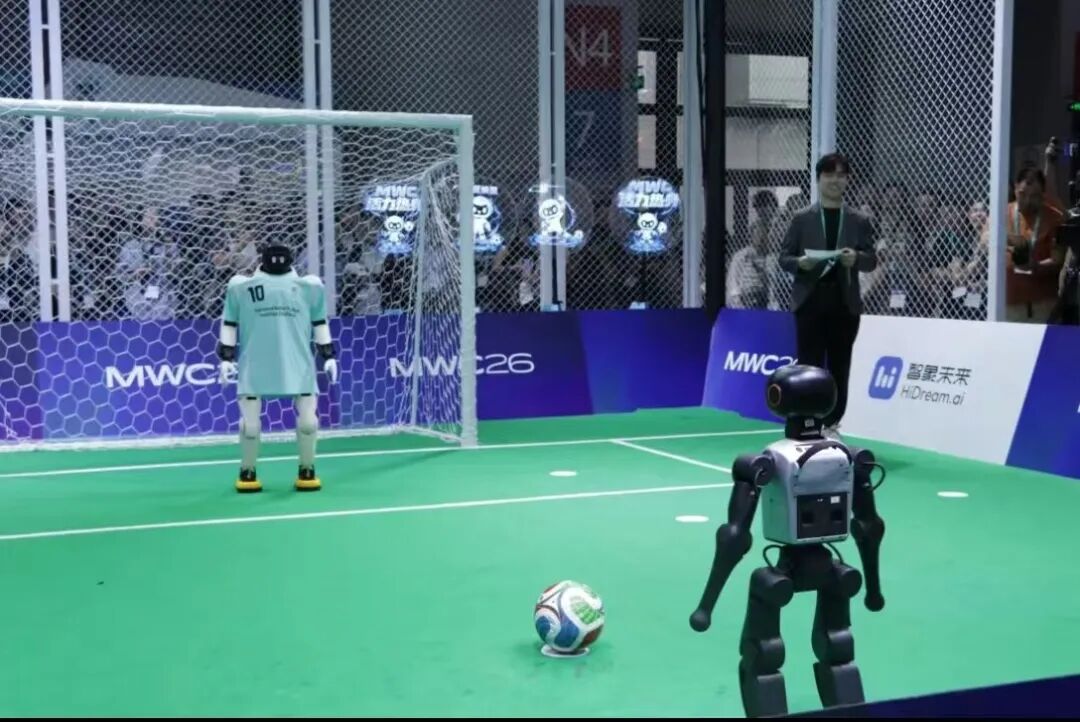
The whistle blows. A silver - white humanoid robot walks steadily to the penalty spot, paces left and right, observes from front to back, takes a few steps back, then starts running, accelerates, and shoots. "Goal!" The audience bursts into thunderous applause. Eight domestic robot teams take turns on the field, competing in pairs. This is one of the most anticipated live events at MWC26 Shanghai.
However, the message conveyed by the humanoid robot penalty shoot - out is far more than just a show. It is also a "physical Turing test" for embodied intelligence. From instant decision - making on the football field to precise operations on factory production lines, the inflection point of the embodied intelligence industry is approaching. The industry is evolving from "being able to move" to "being able to work".
When the World Cup carnival meets the technological wave of MWC this summer, silicon - based and carbon - based entities are defining the future together on the same football pitch for the first time.
Why the penalty shoot - out?
If you often attend major global technology exhibitions, you'll notice an interesting phenomenon: from the World Artificial Intelligence Conference to MWC Barcelona and then to MWC26 Shanghai, almost every robot section at a major exhibition features a penalty shoot - out. The sight of silicon - based players swinging their legs to shoot at the penalty spot seems to have become another "standard move" after dancing.
Why exactly the penalty shoot - out?
Football, with over 4 billion fans, is the "world's number one sport". This year coincides with the World Cup. Liu Hong, the General Manager of Technology at GSMA Greater China, said that from Deep Blue defeating the chess champion in 1997 to AlphaGo beating Lee Sedol in 2016, the milestone events of AI have all used intellectual competitions as breakthrough points. Comprehensive sports like football can serve as a "Turing test" for physical AI. It tests not only calculation but also the all - around capabilities of embodied intelligence in the real physical world.
First is perception. The robot needs to identify the position of the football, track the target, and judge the goalkeeper's position. Then comes decision - making, calculating the shooting angle and planning the movement path. Finally, it's execution, coordinating the whole body to exert force and shoot accurately.
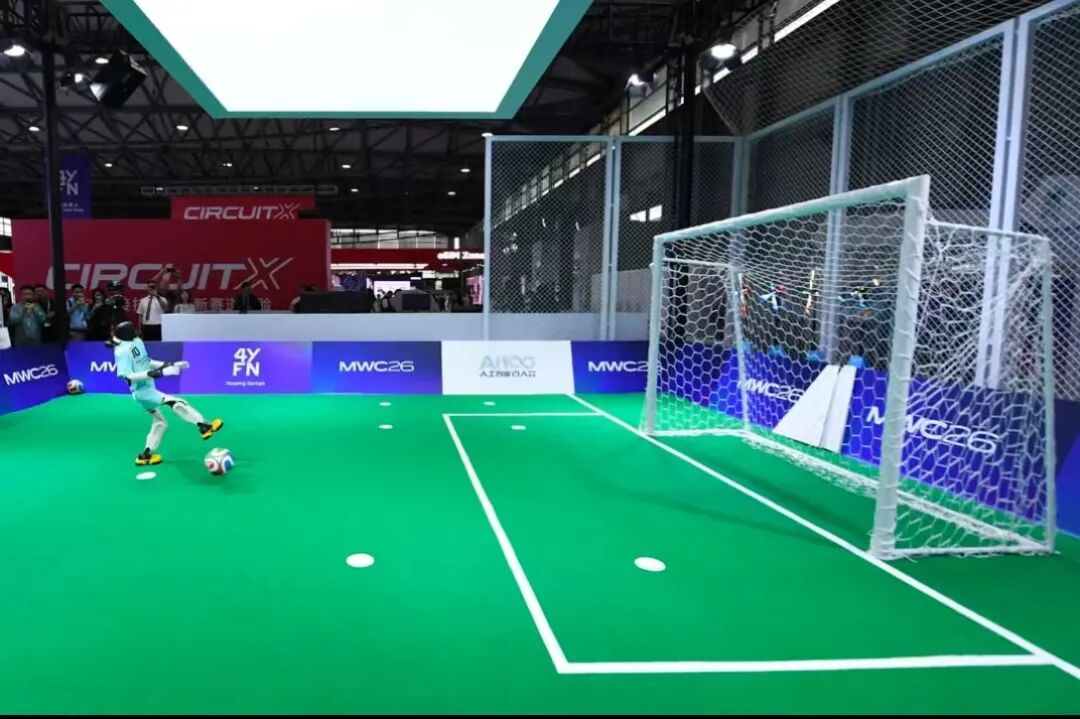
Wang Kailue, the Product Manager of the Embodied Intelligence Industry Innovation Center of China Mobile, said that before the game, the team let the robot learn from videos of football players' kicking actions, simulating, reconstructing, and performing bone redirection on actions like push shots, power shots, and poke shots. After taking the field, the robot has to independently complete the "observation - decision - control" closed - loop process, including observing the environment, tracking the football, calculating the angle, and coordinating the whole body to shoot. Each link relies on autonomous intelligence to complete the closed - loop within about 10 milliseconds.
Of course, these "silicon - based players" are not always accurate. Some shoot with the wrong force or direction, and the ball rolls towards the sideline referee. Some have a good angle but the ball hits the post and goes out. Others accidentally trip over the ball, then slowly get up and "try again". The variables in a real game, such as the friction of the lawn, the shadow of the lights, and the air pressure of the football, are the key to testing the generalization ability of the model.
Li Lei, the person - in - charge of Hangzhou Qianxun Robot, admitted that the robot may be comparable to professional athletes in a single shot. However, in a whole game, involving countless processes from observation to decision - making, it is still a huge challenge for embodied intelligence.
Liu Hong hopes to test whether humanoid robots can "build a good model for our physical world" through football. This requires a large amount of computing power and a high - performance, fast, and stable network to upload various information collected by the robot to the cloud and make decisions in the cloud.
In other words, behind the penalty shoot - out is the collaborative test of the entire communication and computing infrastructure and embodied intelligence.
The inflection point of the "able - to - work" industry has arrived
In the past two years, humanoid robots have been best at running, dancing, doing somersaults, and taking penalty kicks. However, the changes in the embodied intelligence industry this year may go beyond these demonstrations.
Gao Yanhui, the Secretary - General of the AI Hundred - Person Forum, pointed out during MWC that 2026 is a crucial turning point for embodied intelligence. Robots no longer rely on pre - set programs but predict the ball's path through "observation" and "thinking". The unit price of humanoid robots has dropped from the million - yuan level to the hundred - thousand or even ten - thousand - yuan level. The inflection point of hardware costs is pushing laboratory results to the verge of commercialization.
Data confirms this judgment. According to IT Juzi statistics, in the first half of 2026, there were 288 financing events in the domestic embodied intelligence and robot fields, involving 226 enterprises. The disclosed financing amount exceeded 46 billion yuan. The investment boom in embodied intelligence remains undiminished, but the investment logic has shifted from "looking at the team and the demo" to "looking at delivery and data closed - loop".
Financing reflects capital expectations, and the actions of leading enterprises prove that the industry is accelerating its implementation. Peng Zhihui, the co - founder, President, and CTO of Zhiyuan, put forward a key concept in his MWC keynote speech: "deployment state".
In the past few years, the industry has discussed more about flashy demos. Today, the core question is whether robots can truly enter the industry and real workflows. During the MWC, Zhiyuan Robot also launched a 6 - day live broadcast of robots working in a factory, allowing the outside world to directly see how humanoid robots perform a series of practical tasks such as feeding, sorting, and assembling on the 3C electronics production line.
When the industry enters a practical stage, the lag in standardization becomes a new constraint. Zhang Weimin, the team leader of the Embodied Intelligence Group of the China Artificial Intelligence Industry Development Alliance, saw an opportunity for change from another perspective. The rules in the competition, such as emergency stop, speed limit, and no sharp objects design, are forming the prototype of humanoid robot safety standards. These rules derived from sports competitions will promote the accelerated iteration of the industrial chain, including batteries, servo motors, and lightweight materials, and also allow the public to truly perceive the ability boundary of embodied intelligence for the first time.
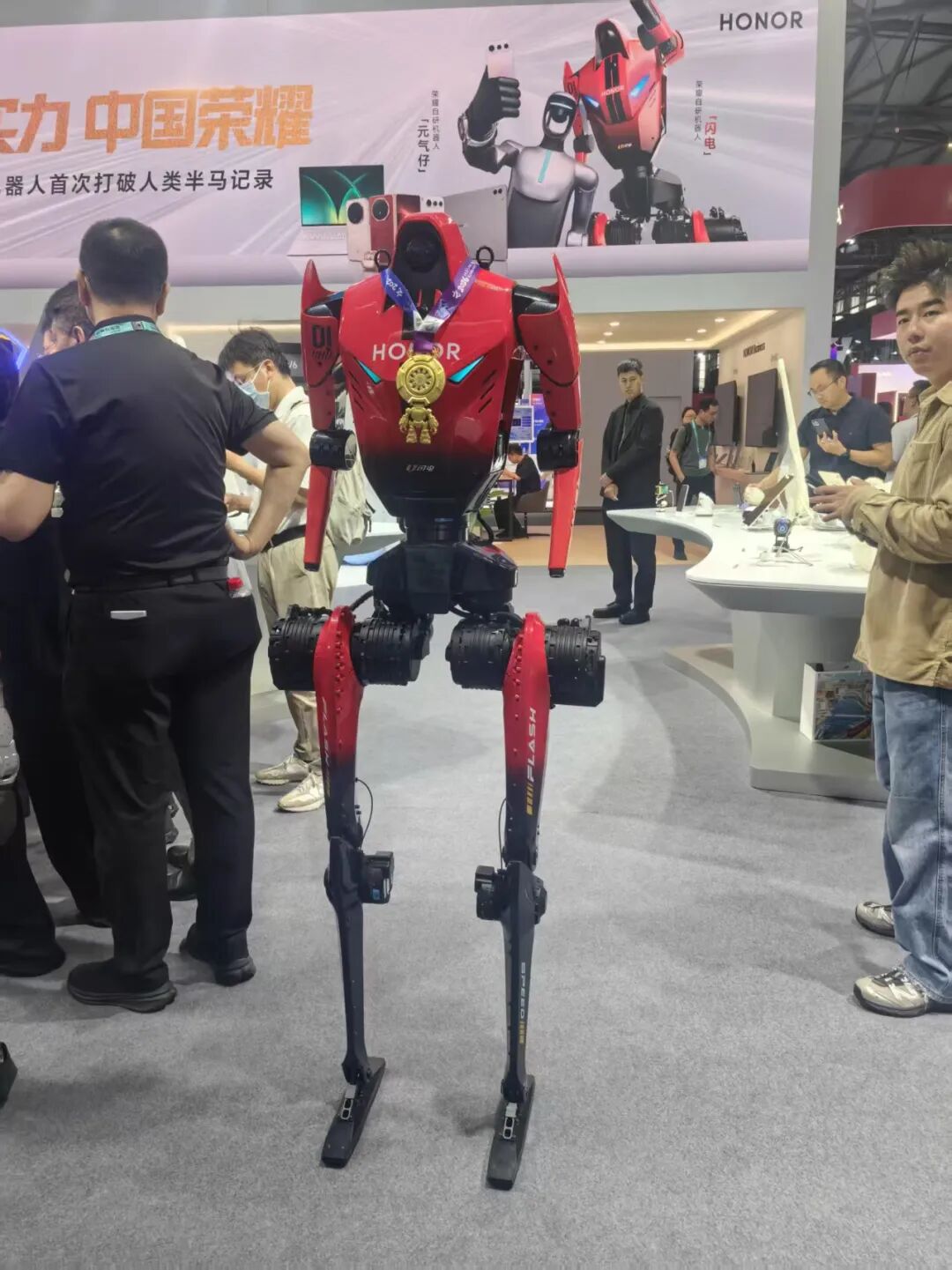
This also means that every reliability problem "forced" to be solved on the field will be gradually refined into an industrial standard "manual". This penalty shoot - out is not a warm - up before commercialization; it is part of the commercialization process itself.
The "last mile" from the football field to the factory
No matter how exciting the penalty kicks on the football field are, they are ultimately just a show. The real value of embodied intelligence lies in those repetitive, heavy, and dangerous labor positions in factories and workshops.
Nicholas Hansen, the person - in - charge of Factory Automation at Siemens Digital Industries, said at the Embodied Intelligence Summit Forum that currently, only 20% of the data in the global industrial scenario is actually used. Meanwhile, factories are evolving from automation to adaptability and then to fully autonomous "lights - out factories". In this process, robots must shift from being "rule - based" to "goal - based", no longer relying on pre - set programs but making autonomous decisions through real - time environmental perception.
Nicholas Hansen showed a comparison video on - site. On the right, traditional robots pick up standardized parts according to a fixed program. On the left, an embodied intelligence robot sorts out miscellaneous objects of different shapes without programming. "This is not the result of programming but the result of perception. This is the future direction of factories."
Zhao Dong, the Vice - President of Huawei's Wireless Network Product Line, responded to this vision from the infrastructure level. He pointed out that for embodied intelligence to truly enter factories, the network must undergo a fundamental upgrade. In the past, communication networks served human information acquisition. In the future, the network will provide intelligent distribution services for embodied intelligence. With large upstream bandwidth, low latency, high reliability, and wide coverage, the network should be like the "meridians of the body", distributing the decisions of the cloud - based brain to every physical entity in real - time.
Under this vision, the challenges are also real. Yu Jingyi, the Vice - President of ShanghaiTech University, said bluntly at the forum that the past success of AI was based on data - driven methods. However, whether data - driven methods can be directly transferred to physical models "is a huge question mark". Taking touch as an example, when humans pick up an object, vision is just the starting point, and touch is the last line of defense to correct errors. Such multi - modal data is "extremely lacking" in current embodied intelligence research.
What worries him more is the academic ecosystem. "Fewer and fewer people are delving into the problems themselves but are focused on quick monetization. Both students and teachers hope for rapid industrialization and quick publication of papers, and many truly difficult problems are being ignored."
Han Zheng, the CEO of Sudo Technology, added from the perspective of industrial collaboration that the iteration speeds of models and hardware are often out of sync. New requirements on the model side may force the hardware to be redesigned. "How to match the rhythms of both sides is an engineering problem that must be solved before large - scale implementation."
This article is from the WeChat official account "IT Times" (ID: vittimes), author: Shen Yibin, editors: Hao Junhui, Sun Yan. Republished by 36Kr with permission.