The "Glass" Set Ablaze by AI: The Hidden Foundation of Advanced Packaging, Whose Industrial Value Awaits a Reckoning
Recently in the A-share market, a seemingly traditional sector has suddenly caught the attention of capital - glass substrates.
The share prices of many related stocks have soared in the short term, and the popularity of the sector is catching up with hot concepts such as AI computing power and advanced packaging.
This is mainly due to the catalysis of tech giants.
TSMC listed glass substrates as an important direction for the next - stage upgrade of CoWoS advanced packaging at this year's technology forum; Intel has also publicly stated on multiple occasions that glass substrates are an important evolutionary path for next - generation packaging technology.
Why can a thin piece of glass make chip giants like TSMC and Intel continuously invest resources?
The answer lies in the development bottleneck of high - end AI chips.
As the parameters of AI large models continue to grow, the computing power requirements of chips keep increasing, and the number of stacked HBM memory chips is getting larger. Traditional organic packaging substrates are gradually showing adaptation pressure.
With high flatness, low thermal expansion coefficient, and excellent insulation performance, glass substrates are expected to significantly alleviate these pain points and are regarded by the industry as an important evolutionary direction for advanced packaging materials.
01
There is a consensus on the long - term trend,
but it is still in the early stage of industrialization
From the perspective of the industrial cycle, the increase in market attention to glass substrates this time is essentially the result of the superposition of the long - term industrial trend consensus and the short - term catalysis of the actions of giants.
It is not a concept out of thin air, nor is it a mature sector that has entered the performance realization period. Distinguishing between the long - term growth space and the short - term development stage is the key to understanding this sector.
In the long - term, the replacement of traditional organic substrates with glass substrates is generally regarded by the industry as an important direction for the evolution of advanced packaging technology and is an industrial upgrade path with ten - year potential.
Looking back at the development history of packaging technology, organic substrates have been commonly used for chip packaging in the past few decades, which can basically meet the packaging needs of traditional chips. However, with the arrival of the AI era, the performance requirements of chips have changed qualitatively.
Currently, high - end AI chips generally stack multiple HBM memory chips, the interconnection speed requirements between chips and memory are continuously increasing, and the packaging size is also constantly expanding.
Against this background, the shortcomings of organic substrates are gradually emerging: First, the thermal expansion coefficient does not match well with that of silicon chips, and warping and deformation are prone to occur during temperature changes; second, the surface flatness is limited, and the height deviation in large - size packaging may affect the bonding accuracy between chips and HBM.
Glass substrates can theoretically significantly improve the above problems.
The thermal expansion coefficient of glass is relatively close to that of silicon, which helps to reduce the risk of warping; the surface flatness of glass can reach the sub - micron level, which is more suitable for large - size, high - precision advanced packaging scenarios; at the same time, glass has good insulation performance and low high - frequency loss, which can support higher - speed signal transmission.
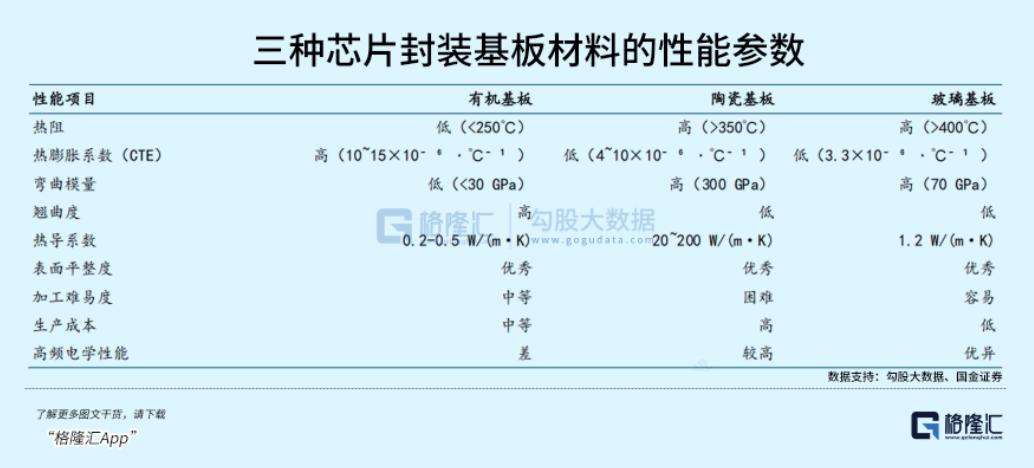
More importantly, glass can achieve vertical interconnection through TGV (Through - Glass Vias) technology, shortening the signal transmission path between chips and substrates and further improving interconnection performance.
Therefore, the transition from organic substrates to glass substrates is not a simple material replacement, but an underlying exploration of advanced packaging technology and an objective requirement after AI computing power has reached a certain stage.
However, in terms of the short - term industrialization progress, the glass substrate industry as a whole is still in the early stage of "transition from technology verification to small - batch trial production", and there is still a long way to go before large - scale mass production and full - industry penetration.
According to the public plans of global leading manufacturers, the mass - production time points are mostly concentrated after 2027.
Intel plans to gradually promote large - scale commercialization from 2026 to 2030 and is currently in the stage of production line construction and reliability verification; TSMC's CoPoS packaging technology has only set up a pilot production line at present.
The overall progress of domestic manufacturers is relatively later.
The vast majority of domestic enterprises are still in the stages of R & D and sample delivery. Only a few enterprises have achieved small - batch supply, but the overall scale is limited, and the contribution to overall revenue and profit is relatively small.
In other words, the current market performance of A - share related companies is more driven by expectations under the industrial trend rather than performance.
The reason why it has become the focus of the market now is mainly due to the intensive actions of industrial giants, which have brought this long - term industrial trend into the public view. From the confirmation of the technical route to the implementation of production line plans, the relevant signals are becoming clearer, driving the market to pay attention to its long - term growth space in advance.
02
A thin piece of glass
hides multiple layers of technical barriers
Many people think that there is no technical content in glass substrates. Isn't it just making the glass thinner? In fact, it is not.
Glass substrates for high - end packaging are products with high technology, high barriers, and high added value, and there are certain technical barriers in each link of the industrial chain.
Let's start with the overall structure of the industrial chain.
The upstream of the glass substrate industrial chain consists of raw materials and equipment, the mid - stream is the manufacturing and processing of glass substrates, and the downstream includes packaging and testing factories and wafer fabs, which are ultimately applied in fields such as AI chips and HBM.
The upstream raw materials mainly include basic chemical raw materials such as quartz sand, soda ash, and limestone, as well as some special additives for adjusting the various properties of glass.
The core barriers upstream are more concentrated in the equipment link.
The production of glass substrates requires a series of precision equipment such as melting furnaces, tin baths, annealing furnaces, polishing machines, and cutting machines. Many of these equipment have long been dominated by overseas manufacturers.
For example, high - end polishing equipment and TGV punching equipment have high technical difficulties, and overseas manufacturers currently occupy the main market share. The barriers at the equipment level are one of the important factors restricting domestic manufacturers from entering this field.
The mid - stream manufacturing of glass substrates is the core link of the entire industrial chain, with relatively high technical barriers.
The production process of glass substrates is relatively complex, generally going through more than a dozen processes such as batching, melting, forming, annealing, polishing, cutting, and testing. Each process has strict precision requirements.
There is also a special technical difficulty in glass substrates for packaging, namely TGV (Through - Glass Vias) technology.
Simply put, it is to process a large number of micro - holes with a diameter of only a few dozen microns in the glass and then fill the holes with metal to achieve vertical electrical signal interconnection between the upper and lower layers of the glass.
Although the principle of this technology seems simple, it is actually very difficult to implement. TGV technology is one of the core competitiveness of high - end glass substrates and is also the key breakthrough direction for domestic manufacturers at present.
Currently, the global high - end packaging glass substrate market is mainly dominated by three overseas manufacturers - Corning of the United States, AGC (Asahi Glass) of Japan, and Schott of Germany.
The three manufacturers together account for the majority of the global high - end glass substrate market, among which Corning occupies a relatively high market share in the field of TGV glass substrates.
Domestic manufacturers started relatively late. In recent years, they have gradually achieved technological breakthroughs, and many domestic enterprises have begun to enter the packaging glass substrate sector.
For example, some domestic leading display glass manufacturers have achieved domestic breakthroughs in the field of display glass substrates and are now extending to packaging glass substrates. The relevant products have entered the sample delivery and verification stage; some other enterprises have long - term accumulations in the fields of ultra - thin glass and TGV technology and are promoting the implementation of packaging glass substrate technology based on their own R & D capabilities.
03
Industry observation: Pay attention to the rhythm of industrial evolution
and track three core dimensions
After understanding the industrial logic and competitive landscape, understanding the glass substrate sector can be carried out around three core dimensions.
It is not a mature sector that can realize performance immediately. It is more like a "sector with a clear industrial trend and left - side attention to expectations". The core attractions are concentrated in three aspects: long - term demand space, potential for domestic substitution, and catalysis of technological breakthroughs.
The first dimension is the long - term demand space brought by the development of AI computing power.
The improvement of computing power depends on the process upgrade of the chips themselves on the one hand, and on the other hand, it also requires the cooperation of advanced packaging technology to achieve higher interconnection speed and larger bandwidth through multi - chip heterogeneous integration.
The more advanced the packaging technology evolves, the higher the performance requirements for substrate materials will be, and the more prominent the adaptability advantages of glass substrates will be. From CoWoS to SoIC, from 2.5D packaging to 3D packaging, each generation of packaging technology upgrade puts forward higher requirements for the flatness, thermal stability, and high - frequency performance of substrates.
In the future, with the continuous expansion of CoWoS production capacity and the increasing penetration rate of HBM, the demand for glass substrates is expected to grow rapidly.
The second dimension is the potential performance elasticity brought by domestic substitution.
As mentioned above, the high - end glass substrate market is currently dominated by overseas manufacturers, and the share of domestic manufacturers is relatively low. However, the domestic industrial chain currently attaches more importance to the autonomy and controllability of the supply chain and is willing to give domestic glass substrate manufacturers more opportunities for verification and introduction.
The third dimension is the change in expectations brought by technological breakthroughs.
For a sector in the early stage of the industry, technological progress is often an important factor affecting market expectations. For example, the improvement of the yield rate of TGV technology, the mass production of large - size glass substrates, and domestic manufacturers entering the supply chain of leading customers. Each important progress may change the market's expectations for the industry.
From the perspective of industry tracking, there are several directions worthy of continuous attention:
First, mid - stream glass substrate manufacturers with core technology accumulation. These enterprises are the core participants in the industrial development. If the industry enters the volume - increasing stage, they are expected to benefit from the growth of demand and the domestic substitution process earlier.
Second, upstream key equipment and material manufacturers. The expansion of production capacity in the glass substrate industry will drive the growth of demand for upstream equipment and materials. Especially in the links with high technical barriers and large domestic substitution space, the business expansion progress of relevant manufacturers is worthy of tracking.
Third, supporting manufacturers with glass deep - processing capabilities. The finished glass substrates need to go through multiple deep - processing processes before being delivered to the downstream. Although the technical barriers of these links are not as high as those of substrate manufacturing, they are also an important part of the industrial chain, and the operating conditions of leading enterprises are also worthy of attention.
Of course, the development of the glass substrate industry also faces many uncertainties, including risks such as the mass - production progress falling short of expectations, the growth of downstream AI computing power demand falling short of expectations, and the technological breakthroughs of domestic manufacturers being slower than expected. Moreover, the current sector market is more driven by expectations, and short - term fluctuations may be relatively large, so it needs to be viewed rationally.
04
Conclusion
This seemingly traditional glass substrate sector is gradually showing its long - term industrial value under the wave of AI computing power.
It is not a illusory concept, but one of the important basic materials supporting the upgrade of advanced packaging technology and an easily overlooked "invisible foundation" in the AI computing power system.
Of course, we also need to clearly recognize that the industry is still in the early stage of industrialization, and it will take some time for large - scale mass production and performance realization.
The current increase in market attention is more of an early pricing of the long - term industrial value, and there will inevitably be repeated expectations and stock price fluctuations in the process.
The Gelonghui Research Institute has long been deeply involved in the semiconductor materials and advanced packaging industrial chain. We continuously track the technological iteration, manufacturer dynamics, and mass - production progress of the glass substrate industry. If you also pay attention to the field of advanced packaging, welcome to follow us and seize the industrial opportunities in the AI era together.
This article is from the WeChat official account “Gelonghui Financial Hotspots” (ID: glh_finance), author: Gelonghui editor. It is published by 36Kr with authorization.