The emerging players in the optical chip sector are on the rise
In June 2026, NVIDIA's Vera Rubin platform officially entered the full - scale mass - production phase, and the supporting Spectrum - X Ethernet silicon - photonics CPO switches were simultaneously delivered on a large scale. This marks that the AI computing power cluster has officially crossed from "electrical interconnection" to the commercial threshold of "optical interconnection."
Just when the industry's focus was still on computing power cores such as GPUs and HBMs a moment ago, optical communication chips have quietly become the new bottleneck for million - level GPU clusters and a new fulcrum for leveraging the global semiconductor industry landscape. According to LightCounting's prediction, by 2029, the shipment volume of 3.2T CPO ports is expected to exceed 10 million. Another research report mentioned that "it is expected that by 2027, CPO ports will account for nearly 30% of the total number of 800G and 1.6T ports."
It is obvious that an arms race centered around "light" has already begun.
For a long time, the global high - end data communication optical chip market has been firmly controlled by two American companies, Broadcom and Marvell. The two oligarchs together have captured more than 90% of the high - end PAM4 DSP market share. The technical barriers and ecological binding have almost discouraged latecomers.
Under this solidified industrial pattern, chip manufacturers are collectively breaking through, trying to build a complete optical chip layout covering pluggable optical module DSPs, silicon photonics engines, CPO optical engines, and even upstream epitaxial materials.
The High Ground of Optical Chips Ruled by Two Oligarchs
The optical communication DSP chip is the brain of the optical module, responsible for encoding, decoding, equalizing, and error - correcting high - speed signals, which directly determines the rate, power consumption, and stability of optical transmission. Driven by the demand for AI computing power, the market scale of this field has become one of the fastest - growing tracks in the semiconductor industry.
This high - growth track has been in a highly monopolized state for a long time.
According to industry statistics, in the high - end data communication PAM4 DSP market of 400G and above, Marvell, relying on the full set of high - speed SerDes and FEC algorithm IP inherited from the acquisition of Inphi, occupies about 60% of the market share; Broadcom, relying on the optoelectronic synergy between switch chips and optical chips, has captured more than 30% of the share. The two together monopolize more than 90% of the high - end market.
From the 800G to the 1.6T era, the official standard - configuration solutions for NVIDIA's high - end GPU clusters and the customized orders from North American leading cloud providers have almost all fallen into the hands of these two companies.
The moats of the two oligarchs are not only at the product end.
Marvell's 1.6T Ara series of DSPs have adopted the 3nm process and provided samples to customers in the first quarter of 2026, covering all scenarios of short - distance, medium - distance, and long - distance. Broadcom's Sian and Taurus series focus on ultra - low power consumption and are deeply bound to top - tier customers such as Google, Microsoft, and Meta, defining the technical standards at the system architecture level.
More importantly, as the CPO technology moves towards commercialization, the two companies have completed the full - chain patent layout of silicon photonics, optical engines, and heterogeneous packaging in advance, trying to extend their monopoly advantages to the next - generation technology cycle.
The industry generally believed that this pattern would be difficult to shake in the next 5 - 10 years. It was not until the explosion of AI computing power brought a window of diversified technical routes that latecomers were given a chance to catch up.
MediaTek Leads the Optical Chip Legion and Makes a Heavy - Hitting Move
In this race, a heavyweight player is emerging in the field of optical interconnection chips, which has long been dominated by two giants - MediaTek. It is worth noting that MediaTek is not entering alone but leading a carefully - organized legion, and its formation is quite clear.
As the core, MediaTek's optical communication layout is directly aimed at the technological high - point of CPO, taking a differentiated route of "optoelectronic integration and monolithic integration."
In terms of self - developed technology, MediaTek has achieved a breakthrough in CPO technology with a bandwidth rate of 400Gbps, focusing on the Micro LED optical technology solution. It can integrate the single crystal of optical devices into a CMOS transceiver compatible with existing data center equipment. This means that a single chip can process both electrical and optical signals simultaneously, eliminating the complex additional optical packaging in traditional solutions. This solution not only retains the reliability of copper wires but also reduces the transmission power consumption by 50%. The technology is downward - compatible with near - packaged optics (NPO) and traditional pluggable scenarios, with extremely high implementation flexibility.
This power - consumption advantage is exactly what AI data centers hungry for computing power are most eager for.
Another trump card is to extend its profound Micro LED technology accumulation to optical interconnection. MediaTek's Micro LED optical technology can be applied to active optical cables (AOC) for data center interconnection and further extended to CPO and near - packaged optics (NPO) architectures. Compared with traditional VCSEL light sources, the Micro LED array shows higher energy efficiency and integration potential in multi - channel parallel transmission, providing a new light source path for the next - generation high - density optical interconnection.
In the first quarter of 2026, MediaTek announced a cooperation with Microsoft Research to launch a next - generation active optical cable (AOC) solution based on the Micro LED light source, verifying the technical feasibility in the short - distance interconnection scenario of data centers.
At the same time, relying on the large - scale CMOS design and high - speed SerDes capabilities accumulated in the consumer electronics era, MediaTek's single - channel 200G SerDes technology has entered the mature stage, and the planning of 400G SerDes IP is clear, laying a foundation for the product iteration in the subsequent 1.6T and 3.2T eras.
However, MediaTek knows well that it is not wise to rely entirely on self - development in the silicon photonics track approaching the physical limit.
In February this year, MediaTek made a decisive move, investing approximately $90 million in Ayar Labs, a star startup in the global CPO optical engine field, and obtaining approximately 2.4% of the equity. Ayar Labs' core technology, TeraPHY, is an "optical chiplet" that encapsulates silicon photonics I/O chips with system - level chips. Its optical engine has been included in the verification path of the next - generation GPU interconnection architecture by giants such as NVIDIA.
It is worth noting that Ayar Labs is a leading enterprise in the global CPO optical engine field, has delivered TeraPHY products to some customers, and its shareholder list includes three chip giants, NVIDIA, AMD, and Intel, and has established strategic cooperation with TSMC. It is the core technical benchmark in the global silicon photonics and CPO fields.
Through this investment, MediaTek not only obtained the technical synergy of optical engines and heterogeneous packaging but also officially joined the global CPO core ecosystem, filling in the most crucial piece of the puzzle, and promoting the implementation of CPO in conjunction with TSMC's advanced packaging technology.
Airoha Technology Aims at the Mainstay of the Mainstream Market
If MediaTek's layout is focused on the future, then its subsidiary, Airoha Technology, is the vanguard charging into battle at present, directly entering the most profitable territory of Broadcom and Marvell - the pluggable optical module PAM4 DSP chip market.
As mentioned above, the DSP chip is the brain of the optical module, responsible for complex modulation and compensation of electrical signals to achieve high - speed and long - distance transmission. For a long time, this market has been firmly controlled by two giants, Marvell and Broadcom, which together occupy more than 90% of the market share, and are almost monopolistic in the high - end field above 100G/channel.
Airoha Technology's breakthrough is real.
It is understood that Airoha Technology's product matrix shows a clear iterative rhythm: The PAM4 DSP products related to single - channel 50G SerDes, paired with self - developed TIAs to form a complete solution, have successfully entered the supply chains of several of the world's top ten optical module manufacturers. The shipment volume in the first quarter of 2026 has increased several times and continues to increase. The 800G DSP products corresponding to single - channel 100G SerDes completed tape - out in the fourth quarter of 2025 and have been designed and introduced by several of the world's top five module manufacturers, and are expected to be officially mass - produced in mid - 2026. This means that Airoha has joined the game in the 800G optical module, the current most mainstream data center rate era.
More importantly, in the 1.6T optical module representing the next wave, the research and development of its higher - order single - channel 200G SerDes has also been launched simultaneously, aiming at the future 3.2T era solution.
The financial data more intuitively shows the results of this charge.
Airoha Technology optimistically estimates that this year's revenue related to optical communication will be more than three times that of last year, becoming the company's strongest - growing product line. Institutional investors also point out that although CPO is the future trend, in the short - term of a few years, pluggable optical modules will still be the mainstream of shipments. Airoha Technology is quickly seizing the mid - to high - end market share with a cost - effective solution, while polishing customer relationships and process experience, providing a solid cash flow and customer entry point for the group's overall optical communication strategy.
Yuancheng Semiconductor: The Invisible Piece on the Silicon Photonics Platform
In MediaTek's optical communication layout, Yuancheng Semiconductor is a key surprise force and the core carrier of the group's silicon photonics technology.
It is reported that Yuancheng Semiconductor focuses on the design and research and development of the silicon photonics platform. Its core products include high - speed optical transceiver module PIC chips, optical transceiver modules, and optical engines, covering LPO (linearly - driven pluggable optics) and CPO - ASIC module solutions, targeting AI data centers and high - performance computing scenarios.
More importantly, Yuancheng Semiconductor completed the extension to the upstream material end by acquiring BrightEpi. BrightEpi originally focused on traditional VCSEL epitaxial wafers and InP epitaxial wafers. After being incorporated into Yuancheng, it fully shifted to the silicon photonics strategy, building a vertical integration ability from epitaxial materials to PIC chips and then to optical engines. Its products cover traditional optical communication epitaxial wafers, Micro LED light sources for AI data centers, and multi - channel low - power CPO solutions.
This vertical integration model of design + materials not only reduces supply chain risks but also gives Yuancheng Semiconductor unique advantages in cost control and customized development.
According to public information, MediaTek Capital, a subsidiary of MediaTek, is an important major shareholder of Yuancheng Semiconductor. The two parties cooperate deeply at the technical and supply chain levels, becoming an important layout fulcrum for the MediaTek Group in the silicon photonics field.
This means that MediaTek not only entered the core technology circle of silicon photonics engines by investing in Ayar Labs but also laid a strategic piece in the upstream epitaxial materials, silicon - photonics PIC chips, and advanced packaging through Yuancheng Semiconductor. When the technical routes converge, this piece may burst out the value of connecting the entire industrial chain, forming an organic complement to MediaTek's CPO/Micro LED technology and Ayar Labs' optical engine.
Facing the longer - term technological evolution, Yuancheng Semiconductor has also invested in the 2D Matrix two - dimensional matrix optical connection technology, aiming at the multi - dimensional optical interconnection demand brought by the expansion of AI models, trying to seize the technological opportunity in the next - generation ultra - high - speed computing power interconnection scenario.
Cross - border Complementation: The Optoelectronic Integration Transformation of Established Manufacturers
The wave of optical chips led by MediaTek has also driven the collective transformation of established IC design companies in Taiwan. Elan Microelectronics is a typical representative.
It is reported that this manufacturer, well - known for its touch chips and MCUs, officially announced in late 2025 that it would join hands with the American company PETA Optronics to jointly enter the optical communication integrated chip market. The cooperation model between the two parties is clear: PETA provides the technical advantages of photonic integrated circuits (PICs), while Elan gives full play to its profound accumulation in the field of electronic integrated circuits (EICs) to jointly develop a new - generation optoelectronic integrated solution.
At the same time, Elan also completed a strategic investment in PETA Optronics, becoming an important institutional shareholder, accelerating the research and development and commercial implementation of silicon photonics technology.
Elan's transformation is not an isolated case. It represents the collective trend of the Taiwanese IC design industry: When the growth of mature tracks such as consumer electronics and industrial control slows down, the booming optical communication has become a new growth curve pursued by many enterprises. Although these cross - border manufacturers started a little later, they are rapidly expanding the overall scale of the Taiwanese optical chip industry and forming a cluster effect with their mature chip design experience and customer resources.
Qualcomm: Building a Clear Optical Interconnection Technology Path
In the era of AI large models, Qualcomm believes that "connection bandwidth" and "power consumption per bit" have surpassed computing power density and are becoming the primary bottlenecks for system expansion.
To this end, Qualcomm has built a clear optical interconnection technology path - starting from the millimeter - level short - distance optoelectronic integration at the package kernel grain level, gradually extending outward to cover intra - cabinet, inter - cabinet, intra - data - center, and finally long - distance communication across campuses for dozens of kilometers, ultimately achieving full - distance optical connection coverage from millimeters to dozens of kilometers.
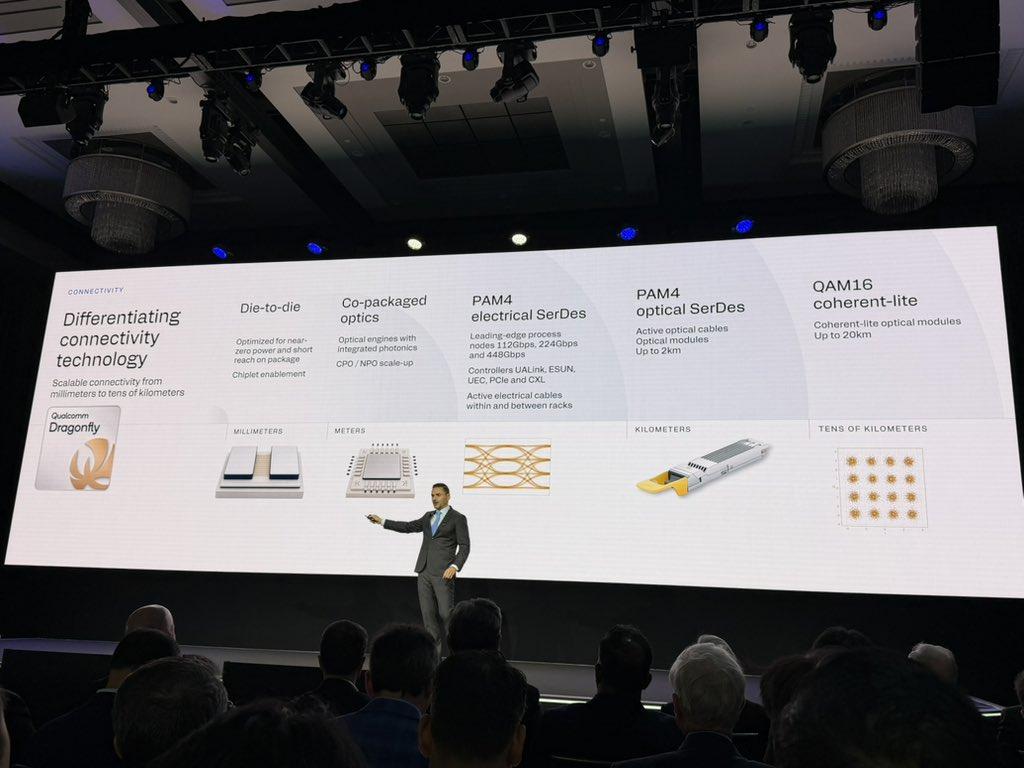
Die - to - die Chiplet Interconnection
As the innermost foundation of the entire connection system, Die - to - die technology is optimized for the extremely short - distance transmission scenario within the package, focusing on near - zero power consumption and ultra - short - distance transmission capabilities. Its core role is to support the Chiplet architecture.
This is not only the electrical interconnection base for computing chiplets and memory chiplets but also the interface foundation for the co - packaged optics (CPO) solution. Qualcomm's optical engine chiplet achieves high - speed interconnection with computing and switching chiplets in the same package through the standard Die - to - die interface, providing standardized underlying interconnection protocol support for subsequent optoelectronic co - packaging.
Co - Packaged Optics (CPO)
Qualcomm's CPO solution adopts an integrated photonics optical engine architecture, which can support the large - scale deployment of CPO and near - packaged optics (NPO). Its core innovation lies in the open concept of "Composable Optical Chiplet."
Different from the closed - bundle solutions of some industry manufacturers, Qualcomm designs the CPO optical engine as an independent chiplet that complies with the UCIe standard. Cloud providers and equipment manufacturers can flexibly assemble Qualcomm's optical engine chiplet with self - developed computing chiplets and third - party switch ASIC chiplets through advanced packaging, achieving hardware decoupling and mixing. When the single - channel rate of the optical interface iterates from 100G to 200G and 448G, theoretically, only the optical engine chiplet needs to be replaced to complete the upgrade, without redesigning the entire set of large - scale switch chips, greatly protecting the customer's R & D investment.
PAM4 Electrical SerDes
This level is targeted at the active copper cable (AEC) scenario within and between cabinets. It is built with advanced processes, covering three single - channel rates of 112Gbps, 224Gbps, and 448Gbps, and can support a variety of mainstream high - speed protocols such as UALink, ESUN, UEC, PCIe, and CXL. It is the core hardware foundation for high - speed signal transmission on server motherboards and within racks.
This part of the technology not only serves the traditional copper cable interconnection scenario but also provides mature electrical interface capabilities for the optoelectronic signal docking within the CPO package. It is the key link for "optoelectronic synergy" in Qualcomm's connection solution.
PAM4 Optical SerDes
This is the most differentiated entry point in Qualcomm's optical interconnection solution, mainly targeting the active optical cable (AOC) and short - distance optical module scenarios, with a maximum transmission distance of up to