OpenAI and Anthropic are locked in a cutthroat rivalry, leaving Google as the biggest victim.
In the AI talent market in June, Google once again found itself at the center of the storm. Over the past week, a series of high - level technical talent movements around Google DeepMind have continued to gain momentum.
Google Loses Four Technical Veterans in Seven Days
According to media reports from Axios, Reuters and other outlets, Noam Shazeer, the co - leader of Gemini, left Google to join OpenAI. Another senior research scientist at DeepMind and co - creator of AlphaFold, John Jumper, also announced on X that he had joined Anthropic.
Additionally, as reported by Bloomberg, Google AI researchers Jonas Adler and Alexander Pritzel also officially announced their departures, and they are also headed to Anthropic.
This is not an ordinary talent movement.
These four individuals correspond to several highly representative technical lines in Google's AI system: Transformer, large - model pre - training, Gemini, AlphaFold, AI coding, and model training systems.
As a result, this wave of departures quickly sparked discussions on X.
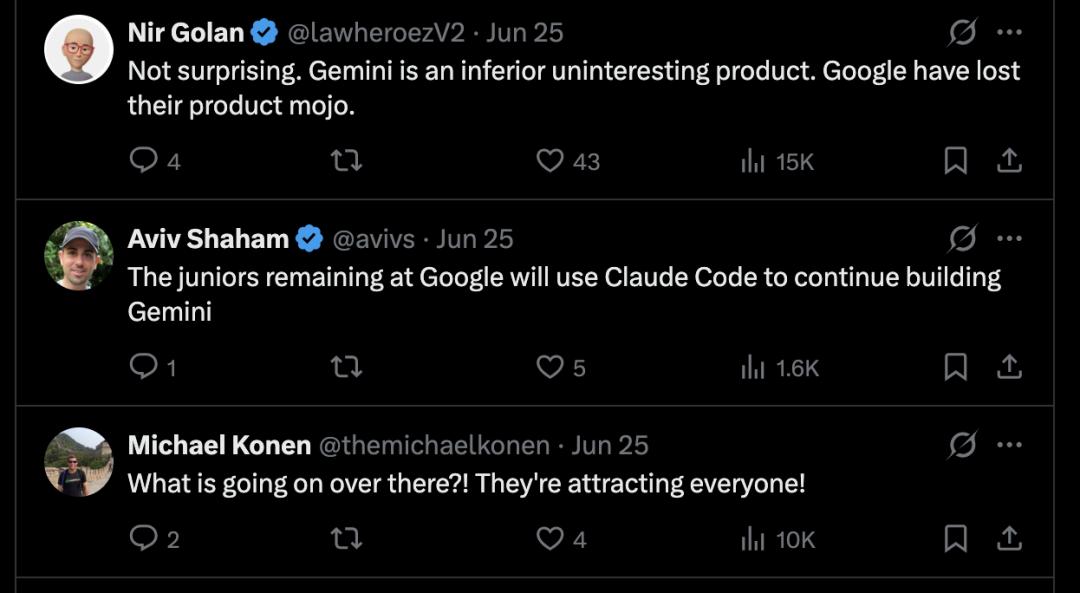
Some users on X directly pointed to Google's AI situation regarding this sensational departure: "Gemini is a mediocre and unexciting product. Google has lost its former product magic."
"Noam Shazeer went to OpenAI, and John Jumper, Jonas Adler, and Alexander Pritzel went to Anthropic." Some also saw this as a sign that Google is under pressure in the AI talent war.
The most attention - grabbing among them is Noam Shazeer.
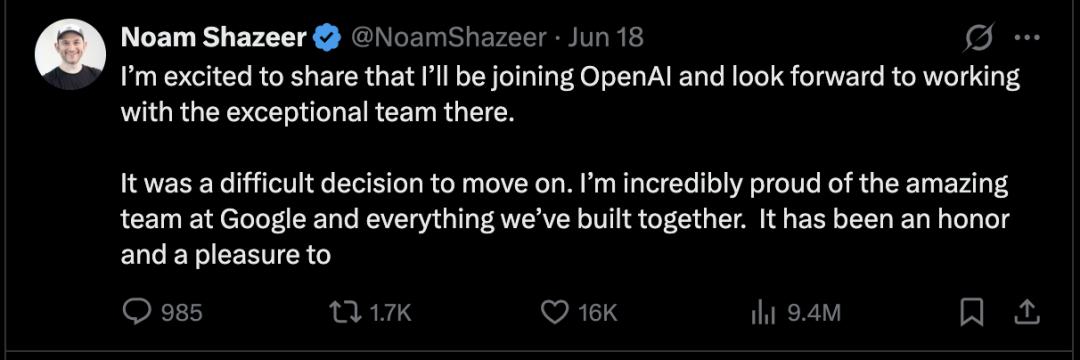
On June 18th, Shazeer himself stated on X that he had joined OpenAI after leaving Google. The timing of his departure is quite interesting. It has been less than two years since Google brought him and part of his team back to the company through a deal related to Character.AI. At that time, the deal was worth approximately $2.7 billion and was once regarded as an important move for Google to strengthen its large - model talent.
There is no need to elaborate on Shazeer's technical significance.
He is one of the co - authors of the 2017 paper "Attention Is All You Need". The Transformer architecture proposed in this paper later became one of the technical foundations for the large - language model wave. After returning to Google, Shazeer was involved in leading the work related to Gemini and was considered one of the most important figures in Google's large - model system.
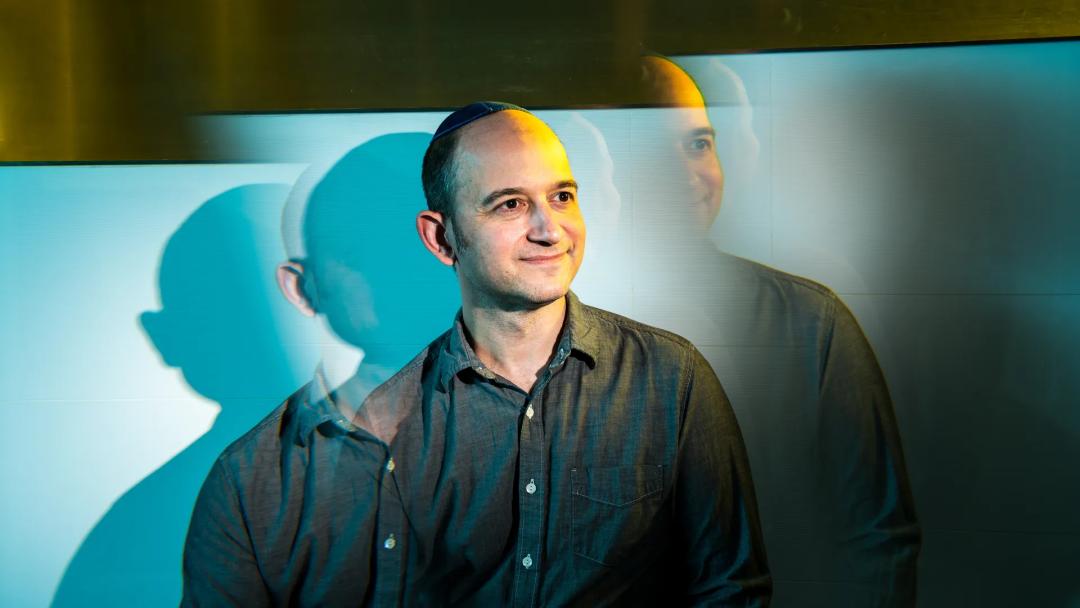
His second departure, therefore, carries a strong symbolic meaning. It shows that in the competition for AI talent, even a company like Google has difficulty permanently binding top - notch researchers through a high - priced "buy - back". Especially when OpenAI is still in a period of rapid expansion and at the center of the capital - market narrative, its attractiveness to top - level model talent remains strong.
Another heavy - weight departure is John Jumper.
Two days after Shazeer announced his departure, Jumper also posted on X that he had left DeepMind and joined Anthropic. Jumper is one of the core figures of AlphaFold. He and DeepMind CEO Demis Hassabis jointly won the 2024 Nobel Prize in Chemistry for their work related to protein structure prediction. The significance of AlphaFold lies not only in the technical breakthrough but also in the fact that it allows the outside world to see that AI can enter the core process of scientific research, rather than just staying in chat, search, or content - generation scenarios.
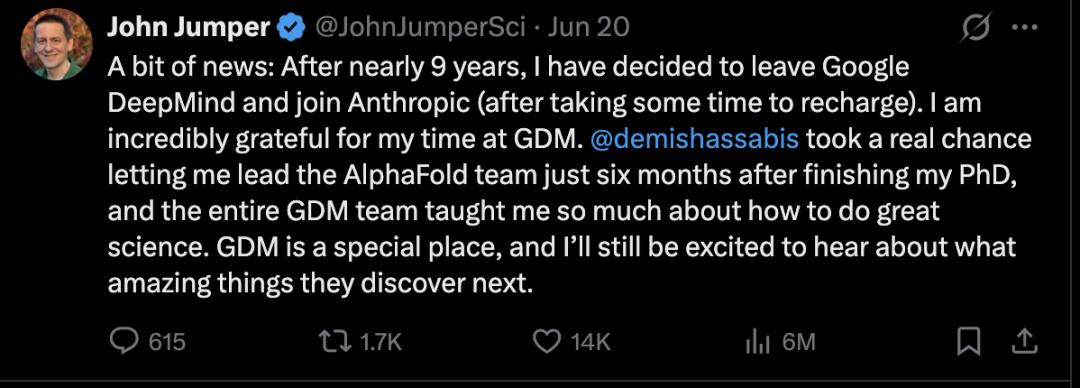
Therefore, Jumper's departure represents a different kind of loss: DeepMind has lost not just a large - model researcher but a signature figure representing the "AI for Science" direction.
If Shazeer's move strengthens OpenAI's attractiveness in basic model and architecture research, then Jumper's joining Anthropic makes the outside world start to pay attention to whether Anthropic is systematically strengthening its capabilities in scientific AI, life sciences, and high - reliability models.
Anthropic was previously best known for Claude, AI safety, and model alignment. However, with the continuous expansion of Claude Code, enterprise scenarios, and multi - step task capabilities, it needs not only a product engineering team but also stronger underlying research and scientific computing talent.
Additionally, according to reports, two other researchers, Jonas Adler and Alexander Pritzel, also left Google.
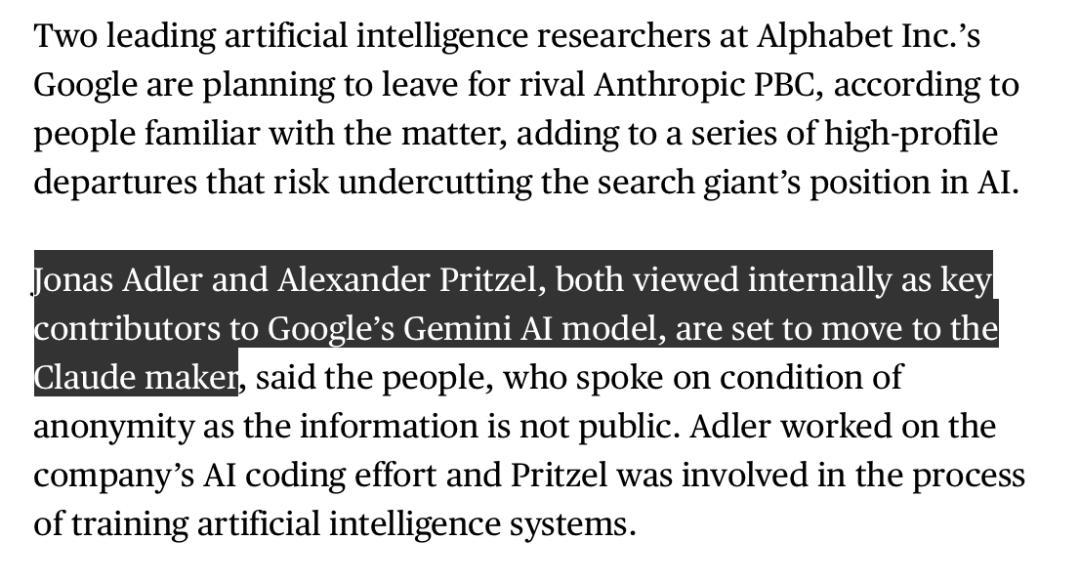
According to media reports citing Bloomberg, both Adler and Pritzel were regarded as important AI researchers within Google. Adler was involved in Google's AI Coding direction, while Pritzel focused on AI system training. The reports said that both were important contributors to the development of the Gemini model and planned to join Anthropic.
The movement of these two individuals is also worthy of attention. AI Coding has become one of the most fiercely contested application entry points among companies such as OpenAI, Anthropic, Google, and Microsoft. The popularity of Claude Code has given Anthropic a stronger presence among developers. At this time, if Anthropic continues to recruit researchers from Google's Gemini and AI Coding directions, its goal is obviously not just to maintain Claude's conversation ability but to further enhance its competitiveness in coding, agents, and complex task execution.
Is Google Really Failing?
This is why it's difficult for the outside world to simply interpret this wave of departures as "Google is failing".
More accurately, this is the result of the re - pricing of talent value in the AI industry.
Business Insider analyzed that the attractiveness of OpenAI and Anthropic to top - level AI talent comes partly from their more focused organizational goals and partly from potential pre - IPO equity. Compared with a mature listed company like Google, OpenAI and Anthropic are still in a period of rapid valuation changes and high capital - market expectations. For top - level researchers, this means higher uncertainty but also greater upside potential in equity.
Meanwhile, computing power is also becoming an implicit variable behind talent movement. Media reports said that shortly before Shazeer announced his joining of OpenAI, part of the computing power of the project he was in charge of was re - allocated to Google DeepMind's London team to promote collaboration and unified pre - training work. The reports did not directly attribute this to Shazeer's reason for leaving, but within large - model companies, computing power is not just infrastructure; it also means project priority, technical routes, and organizational influence.
For Google, the problem is not whether it still has one of the world's strongest AI research teams. The answer is obviously yes. DeepMind still has a deep talent reserve, computing power foundation, product entry points, and a research tradition.
However, there is an important piece of information that cannot be ignored: OpenAI and Anthropic are changing the reference frame for talent competition.
In the past, Google was one of the important birthplaces of modern AI. From Transformer to AlphaFold, many key breakthroughs were born within the Google system. But today, the selection criteria for technical talent are changing. Top - level researchers not only look at the platform scale but also at model routes, organizational efficiency, computing - power allocation, product implementation speed, and whether they can gain greater benefits in the next round of AI company capitalization.
What makes this wave of departures in June so eye - catching is not the absolute number of people leaving but the representativeness of their names. This points to a signal: the core resources in the AI competition are not just GPUs, data centers, and model parameters, but also the very few people who truly know how to transform these resources into breakthroughs.
Hassabis Responds to Model Lag and Talent Drain: Don't Compete for Short - Term Gains
There are also reports that in addition to the frequent loss of talent, the capabilities of Gemini have also been questioned.
On X, someone posted:
As Fable 5 is released and GPT - 5.6 is approaching, the atmosphere inside Google DeepMind is increasingly being shrouded in frustration and general dissatisfaction. Many people believe that this laboratory has been left far behind in third or even fourth place.
A well - informed DeepMind employee told me: "I can't blame Noam Shazeer for leaving. He won't be the last heavy - weight person to leave."
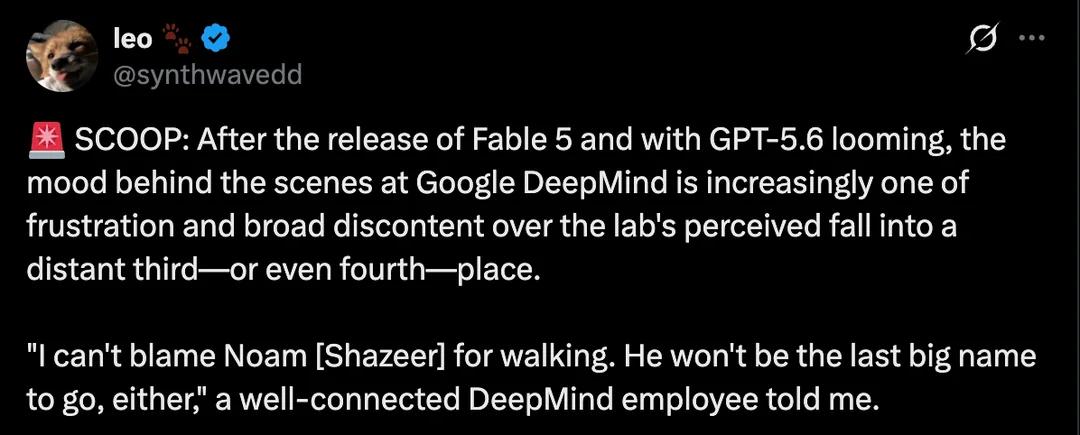
As OpenAI and Anthropic have successively poached Google's core AI talent, DeepMind CEO Demis Hassabis finally responded directly in a recent podcast interview to the question that the outside world is most concerned about: Does DeepMind still have enough talent to win the race to AGI?
His answer did not avoid the competitive pressure, but he also did not accept the narrative that "Google is losing its AI talent advantage".
In this interview, the host mentioned that when DeepMind joined Google, it almost made the outside world feel that "the most important talent in the AI field was all under the same roof". But now, at least three cutting - edge laboratories, such as OpenAI and Anthropic, are competing for top - level researchers. Facing such changes, does DeepMind still have the talent needed to win the AGI race today?
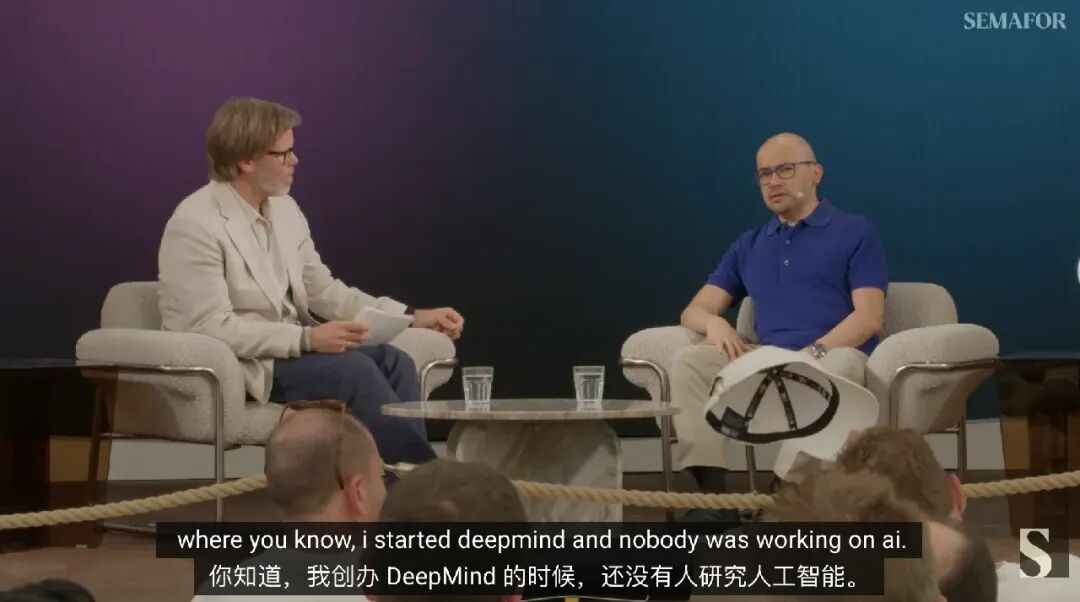
Hassabis's response was straightforward: There is indeed a large amount of talent movement among top - level laboratories, and DeepMind is inevitably involved. But he emphasized that Google can still attract "a considerable portion" of top - level talent, and DeepMind has the "largest and most comprehensive" research team among all cutting - edge laboratories.
Subsequently, Hassabis tried to put this issue in a longer - term perspective.
In his view, the fierce talent competition in the AI industry today is a situation that was almost unimaginable when DeepMind was founded. In 2010, when he founded DeepMind, few people in the industrial circle were really involved in AI; even in the academic circle, AI was once regarded as a "career - suicide" direction. Neural networks, reinforcement learning, and learning systems were not mainstream at that time. DeepMind was more like a small group of people betting on an unpopular direction.
But more than a decade later, the whole world has realized the potential of AI. Hassabis said that now almost every important company is involved in AI, which naturally brings about one of the most intense talent competitions in the history of the technology industry.
Therefore, he does not deny the attractiveness of competitors such as OpenAI and Anthropic, nor does he deny that talent movement has become the norm among cutting - edge model companies. But his counter - argument is that judging who can win the AGI race cannot be based solely on the destination of a few star researchers, nor can it be based on who has a louder voice in text models or AI coding in the short term.
What Hassabis really emphasizes is the "breadth" of DeepMind.
He mentioned that over the past decade, many key breakthroughs behind the modern AI industry have come from Google Brain and DeepMind. From the Transformer that supports large - language models, to the reinforcement learning behind AlphaGo, to the scientific discovery ability represented by AlphaFold, the Google system has long played the role of the origin of AI basic breakthroughs. Now Google Brain and DeepMind have merged into Google DeepMind, which integrates the originally scattered research forces under the same organization.
This is also the reason why he repeatedly emphasizes the "largest and most comprehensive research team".
In Hassabis's view, the path to AGI will not only pass through text models, nor will it be determined solely by code - generation ability.
The host asked whether the path to AGI would be achieved through current text models, especially models that can self - improve; Hassabis did not give a definite answer but emphasized that DeepMind has always bet on multiple routes.
This set of routes includes multi - modal basic models like Gemini, as well as code - generation ability, video generation, image generation, music generation, and models for scientific research.
He believes that to build a truly complete AGI system, the model must understand the surrounding world, not only process text and logic but also understand the physical world, the visual world, and the real environment. This is especially important for directions such as robotics, smart - glasses assistants, and scientific discovery.
This is actually a response to another layer of imagination about OpenAI and Anthropic in the outside world: If today's cutting - edge competition is understood as a competition between "large - text models + programming agents", then the voices of Anthropic and OpenAI are indeed strong. But if the end goal is general intelligence, Hassabis believes that the race is far from being limited to this one track.
He also incorporated DeepMind's early experience in game AI into this logic. AlphaGo, Atari games, and simulation environments were not for the sake of the games themselves but to provide quantifiable, verifiable, and moderately difficult intermediate goals for AI systems. Games are just a step towards real - world problems. Later, AlphaFold, drug discovery, weather models, and scientific simulations are the real destinations of this route.
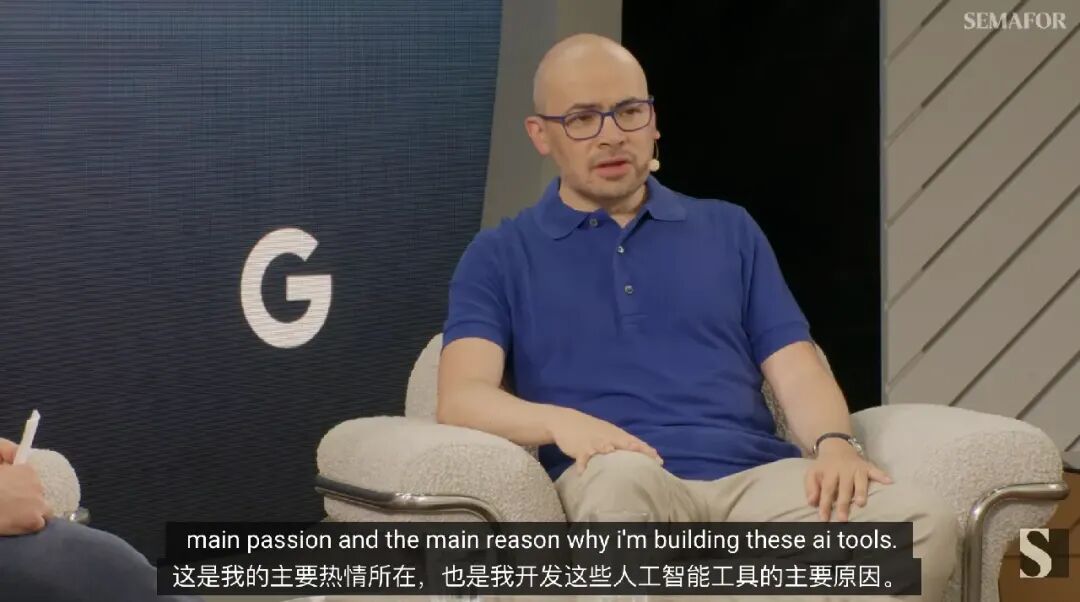
This is also Hassabis's version of the logic of "why Google will still win": not because Google will not lose talent, but because he believes that AGI ultimately requires cross - disciplinary, cross - modal, and cross - scenario system capabilities. Whoever can integrate language, vision, code, scientific reasoning, world models, robotics, and simulation capabilities will be closer to the final answer.
When talking about AI risks, Hassabis also maintained his consistent cautious attitude. He believes that as the industry approaches AGI, cyber security is just a "warning signal". In the next few years, more serious risks such as biological and nuclear security may also emerge. Therefore, he advocates establishing a more systematic testing mechanism and even an international